India’s Fusion Programme: ADITYA, SST-1, and the Long Road from Plasma Lab to Commercial Power
A complete UPSC GS-III explainer on India's magnetic confinement fusion programme. Covers the ADITYA tokamak, the SST-1 superconducting tokamak, the planned SST-2 bridge device, the Institute for Plasma Research at Gandhinagar, the Department of Atomic Energy linkage, India's contribution to ITER, and how the indigenous fusion roadmap connects to a future Indian DEMO power plant.
The sun and every other star in the night sky run on fusion. Two light hydrogen nuclei collide hard enough that the strong nuclear force overcomes their electrostatic repulsion and they merge into a heavier helium nucleus, releasing energy in the process. Every attempt at copying that mechanism inside a machine on Earth has needed a way to hold a gas at temperatures of more than a hundred million degrees Celsius without the gas touching any wall. The standard answer, developed in the Soviet Union in the 1950s and now the dominant fusion architecture worldwide, is the tokamak.
India’s tokamak programme is run by the Institute for Plasma Research at Gandhinagar in Gujarat, an autonomous institute under the Department of Atomic Energy. The programme has produced two operational machines, ADITYA and SST-1, contributes major hardware to the international ITER project, and has begun planning a third domestic device, SST-2, that would bridge the gap between SST-1 and an eventual Indian DEMO power plant. This is a long-horizon engineering effort, with the science aimed at a payoff in the second half of this century, and it sits at the intersection of physics research, industrial capacity building, and energy policy.
This article walks through how a tokamak works, the architecture of ADITYA and SST-1, the role of the Institute for Plasma Research, the path through ITER to an Indian DEMO, the budgetary and institutional anchoring, and the strategic case for spending public money on a technology whose first commercial output may not arrive for decades.
The Physics in One Paragraph
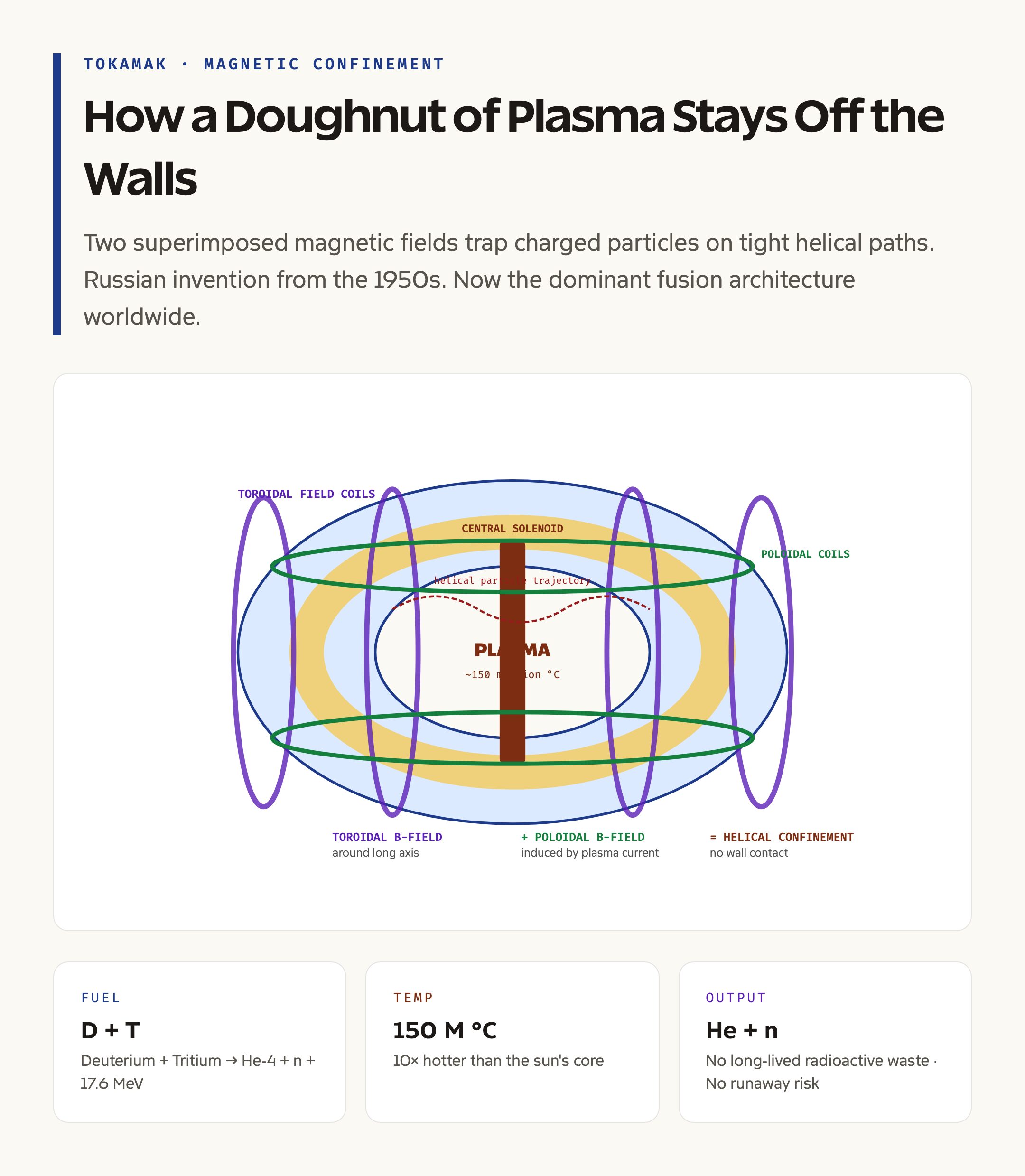
Fusion is the opposite of fission. In fission a heavy nucleus splits and releases energy. In fusion two light nuclei merge and release energy. The easiest reaction to engineer uses two isotopes of hydrogen, deuterium and tritium, which fuse into helium-4 plus a free neutron and 17.6 megaelectronvolts of energy. To make the reaction happen, the deuterium-tritium gas must be heated to roughly one hundred and fifty million degrees Celsius, ten times the temperature of the sun’s core. At that temperature the gas is fully ionised. It is plasma, the fourth state of matter. No solid container can hold a 150-million-degree plasma. The plasma must be held away from the walls by a magnetic field. That is the job of a tokamak.
What a Tokamak Is
A tokamak shapes plasma into a doughnut-shaped torus and confines it with two superimposed magnetic fields. The toroidal field, generated by ring-shaped coils around the chamber, runs along the long axis of the doughnut. The poloidal field, generated by an induced current that flows through the plasma itself, runs around the cross-section of the doughnut. The combined field forms a helical pattern that traps charged particles on tight spiral trajectories, well away from the walls. The word “tokamak” is a Russian acronym for “toroidal chamber with magnetic coils.”
The plasma must be heated to fusion temperatures, held stable for as long as possible, and prevented from contacting the wall. Heating uses three combined methods: ohmic heating from the resistance of the plasma to its own current, neutral beam injection in which fast hydrogen atoms are shot into the plasma, and radio-frequency heating tuned to the resonance of plasma particles. Stability depends on careful tuning of the magnetic field profile and on real-time control by fast power supplies. The wall, called the first wall, is lined with materials such as tungsten, molybdenum, or beryllium that can survive neutron flux and occasional plasma contact.
ADITYA: India’s First Tokamak
ADITYA was commissioned at the Institute for Plasma Research in 1989 and was the first tokamak built and operated in India. The name is the Sanskrit word for the sun, which is the appropriate poetic anchor for any fusion machine. ADITYA is a conventional tokamak, which means it uses copper electromagnets rather than superconducting ones. Copper coils dissipate energy as heat under the high currents required for magnetic confinement, which limits the duration of each shot to a few hundred milliseconds before the coils need cooling.
ADITYA was never intended to produce net energy. It is a research machine for basic plasma physics. Its purpose is to study how plasma forms, how it disrupts, how impurities behave at the wall, how diagnostic instruments respond, and how Indian research engineers can build and operate a complete tokamak system. The decade of operations on ADITYA gave India the indigenous capability to design, fabricate, instrument, and run a fusion device. That capability is the precondition for the larger machines that followed. ADITYA was upgraded to ADITYA-U with a divertor and improved heating systems and continues to operate as a workhorse for plasma diagnostics development.
SST-1: The First Indian Superconducting Tokamak
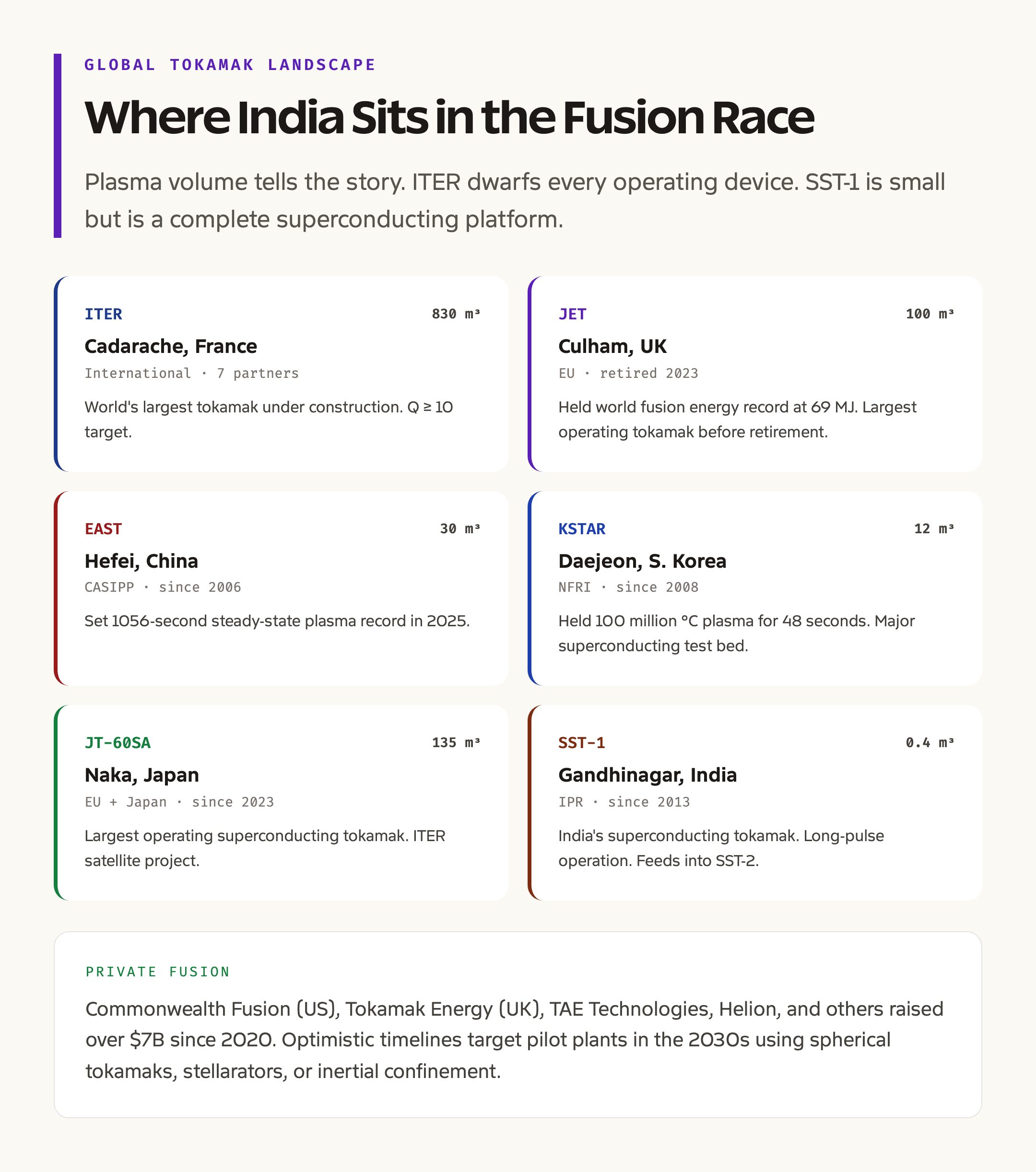
SST-1, short for Steady State Superconducting Tokamak-1, is India’s first superconducting tokamak. The crucial qualifier is “steady state.” A copper-coil tokamak can sustain plasma for less than a second. A superconducting-coil tokamak, where the magnets carry no electrical resistance and dissipate effectively no heat, can sustain plasma for much longer pulses, on the order of several hundred seconds in principle. Long-pulse operation is the regime that matters for an eventual fusion power plant. A pulsed device cannot deliver continuous electricity to a grid.
SST-1 went through an extended design and commissioning phase from the 1990s through the 2000s and achieved its first plasma in 2013. The machine uses superconducting magnets cooled to liquid helium temperatures of around 4.5 Kelvin. The cryogenic plant, the cryostat, the vacuum systems, the power supplies, and the diagnostic instruments are all indigenous. Building SST-1 required India to develop industrial capability in superconducting cable production, large cryogenic systems, ultra-high vacuum engineering, and high-precision magnetic field control. Each of these capabilities is independently strategic.
The scientific objective of SST-1 is to study long-pulse plasma operation, to test the technologies needed for steady-state fusion devices, and to feed back design experience into ITER and into India’s own future devices. The machine has been progressively upgraded with higher heating power, improved divertor materials, and additional diagnostic systems.
The Institute for Plasma Research
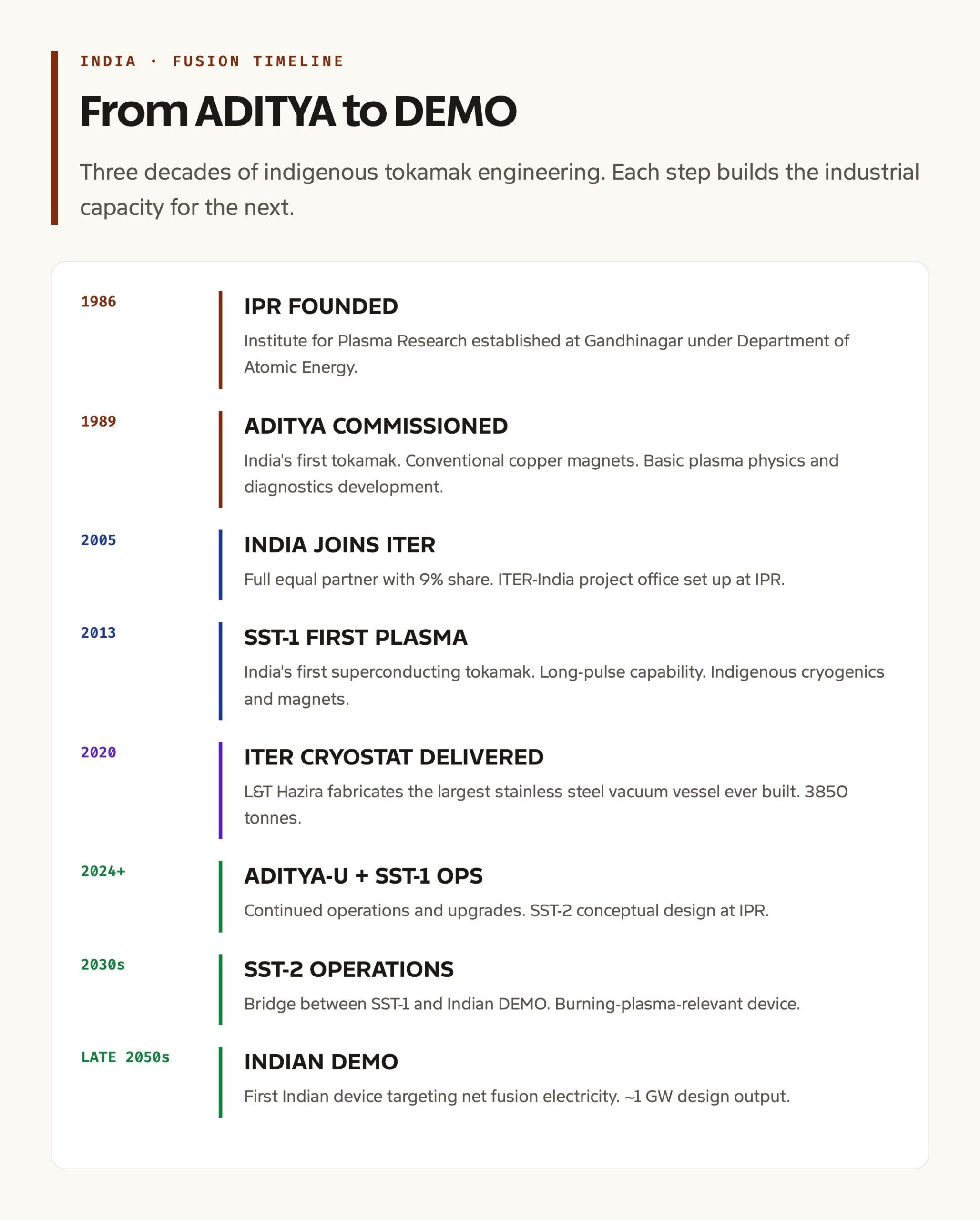
The Institute for Plasma Research at Gandhinagar is the institutional core of the Indian fusion programme. It is an autonomous institute under the Department of Atomic Energy, founded in 1986. IPR runs the ADITYA-U and SST-1 machines, hosts the ITER-India project office, runs the Centre for Plasma Physics in Sonapur Assam as a sister institute, and operates a graduate training programme that supplies plasma physics talent across the Indian academic and engineering ecosystem.
IPR also coordinates the Indian Plasma Research Society, the technical reviews of fusion-related budgets at the Department of Atomic Energy, and the bilateral scientific cooperation agreements with overseas fusion programmes. Researchers from IPR sit on the ITER scientific committees and contribute to the international plasma physics literature.
SST: The Vision Beyond SST-1
The original SST programme envisaged a series of devices, with SST-1 as the first and a follow-on SST-2 as a higher-performance machine. SST-2 is in the design phase at IPR. The design parameters target a larger plasma volume, higher magnetic field, longer pulse duration, and a tritium-compatible vacuum vessel that can handle the burning plasma regime that ITER will demonstrate. SST-2 is intended to bridge SST-1 and an eventual Indian DEMO, the first device that would actually generate fusion electricity for the grid.
The funding and timeline for SST-2 depend on the next round of Department of Atomic Energy planning and on the data feedback from ITER first plasma operations later this decade. The general expectation is that SST-2 construction would begin in the late 2020s and operations in the 2030s, with Indian DEMO conceptual design running in parallel.
India’s Role in ITER
The ITER project is the largest international science collaboration ever undertaken, with seven members building the world’s largest tokamak at Cadarache in France. India joined ITER in 2005 as a full equal partner, paying roughly nine percent of the construction cost in the same share as the United States, Russia, China, Japan, and South Korea. The European Union, as the host, pays roughly forty-five percent.
India’s main in-kind contribution is the ITER cryostat, the giant stainless-steel vacuum vessel that surrounds the entire tokamak and holds the cryogenic environment for the superconducting magnets. The cryostat weighs about three thousand eight hundred and fifty tonnes and is the largest stainless steel vacuum vessel ever built. It was fabricated by Larsen and Toubro at the company’s Hazira facility in Gujarat and shipped in sections to France, where it was reassembled and installed in the tokamak pit by 2020. India also contributes the in-wall shielding, parts of the cryogenic distribution system, the cooling water system, several plasma diagnostic systems, and elements of the heating systems including ion cyclotron and electron cyclotron sources.
The ITER work has built a complete domestic fusion engineering ecosystem that feeds back into SST-1 operations and into the design of SST-2. The cryostat, the magnets, the vacuum technology, and the cryogenics that Indian industry built for ITER are the same families of technology that any future Indian fusion device will need at scale.
How the Programme is Funded and Coordinated
The fusion programme is anchored institutionally in the Department of Atomic Energy and managed scientifically by the Institute for Plasma Research. Annual budgetary allocations come through the DAE plan grants and through specific ITER-India project funding. Industrial partners include Larsen and Toubro, BHEL, Avasarala Technologies, and several specialist vendors in cryogenics, superconducting cables, and ultra-high vacuum. The Institute also operates collaboratively with several IITs, IISc Bangalore, and several CSIR labs on diagnostics, materials, and computational plasma physics.
The international partnerships include bilateral agreements with the United States, Japan, South Korea, and several European laboratories on tokamak operations, plasma physics theory, and personnel exchange. ITER is the dominant multilateral channel.
What Comes After: DEMO and Commercial Fusion
ITER is a research machine designed to demonstrate that a burning plasma is possible at engineering scale. It will not generate electricity for any grid. The next step is DEMO, short for demonstration power plant, which would actually produce on the order of one gigawatt of net fusion electricity. Each ITER member is independently planning a DEMO programme. India’s roadmap envisages SST-2 as the bridge between SST-1 and an Indian DEMO. The DEMO timeline depends on ITER’s results, on the maturity of materials that can survive the long-term neutron flux of a fusion power plant, on tritium breeding technology, and on the cost of large-scale superconducting magnets.
Commercial fusion plants would come after DEMO. Industry forecasts vary. Optimistic private fusion startups in the United States and the United Kingdom claim pilot plants in the 2030s using alternative concepts including spherical tokamaks, stellarators, and inertial confinement. Most mainstream estimates put commercial fusion power on the grid in the second half of this century. The relevance of fusion for nuclear energy in India and for global climate policy depends on whether that timeline can be compressed.
Strategic Logic and Why It Is Worth the Wait
Fusion has structural advantages over fission as a power source. The fuel is essentially unlimited. Deuterium can be extracted from seawater. Tritium is bred inside the reactor blanket from lithium, which is abundant. There is no risk of a runaway chain reaction. If the plasma is disturbed, it cools and the reaction stops, the opposite of a fission criticality accident. The waste is short-lived. The activated structural materials decay to background levels in about a century, compared to thousands of years for fission spent fuel. There is no weapons-usable material in the fuel cycle.
The argument for state spending on fusion is therefore strategic rather than near-term economic. India does not need fusion in the next decade. It does need the industrial capacity that fusion engineering builds, the trained physicists and engineers, the cryogenic and superconducting supply chain, and a credible position in the international science community. The ADITYA-SST-1-SST-2-DEMO ladder is the path through which all of that is being built. ADITYA gave India tokamak literacy. SST-1 gave India superconducting tokamak engineering. ITER gives India a seat at the largest collaboration in the field. SST-2 will give India a burning-plasma-relevant device of its own. DEMO is the eventual destination. The patience required is the price of being a fusion-capable country.