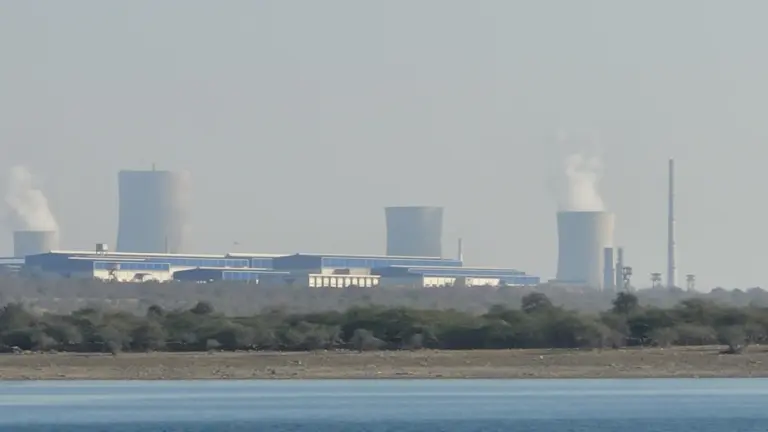
India’s nuclear energy programme is among the world’s most distinctive. It is indigenously driven, anchored in Homi Bhabha‘s three-stage plan, and now expanding into Small Modular Reactors (SMRs) and private-sector participation under the Nuclear Energy Mission (Budget 2024-25). This guide covers India’s reactors, institutions, recent reforms and policy debates for UPSC GS Paper III (Science & Tech, Energy, Environment, Internal Security).
Why nuclear for India?
- Climate commitments — Panchamrit pledge at COP26 (2021): 500 GW non-fossil capacity by 2030; net-zero by 2070.
- Baseload reliability — essential to complement variable solar and wind.
- Strategic autonomy — domestic fuel cycle reduces import risks compared to LNG and coal.
- Thorium wealth — India sits on ~25% of world's thorium.
- Industrial depth — heavy engineering, precision manufacturing, semiconductor demand from reactors.
Reactor fleet snapshot (2025)
| Plant | Reactors | Technology | Status |
|---|---|---|---|
| Tarapur (TAPS) | 4 | BWR, PHWR | Operational since 1969 |
| Rajasthan (RAPS) | 7 | PHWR | 8th under construction |
| Madras (MAPS) Kalpakkam | 2 | PHWR | Operational |
| Narora (NAPS) | 2 | PHWR | Operational |
| Kakrapar (KAPS) | 4 | PHWR incl. 700 MWe | KAPS-3 & 4 commissioned 2023-24 |
| Kaiga | 4 | PHWR | Unit 5 and 6 planned |
| Kudankulam (KKNPP) | 2 operational + 4 under construction | Russian VVER (PWR) | Units 3-6 progress |
| PFBR Kalpakkam | 1 | FBR 500 MWe | Core loading March 2024 |
| Gorakhpur (GHAVP) | 2 × 700 MWe PHWR | PHWR | Under construction |
| Chutka, Mahi Banswara, Kaiga 5&6 | 2 × 700 each | PHWR | Approved fleet mode |
Installed capacity: ~8,180 MWe (2025); under construction: ~7-8 GWe. Target: 22.5 GWe by 2031; 100 GWe by 2047 (Union Budget vision).
Nuclear's share in India's electricity generation is ~3% today — intended to reach ~9% by 2047.
Institutional architecture
| Body | Role |
|---|---|
| Atomic Energy Commission (AEC) | Policy |
| Department of Atomic Energy (DAE) | Implementation under PM |
| NPCIL | Operates all commercial reactors (PHWR, VVER) |
| BHAVINI | Fast Breeder Reactor operation |
| BARC Trombay | R&D; weapons legacy |
| IGCAR Kalpakkam | Fast reactor and thorium R&D |
| UCIL | Uranium mining |
| Nuclear Fuel Complex (NFC) Hyderabad | Fuel fabrication |
| Heavy Water Board | Heavy water production |
| IREL | Rare earths, thorium |
| AERB | Safety regulator |
| DAE PSUs (ECIL, NFC) | Equipment manufacture |
Three-stage programme — where we stand
- Stage I — Uranium-fuelled PHWRs indigenously built and operated. 220 MWe and 700 MWe variants.
- Stage II — Fast Breeder Reactors using Pu and U-238 to breed more fissile material; PFBR core loading began March 2024, criticality expected in 2025. Follow-on FBR-1 & 2 (600 MWe each) to be co-located at Kalpakkam.
- Stage III — Thorium-U-233 cycle; the Advanced Heavy Water Reactor (AHWR) is the flagship design. A Kamini research reactor at Kalpakkam already runs on U-233.
Compact high-temperature reactor (CHTR) and Indian Molten Salt Breeder Reactor are under R&D for distributed nuclear.
Nuclear Energy Mission — Budget 2024-25
Finance Minister Nirmala Sitharaman announced:
- Outlay: Rs 20,000 crore for nuclear energy research.
- Goal: Development and deployment of at least five indigenous SMRs by 2033.
- Bharat Small Reactor — ~200 MWe design; private participation piloted.
- Amendments proposed to:
- Atomic Energy Act, 1962 — permit private Indian companies.
- CLND Act, 2010 — especially Section 17(b) — to attract foreign vendors (US, France, Russia).
This is the most substantial shift in India's nuclear policy since 2008.
Small Modular Reactors (SMRs)
- Power range: ~50-300 MWe; factory-built modules; reduced capex and siting footprint.
- Can repurpose retiring coal plants by using existing grid connections and cooling systems.
- Passive safety — natural circulation and gravity-driven cooling reduce human-error risk.
- Global leaders: NuScale (USA), GE-Hitachi BWRX-300, Rolls Royce SMR, Russia's RITM-200, China's Linglong One.
- India's contenders: DAE's BSR 200, IPHWR-220 derivative, BARC-designed AHWR-300 LEU variant.
Civil nuclear deals
- India-US 123 Agreement (2008), IAEA Safeguards Agreement (2008), NSG waiver (2008).
- India-France — Jaitapur (EPR reactors); agreement revisited 2024.
- India-Russia — Kudankulam; Units 3-6 plus future BWR discussions.
- India-Japan (2016), India-Australia (2015 uranium supply), India-Canada, India-South Korea, India-UK cooperation.
India is part of MTCR, Wassenaar, Australia Group, but NSG membership remains blocked by China.
Fuel security
- Domestic uranium — Jaduguda (Jharkhand), Tummalapalle (AP, world's largest low-grade reserve).
- Imports — Kazakhstan, Russia, Canada, Uzbekistan, Australia.
- Stockpile — strategic uranium reserve expanded in 2023-24 to secure 7-10 years of operation.
Safety regulation — AERB
- Established 1983 under Atomic Energy Act.
- Nuclear Safety Regulatory Authority Bill, 2011 — attempted to make it statutory; still pending.
- Safety benchmarking with WANO, IAEA Peer Reviews.
- Post-Fukushima stress tests completed across all plants (2012-14).
Liability debate — Section 17(b)
Under the Civil Liability for Nuclear Damage Act, 2010, the operator has right of recourse against the supplier for "defect in design/supply". Foreign vendors — especially Westinghouse and GE — have sought clarifications and caps. A nuclear insurance pool (Rs 1,500 crore) was created by GIC Re in 2015. The 2024-25 reform proposals are expected to recalibrate this.
Concerns and critiques
| Concern | Detail |
|---|---|
| Capital cost & timelines | PHWR 700 MWe fleet cost-per-MW needs benchmarking |
| Waste & decommissioning | Long-lived high-level waste; vitrification at Tarapur |
| Water stress | Cooling water in arid sites (Rajasthan) |
| Human resource | Specialist manpower for expansion |
| Public acceptance | Jaitapur, Kudankulam protests |
| Private sector safety culture | Must match BARC-NPCIL standards |
| Proliferation optics | Non-NPT status complicates fuel supply |
Latest developments (2024-26)
- PFBR core loading (March 2024) — India becomes a full-fledged FBR operator.
- Kakrapar 3 & 4 commercial operation (2023-24).
- Nuclear Energy Mission announced (Feb 2025) — Rs 20,000 crore; SMR and law reform push.
- Amendments to AEA 1962 and CLND 2010 drafting (2025).
- India-US civil nuclear working group revived (2024) after PM Modi's US state visit.
- Westinghouse-Kovvada (Andhra Pradesh) project gets fresh technical review.
- Jaitapur EPRs — India-France cooperation revisited.
- AI Action Summit, Paris (Feb 2025) — DAE tabled AI-in-nuclear-safety paper.
- India Semiconductor Mission — rad-hard semiconductors for reactors.
- DeepTech Policy 2024 — SMR start-ups and fusion start-ups supported.
- National Quantum Mission (2024) — quantum magnetometers for reactor diagnostics.
- Chandrayaan-4 plan and Gaganyaan progress — interest in RTGs and space nuclear power research.
- Bharat Small Reactor and IPHWR-220 SMR variant design frozen 2025.
UPSC Relevance
GS Paper III — Science & Technology
- Reactor types, three-stage programme, SMRs, Nuclear Energy Mission.
GS Paper III — Energy / Environment
- Low-carbon transition, land-water footprint, waste.
GS Paper II — International Relations
- 123 Agreement, NSG, IAEA, French and Russian collaborations.
GS Paper III — Internal Security
- Non-proliferation, reactor security.
Essay
- "Atoms for all: India's nuclear bet in the climate decade."
Prelims pointers — PFBR 500 MWe, AHWR, Section 17(b) CLND, Nuclear Energy Mission Rs 20,000 crore, NSG waiver 2008, SMR definition (up to 300 MWe), Kamini (U-233), Jaitapur, Kudankulam.
Interview probes — how to rebuild trust post-Kudankulam; CLND Section 17 reform debate; SMR vs large reactor choice; thorium roadmap.
India's nuclear story is a rare instance of sustained scientific and industrial self-reliance. With the 2024-25 reforms it is now entering a second founding phase — faster, private-enabled, SMR-driven — that could decide whether 100 GWe by 2047 is rhetoric or reality.
Tell Google you want more of this.
Add Anantam IAS as a preferred sourceOne tap, and this site shows up more often in your own Top Stories, AI Overviews and AI Mode. Remove it any time.