India’s Record Seafood Exports: MPEDA, the Blue Economy and Trade Risks (UPSC Economy)
India shipped a record $8.46 billion (Rs 73,890 crore) of seafood in 2025-26, with frozen shrimp earning two-thirds of it. Here's the full picture — MPEDA, the blue economy, the PMMSY, and the US-tariff and antibiotic-rejection risks that could cap it — explained for UPSC GS3.
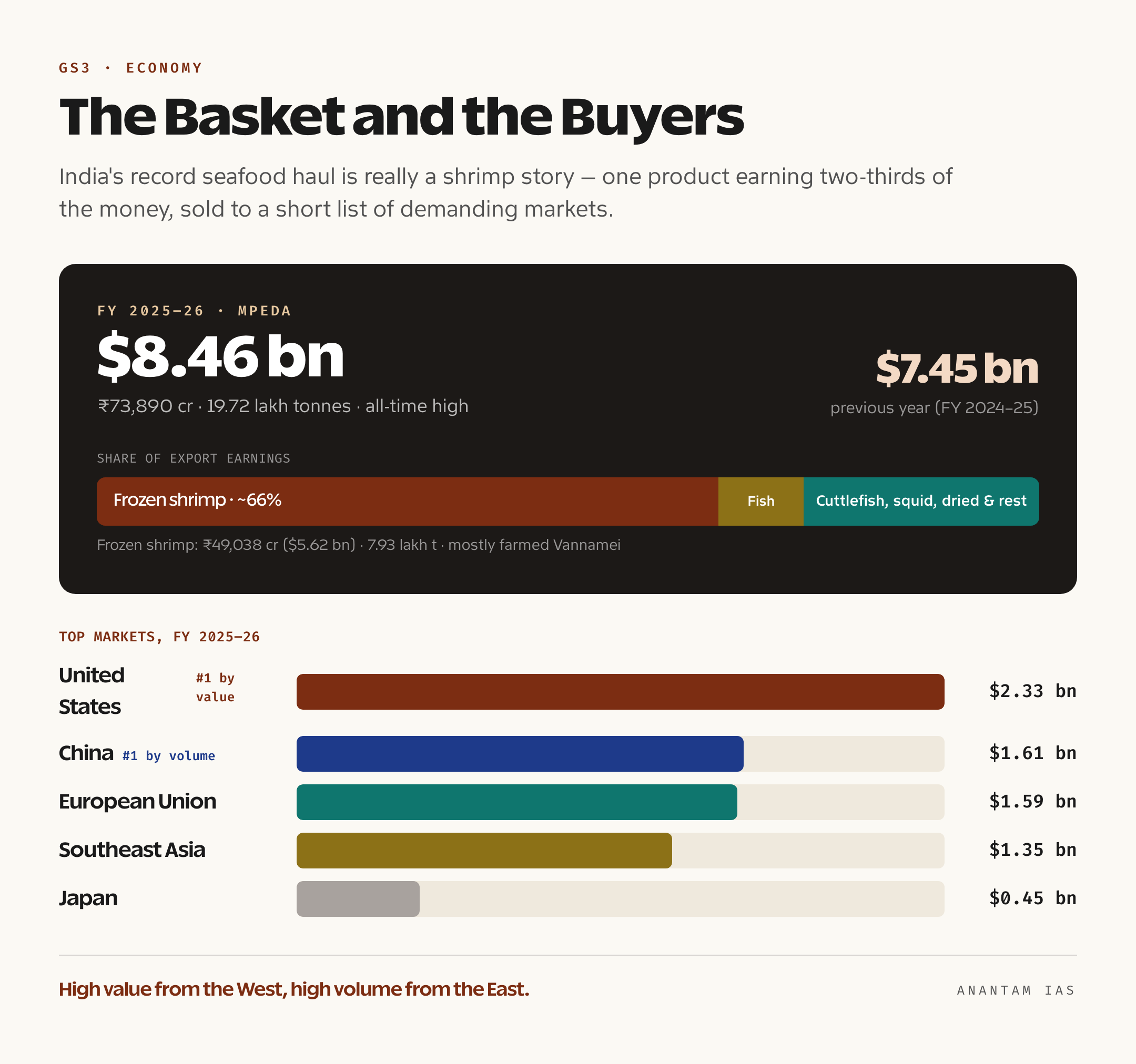
In April 2026, the Marine Products Export Development Authority announced a number it had been chasing for years: India shipped a record 19.72 lakh tonnes of seafood worth roughly Rs 73,890 crore, or about US$8.46 billion, in the financial year that had just ended. That made 2025-26 the country’s biggest seafood-export year ever, and it happened in a year when American tariffs on Indian shrimp climbed to punishing levels for months at a stretch. The headline almost wrote itself — a record set into a headwind. But the more interesting story is what the record is built on, how fragile its foundations are, and why a single product going to a single market can decide whether India’s “blue economy” keeps growing or stalls.
And that’s why this belongs on every aspirant’s radar. Seafood is one of India’s largest agricultural exports by value, the country is the world’s biggest shrimp exporter, and the sector feeds and employs millions along the coast. So when you read about MPEDA, the Pradhan Mantri Matsya Sampada Yojana, or a US anti-dumping duty, you’re reading about the same thing from different angles — a growth engine that sits right at the meeting point of trade policy, agriculture, food safety and ocean sustainability. It maps almost perfectly onto the economy and external-sector portions of the syllabus, and it rewards a candidate who can hold the big number and the big risk in the same answer.
What India Exports, How Much, and to Whom
Start with the basket, because the whole story turns on how lopsided it is. Of that record 2025-26 haul, frozen shrimp alone earned about Rs 49,038 crore — close to US$5.62 billion — which is roughly two-thirds of India’s entire seafood-export earnings from a single item. India sold around 7.93 lakh tonnes of frozen shrimp that year, and the great bulk of it is one species: Vannamei, or whiteleg shrimp, a fast-growing farmed prawn that now accounts for well over four-fifths of the shrimp India exports. Frozen fish is a distant second item, frozen cuttlefish, squid and dried products fill in the rest. So when people say India is a “seafood” exporter, what they really mean is that India is a shrimp exporter with a side business in everything else. That concentration is the source of both the boom and the danger.
The map of buyers matters just as much as the basket. The United States is India’s single most valuable market — it took about US$2.33 billion of Indian seafood in 2025-26 — and it is overwhelmingly a shrimp market, which is exactly why US trade policy can shake the whole sector. China is the largest buyer by sheer volume, importing the most tonnes (a lot of it lower-value fish and squid for reprocessing), worth roughly US$1.61 billion. The European Union follows at around US$1.59 billion, Southeast Asia at about US$1.35 billion, and Japan at roughly US$0.45 billion, with the Middle East a smaller but growing outlet. Read that list and a pattern jumps out: the high-value money comes from the US and the EU, the high-volume tonnage comes from China and Southeast Asia, and India’s earnings rise or fall with how the rich, demanding Western markets behave. Almost all of it traces back to a single quiet engine room — the aquaculture pond — which is worth a section of its own. But first it helps to know who runs the whole machine.
MPEDA, the Blue Economy and the Schemes Behind the Boom
So who actually runs this? The body at the centre is the Marine Products Export Development Authority — MPEDA — a statutory organisation set up in 1972 under the Ministry of Commerce and Industry. Think of MPEDA as the nodal agency for the whole seafood-export chain: it registers exporters and processing plants, sets and polices quality standards, runs labs and testing, promotes Indian seafood at global trade fairs, and helps farmers adopt better, safer practices. It also runs a traceability and certification scheme called Shaphari for antibiotic-free, responsibly farmed shrimp, so that an importer in Boston or Brussels can trust where a consignment came from. When you see the export numbers each year, they come from MPEDA, and when a foreign country threatens a duty, MPEDA is the agency negotiating and firefighting on the industry’s behalf.
MPEDA sits inside a bigger idea the government keeps repeating: the blue economy. In plain terms, the blue economy means using the ocean and inland waters — fishing, aquaculture, shipping, tourism, energy, minerals — for economic growth while keeping those waters healthy enough to keep producing. India’s blue economy is estimated to contribute around 4 per cent of GDP, with the fisheries sector specifically adding a little over 1 per cent of GDP and a much larger share of farm exports. The pitch is that India has a coastline of over 11,000 kilometres and a vast Exclusive Economic Zone, so the sea is an underused growth frontier, and seafood exports are the most export-ready piece of it. Seafood also punches above its weight in jobs: the fisheries sector supports the livelihoods of close to three crore people, many of them small fishers and pond farmers along the coast, which is why the government treats export earnings as a rural-income story as much as a trade one.
The money flows through schemes, and two are worth knowing by name. The flagship is the Pradhan Mantri Matsya Sampada Yojana, or PMMSY, launched in 2020 with a total planned outlay of about Rs 20,050 crore over five years, run by the Department of Fisheries under the Ministry of Fisheries, Animal Husbandry and Dairying. PMMSY funds the unglamorous backbone — fishing harbours, cold chains, hatcheries, fish-farmer producer organisations, mariculture and seaweed, insurance for fishers — to drive a “Blue Revolution,” with the original target of pushing fish production toward 22 million tonnes and roughly doubling export earnings. Sitting under it is a newer sub-scheme, the Pradhan Mantri Matsya Kisan Samridhi Sah-Yojana, or PM-MKSSY, a roughly Rs 6,000-crore push to formalise the sector — digital registration of fishers and small enterprises, better access to credit and insurance, and traceability — so that the small farmer, not just the big processor, can plug into the export chain.
The US Tariff Storm and Why One Market Can Shake the Whole Sector
Now the part that nearly derailed the record. Indian shrimp has faced US trade barriers for years, well before the recent drama. The United States has long applied an anti-dumping duty on Indian frozen shrimp — the charge that exporters sell below “fair” value — and in 2024 it added a countervailing duty of around 5.77 per cent, the charge that Indian shrimp benefits from government subsidies like cheap credit and duty rebates. Together those two duties already put a single-digit tax on every consignment. The point to remember is that anti-dumping and countervailing duties are product-specific and decided by the US Commerce Department through periodic reviews, so they grind on regardless of the broader political mood.
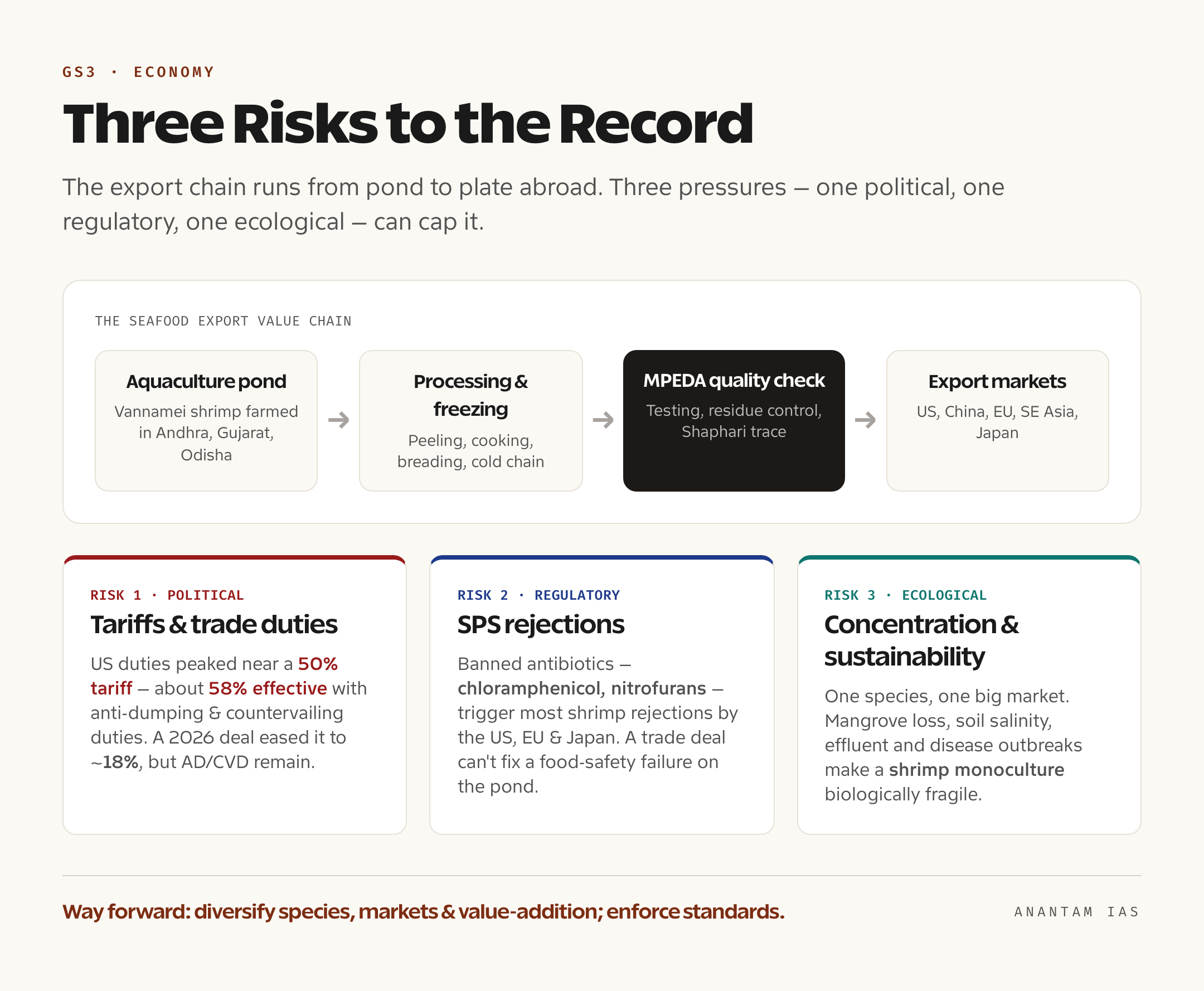
Then came the tariff shock of 2025. Through the year the US layered on broad “reciprocal” tariffs on Indian goods, and at the peak — after an extra penalty linked to India’s purchases of Russian oil — the headline tariff on Indian exports hit 50 per cent, which, stacked on the existing anti-dumping and countervailing duties, pushed the effective burden on Indian shrimp to around 58 per cent. For a low-margin farmed commodity competing head-to-head with Ecuador and Indonesia, that is close to a death sentence in the US market. Exporters rushed shipments out during pauses, US-bound volumes fell sharply, and coastal Andhra Pradesh — where farm-gate prices are set by US demand — felt the squeeze first. A US-India trade understanding reached in early 2026 brought the headline rate down to around 18 per cent, a big relief, but Indian shrimp still carries that 18 per cent plus the anti-dumping and countervailing duties on top — so the threat has been reduced, not removed.
Two lessons here are worth carrying into an answer. First, this is a textbook case of concentration risk: when one product (shrimp) sold to one market (the US) drives the headline number, a single foreign policy decision can swing the entire sector. That’s why MPEDA and exporters have spent the past two years scrambling to diversify — pushing harder into China, the EU, the Middle East and Russia, and racing to ship value-added shrimp (cooked, breaded, peeled, marinated) that earns more per kilo and dodges some commodity-tariff pressure. The striking thing about 2025-26 is that the record was set even as US demand fell, because other markets and higher-value products absorbed much of the lost volume. Second, it shows how non-trade tools — tariffs, duties, even geopolitics over oil — now shape “agricultural” exports as much as the weather or the catch does.
From Capture to Culture: The Aquaculture Engine
Behind every export figure sits the question of where the fish actually comes from, and the answer has flipped within a generation. India’s seafood used to come mainly from the sea — from trawlers and traditional boats working the coast, what’s called capture fisheries. Today the growth comes from the pond. Inland and coastal aquaculture — farming fish and shrimp in controlled ponds — now supplies the majority of India’s fish, and it is the only reason production could grow so fast. India’s total fish production has roughly doubled over the past decade to around 19.5 million tonnes, and the share coming from farms keeps rising while the wild catch stays broadly flat, because you can scale a farm in a way you can never scale the ocean.
Shrimp is the star of that shift. Farmed shrimp — raised in coastal ponds across Andhra Pradesh, Gujarat, Odisha, West Bengal and Tamil Nadu — is what turned India into the world’s biggest shrimp exporter, with Andhra Pradesh alone supplying the lion’s share. And it is overwhelmingly one species: Vannamei, or whiteleg shrimp, a fast-growing American prawn introduced to Indian farms after 2009 that now makes up well over four-fifths of the shrimp India exports, with a little black tiger shrimp alongside it. Vannamei caught on because it grows quickly, tolerates dense stocking and converts feed efficiently, so a farmer can harvest more kilos from the same pond. That productivity is the secret behind the export boom.
But the same traits that make this engine powerful also make it brittle, and an aspirant should be able to say why in a sentence. A boom resting on culture rather than capture, on one species rather than many, and on one cluster of states rather than the whole coast, concentrates the risk at every level: a disease outbreak in Andhra ponds, a feed-price spike, or a glut that crashes farm-gate prices can ripple through the entire export number. So the move from capture to culture is both India’s great strength here and the root of its fragility — which is exactly where the trade and sustainability risks bite.
The SPS Wall, Sustainability and the Real Long-Term Risks
Tariffs grab headlines, but a quieter barrier may matter more over time: standards. Rich importing markets enforce strict Sanitary and Phytosanitary measures — SPS, the food-safety and animal-and-plant-health rules countries are allowed to set to protect consumers — and Indian shrimp keeps tripping over them. The recurring villain is antibiotic residue. Indian regulators have flagged that a large share of shrimp rejections by the US, EU and Japan trace back to banned antibiotics like chloramphenicol and nitrofurans, used by some farmers to fight disease in crowded ponds. In 2025-26, multiple Indian consignments were rejected over banned residues, with the problem farms concentrated heavily in Andhra Pradesh. Each rejection isn’t just a lost container — it dents the “Brand India” reputation that high-value buyers pay a premium for.
This is where the alphabet soup of Indian agencies earns its keep. MPEDA, together with the Coastal Aquaculture Authority and the Export Inspection Council, runs a National Residue Control Plan and pre-harvest testing to catch contaminated shrimp before it ships, and the Shaphari certification rewards farms that go antibiotic-free. The EU has at times threatened tighter checks on Indian shrimp precisely because of residue worries, which is a reminder that an SPS barrier, unlike a tariff, can’t be negotiated away with a trade deal — you have to actually fix the practice on the pond. For India, the answer is better farm extension, disease-resistant seed, and traceability so a bad batch can be traced to its source and not the whole country’s output.
Then there’s the deepest risk of all: sustainability and the limits of the boom itself. Intensive shrimp aquaculture brings real environmental costs — the conversion of mangroves and farmland into ponds, the salinisation of soil and groundwater, water pollution from feed and effluent, and the disease outbreaks that periodically wipe out a season’s crop. A monoculture built on one species is biologically fragile: a single virus can crash production across a region. So the way forward that examiners like to see is not “export more shrimp at any cost” but a smarter blue economy — diversifying into other species and value-added products, spreading risk across more markets, enforcing food-safety and environmental standards rigorously, and protecting the coastal ecosystems and small fishers the trade ultimately depends on. The record is real and worth celebrating. But a record built on one prawn, one big market and one set of farm practices is exactly the kind of success that needs the most careful management.
For Your Mains Answer
This is prime material for GS Paper 3, which covers the economy, agriculture and allied sectors, mobilisation of resources, and the external sector — and seafood sits across all of those. It can answer questions on India’s agricultural exports, the blue economy, food processing and value addition, government schemes for farmers and fishers, and the way non-tariff and tariff barriers shape India’s trade. It also gives you a sharp, data-rich case study for the Essay paper on themes like sustainable development, self-reliance, or the costs of export-led growth. The examiner-pleasing move is the one this article makes: state the record, then immediately show what makes it fragile.
How to Build the Answer
Move from the number to the structure to the risk. Open with the record ($8.46 billion in 2025-26) and the concentration (frozen shrimp ≈ two-thirds, US the top market). Then explain the architecture — MPEDA as the nodal agency, the blue-economy framing, PMMSY and PM-MKSSY as the funding, and aquaculture as the engine. Then turn to the three risks in order of urgency: US tariffs plus anti-dumping and countervailing duties, SPS antibiotic-residue rejections, and sustainability with concentration. Close with a balanced verdict on diversification and standards. That arc — achievement, architecture, vulnerability, way forward — fits almost any question on the sector.
Common Mistakes to Avoid
Don’t treat “seafood exports” as one undifferentiated thing — the whole answer turns on shrimp being two-thirds of it. Don’t confuse the duties: tariffs are broad and political, while anti-dumping and countervailing duties are product-specific and set by the US Commerce Department. Don’t say a trade deal solves everything — SPS barriers and the existing duties survive any tariff cut. And don’t forget the home side of the risk: the antibiotic problem is an Indian farm-practice failure, not just foreign protectionism.
A Compact Answer Spine
Record seafood exports of ~$8.46 bn (Rs 73,890 cr), 19.72 lakh tonnes in 2025-26 → frozen shrimp ≈ two-thirds, mostly Vannamei from aquaculture → MPEDA (1972, Ministry of Commerce) is the nodal agency → blue economy ≈ 4% of GDP; funded by PMMSY (Rs 20,050 cr) and PM-MKSSY (Rs 6,000 cr) → top markets US, China, EU, Southeast Asia, Japan → Risk 1: US tariffs peaked near 50% (effective ~58% with AD/CVD), eased to ~18% in 2026 → Risk 2: SPS antibiotic-residue rejections (chloramphenicol, nitrofurans) → Risk 3: sustainability + over-dependence on one species and one market → way forward: diversify species, markets and value-addition; enforce standards.
Diagram or Flowchart Idea
Draw a simple value chain — aquaculture pond → processing and freezing → MPEDA quality check → export markets — with three “risk” arrows pointing at it: a tariff/duty arrow from the US, an SPS-rejection arrow from the EU/US/Japan, and a sustainability arrow from the environment. A clean chain-with-risks visual shows you understand both the structure and what threatens it.
A Balanced-Conclusion Line
A line that lands the marks: “India’s record seafood exports prove the blue economy can deliver — but a boom resting on one species, one big market and uneven farm standards is only as strong as its weakest pond, which is why diversification and food-safety enforcement matter more now than the next record.”
How to Use Data Without Cramming
You need only a handful of anchors: $8.46 billion (the record), two-thirds (shrimp’s share), the US-China-EU order of buyers, around 18 per cent (the eased US tariff, plus AD/CVD), and Rs 20,050 crore (PMMSY). Attribute them plainly — “as MPEDA reported for 2025-26” or “under the PMMSY launched in 2020” — rather than scattering numbers loose.
FAQ
How much seafood did India export, and what’s the latest figure? India recorded its highest-ever seafood exports in 2025-26 — about 19.72 lakh tonnes worth roughly Rs 73,890 crore, or US$8.46 billion, as reported by MPEDA. That beat the previous year’s US$7.45 billion, and it was achieved despite steep US tariffs for much of the year, because other markets and higher-value products absorbed the slack.
What is MPEDA and what does it do? MPEDA, the Marine Products Export Development Authority, is a statutory body set up in 1972 under the Ministry of Commerce and Industry. It is the nodal agency for seafood exports — it registers exporters and processors, sets and enforces quality and food-safety standards, runs testing labs, promotes Indian seafood abroad, and helps farmers adopt safer, traceable practices through schemes like Shaphari certification.
Why is frozen shrimp so important, and why is that risky? Frozen shrimp — mostly farmed Vannamei — earns about two-thirds of India’s seafood-export money, which makes the whole sector dependent on one product and on the demanding markets that buy it, above all the United States. So a US tariff hike, an anti-dumping duty, or a wave of food-safety rejections over banned antibiotics can shake the entire sector. That concentration risk is the central vulnerability of India’s seafood trade.
What is the blue economy, and how does it connect to fisheries? The blue economy means using oceans and inland waters — fishing, aquaculture, shipping, tourism, energy — for growth while keeping those waters healthy. It contributes roughly 4 per cent of India’s GDP, with fisheries adding a little over 1 per cent. The government funds it mainly through the Pradhan Mantri Matsya Sampada Yojana (Rs 20,050 crore) and the PM-MKSSY (Rs 6,000 crore), and seafood exports are its most export-ready segment.
Practice Questions
Prelims MCQs
- With reference to India’s seafood exports in recent years, consider the following. Which item accounts for the largest share of export earnings?
(a) Frozen fish
(b) Frozen shrimp
(c) Frozen cuttlefish
(d) Dried items
Answer: (b) Frozen shrimp, mostly farmed Vannamei, earns roughly two-thirds of India’s seafood-export value, far ahead of frozen fish, the second item. - The Marine Products Export Development Authority (MPEDA) functions under which ministry?
(a) Ministry of Fisheries, Animal Husbandry and Dairying
(b) Ministry of Agriculture and Farmers’ Welfare
(c) Ministry of Commerce and Industry
(d) Ministry of Environment, Forest and Climate Change
Answer: (c) MPEDA is a statutory body set up in 1972 under the Ministry of Commerce and Industry; the Department of Fisheries that runs PMMSY sits under a different ministry. - The Pradhan Mantri Matsya Sampada Yojana (PMMSY) is best described as which of the following?
(a) A crop insurance scheme for inland farmers
(b) A flagship scheme for development of the fisheries sector and a Blue Revolution
(c) A scheme to subsidise diesel for fishing trawlers only
(d) A coastal disaster-relief fund
Answer: (b) PMMSY, launched in 2020 with an outlay of about Rs 20,050 crore, funds the fisheries value chain — harbours, cold chains, hatcheries and more — to drive a Blue Revolution. - “Anti-dumping duty” and “countervailing duty” on Indian shrimp differ in that
(a) anti-dumping targets below-fair-value sales while countervailing targets foreign subsidies
(b) both are imposed only by the World Trade Organization
(c) anti-dumping targets subsidies while countervailing targets cheap labour
(d) both apply only to wild-caught shrimp
Answer: (a) An anti-dumping duty counters selling below fair value; a countervailing duty counters government subsidies — both decided by the importing country’s authorities. - The term “Sanitary and Phytosanitary (SPS) measures,” relevant to India’s shrimp exports, refers to
(a) tariffs imposed for environmental reasons
(b) food-safety and animal-and-plant-health standards set by importing countries
(c) a subsidy for sanitary infrastructure at ports
(d) a UN treaty banning aquaculture
Answer: (b) SPS measures are food-safety and health standards; Indian shrimp consignments are often rejected under them for banned antibiotic residues like chloramphenicol and nitrofurans.
Mains Practice Questions
- India’s record seafood exports rest heavily on a single product sold to a few markets. Examine the structure of India’s seafood-export sector and the risks created by this concentration. (15 marks, 250 words)
- “An SPS barrier, unlike a tariff, cannot be negotiated away with a trade deal.” In the context of repeated rejections of Indian shrimp over antibiotic residues, discuss the food-safety challenge facing India’s seafood exports and the way forward. (15 marks, 250 words)
- Evaluate the role of MPEDA and the Pradhan Mantri Matsya Sampada Yojana in developing India’s blue economy and fisheries exports. (15 marks, 250 words)
- Distinguish between tariffs, anti-dumping duties and countervailing duties, using the recent US action on Indian shrimp to illustrate how each affects an exporting sector. (10 marks, 150 words)
- “A record built on one species, one major market and uneven farm practices is a vulnerable success.” Critically analyse India’s seafood-export performance in light of sustainability and trade risks. (15 marks, 250 words)