India’s Three-Stage Nuclear Programme: Bhabha’s Blueprint from Uranium to Thorium
India's three-stage nuclear programme explained: PHWR > FBR > AHWR, thorium cycle, key reactors (Tarapur, Kudankulam, Kalpakkam), regulators (DAE, AERB, NPCIL, BHAVINI).
India’s nuclear programme is the most ambitious civilian science endeavour the country has ever attempted, and the bet at its core is simple. India sits on roughly two percent of the world’s uranium reserves but a quarter of its thorium, mostly locked in the monazite sands of Kerala. A nuclear strategy built on uranium alone would always be import-dependent and externally constrained. A strategy built on thorium escapes both constraints, but thorium is not directly fissile and cannot fuel a reactor on its own. Bridging that gap is the entire purpose of the three-stage programme that Dr Homi Jehangir Bhabha laid out in the 1950s and that India has been executing, with delays and detours, ever since.
The three-stage blueprint is also, intellectually, the cleanest example of long-horizon Indian science policy. It sets quantitative goals decades ahead, accepts that Stage 2 will demand commercial Stage 1 capacity, and Stage 3 will demand commercial Stage 2 capacity. It binds reactor design choices to fuel availability, and it embeds a standing commitment to indigenous technology. Every twist in India’s civil nuclear story, from the Smiling Buddha test of 1974, the Pokhran-II tests of 1998, the NSG waiver of 2008, the Indo-US 123 Agreement, to the Civil Liability for Nuclear Damage Act, 2010 and SHANTI Act, 2025, can be read as either supporting or constraining the three-stage path.
For UPSC, the topic is unavoidable. It anchors GS-III (energy security, science and technology, indigenous capability), shows up in prelims through reactor names, regulatory bodies, and locations, and connects to GS-II governance themes through the Department of Atomic Energy structure. This guide is the version that ties together the science, the institutions, and the policy stakes in one coherent answer.
Quick Facts
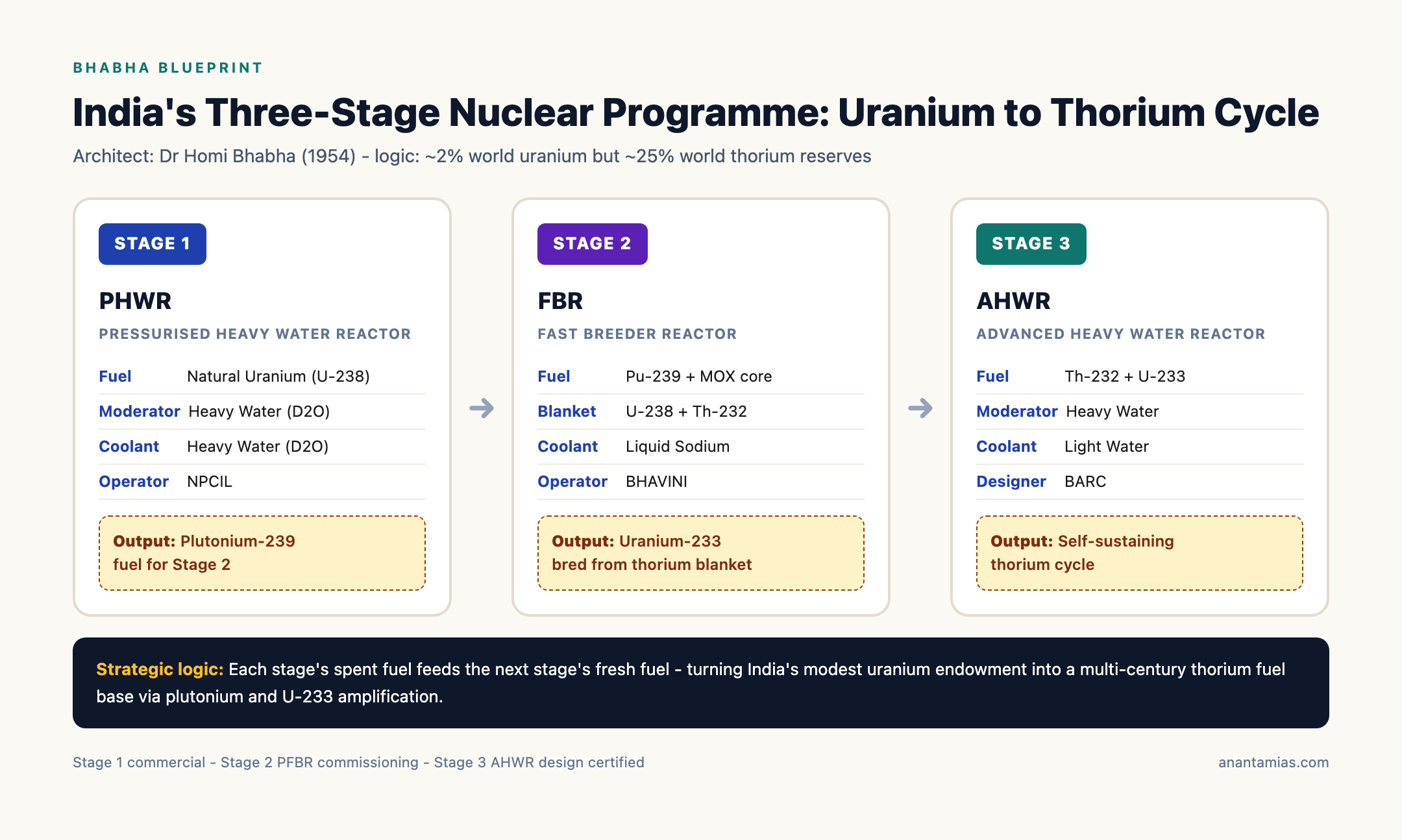
- Architect: Dr Homi Jehangir Bhabha (proposed 1954)
- Logic: India has ~2% of world uranium but ~25% of world thorium reserves
- Stages: 3, each based on a different reactor and fuel cycle
- Stage 1: PHWR (Pressurised Heavy Water Reactor), natural uranium fuel
- Stage 2: FBR (Fast Breeder Reactor), plutonium-uranium mixed oxide
- Stage 3: AHWR (Advanced Heavy Water Reactor), thorium-U-233
- Apex body: Department of Atomic Energy (DAE), under the Prime Minister
- Operator (Stage 1): Nuclear Power Corporation of India Limited (NPCIL)
- Operator (Stage 2): Bharatiya Nabhikiya Vidyut Nigam Limited (BHAVINI)
- Regulator: Atomic Energy Regulatory Board (AERB)
- First commercial nuclear plant: Tarapur Atomic Power Station, Maharashtra (1969)
- Prototype Fast Breeder Reactor: Kalpakkam, Tamil Nadu
What the Three-Stage Programme Is
The three-stage programme is India’s long-term plan to transition from natural uranium-fuelled reactors (Stage 1), through plutonium-fuelled fast breeder reactors that “breed” U-233 from a thorium blanket (Stage 2), to thorium-U-233 fuelled advanced reactors that achieve a self-sustaining thorium cycle (Stage 3). The plan is not three plants; it is three generations of reactor technology, with each generation’s spent fuel feeding the next generation’s fresh fuel.
The genius of the design lies in the linkage. India lacks uranium but has thorium. Thorium-232 is fertile (it absorbs a neutron and decays to U-233) but not directly fissile. To breed U-233, India needs a neutron-rich environment, which Stage 2 fast breeder reactors supply. To run Stage 2, India needs plutonium-239, which Stage 1 PHWRs produce as a by-product of natural uranium fission. The whole sequence is a fuel-amplification chain that turns India’s small uranium resource into a much larger fuel base.
Background and Historical Context
The institutional foundation was laid in 1948 when the Atomic Energy Commission was constituted with Bhabha as its first chairman. The Atomic Energy Establishment, Trombay (later renamed Bhabha Atomic Research Centre, BARC, in 1967) was set up in 1954 as the country’s primary nuclear R&D institution. Bhabha’s three-stage proposal at the 1955 Atoms for Peace Conference in Geneva crystallised the strategic logic that has guided every subsequent decision.
The first commercial reactors, Tarapur Units 1 and 2, were built by General Electric of the United States and commissioned in 1969 as boiling water reactors (BWRs). The Rajasthan Atomic Power Station Units 1 and 2, built with Canadian technology in the 1970s, introduced the CANDU-style PHWR design that would become the backbone of the Indian programme. After the Smiling Buddha test in 1974 invited international sanctions, India was effectively cut off from foreign nuclear fuel and technology supply, which forced indigenous development of the PHWR. By the 1990s, India had standardised the 220-MWe PHWR and, by the 2010s, scaled up to indigenous 540-MWe and 700-MWe PHWR designs.
Stage 2 began with the Fast Breeder Test Reactor (FBTR) at Kalpakkam, commissioned in 1985 with French collaboration on the original design. The Prototype Fast Breeder Reactor (PFBR), 500 MWe, has been under construction at Kalpakkam since 2004; commissioning has slipped multiple times and is expected to be completed in stages through the late 2020s. Stage 3 is represented by the Advanced Heavy Water Reactor (AHWR-300LEU) design developed at BARC, which has not yet been built but has undergone extensive design certification.
The 2008 NSG waiver, granted after India signed the Indo-US 123 Agreement, ended three decades of fuel and technology isolation. Imported uranium became available for civil reactors placed under IAEA safeguards, and foreign reactor vendors (Russia’s Rosatom, France’s EDF, the United States’ Westinghouse and General Electric Hitachi) became eligible to bid. Kudankulam Units 1 to 6 (Russian VVER-1000) and the proposed Jaitapur Nuclear Power Project (French EPR) reflect this opening, though the Civil Liability for Nuclear Damage Act, 2010 has constrained foreign vendor participation. The SHANTI Act, 2025 is the latest reform and modifies the liability and safety regime in significant ways.
The Three Stages: Reactor-by-Reactor
| Stage | Reactor Type | Fuel | Moderator | Coolant | Key Output |
|---|---|---|---|---|---|
| Stage 1 | PHWR (Pressurised Heavy Water Reactor) | Natural Uranium (U-238 with 0.7% U-235) | Heavy Water (D2O) | Heavy Water (D2O) | Plutonium-239 (Pu-239) for Stage 2 |
| Stage 2 | FBR (Fast Breeder Reactor) | Pu-239 + U-238 in MOX core; Thorium-232 blanket | None (fast neutrons) | Liquid Sodium | U-233 bred from thorium blanket |
| Stage 3 | AHWR (Advanced Heavy Water Reactor) | Thorium-232 + U-233 | Heavy Water | Light Water | Self-sustaining thorium cycle |
Stage 1: PHWR Workhorse
The Pressurised Heavy Water Reactor uses natural uranium as fuel and heavy water (deuterium oxide) as both moderator and coolant. Natural uranium contains only 0.7% of the fissile isotope U-235; the remaining 99.3% is U-238, which is fertile. Each fission of U-235 also produces neutrons that are absorbed by U-238 nuclei, producing U-239 that quickly decays to neptunium-239 and then plutonium-239 (Pu-239). Pu-239 is the fuel for Stage 2.
PHWRs do not require enriched uranium, which is why they suit India’s resource profile. They do require heavy water, which India produces at multiple plants under the Heavy Water Board. The 220-MWe and 540/700-MWe PHWR designs are India’s own. Stage 1 reactors are still being built in fleet mode at sites like Kakrapar and Gorakhpur (Haryana).
Stage 2: The Breeder Reactor
A Fast Breeder Reactor uses fast (un-moderated) neutrons. The core is fuelled by a mix of plutonium and depleted uranium (MOX) and surrounded by a blanket of thorium and depleted uranium. Fast neutrons fission Pu-239 efficiently and also escape into the blanket, where they are absorbed by Th-232 (producing Pa-233, which decays to U-233) and U-238 (producing more Pu-239). FBRs “breed” more fissile material than they consume, hence the name.
The coolant is liquid sodium because water would moderate the neutrons and defeat the purpose. Liquid sodium is excellent at heat transfer but reacts violently with water and air; FBR safety engineering is therefore one of the most demanding domains in nuclear technology. The Prototype Fast Breeder Reactor at Kalpakkam, operated by BHAVINI, is the testbed for India’s commercial Stage 2 fleet.
Stage 3: The Thorium Endgame
The Advanced Heavy Water Reactor is designed to operate primarily on thorium and U-233. Th-232 absorbs a neutron, becomes Pa-233, decays to U-233, and U-233 fissions to release energy and more neutrons. Once the U-233 inventory is built up via Stage 2, the AHWR can sustain its own fuel cycle from thorium with minimal external Pu input.
The AHWR-300LEU design developed by BARC uses light water as coolant and heavy water as moderator, with passive safety features that allow shutdown without operator intervention. It has not yet been built; commercial deployment depends on Stage 2 producing enough U-233 to start a fleet of AHWRs.
India’s Nuclear Power Plants: Inventory
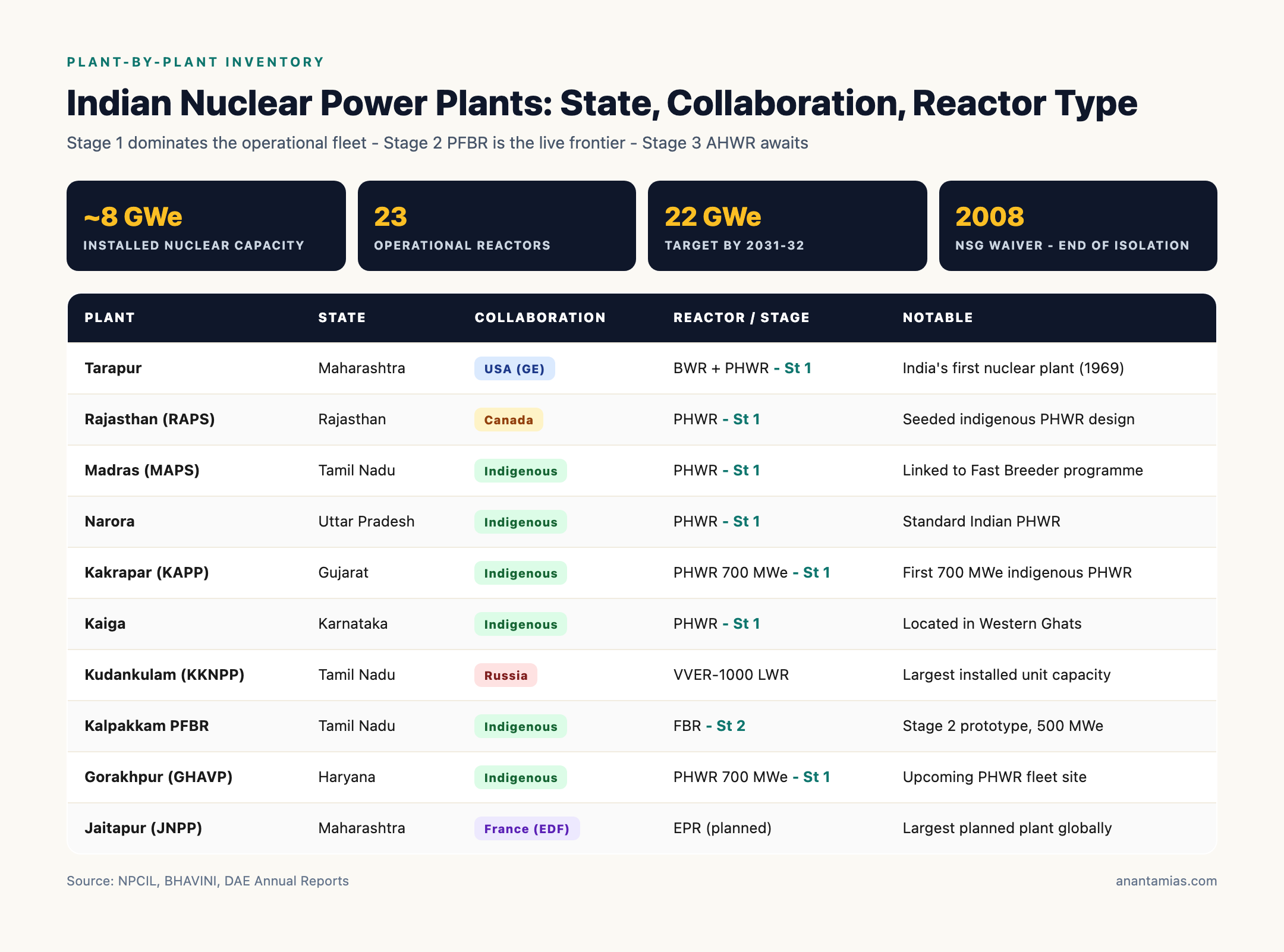
| Plant | State | Foreign Collaboration | Reactor Type | Notable Feature |
|---|---|---|---|---|
| Tarapur Atomic Power Station | Maharashtra | USA (GE) | BWR (Units 1-2), PHWR (Units 3-4) | India’s first nuclear plant |
| Rajasthan Atomic Power Station | Rajasthan | Canada (CANDU) | PHWR | Seeded indigenous PHWR design |
| Madras Atomic Power Station | Tamil Nadu | Indigenous | PHWR | Linked to Fast Breeder programme |
| Narora Atomic Power Station | Uttar Pradesh | Indigenous | PHWR | Standard Indian PHWR design |
| Kakrapar Atomic Power Station | Gujarat | Indigenous | PHWR | First 700 MWe indigenous PHWR (KAPP-3) |
| Kaiga Generating Station | Karnataka | Indigenous | PHWR | Located in the Western Ghats |
| Kudankulam Nuclear Power Plant | Tamil Nadu | Russia | VVER-1000 (LWR) | Largest installed unit capacity |
| Kalpakkam PFBR | Tamil Nadu | Indigenous (FR design adapted) | Fast Breeder Reactor | Stage 2 prototype |
| Gorakhpur Haryana Anu Vidyut Pariyojana | Haryana | Indigenous | PHWR (700 MWe) | Upcoming PHWR fleet site |
| Jaitapur Nuclear Power Project | Maharashtra | France (EDF) | EPR (planned) | Largest planned plant globally |
As of the latest available data, India’s installed nuclear capacity is approximately 8 GWe across 23 operational reactors, with another 8 to 10 GWe under construction or sanctioned. The government has set out a target trajectory of around 22 GWe by 2031-32 and substantially higher by mid-century, contingent on Stage 2 commercial deployment.
Regulatory and Management Architecture
| Body | Full Form | Role |
|---|---|---|
| DAE | Department of Atomic Energy | Apex policy body; reports directly to the Prime Minister |
| AEC | Atomic Energy Commission | Apex decision-making body chaired by the DAE Secretary |
| AERB | Atomic Energy Regulatory Board | Independent safety regulator |
| NPCIL | Nuclear Power Corporation of India Limited | Operates Stage 1 commercial PHWRs and imported LWRs |
| BHAVINI | Bharatiya Nabhikiya Vidyut Nigam Limited | Operates Stage 2 Fast Breeder Reactors |
| BARC | Bhabha Atomic Research Centre | Premier R&D institution; designs reactors and fuel cycles |
| IGCAR | Indira Gandhi Centre for Atomic Research | Stage 2 R&D, Kalpakkam |
| IREL | Indian Rare Earths Limited | Mines and processes monazite for thorium |
| NFC | Nuclear Fuel Complex, Hyderabad | Manufactures fuel assemblies |
| HWB | Heavy Water Board | Produces heavy water for PHWRs |
| UCIL | Uranium Corporation of India Limited | Mines uranium (Jaduguda, Tummalapalle) |
The DAE’s direct reporting to the Prime Minister, a feature unusual among Indian ministries, reflects the strategic importance of the programme. The AERB’s independence from the operating bodies is essential for safety regulation; it has been periodically debated whether AERB should be made fully statutory through a Nuclear Safety Regulatory Authority Act.
Why It Matters: Energy, Climate, Strategy
The energy security argument is the original. Reducing dependence on imported coal, oil, and gas requires a substantial baseload power source that does not produce greenhouse gases. Nuclear is the only proven technology that delivers gigawatt-scale baseload zero-carbon power.
The climate argument has gained weight since India’s net-zero-by-2070 pledge at COP26 (2021). Coal-fired thermal plants, which still generate the majority of Indian electricity, must be replaced with low-carbon alternatives at speed. Renewables provide intermittent power; nuclear provides firm power. The two are complementary in any credible decarbonisation pathway.
The strategic argument is about technology autonomy. A country that masters the full nuclear fuel cycle (mining, enrichment, fuel fabrication, reactor operation, reprocessing, waste management) commands a high-technology base that spills over to advanced materials, precision engineering, instrumentation, robotics, and computational modelling. India is one of fewer than ten countries with such a base.
The geopolitical argument is about strategic depth. India’s civil nuclear programme is intertwined with its strategic deterrent. The 1974 and 1998 tests reshaped India’s place in the international order; the Indo-US 123 Agreement of 2008 and the NSG waiver brought India into the de facto fold of recognised nuclear states without NPT membership. Future programmes, including Small Modular Reactors and the SHANTI Act reform, are being shaped by this geopolitical position.
Comparative: India versus Major Nuclear Powers
| Country | Installed Nuclear Capacity (latest) | Primary Reactor Type | Strategic Posture |
|---|---|---|---|
| United States | ~95 GWe | PWR, BWR | Largest civil fleet; SMR-focused expansion |
| France | ~63 GWe | PWR (EPR) | Highest nuclear share in mix (~70%) |
| China | ~55 GWe | PWR (Hualong One) | Fastest builder globally |
| Russia | ~28 GWe | VVER, BN (FBR) | Leading FBR commercial deployment |
| South Korea | ~25 GWe | APR-1400 (PWR) | Major exporter |
| India | ~8 GWe (operating) | PHWR (and VVER, FBR) | Three-stage thorium-oriented |
India’s installed capacity is modest by comparison, but its design diversity and the thorium-oriented strategy are unique. No other country has committed to a thorium-based fuel cycle at scale. Whether India can convert that distinctive strategy into commercial reality by the 2040s is the open question.
Challenges and Risks
- Construction delays: PFBR commissioning has slipped repeatedly; PHWR fleet builds have also faced timeline pressure.
- Liability framework: The Civil Liability for Nuclear Damage Act, 2010 introduced supplier liability that deterred foreign vendors. The SHANTI Act, 2025 is intended to recalibrate this.
- Fuel cycle bottlenecks: Indigenous uranium mining is constrained; reprocessing capacity for Stage 2 fuel is limited; thorium fuel fabrication is still at pilot scale.
- Public acceptance: Anti-nuclear protests have delayed projects (Kudankulam, Jaitapur) and a credible public communication strategy is overdue.
- Capital intensity: Nuclear plants are expensive and slow to build; financing is a recurring constraint.
- Waste management: Long-lived high-level waste from PHWRs and FBRs requires disposal solutions that India has not yet operationalised at scale.
- Workforce pipeline: Reactor physics, neutronics, sodium-loop engineering, and reprocessing chemistry require sustained talent investment.
Prelims Pointers
- The three-stage programme was proposed by Dr Homi Bhabha in the 1950s.
- Stage 1 uses Pressurised Heavy Water Reactors (PHWRs) with natural uranium fuel.
- Stage 2 uses Fast Breeder Reactors (FBRs) cooled by liquid sodium.
- Stage 3 uses Advanced Heavy Water Reactors (AHWRs) with a thorium-U-233 cycle.
- Tarapur (Maharashtra) is India’s first nuclear plant; built with US (GE) collaboration.
- Kudankulam (Tamil Nadu) uses Russian VVER-1000 light water reactors.
- Kalpakkam hosts the Prototype Fast Breeder Reactor operated by BHAVINI.
- NPCIL runs commercial Stage 1 plants; BHAVINI runs Stage 2.
- AERB is the independent safety regulator; DAE reports directly to the PM.
- Monazite sands of Kerala host most of India’s thorium reserves.
- The 2008 NSG waiver ended India’s nuclear isolation post-1974.
- India is not a signatory to the NPT (Nuclear Non-Proliferation Treaty) or the CTBT (Comprehensive Test Ban Treaty).
Mains Practice Questions
- GS-III: Explain the rationale and structure of India’s three-stage nuclear programme. Why is the thorium endgame strategically important for a country with limited uranium reserves? (250 words)
- GS-III: Critically examine the role of the Department of Atomic Energy and its constituent bodies (NPCIL, BHAVINI, AERB, BARC). How does India’s regulatory architecture compare with international best practice? (250 words)
- GS-III: Discuss the impact of the Civil Liability for Nuclear Damage Act, 2010 on India’s civil nuclear cooperation with foreign vendors. How does the SHANTI Act, 2025 attempt to recalibrate this regime? (250 words)
- GS-III: “Nuclear power is essential for India’s net-zero pathway, yet construction has lagged targets.” Examine the factors behind the slow pace of nuclear capacity addition and suggest measures to accelerate it. (250 words)
Way Forward
Three priorities should shape the next decade of policy. First, complete and operate the Prototype Fast Breeder Reactor at Kalpakkam and use the operating experience to design and build a small fleet of commercial FBRs. Without Stage 2 commercial capacity, Stage 3 remains theoretical. The DAE’s roadmap envisages multiple commercial FBRs by the late 2030s; that timeline must be defended with concrete project sanctions and budget allocations.
Second, accelerate Stage 1 deployment in fleet mode. The 700-MWe indigenous PHWR is now a proven design; the Gorakhpur Haryana Anu Vidyut Pariyojana, Mahi Banswara, Chutka, and Kaiga expansion projects together can add 10 to 15 GWe by 2031-32. Standardisation, supply chain consolidation, and public-private partnership models (now permitted under the SHANTI Act, 2025 for certain plant categories) should be used to compress timelines.
Third, build the SMR (Small Modular Reactor) capability. India’s BHAVINI and BARC are well-placed to design and certify a 300-MWe Bharat Small Modular Reactor (BSMR) suitable for replacing retiring coal plants on existing grid infrastructure. SMRs combine some of the advantages of nuclear (low carbon, firm power) with shorter construction timelines and modular financing.
In parallel, India must invest in waste management, reprocessing, the thorium fuel fabrication chain, and a transparent public communication strategy. The three-stage programme is not just a science project; it is a strategic choice about what kind of energy economy and what kind of technological power India intends to be by mid-century.
Frequently Asked Questions
What is the three-stage nuclear programme and who proposed it?
The three-stage nuclear programme was proposed by Dr Homi Jehangir Bhabha in the 1950s as India’s long-term plan to transition from natural uranium-fuelled reactors (Stage 1) through plutonium-fuelled fast breeder reactors (Stage 2) to thorium-U-233 fuelled advanced reactors (Stage 3). The strategy is designed to leverage India’s large thorium reserves despite its limited uranium endowment.
Why does India need a thorium-based reactor strategy?
India holds roughly 25% of the world’s thorium reserves but only about 2% of uranium. A uranium-only programme would always be import-dependent. Thorium is fertile (it can be converted to fissile U-233 in a reactor) but not directly fissile, so it must be paired with U-233 produced via Stage 2 fast breeders. The thorium endgame promises decades to centuries of indigenous fuel.
What is the difference between Stage 1, Stage 2, and Stage 3 reactors?
Stage 1 uses Pressurised Heavy Water Reactors (PHWRs) fuelled by natural uranium with heavy water as moderator and coolant. Stage 2 uses Fast Breeder Reactors (FBRs) fuelled by plutonium-239 with a thorium blanket and liquid sodium as coolant; they breed U-233 from thorium. Stage 3 uses Advanced Heavy Water Reactors (AHWRs) fuelled mainly by thorium and U-233 to achieve a self-sustaining thorium cycle.
What is a Fast Breeder Reactor and why is liquid sodium used as coolant?
A Fast Breeder Reactor uses fast (un-moderated) neutrons to fission plutonium in the core and breed new fissile material in a thorium-uranium blanket. Water cannot be used as a coolant because it would moderate the neutrons. Liquid sodium has excellent heat-transfer properties and does not slow neutrons, but it reacts violently with air and water, which makes FBR safety engineering exceptionally demanding.
Which Indian agencies run the nuclear programme?
The Department of Atomic Energy (DAE) is the apex policy body and reports directly to the Prime Minister. The Atomic Energy Regulatory Board (AERB) is the independent safety regulator. NPCIL operates Stage 1 commercial PHWRs and imported reactors. BHAVINI operates Stage 2 Fast Breeder Reactors. BARC and IGCAR conduct R&D, and entities like NFC, HWB, UCIL, and IREL handle fuel cycle services.
What was Tarapur Atomic Power Station’s significance?
Tarapur Atomic Power Station, commissioned in 1969 with US (General Electric) collaboration, was India’s first commercial nuclear power plant. It used boiling water reactor (BWR) technology and shaped India’s early operational learning. Subsequent reactors at Rajasthan, Madras, Narora, Kakrapar, and Kaiga moved to indigenous PHWR designs.
What is the Prototype Fast Breeder Reactor and where is it located?
The Prototype Fast Breeder Reactor (PFBR) is a 500 MWe sodium-cooled fast breeder reactor located at Kalpakkam, Tamil Nadu. It is operated by BHAVINI and is the testbed for India’s commercial Stage 2 fleet. Commissioning has been delayed multiple times, with full criticality and grid connection expected through the late 2020s.
How does India’s three-stage strategy compare with global nuclear approaches?
Most major nuclear powers (USA, France, China, South Korea) operate primarily Pressurised Water Reactors (PWRs) using enriched uranium. Russia is the leader in commercial fast breeder operation. No other country has committed to a thorium-based fuel cycle at India’s scale. India’s strategy is unique and reflects its specific resource endowment.
What is the role of the Civil Liability for Nuclear Damage Act, 2010?
The Civil Liability for Nuclear Damage Act (CLNDA), 2010 sets out the liability framework for nuclear incidents. Its supplier-liability provisions (Section 17) deterred foreign reactor vendors from participating in Indian projects. The SHANTI Act, 2025 is the latest legislative reform aimed at recalibrating the liability and safety regime to attract investment while preserving public protection.
What are the main challenges facing India’s nuclear programme?
The main challenges are construction delays and capital intensity, the deterrent effect of the 2010 liability law on foreign vendors (now being addressed by SHANTI 2025), limited indigenous uranium and reprocessing capacity, public acceptance issues at proposed sites, the long lead time required to commercialise Stage 2 FBRs, and the slow pace of high-level waste management infrastructure.