India Since Independence for UPSC
Use India Since Independence selectively for nation-building, institutions and development, with worked notes and an adjustable reading plan.
India Since Independence helps you study what happened after political freedom: the choices involved in building institutions, consolidating the nation and pursuing development. Use it for explanations and competing interpretations. Don’t read it as a current-affairs compilation or as a replacement for every GS1 history source.
If your notes stop at 1947, this book can fill a specific gap. Read selected themes, place events in a short timeline and ask what problem a policy was trying to solve. A list of leaders and dates won’t explain how independent India took shape.
Identify the Book Before Buying
India Since Independence is distinct from India’s Struggle for Independence. The publisher calls it a sequel, so the two titles serve different chronological purposes.
- Title: India Since Independence.
- Publisher: Penguin Random House India.
- Credited authors: Bipan Chandra, Mridula Mukherjee and Aditya Mukherjee, as identified in the publisher’s collector-edition record.
- Main use here: selected post-independence history and interpretation, followed by your own syllabus mapping.
Check the Penguin book page and the publisher’s collector-edition record against the edition you’re buying. An edition’s subtitle, pagination and format shouldn’t be copied from another listing.
The publisher describes coverage of constitutional formation, political and economic agendas, foreign policy and national consolidation. Those broad themes establish a useful reading route. They don’t authorize an assumption that the book covers events up to the present day.
Read Around Historical Problems
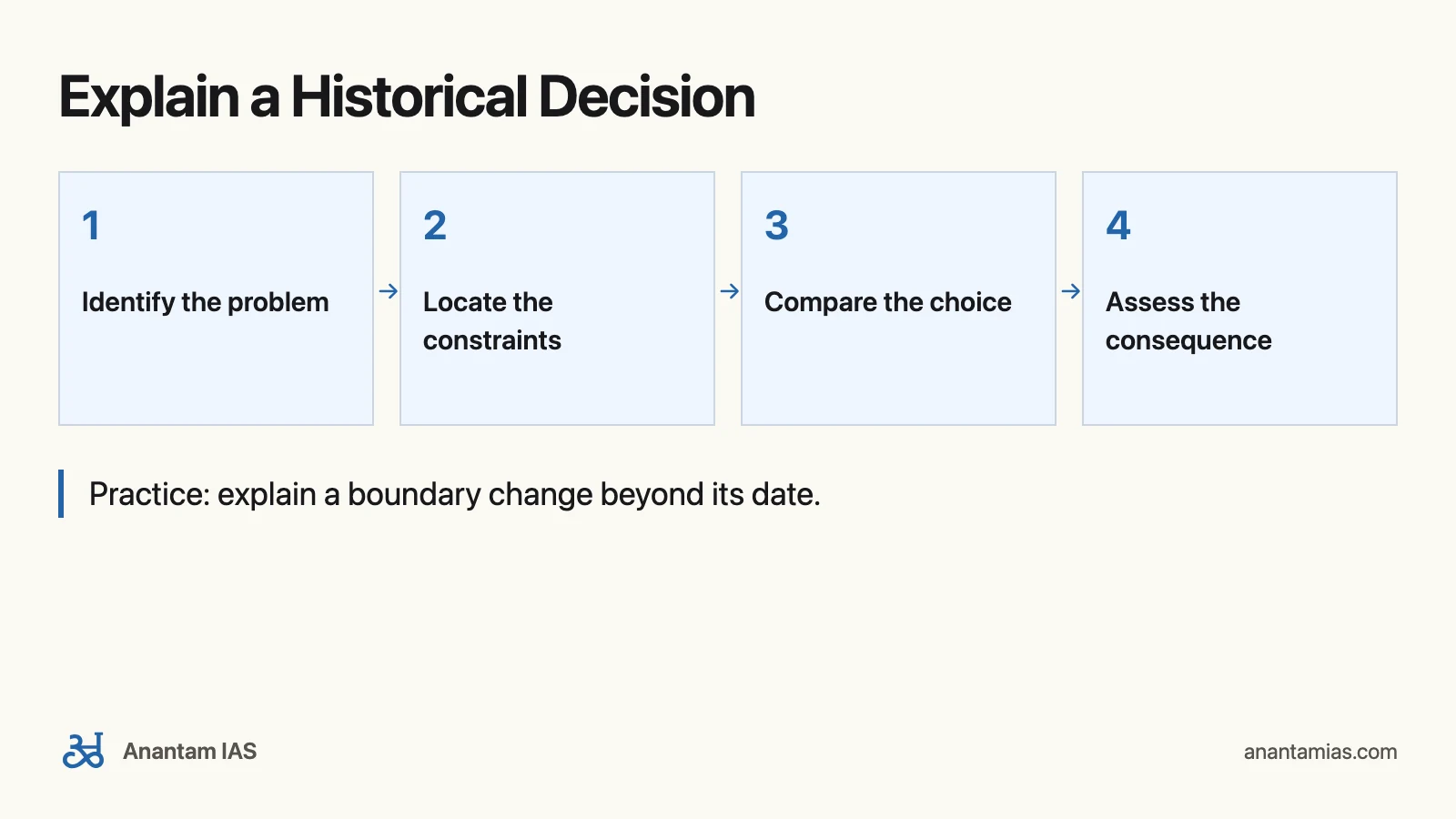
Start with a problem, then place the event or policy inside it. This keeps the reading analytical without making chronology disappear.
| Theme | Question to Ask | Note to Make |
|---|---|---|
| Nation-building | What needed to be integrated or accommodated? | Problem, choices and consequences |
| Constitution and democracy | Which institutions were being established? | Institution and purpose |
| Development policy | Which constraints shaped the choice? | Goals, instruments and tradeoffs |
| Foreign policy | Which domestic and international conditions mattered? | Context and decision |
| Social and political change | Who sought change, and through what channel? | Actor, demand and response |
Use the Mains booklist for the broader source-selection decision. This book’s task is narrower: make a historical process explainable.
A Worked Nation-Building Note
Try this original practice prompt: ‘Why can a change in administrative boundaries have both integrative and disruptive consequences?’ Treat it as a reasoning exercise, not as a past UPSC question.
Begin with a hypothetical region whose residents seek a boundary change. A weak note says ‘the government created a new unit’ and records a date. A useful note separates the problem from the decision.
Build it in five stages:
- Demand: what did the people asking for change want represented or administered differently?
- Constraints: what other communities, resources or institutions would the decision affect?
- Choice: which arrangement was adopted, and which alternatives were considered?
- Mechanism: how could the arrangement improve access or recognition, and how could it generate a new disagreement?
- Assessment: which evidence would you need before judging whether it worked?
Now read a relevant nation-consolidation discussion in your edition. Replace the hypothetical labels with verified historical details from that passage. Keep the author’s assessment separate from the evidence supporting it. If the passage doesn’t address an alternative, don’t invent one to complete the template.
The finished note should let you explain the decision and its tradeoff without retelling an entire chapter. That is the gain from reading history as a set of problems rather than as a procession of office-holders.
Keep Chronology and Interpretation Separate
Use one short timeline for sequence and a different note for explanation. A timeline answers ‘what followed what?’ An analytical note answers ‘why did this choice make sense to the actors, and with what consequences?’
For a claim you may use in an answer, distinguish:
- the event or decision;
- the reason given by the actor;
- the authors’ explanation;
- an alternative interpretation where a credible source actually supplies one;
- later evidence relevant to assessing the outcome.
You don’t need a disagreement in every note. You do need to recognize when an interpretation is being presented rather than a simple event date. The Indian history source guide can help you keep this book’s role separate from ancient, medieval and freedom-struggle preparation.
A Four-Week Reading Cycle
Use this as a flexible sequence, not a promise to finish the entire book in a month.
- Week 1: select the relevant syllabus themes, identify your edition’s coverage and build a brief chronological frame.
- Week 2: read one nation-building theme and one institutional theme. Produce a problem-choice-consequence note for each.
- Week 3: read one development or foreign-policy theme. Identify the constraints behind a decision.
- Week 4: close the book and write answer outlines from your notes. Reread only the passages needed to repair missing links or uncertain details.
Current statistics, laws and contemporary policy developments need current official sources. Historical explanations shouldn’t be silently updated by inserting today’s figures into yesterday’s argument.
Choose one post-independence process that your notes reduce to a date. Use the book to reconstruct the problem, the choice and the consequence. That is a useful first session.
Frequently Asked Questions
Is this the same as India’s Struggle for Independence?
No. Penguin describes India Since Independence as a sequel. The titles serve different chronological purposes.
Who are the credited authors?
The publisher’s collector-edition record identifies Bipan Chandra, Mridula Mukherjee and Aditya Mukherjee. Check the title page of your edition.
Should I read the whole book for GS1?
Map your syllabus and select the themes needed to explain post-independence processes. The suggested routine is a selective reading cycle, not a requirement to finish every chapter.
Does it supply current affairs?
It is a historical source. Present laws, statistics and contemporary developments need current sources; do not assume that an edition covers events to the present.
What notes should I make?
Keep a short timeline for sequence and a separate problem-choice-consequence note for explanation. Distinguish the authors’ interpretation from the historical details supporting it.