Disclosure: this guide contains Amazon affiliate links. As an Amazon Associate, Anantam IAS earns from qualifying purchases — at no extra cost to you.
Best Books for UPSC Mains GS Papers
Choosing the right books for UPSC Mains is half the battle. The Mains examination tests analytical depth, not surface-level knowledge — and the quality of source material directly determines answer quality. This guide provides a paper-wise book list covering all four GS papers, the Essay paper, and general reference works, curated from topper recommendations and faculty experience.
How to Use This Book List
Before diving into specific recommendations, some ground rules:
- Don’t read everything. Select 1–2 books per subject area. Multiple sources on the same topic create confusion, not clarity.
- NCERTs first, always. Reference books supplement NCERTs — they don’t replace them.
- Match books to the syllabus. Read only the chapters relevant to the UPSC Mains syllabus, not entire textbooks.
- Integrate current affairs. No book alone is sufficient. Newspaper reading and monthly magazines fill the gap between static content and exam requirements.
NCERT Books for UPSC: Complete Guide
GS Paper I: Indian Heritage, History, Geography, Society
GS Paper I covers Indian History and Culture, World History, Indian Society, and Geography. The challenge is breadth — the syllabus spans ancient civilizations to contemporary social issues.
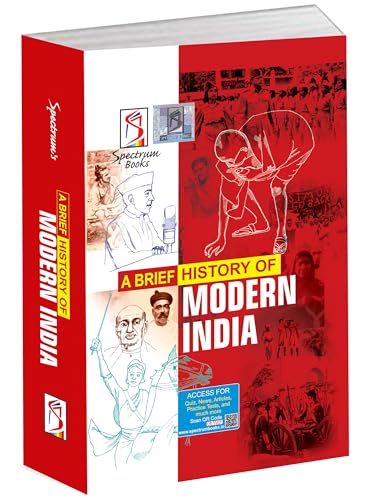
A Brief History of Modern India — Spectrum
- 1,000 pages covering 1707 to the present
- Chronological narrative with chapter summaries
- The most-used modern history book in the exam
History Books
| Book | Author/Publisher | Best For |
|---|---|---|
| India’s Struggle for Independence | Bipan Chandra | Modern Indian History (primary text) |
| India’s Ancient Past | R.S. Sharma | Ancient India |
| History of Medieval India | Satish Chandra | Medieval India |
| A Brief History of Modern India | Spectrum | Quick revision of Modern History |
| NCERT History (Class 6–12) | NCERT | Foundation concepts |
| Mastering Modern World History | Norman Lowe | World History post-1750 |
Tip: For Indian History, stick with Bipan Chandra or Spectrum — not both. Bipan Chandra offers depth; Spectrum offers speed. Choose based on available preparation time.
Culture and Heritage
| Book | Author | Best For |
|---|---|---|
| Indian Art and Culture | Nitin Singhania | Art, architecture, music, dance |
| CCRT Publications | Centre for Cultural Resources | Specific cultural topics |
| NCERT Fine Arts (Class 11–12) | NCERT | Foundation for art and architecture |
Nitin Singhania’s book is the gold standard for culture. It covers everything the syllabus demands — architecture, sculpture, painting, music, dance, theatre, and literature — in exam-friendly format.
Geography
| Book | Author | Best For |
|---|---|---|
| Certificate Physical & Human Geography | G.C. Leong | Physical Geography foundation |
| Geography of India | Majid Husain | Indian Geography |
| Oxford School Atlas | Oxford | Map-based preparation |
| NCERT Geography (Class 6–12) | NCERT | Concepts foundation |
Best Geography Books for UPSC: GC Leong & More
Indian Society
| Book | Author | Best For |
|---|---|---|
| Indian Society | NCERT (Class 12) | Sociological concepts |
| Social Problems in India | Ram Ahuja | Issues-based preparation |
| India Year Book | Government of India | Data and facts |
Indian Society topics — communalism, regionalism, secularism, globalization, women’s issues — are best prepared through a combination of NCERT foundation and newspaper reading.
GS Paper II: Governance, Constitution, Polity, IR
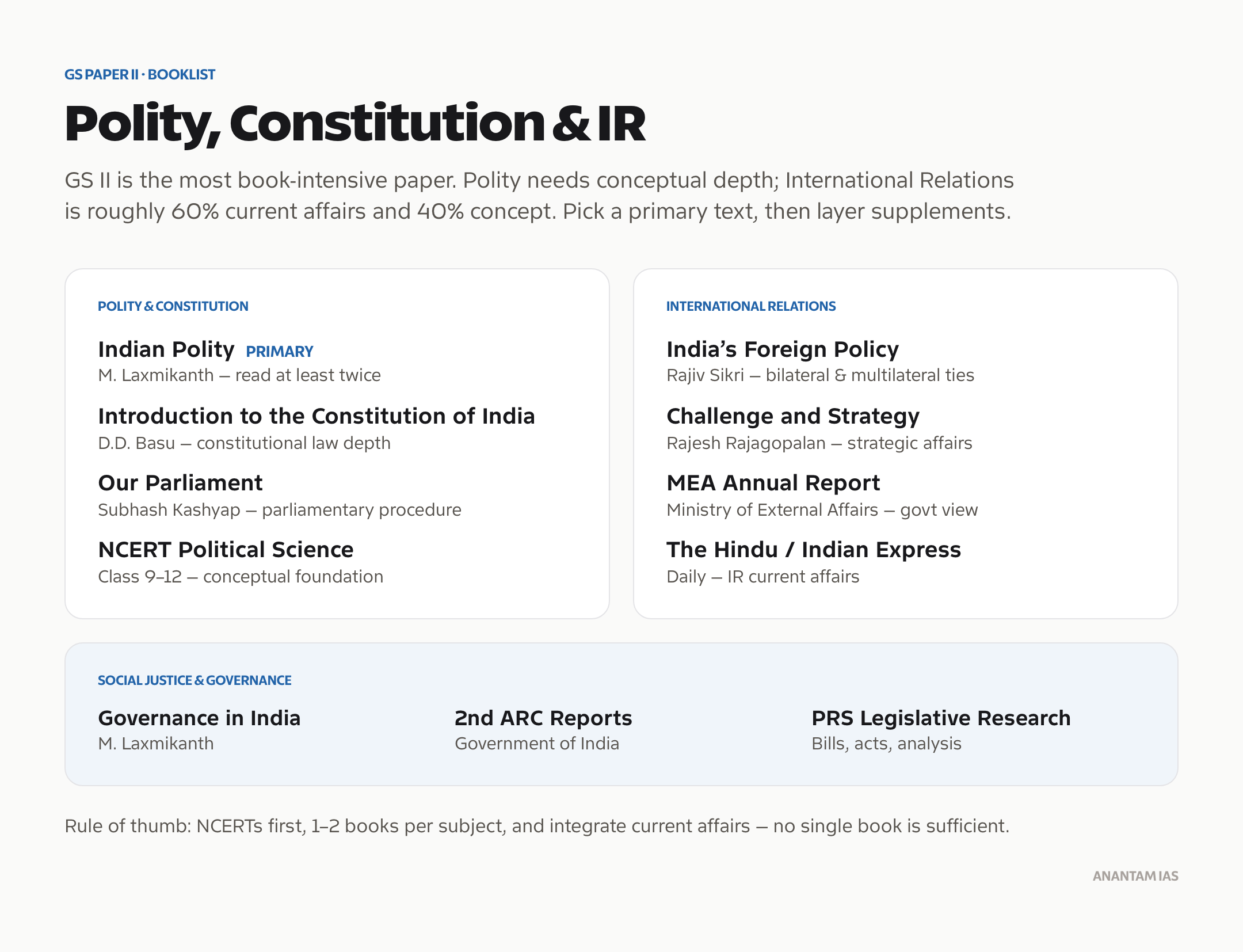
GS Paper II is the most book-intensive paper. Polity and governance require conceptual depth, while International Relations demands current awareness.
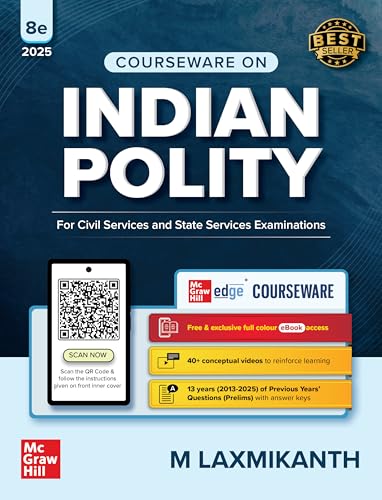
Indian Polity — M. Laxmikanth (8th Edition)
- McGraw Hill courseware edition, 856 pages
- Covers the full Prelims and Mains polity syllabus in one volume
- Solved Prelims PYQs from 2013–25 plus 12 years of Mains questions
Polity and Constitution
| Book | Author | Best For |
|---|---|---|
| Indian Polity | M. Laxmikanth | Comprehensive polity reference (primary) |
| Introduction to the Constitution of India | D.D. Basu | Constitutional law depth |
| Our Parliament | Subhash Kashyap | Parliamentary procedures |
| Governance in India | M. Laxmikanth | Governance-specific topics |
| NCERT Political Science (Class 9–12) | NCERT | Conceptual foundation |
Laxmikanth is non-negotiable for GS Paper II. Every topper recommends it. Read it at least twice — first for understanding, second for retention.
Laxmikanth Indian Polity: How to Read
International Relations
| Book | Author | Best For |
|---|---|---|
| India’s Foreign Policy | Rajiv Sikri | India’s bilateral and multilateral relations |
| Challenge and Strategy (Rajesh Rajagopalan) | Rajesh Rajagopalan | Security and strategic affairs |
| MEA Annual Report | Ministry of External Affairs | Current year developments |
| The Hindu / Indian Express | Daily newspaper | IR current affairs |
IR preparation is 60% current affairs and 40% conceptual. The MEA Annual Report provides a government perspective on all major bilateral relationships and multilateral engagements.
Social Justice and Governance
| Book | Author | Best For |
|---|---|---|
| Governance in India | Laxmikanth | Government schemes, e-governance |
| ARC Reports (2nd ARC) | Government of India | Governance reform recommendations |
| PRS Legislative Research | PRS India (online) | Bills, acts, parliamentary analysis |
Second ARC reports are goldmines for governance questions. At minimum, read the reports on ethics, right to information, local governance, and social capital.
GS Paper III: Economy, Security, Environment, S&T
GS Paper III covers the widest range of topics. Economy, Science & Technology, Environment, Internal Security, and Disaster Management all fall under this paper.
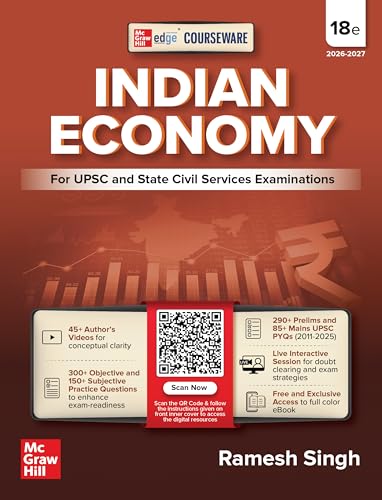
Indian Economy — Ramesh Singh (18th Edition)
- McGraw Hill courseware edition, 624 pages
- Concept-first treatment of growth, banking, fiscal policy and external sector
- Includes Economic Survey and Union Budget coverage
Economy
| Book | Author | Best For |
|---|---|---|
| Indian Economy | Ramesh Singh | Comprehensive economy reference |
| Indian Economy | Sanjeev Verma | Alternative to Ramesh Singh |
| Economic Survey | Government of India | Annual economic analysis |
| NCERT Economics (Class 9–12) | NCERT | Foundation concepts |
| Budget Documents | Ministry of Finance | Fiscal policy, allocations |
Choose either Ramesh Singh or Sanjeev Verma — not both. Ramesh Singh is more detailed; Sanjeev Verma is more concise. Both serve the purpose equally well.
Science and Technology
| Book | Author | Best For |
|---|---|---|
| Science & Technology in India | TMH / Spectrum | Static S&T concepts |
| NCERT Science (Class 6–10) | NCERT | Foundation |
| ISRO / DST Annual Reports | Government | Space, defence, biotech updates |
| The Hindu Science Section | The Hindu | Current S&T developments |
S&T is heavily current affairs-dependent. Space missions (ISRO, NASA), AI developments, biotechnology breakthroughs, and digital governance initiatives dominate recent papers.
Environment and Ecology
| Book | Author | Best For |
|---|---|---|
| Environment by Shankar IAS | Shankar IAS Academy | Comprehensive environment coverage |
| NCERT Biology (Class 12) | NCERT | Biodiversity, ecology basics |
| India State of Forest Report | Forest Survey of India | Forest cover data |
| UNEP/IPCC Reports | United Nations | Climate change, global environment |
Shankar IAS Environment book is the single best resource for this section. It covers biodiversity, climate change, environmental legislation, pollution, and conservation in exam-oriented format.
Internal Security
| Book | Author | Best For |
|---|---|---|
| Internal Security | Ashok Kumar | Comprehensive security coverage |
| India’s Internal Security | Ministry of Home Affairs | Government perspective |
| Newspaper Analysis | Daily | Current security developments |
Internal Security is a current-affairs-heavy section. Left-wing extremism, border management, cyber security, money laundering, and terrorism are tested through contemporary examples.
GS Paper IV: Ethics, Integrity, and Aptitude
GS Paper IV is unique — it tests values and ethical reasoning, not factual knowledge. Book selection matters differently here.
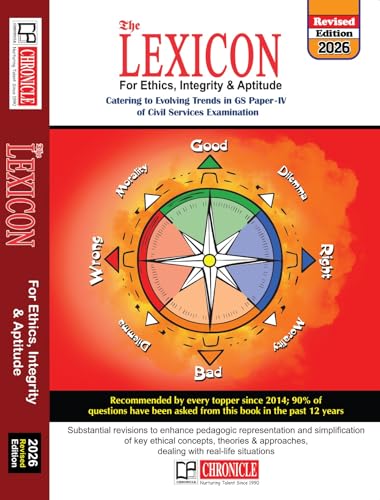
The Lexicon for Ethics, Integrity and Aptitude — Niraj Kumar
- Term-by-term treatment of the GS-4 syllabus vocabulary
- Definitions an examiner recognises, with short illustrations
- Organised as a dictionary, so it survives repeated revision
Ethics Books
| Book | Author | Best For |
|---|---|---|
| Ethics, Integrity, and Aptitude | Lexicon / Subba Rao | Comprehensive ethics text |
| ARC Report on Ethics in Governance | Government of India | Governance ethics framework |
| NCERT Political Science (Class 12) | NCERT | Foundational value concepts |
| Justice by Michael Sandel | Michael Sandel | Ethical philosophy overview |
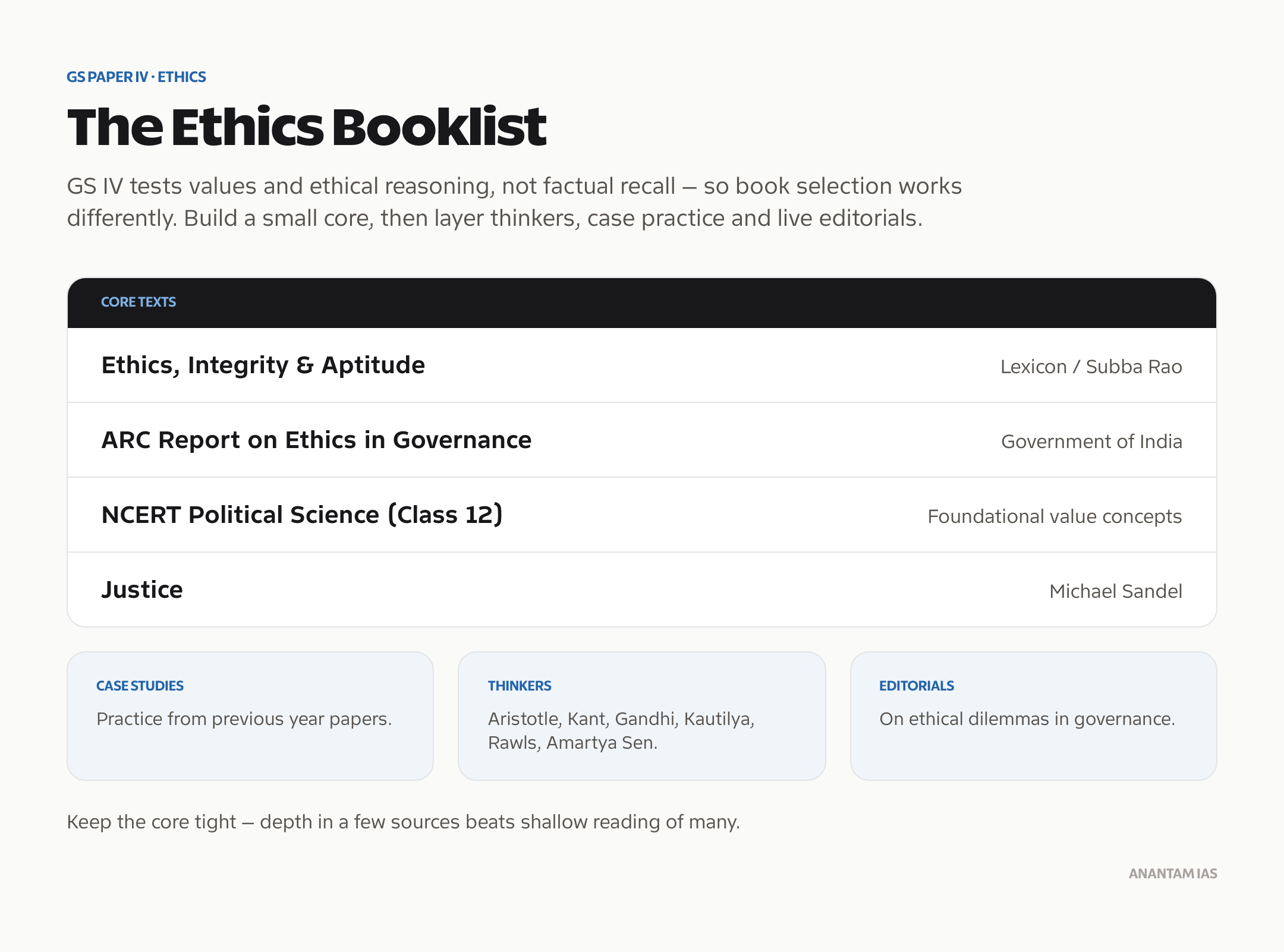
Additional Preparation:
- Case study practice from previous year papers
- Thinker compilation (Aristotle, Kant, Gandhi, Kautilya, Rawls, Amartya Sen)
- Newspaper editorials on ethical dilemmas in governance
Emotional Intelligence: UPSC Notes Attitude & Aptitude: UPSC Ethics Paper Notes
Essay Paper
The Essay paper carries 250 marks and demands a different skill set — structured thinking, diverse perspectives, and eloquent expression.
| Resource | Purpose |
|---|---|
| Previous Year Essay Topics (2013–2025) | Pattern analysis |
| Newspaper Editorials (Hindu, IE) | Argument building, vocabulary |
| Yojana & Kurukshetra magazines | Government perspective |
| Essay writing practice (weekly) | Skill development |
Essay Structure Framework:
- Engaging introduction (anecdote, quote, or statistic)
- Multidimensional body (social, economic, political, ethical, environmental)
- Balanced arguments (both sides)
- Contemporary examples and data
- Forward-looking conclusion
UPSC Mains Answer Writing: Strategy & Tips
Complete Paper-Wise Book Summary
| Paper | Must-Read Books | Supplementary |
|---|---|---|
| GS I | Bipan Chandra, Laxmikanth, GC Leong, Nitin Singhania | NCERTs, Norman Lowe |
| GS II | Laxmikanth (Polity + Governance), Rajiv Sikri | ARC Reports, PRS India |
| GS III | Ramesh Singh, Shankar Environment, Ashok Kumar | Economic Survey, ISRO reports |
| GS IV | Lexicon Ethics, ARC Ethics Report | Michael Sandel, newspaper editorials |
| Essay | Newspaper editorials + practice | Yojana, Kurukshetra |
Common Mistakes in Book Selection
- Buying too many books. More books don’t mean better preparation. Depth in few sources beats shallow reading of many.
- Ignoring NCERTs. Advanced books make sense only after NCERT concepts are clear. Jumping directly to reference books creates fragmented understanding.
- Not reading the Economic Survey. The Survey is a single document that covers almost every economic concept UPSC can test. Ignoring it is leaving marks on the table.
- Skipping government reports. ARC reports, India Year Book, and ministry annual reports provide authentic data and perspectives that no commercial book can replicate.
- Over-reliance on one source. While focusing on fewer books is wise, relying on a single source for any subject creates blind spots. Cross-reference key topics across 2 sources minimum.
Reading Strategy: How to Extract Maximum Value
Step 1: Syllabus Mapping
Print the UPSC Mains syllabus. Map each topic to specific chapters in chosen books. Read only those chapters.
Step 2: Active Reading
Don’t just read — annotate. Mark key facts, arguments, and examples. Create margin notes linking topics to recent current affairs.
Step 3: Note-Making
Create concise notes topic-wise (not book-wise). Merge content from different sources under each syllabus heading.
Step 4: Revision Cycle
Revise notes at least 3 times before the exam. Each revision should take less time than the previous one.
UPSC Topper Strategy: How Toppers Prepare
Frequently Asked Questions
How many books should one read for UPSC Mains?
Keep the total count between 15–20 books across all papers, including NCERTs. The goal isn’t to read more books but to extract more from fewer sources. One thorough reading of Laxmikanth with notes is worth more than skimming three polity books without retention.
Are NCERTs enough for UPSC Mains?
NCERTs provide the conceptual foundation but aren’t sufficient alone for Mains. Mains demands analytical depth, diverse perspectives, and current affairs integration that NCERTs don’t cover. Use NCERTs as the base, then build upon them with 1–2 reference books per subject area.
Should one read different books for Prelims and Mains?
There’s significant overlap. Books like Laxmikanth, Bipan Chandra, and Ramesh Singh serve both Prelims and Mains. The difference lies in how content is consumed — Prelims requires factual recall, while Mains requires analytical understanding of the same content.
Is it necessary to read the entire Laxmikanth for GS Paper II?
Not every chapter is equally important for Mains. Focus on constitutional provisions, fundamental rights vs DPSP, Parliament, federalism, judiciary, local governance, and governance-related chapters. Chapters on specific amendments or state-level details carry less Mains weight.
How important is the Economic Survey for UPSC Mains?
Extremely important. The Economic Survey provides data, analysis, and government perspectives that directly translate into GS III answers. At minimum, read the summary chapters and key themes. The Survey’s approach to analyzing economic challenges often mirrors UPSC question framing.
Tell Google you want more of this.
Add Anantam IAS as a preferred sourceOne tap, and this site shows up more often in your own Top Stories, AI Overviews and AI Mode. Remove it any time.