Indian Nobel Prize Winners: Complete List from Rabindranath Tagore (1913) to Abhijit Banerjee (2019)
Indian Nobel Prize winners across Literature, Physics, Medicine, Peace, Chemistry, and Economics. Full list, dates, contributions, and UPSC pointers.
Few honours sit higher in the global imagination than the Nobel Prize. Since Alfred Nobel’s will established the awards in 1895, only a handful of Indians and people of Indian origin have stood on the Stockholm and Oslo podiums. The Indian Nobel Prize winners span a full century, from Rabindranath Tagore’s Literature prize in 1913 to Abhijit Banerjee’s Economics award in 2019. Their work covers light scattering, parallel poetry, ribosome architecture, child labour activism, planetary collapse, and randomized experiments in development economics.
This article lists every Indian and Indian-origin laureate, the field, the year, and the contribution. We separate Indian citizens at the time of award from Indian-American or Indian-British winners, because UPSC questions often test this distinction. We also flag the institutions — Bose Institute, Cambridge, MIT, Trinity, Calcutta University — that shaped them.
Ten laureates is a small number for a country of 1.4 billion. The story is as much about what India has produced as what it hasn’t yet — and the structural reasons behind both.
Quick Facts About Indian Nobel Prize Winners
- Total Indian and Indian-origin laureates: 10 (across 1913-2019)
- First Indian Nobel: Rabindranath Tagore, Literature, 1913 — first non-European laureate in any field
- Only Indian citizen Nobel in science: C.V. Raman, Physics, 1930
- Most recent: Abhijit Banerjee, Economics, 2019 (shared with Esther Duflo and Michael Kremer)
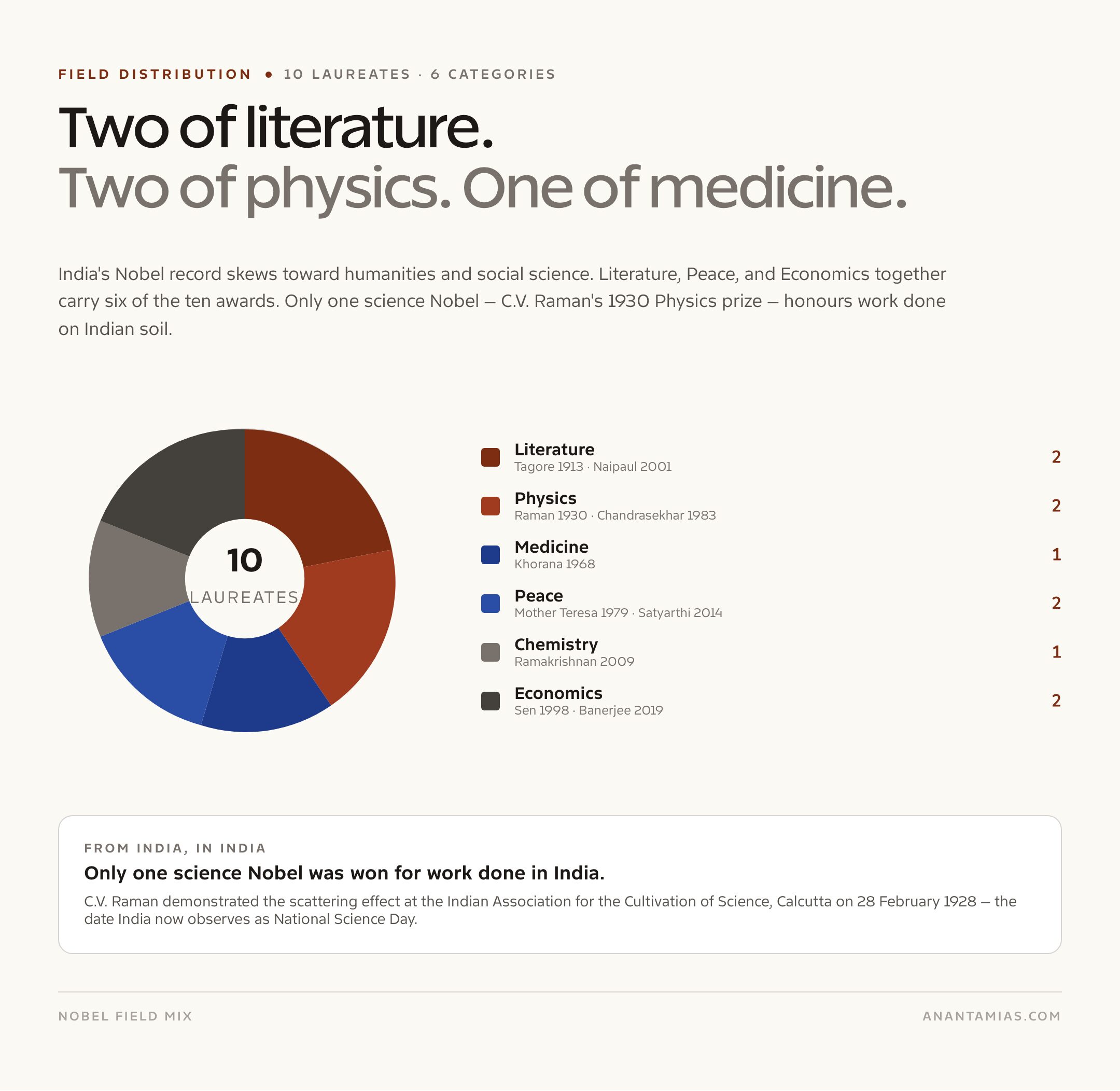
- Fields covered: Literature (2), Physics (2), Medicine (1), Peace (2), Chemistry (1), Economics (2)
- Indian-American/Indian-British laureates: Khorana, Chandrasekhar, Naipaul, Ramakrishnan, Banerjee
- Naturalized Indian: Mother Teresa (Albanian-origin, Indian citizen from 1948)
Who Counts as an Indian Nobel Prize Winner
The phrase “Indian Nobel Prize winners” is contested. The strictest definition includes only Indian citizens at the time of the award: Tagore, Raman, Mother Teresa, Amartya Sen, and Kailash Satyarthi. A wider definition includes people of Indian origin who held foreign citizenship when honoured: Hargobind Khorana (US), Subrahmanyan Chandrasekhar (US), V.S. Naipaul (UK, Trinidad-born), Venkatraman Ramakrishnan (US/UK), and Abhijit Banerjee (US).
UPSC questions test both definitions. In Prelims, you may be asked “Who was the first Indian to win the Nobel Prize?” — answer: Rabindranath Tagore. You may also be asked “Which Indian-American won the Chemistry Nobel?” — answer: Venkatraman Ramakrishnan. Read the question carefully.
Background and Historical Context of the Nobel Prize
Swedish chemist Alfred Nobel signed his final will on November 27, 1895, leaving most of his fortune to fund five annual prizes: Physics, Chemistry, Physiology or Medicine, Literature, and Peace. The first awards were given in 1901. The Royal Swedish Academy of Sciences awards Physics and Chemistry. The Karolinska Institutet awards Medicine. The Swedish Academy awards Literature. The Norwegian Nobel Committee awards Peace. The Sveriges Riksbank Prize in Economic Sciences in Memory of Alfred Nobel was instituted in 1968 by the Swedish central bank and is awarded by the Royal Swedish Academy — strictly, it’s not a Nobel but is treated as one.
India was still under British rule when Rabindranath Tagore became the first non-European laureate in 1913 for Gitanjali. C.V. Raman’s 1930 Physics prize for the Raman Effect remains the only Nobel won by an Indian citizen for work done in India. After independence, Indians produced extraordinary research, but most laureates of Indian origin moved abroad — a pattern that says as much about Indian science funding as about individual genius.
Indian Nobel Prize Winners: Complete List
Below is the chronological roster. We follow with detailed profiles.
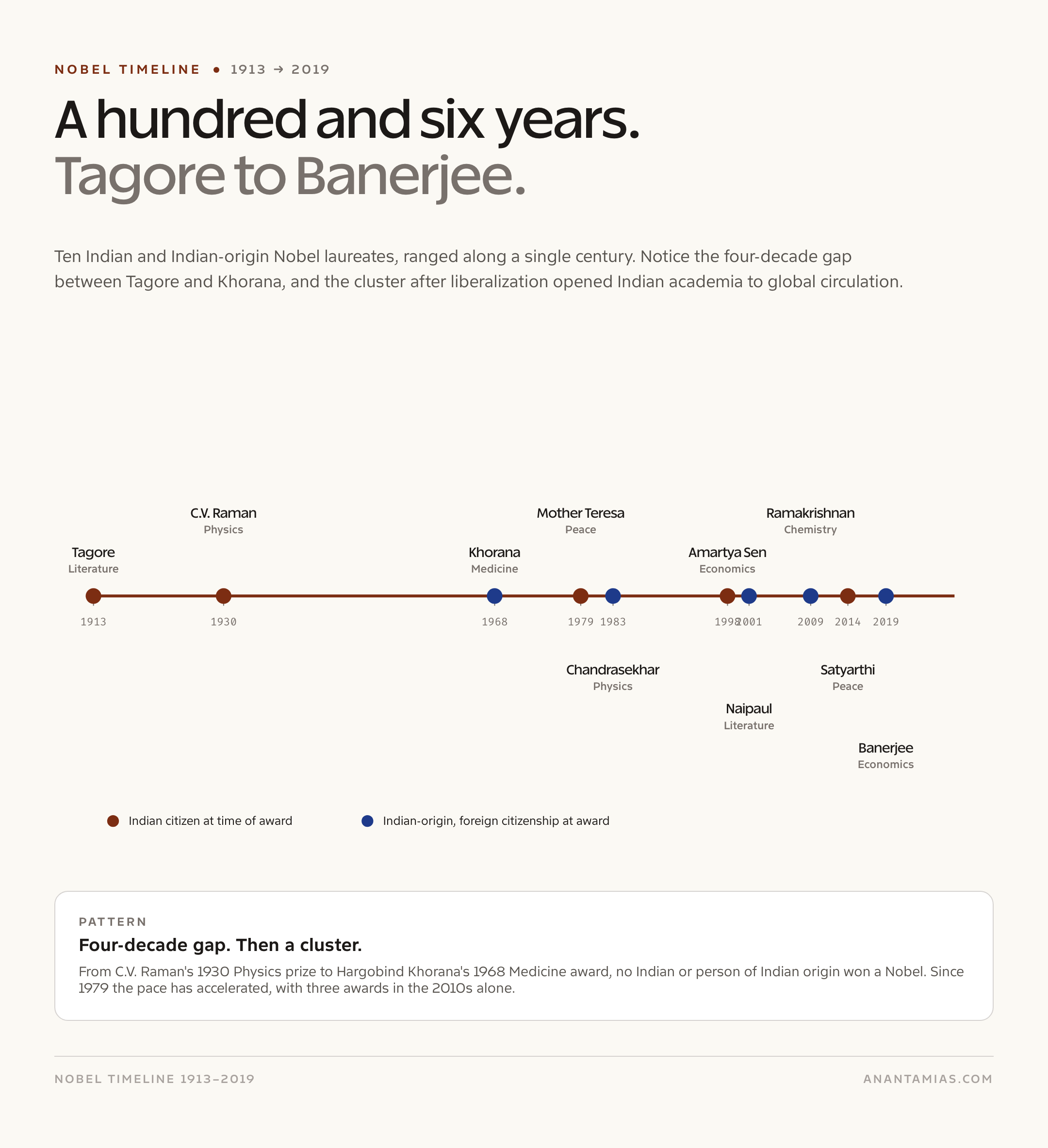
| # | Year | Laureate | Field | Citizenship at award |
|---|---|---|---|---|
| 1 | 1913 | Rabindranath Tagore | Literature | British India |
| 2 | 1930 | C.V. Raman | Physics | British India |
| 3 | 1968 | Hargobind Khorana | Medicine | United States |
| 4 | 1979 | Mother Teresa | Peace | India |
| 5 | 1983 | Subrahmanyan Chandrasekhar | Physics | United States |
| 6 | 1998 | Amartya Sen | Economics | India |
| 7 | 2001 | V.S. Naipaul | Literature | United Kingdom |
| 8 | 2009 | Venkatraman Ramakrishnan | Chemistry | US/UK |
| 9 | 2014 | Kailash Satyarthi | Peace | India |
| 10 | 2019 | Abhijit Banerjee | Economics | United States |
Detailed Profiles of Indian Nobel Prize Winners
Rabindranath Tagore (Literature, 1913)
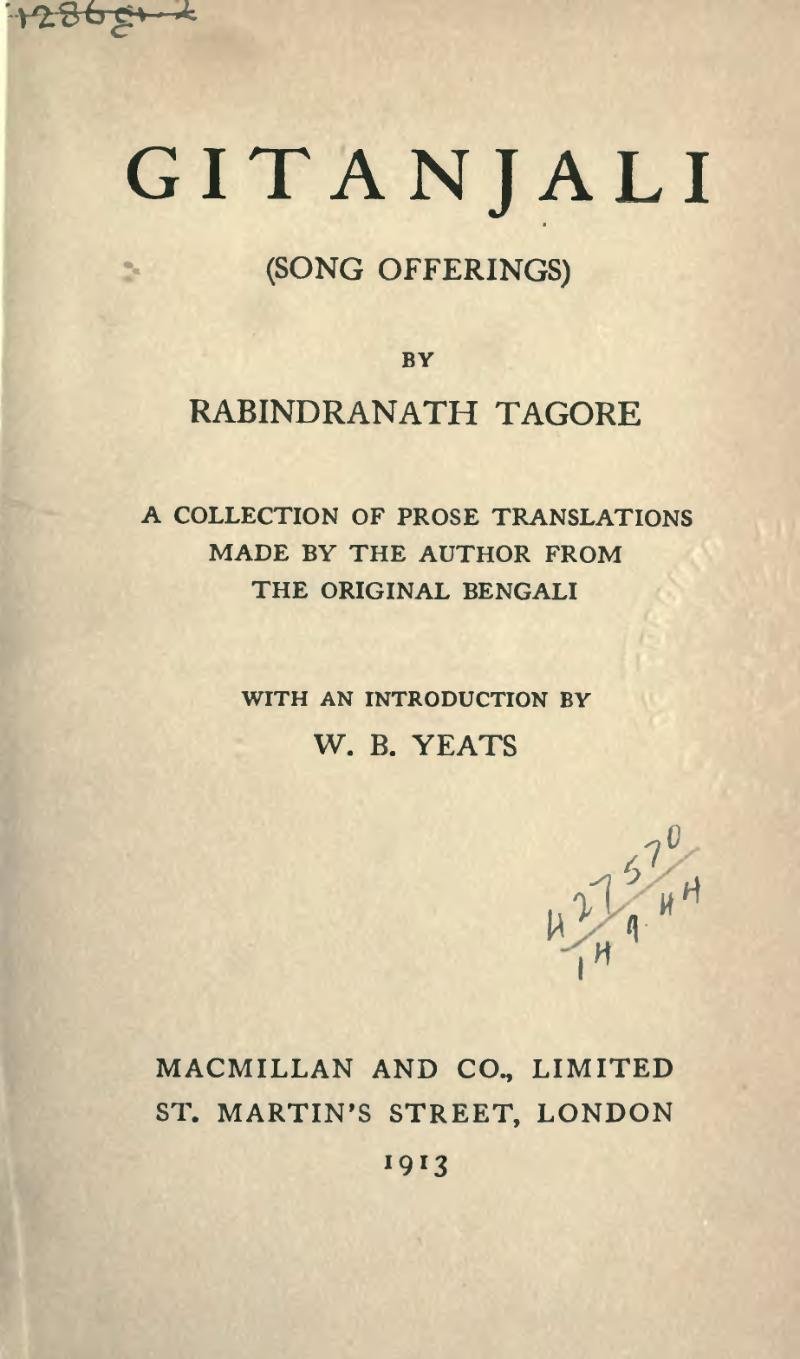
Born in Calcutta on May 7, 1861, Rabindranath Tagore became the first Asian and first non-European Nobel laureate. He was honoured “because of his profoundly sensitive, fresh and beautiful verse, by which, with consummate skill, he has made his thought, expressed in his own English words, a part of the literature of the West.” The work cited was Gitanjali (Song Offerings), self-translated into English with an introduction by W.B. Yeats. Tagore wrote India’s national anthem Jana Gana Mana, Bangladesh’s Amar Shonar Bangla, and influenced Sri Lanka’s anthem. He returned his British knighthood after the Jallianwala Bagh massacre of 1919. Founded Visva-Bharati at Santiniketan in 1921.
Sir C.V. Raman (Physics, 1930)
Chandrasekhara Venkata Raman, born November 7, 1888 at Tiruchirapalli, won “for his work on the scattering of light and for the discovery of the effect named after him.” The Raman Effect — that monochromatic light scattered by molecules picks up wavelength shifts characteristic of those molecules — was demonstrated on February 28, 1928, observed using sunlight, a prism, and his own eyes. February 28 is celebrated as National Science Day in India. Raman founded the Indian Academy of Sciences in 1934 and the Raman Research Institute in 1948. He was the first non-white Asian to win a Nobel in any science.
Hargobind Khorana (Medicine, 1968)
Born January 9, 1922 at Raipur (now Pakistan), Khorana shared the 1968 Physiology or Medicine prize with Robert W. Holley and Marshall W. Nirenberg “for their interpretation of the genetic code and its function in protein synthesis.” Khorana worked out which sequences of nucleotides in DNA code for which amino acids — finishing the genetic dictionary. He was an Indian-American at the time, having moved to the US in 1960 and joined MIT in 1970. He was the first to synthesize a functional gene from scratch in 1972.
Mother Teresa (Peace, 1979)
Anjezë Gonxhe Bojaxhiu was born in Skopje on August 26, 1910 and became an Indian citizen in 1948. She founded the Missionaries of Charity in 1950 in Calcutta. The 1979 Nobel Peace Prize honoured “her work undertaken in the struggle to overcome poverty and distress, which also constitutes a threat to peace.” She declined the conventional Nobel banquet, asking instead that the funds be redirected to the poor in India. She was canonized as Saint Teresa of Calcutta on September 4, 2016.
Subrahmanyan Chandrasekhar (Physics, 1983)
Born October 19, 1910 at Lahore, Chandrasekhar was C.V. Raman’s nephew. He shared the 1983 Physics Nobel with William Fowler “for his theoretical studies of the physical processes of importance to the structure and evolution of the stars.” The Chandrasekhar Limit (about 1.4 solar masses) — the maximum mass of a stable white dwarf — sets the boundary between stars that fade as white dwarfs and those that collapse into neutron stars or black holes. He developed the theory at age 19 on a steamship to England in 1930. NASA’s Chandra X-ray Observatory is named after him.
Amartya Sen (Economics, 1998)
Born November 3, 1933 at Santiniketan, Amartya Sen was awarded the 1998 Sveriges Riksbank Prize “for his contributions to welfare economics.” His work on social choice, famines (notably the 1943 Bengal famine), and capability approach reshaped development economics. The Human Development Index, designed with Mahbub ul Haq, draws on his capability framework. He was Master of Trinity College, Cambridge (1998-2004) and is currently Thomas W. Lamont University Professor at Harvard. He’s an Indian citizen and India’s only economics Nobel laureate who is an Indian national.
V.S. Naipaul (Literature, 2001)
Sir Vidiadhar Surajprasad Naipaul, born August 17, 1932 in Chaguanas, Trinidad, to Indian-origin parents, won the 2001 Literature Nobel “for having united perceptive narrative and incorruptible scrutiny in works that compel us to see the presence of suppressed histories.” His works on India — An Area of Darkness, India: A Wounded Civilization, India: A Million Mutinies Now — remain controversial classics. He was a British citizen at the time of the award.
Venkatraman Ramakrishnan (Chemistry, 2009)
Born April 1952 at Chidambaram, Tamil Nadu, Ramakrishnan shared the 2009 Chemistry Nobel with Thomas Steitz and Ada Yonath “for studies of the structure and function of the ribosome.” Their atomic-resolution maps of the ribosome — the cellular machine that translates genetic code into protein — explained how many antibiotics work. He served as President of the Royal Society from 2015 to 2020. He’s a US and UK citizen.
Kailash Satyarthi (Peace, 2014)
Born January 11, 1954 at Vidisha, Madhya Pradesh, Satyarthi shared the 2014 Peace Nobel with Pakistan’s Malala Yousafzai “for their struggle against the suppression of children and young people and for the right of all children to education.” He founded Bachpan Bachao Andolan in 1980, which has freed more than 90,000 children from bonded labour and trafficking. He led the Global March Against Child Labour 1998, contributing to ILO Convention 182.
Abhijit Banerjee (Economics, 2019)
Born February 21, 1961 at Mumbai, Banerjee shared the 2019 Economics Nobel with Esther Duflo and Michael Kremer “for their experimental approach to alleviating global poverty.” The trio pioneered randomized controlled trials in development economics. Banerjee co-founded the Abdul Latif Jameel Poverty Action Lab (J-PAL) at MIT in 2003. He was a US citizen at the time of the award. Duflo, his co-laureate and spouse, became the youngest woman to win the Economics Nobel.
Indians Nominated But Not Awarded
Mahatma Gandhi was nominated five times (1937, 1938, 1939, 1947, 1948) but never received the Peace Prize. The Norwegian Nobel Committee publicly regretted this gap in 2006. Other notable nominees include Jagadish Chandra Bose (Physics, multiple times), Meghnad Saha, Satyendra Nath Bose (after whom the boson is named), Homi Bhabha, and G.N. Ramachandran.
Comparative Field Distribution
Indian Nobel achievement skews toward humanities and social science. Literature, Peace, and Economics together account for 6 of the 10 awards. Science accounts for 4 — Physics (Raman, Chandrasekhar), Medicine (Khorana), and Chemistry (Ramakrishnan). Three of the four science laureates did their cited work abroad. Only C.V. Raman’s award honours research conducted on Indian soil.
This pattern raises uncomfortable questions for science policy: why does a country with so many world-class minds depend on foreign laboratories to win Nobel-class recognition? The answers involve research funding (India spends about 0.65% of GDP on R&D versus 2-3% in advanced economies), institutional rigidity, brain drain, and the slow translation of science into citation-worthy paradigm shifts.
Challenges and Significance
The Indian Nobel record is both inspiring and incomplete. Tagore’s prize gave India a voice in world letters at a time of colonial subjugation. Raman’s award proved Indian science could compete on first principles. Mother Teresa and Kailash Satyarthi turned grassroots service into globally legible work. Amartya Sen made famines and freedom inseparable from economics.
But the gaps are real. No Indian woman has won in any field. No Indian citizen has won a science Nobel since 1930. Theoretical breakthroughs by Bose, Bhabha, Saha, and Ramachandran went unrewarded by the Stockholm establishment. The challenge ahead is institutional: better laboratories, longer research cycles, deeper interdisciplinary work, and a science culture that rewards risk over rank.
Prelims Pointers
- Rabindranath Tagore was the first non-European Nobel laureate, 1913
- C.V. Raman’s Nobel year is 1930, awarded for the Raman Effect demonstrated February 28, 1928
- National Science Day in India is observed on February 28 to mark the Raman Effect
- Hargobind Khorana shared the 1968 Medicine Nobel with Holley and Nirenberg
- Mother Teresa won the 1979 Peace Nobel; founded Missionaries of Charity 1950
- Subrahmanyan Chandrasekhar was C.V. Raman’s nephew
- Amartya Sen is the only Indian citizen to win the Economics Nobel (1998)
- V.S. Naipaul (2001) and Tagore (1913) are the two Indian-origin Literature laureates
- Venkatraman Ramakrishnan worked on the ribosome
- Kailash Satyarthi shared the 2014 Peace Nobel with Malala Yousafzai
- Abhijit Banerjee shared the 2019 Economics Nobel with Esther Duflo and Michael Kremer
- The Economics Nobel was instituted in 1968 by Sveriges Riksbank
Mains Practice Questions
- Discuss the contribution of Indian Nobel laureates in science. Why has no Indian citizen won a science Nobel since C.V. Raman in 1930? (GS Paper 3, 15 marks)
- The capability approach pioneered by Amartya Sen transformed welfare economics. Examine its impact on the Human Development Index. (GS Paper 3, 10 marks)
- Evaluate the role of Mother Teresa and Kailash Satyarthi in advancing human rights in India. (GS Paper 1, 10 marks)
- Critically analyze the gap between India’s scientific potential and its Nobel record. Suggest reforms. (GS Paper 3, 15 marks)
Way Forward
India needs a Nobel pipeline, not just laureates. That means R&D spending closer to 2% of GDP, longer tenure-track positions, fewer administrative chokeholds on principal investigators, and genuine autonomy for institutions like IISc, TIFR, IUCAA, JNCASR, and the new IITs. Programs like the SERB-POWER for women scientists, the Vaibhav Fellowship to bring back the diaspora, and Anusandhan National Research Foundation (ANRF) launched in 2023 are steps. The next Indian Nobel may come from cleaner labs, deeper philanthropy, and a culture that lets researchers fail in interesting ways.
Frequently Asked Questions
Who was the first Indian Nobel Prize winner?
Rabindranath Tagore won the 1913 Nobel in Literature for Gitanjali. He was the first non-European Nobel laureate in any field.
Which Indian won the Nobel Prize in Physics?
C.V. Raman won the 1930 Physics Nobel for the Raman Effect. Subrahmanyan Chandrasekhar, an Indian-American, won the 1983 Physics Nobel for stellar structure work.
How many Indians have won the Nobel Prize?
Five Indian citizens have won at the time of award — Tagore, Raman, Mother Teresa, Amartya Sen, and Kailash Satyarthi. Including Indian-origin laureates with foreign citizenship, the count is ten.
Did Mahatma Gandhi win the Nobel Peace Prize?
No. Gandhi was nominated five times between 1937 and 1948 but never won. The Nobel Committee publicly acknowledged this omission as a major gap in 2006.
Who is the only Indian citizen to win the Economics Nobel?
Amartya Sen won the 1998 Sveriges Riksbank Prize in Economic Sciences. Abhijit Banerjee, who won in 2019, was a US citizen at the time of the award.
What did Hargobind Khorana win the Nobel for?
Hargobind Khorana shared the 1968 Medicine Nobel with Robert Holley and Marshall Nirenberg for interpreting the genetic code and how it functions in protein synthesis.
Was Mother Teresa Indian by birth?
No. She was born Anjezë Gonxhe Bojaxhiu in Skopje, then part of the Ottoman Empire, in 1910. She became an Indian citizen in 1948 and lived in Calcutta until her death in 1997.
Why is February 28 called National Science Day?
February 28 marks the date in 1928 when C.V. Raman first observed the Raman Effect in Calcutta. The Government of India declared it National Science Day in 1986.
Which Indian-origin scientist won the Chemistry Nobel?
Venkatraman Ramakrishnan, born in Chidambaram, Tamil Nadu, shared the 2009 Chemistry Nobel with Thomas Steitz and Ada Yonath for studies of the ribosome’s structure and function.
Has any Indian woman won a Nobel Prize?
Mother Teresa, who became an Indian citizen in 1948, won the 1979 Peace Prize and is the only woman associated with India to win a Nobel. No India-born woman has won as yet.