Indian Independence Movement: Timeline & Key Events
India’s independence movement stretched over 90 years — from the Revolt of 1857 to the final transfer of power on August 15, 1947. It moved through distinct phases, produced radically different strategies (petitions, mass movements, revolutionary violence, armed militancy), and involved millions of ordinary people alongside its famous leaders.
No other anti-colonial movement in the 20th century was as complex, as large, or as influential on subsequent independence movements worldwide.
For UPSC, this is one of the most important and frequently examined topics. You need to know the phases, the key events, the organisations, the landmark dates, and the personalities.
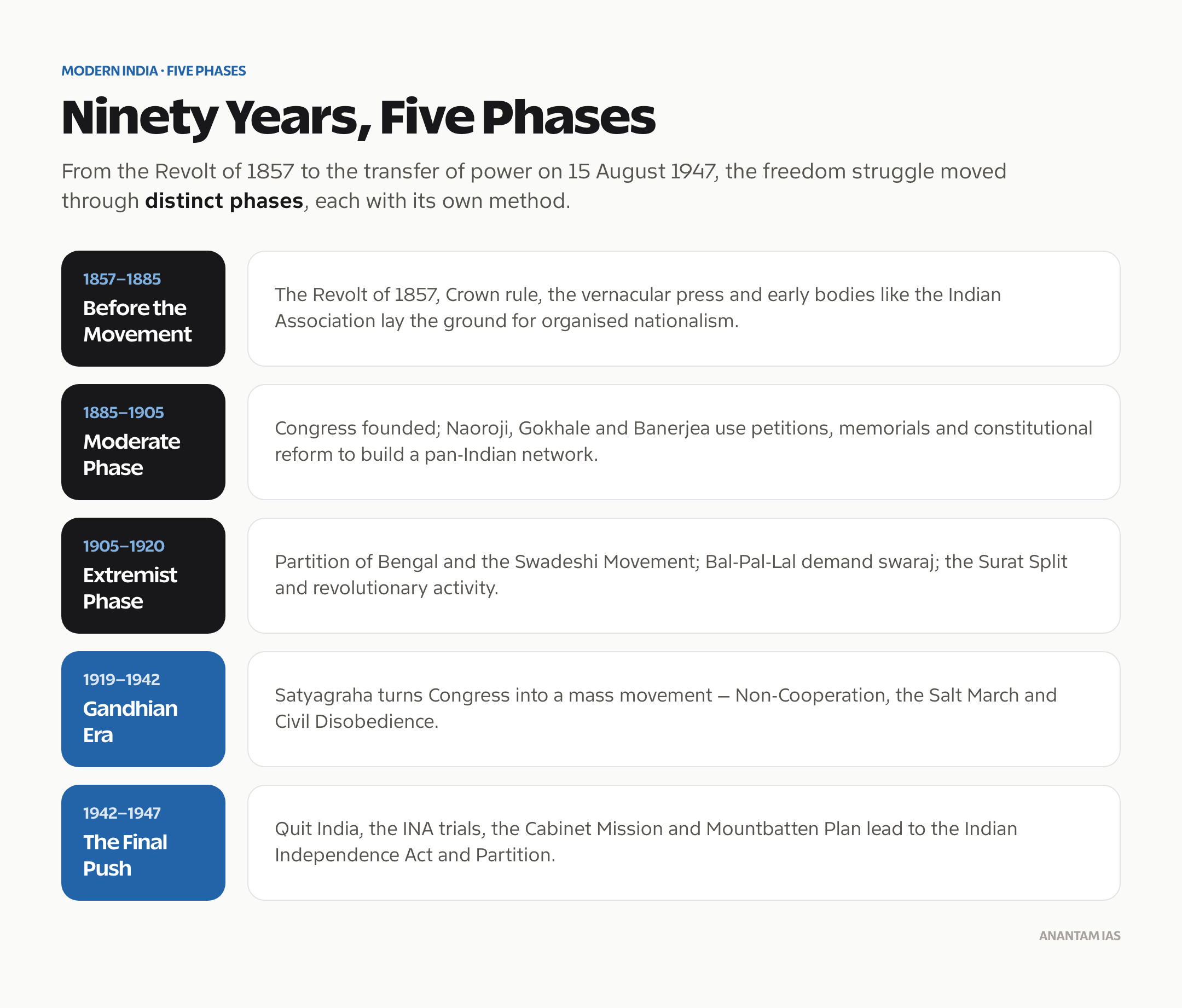
Phase 1: Before the Organised Movement (1857–1885)
The Revolt of 1857
The Revolt of 1857 is the starting point. It was not an organised independence movement in the modern sense — it had no common programme, no unified leadership, and no political organisation. But it was a mass uprising that demonstrated the potential for resistance to British rule.
Its consequences changed everything: the East India Company was abolished, the Crown took direct control, and Queen Victoria’s Proclamation promised a new kind of relationship with Indian subjects. The promise was partly kept, partly not — but British India after 1858 had to operate with the knowledge that consent mattered.
The Revolt also created martyrs: Rani Laxmibai, Tantia Tope, Kunwar Singh, Bahadur Shah Zafar. These figures became touchstones for the next generation of nationalists.
Precursors to Organised Nationalism
Between 1857 and 1885, several developments set the stage:
- Vernacular Press grew rapidly; papers like Amrit Bazar Patrika, Kesari, and Hindu carried nationalist sentiment
- Indian Association (1876) — founded by Surendranath Banerjea in Calcutta, a precursor to the Indian National Congress
- Ilbert Bill controversy (1883) — a proposal to allow Indian judges to try Europeans; the European community’s vehement racist opposition showed Indians what colonial equality actually meant
- Rise of social reform movements — Brahmo Samaj, Arya Samaj, Prarthana Samaj debated what Indian society should be, creating the educated class that would lead the national movement
Phase 2: The Moderate Phase (1885–1905)
Indian National Congress: Foundation
The Indian National Congress (INC) was founded on December 28, 1885 in Bombay. The founding session was attended by 72 delegates. Womesh Chandra Bonerjee was the first President.
The founding involved A.O. Hume, a retired British civil servant, which has led to debate about the Congress’s early character. Was it a “safety valve” designed to channel Indian discontent harmlessly, as some British officials hoped? Or a genuine nationalist platform? The answer is both — it began as a moderate political association and was transformed into a mass movement over decades.
Early INC leaders (Moderates):
- Dadabhai Naoroji — “Grand Old Man of India”; articulated the Drain of Wealth theory (India’s wealth was being siphoned to Britain); first Indian elected to the British Parliament (1892)
- Gopal Krishna Gokhale — Gandhi’s political mentor; believed in gradual constitutional reform through cooperation with British institutions
- Surendranath Banerjea — “Surrender Not Banerjea”; major Bengal Congress figure
- Pherozeshah Mehta — dominant Congress leader in Bombay
Moderate methods:
- Petitions, memorials, resolutions
- Sending representatives to England to lobby Parliament
- Newspapers and public meetings
- Focus on constitutional reforms — more Indians in the civil service, in legislative councils
The Moderates were mocked by later nationalists as too deferential to the British. But they did build an institutional base, articulate economic grievances clearly, and create a pan-Indian political network.
Key Moderate Achievements
- The Indian Councils Act of 1892 — expanded legislative councils and allowed some (very limited) Indian participation
- Articulation of the economic case against colonialism — the Drain theory
- Creation of a network of educated political actors across India
Phase 3: The Extremist Phase and Partition of Bengal (1905–1920)
Partition of Bengal (1905)
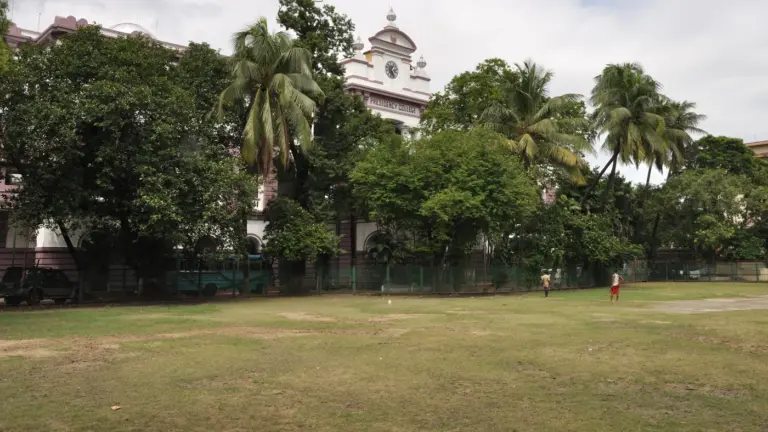
Lord Curzon partitioned Bengal in 1905 — dividing it into Bengal (East and Assam, with a Muslim majority) and Bengal (West, with a Hindu majority). The official rationale was administrative efficiency; the nationalist charge was deliberate divide-and-rule.
The Partition triggered the Swadeshi Movement — the most significant political mobilisation in India before Gandhi:
- Boycott of British goods, especially cloth
- Promotion of Indian goods (swadeshi — “of one’s own country”)
- Aggressive nationalism — public meetings, the use of Hindu religious symbols, and calls for swaraj
The Extremists: Bal-Pal-Lal
Three leaders dominated the Extremist faction:
- Bal Gangadhar Tilak — “Father of Indian Unrest” (per the British); based in Pune; published Kesari and Mahratta; revived Ganesh Chaturthi and Shivaji celebrations as political platforms; “Swaraj is my birthright and I shall have it”
- Bipin Chandra Pal — orator and writer from Bengal; advocated passive resistance and swaraj
- Lala Lajpat Rai — “Punjab Kesari”; the Lion of the Punjab; died of injuries from a police lathi charge during protests against the Simon Commission in 1928
Surat Split (1907)
At the Surat Congress (1907), the Congress split between the Moderates and Extremists. The specific dispute was over the election of Congress president and resolutions on the Swadeshi Movement. The Extremists (Tilak’s faction) were expelled — or walked out, depending on whose account you accept.
The split weakened Congress for several years. The Moderates retained control of the organisation but lost the energy that the Extremist wing had generated.
Revolutionary Terrorism
Parallel to the constitutional/agitational Extremists, a revolutionary strand emerged:
- Anushilan Samiti — Bengal revolutionary organisation; bomb-making, political assassinations
- Yugantar Patrika — radical Bengali newspaper
- Alipore Bomb Case (1908) — Khudiram Bose threw a bomb at the carriage of a British judge (missed; killed two others); was hanged at 18
- Muzaffarpur Conspiracy (1908) — connected to Tilak’s arrest and 6-year prison sentence
- India House in London — V.D. Savarkar’s revolutionary circle in London; Madan Lal Dhingra assassinated a British official (Curzon Wyllie) in 1909
- Ghadar Party (1913) — Indian workers in North America, especially Punjabis, formed the Ghadar Party to organise armed revolt; the 1915 conspiracy to spark a military mutiny failed
Lucknow Pact (1916)
The Lucknow Pact (1916) between the INC and the All India Muslim League (founded 1906) was significant. Congress and the Muslim League agreed to:
- Separate electorates for Muslims (Congress accepted the principle)
- A common constitutional demand for greater Indian self-government
This represented a moment of Hindu-Muslim political cooperation — short-lived, as subsequent events would show.
Tilak and Annie Besant led the Home Rule Leagues (1916) — demanding self-government (Home Rule) within the British Empire on the Irish model.
Phase 4: The Gandhian Era (1919–1947)
Gandhi’s Entry
Mohandas Karamchand Gandhi returned to India from South Africa in 1915, where he had developed satyagraha — truth-force or soul-force — as a method of non-violent resistance. He spent 1915–1917 learning Indian conditions, mentored by Gokhale.
His early Indian campaigns:
- Champaran Satyagraha (1917) — against forced indigo cultivation in Bihar; first use of satyagraha in India
- Kheda Satyagraha (1918) — for remission of land revenue during crop failure
- Ahmedabad Mill Strike (1918) — for better wages for mill workers; Gandhi’s first hunger strike
These campaigns established Gandhi’s method and reputation. When the Rowlatt Act and Jallianwala Bagh created a national crisis in 1919, Gandhi was positioned to lead.
Key Movements of the Gandhian Phase
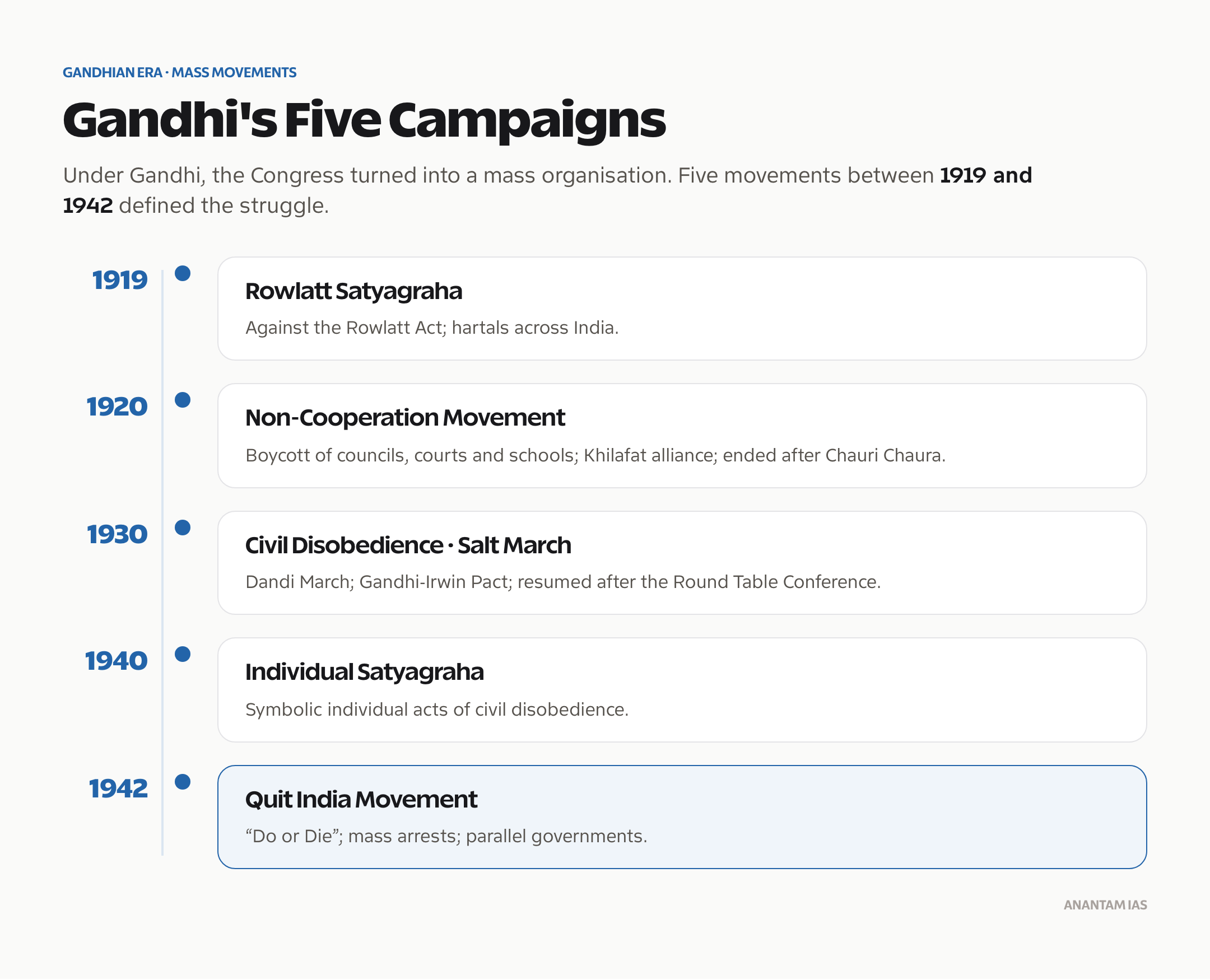
| Movement | Year | Key Feature |
|---|---|---|
| Rowlatt Satyagraha | 1919 | Against Rowlatt Act; hartals across India |
| Non-Cooperation Movement | 1920–1922 | Boycott of councils, courts, schools; Khilafat alliance; ended after Chauri Chaura |
| Civil Disobedience Movement (Salt Satyagraha) | 1930–1934 | Dandi March; Gandhi-Irwin Pact (1931); resumed 1932 |
| Individual Satyagraha | 1940–1941 | Symbolic individual acts of civil disobedience |
| Quit India Movement | 1942 | “Do or Die”; mass arrests; parallel governments |
The Salt March (1930)
The Dandi March (March 12 – April 6, 1930) was Gandhi’s 241-mile walk from Sabarmati Ashram to Dandi on the Gujarat coast, to make salt from sea water in defiance of the British salt monopoly.
The choice of salt was brilliant. Salt was consumed by every Indian regardless of class, religion, or region. The salt tax was visible, daily, and felt by the poorest. By breaking the salt law, Gandhi made law-breaking a patriotic act that any Indian could perform.
The Salt March galvanised the Civil Disobedience Movement. The world press covered it. Millions participated. The Gandhi-Irwin Pact (March 5, 1931) temporarily suspended the movement — Gandhi agreed to attend the Second Round Table Conference in London.
The Second Round Table Conference (September–December 1931) failed. Gandhi returned to India, was arrested, and the movement resumed but with less force.
Political Organisations
Indian National Congress: Founded 1885, transformed into a mass organisation under Gandhi in 1920. The dominant political organisation of the independence movement.
All India Muslim League: Founded in Dhaka in 1906 by Nawab Salimullah and others. Initially loyal to the British; became the main Muslim political organisation. Under Muhammad Ali Jinnah (who joined in 1913), it became the voice of Muslim separatism, eventually demanding Pakistan. The Lahore Resolution (March 23, 1940) formally demanded a separate Muslim state.
Forward Bloc (1939): Founded by Subhas Chandra Bose after his resignation as Congress President. Bose had won the Congress presidency in 1939, defeating Gandhi’s candidate Pattabhi Sitaramayya — a humiliation for Gandhi. Bose resigned when Gandhi’s supporters made the working committee unworkable. The Forward Bloc advocated more aggressive action against the British.
Bose and the INA: Bose escaped from house arrest in 1941, reached Germany, then Japan via submarine. He organised the Indian National Army (Azad Hind Fauj) from Indian prisoners of war captured by Japan in Southeast Asia. The INA fought alongside Japanese forces in the Imphal Campaign (1944) and briefly occupied parts of Manipur. Bose died in an air crash on August 18, 1945 — circumstances still debated.
Communist Party of India (CPI, 1920): Founded at Tashkent under M.N. Roy’s influence. Its relationship with the independence movement was complicated — it supported the British war effort after Germany invaded the Soviet Union (1941), opposing Quit India, which damaged its nationalist credentials.
Rashtriya Swayamsevak Sangh (RSS, 1925): Founded by K.B. Hedgewar; focused on Hindu nationalist social organisation rather than anti-colonial politics.
Scheduled Castes and B.R. Ambedkar: B.R. Ambedkar led the Dalit political movement, arguing that formal independence under Congress domination would not end caste oppression. His debate with Gandhi over separate electorates for “Untouchables” — resolved in the Poona Pact (1932), which gave reserved seats in general Hindu electorates instead — is one of the independence movement’s most important political confrontations.
Phase 5: The Final Push (1942–1947)
Post-War Political Situation
Japan’s defeat by 1945 changed India’s situation. The Labour Party won the British general election in July 1945, replacing Churchill. Labour was more sympathetic to Indian independence than the Conservatives.
The INA Trials (1945) — where officers of Bose’s INA were tried for treason — backfired. Nehru defended them in court. The Royal Indian Navy Mutiny (February 1946) showed British military planners that Indian soldiers could not be relied upon to maintain colonial order.
Constitutional Negotiations
Cabinet Mission (1946): The British sent a Cabinet-level delegation (Cripps, Pethick-Lawrence, A.V. Alexander) with a plan to keep India united as a loose federation. Congress accepted with conditions; the Muslim League accepted then rejected. The plan collapsed.
Direct Action Day (August 16, 1946): Jinnah called for “Direct Action” to press the Pakistan demand. Massive communal riots in Calcutta killed thousands — “The Great Calcutta Killings.” This set off a chain of communal violence across India.
Mountbatten Plan (June 3, 1947): The last Viceroy, Lord Louis Mountbatten, proposed the Partition Plan — India and Pakistan would become independent Dominions on the same date. Both Congress (reluctantly) and the Muslim League accepted.
The Indian Independence Act was passed by the British Parliament in July 1947. August 15, 1947 was set as Independence Day — Nehru’s “Tryst with Destiny” speech addressed the Constituent Assembly in New Delhi at midnight.
Partition’s cost: Independence came with the partition of India and Pakistan — the largest forced migration in history, with 10–20 million people displaced and an estimated 200,000–2 million deaths in communal violence.
Key Dates: Complete Timeline
| Year | Event |
|---|---|
| 1857 | Revolt of 1857; East India Company abolished |
| 1858 | Government of India Act; direct Crown rule; Queen’s Proclamation |
| 1876 | Indian Association founded (Surendranath Banerjea) |
| 1885 | Indian National Congress founded (Bombay) |
| 1892 | Indian Councils Act |
| 1905 | Partition of Bengal; Swadeshi Movement begins |
| 1906 | Muslim League founded (Dhaka) |
| 1907 | Surat Split; Extremists expelled from Congress |
| 1908 | Tilak’s 6-year sentence; Khudiram Bose hanged |
| 1909 | Morley-Minto Reforms (Indian Councils Act 1909) |
| 1913 | Ghadar Party founded |
| 1916 | Lucknow Pact; Home Rule Leagues |
| 1919 | Rowlatt Act; Jallianwala Bagh; Government of India Act (Montagu-Chelmsford) |
| 1920 | Non-Cooperation Movement begins; Nagpur Congress |
| 1922 | Chauri Chaura; movement suspended; Gandhi arrested |
| 1923 | Swarajists contest elections |
| 1928 | Simon Commission boycott; Lala Lajpat Rai dies |
| 1929 | Lahore Congress: Poorna Swaraj resolution; Congress declares January 26 Independence Day |
| 1930 | Dandi March; Civil Disobedience Movement |
| 1931 | Gandhi-Irwin Pact; Second Round Table Conference |
| 1935 | Government of India Act 1935 |
| 1937 | Provincial elections; Congress forms ministries in 7 provinces |
| 1939 | Congress ministries resign; Forward Bloc founded |
| 1940 | Lahore Resolution (Pakistan demand); Individual Satyagraha |
| 1942 | Cripps Mission fails; Quit India Movement |
| 1943 | Bengal Famine; Subhas Bose forms Azad Hind Government |
| 1945 | INA Trials; Labour government in UK |
| 1946 | Cabinet Mission; Direct Action Day; Constituent Assembly begins |
| 1947 | Mountbatten Plan (June 3); Indian Independence Act; August 15 Independence |
Frequently Asked Questions
What were the three phases of the Indian independence movement?
Historians typically identify three main phases: (1) The Moderate Phase (1885–1905) — petitions, constitutional demands, press campaigns led by Dadabhai Naoroji, Gokhale; (2) The Extremist Phase (1905–1920) — Bal-Pal-Lal, Swadeshi Movement, revolutionary terrorism, mass agitation; and (3) The Gandhian Phase (1919–1947) — non-violent mass movements (Non-Cooperation, Civil Disobedience, Quit India), with Congress as a mass organisation.
When was the Indian National Congress founded and who founded it?
The Indian National Congress was founded on December 28, 1885 in Bombay. The founding involved A.O. Hume (a retired British civil servant), Dadabhai Naoroji, Dinshaw Wacha, and others. Womesh Chandra Bonerjee was the first President. The founding session had 72 delegates.
What was the Lahore Resolution of 1940?
The Lahore Resolution (March 23, 1940) was passed by the All India Muslim League under Muhammad Ali Jinnah’s leadership. It formally demanded a separate independent state for Muslims in the northwestern and northeastern zones of India. This resolution is the founding document of the Pakistan demand, and March 23 is celebrated as Pakistan Day.
What was Subhas Chandra Bose’s contribution to the independence movement?
Subhas Chandra Bose founded the Forward Bloc (1939) within Congress, then escaped India (1941) to build support from Germany and Japan. He organised the Indian National Army (INA/Azad Hind Fauj) from Indian prisoners of war in Southeast Asia. The INA fought in the Imphal Campaign (1944) and briefly raised the Indian flag in Manipur. His post-war INA trials (1945) galvanised Indian opinion. He died in August 1945 in an air crash in Taiwan.
Why was the partition of India in 1947 unavoidable by that point?
By 1946–47, partition had become very difficult to avoid because: the Muslim League under Jinnah had won the 1946 elections decisively among Muslim constituencies and had a democratic mandate for Pakistan; Direct Action Day (August 1946) and subsequent communal violence had poisoned Hindu-Muslim relations irreparably; Congress leaders, especially Patel, had concluded that a united India with a hostile Muslim League was less workable than a smaller but cohesive independent state; and the British, exhausted and eager to leave, gave a fixed deadline that forced a decision.
Tell Google you want more of this.
Add Anantam IAS as a preferred sourceOne tap, and this site shows up more often in your own Top Stories, AI Overviews and AI Mode. Remove it any time.