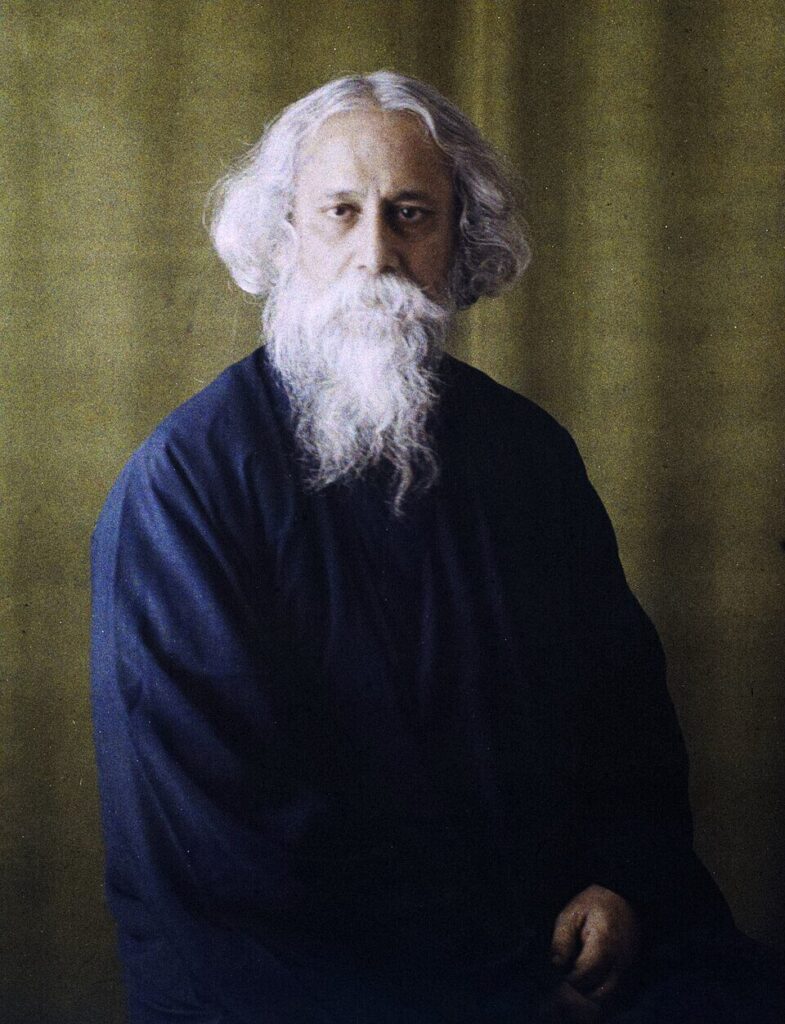
Tagore’s philosophy is the most cosmopolitan voice modern India has produced, and the perfect counterweight to read alongside Gandhian thought in any UPSC ethics or modern history paper. Rabindranath Tagore (1861–1941) wrote, painted, composed music, founded a university, and argued in print with Gandhi, Einstein, Romain Rolland, and Bertrand Russell — yet the core of Tagore’s philosophy can be stated simply. The human being realises itself only by uniting with others, with nature, and with the infinite (Brahman). Anything that divides — narrow nationalism, mechanical industry, ritual exclusion, coerced ideology — is an enemy of that realisation. Universalism is therefore not a polite cosmopolitan preference for Tagore; it is the metaphysical condition for being human.
Tagore became the first non-European to win the Nobel Prize in Literature in 1913 for Gitanjali, but his significance for an Indian aspirant lies in the philosophical writings — Sadhana (1913), Nationalism (1917), Personality (1917), The Religion of Man (1931), and the searing late essay Crisis in Civilization (1941) — and in the institution he built at Santiniketan, which became Visva-Bharati in 1921.
The metaphysical core: Brahman, joy, and self-realisation
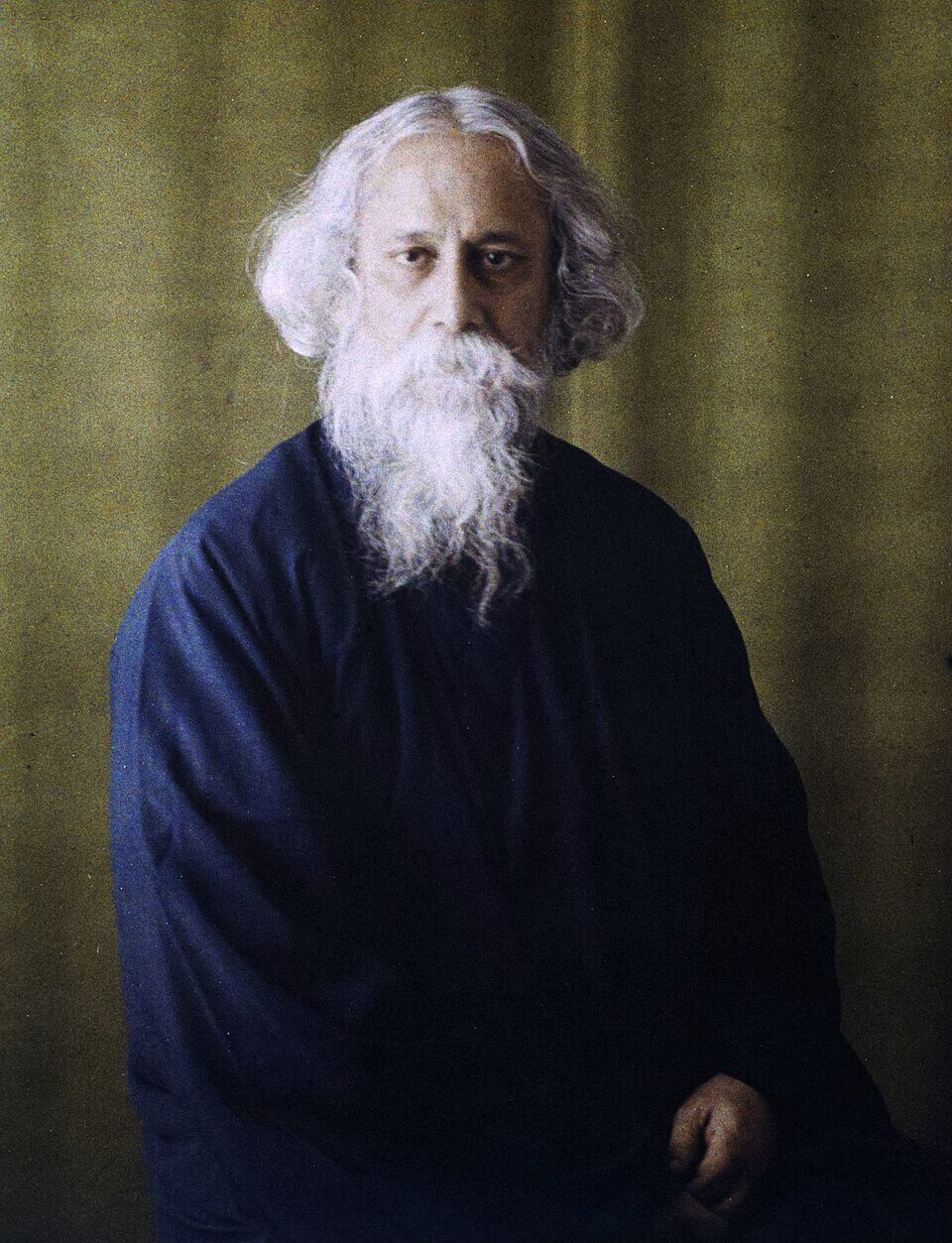
Tagore inherits the Upanishadic idea of Brahman — the one infinite reality of which all finite beings are expressions. But he reads it through the ananda (joy, bliss) tradition rather than the austere monism of Shankara. For Tagore, creation is not illusion (maya); it is the overflow of divine joy. The self does not seek to annihilate itself in the absolute. It seeks to realise itself by widening its sympathies until it embraces all life.
The eight lectures collected as Sadhana (delivered at Harvard in 1913) set out this vision: the relation of the individual to the universe, soul consciousness, evil, self-realisation, love, action, beauty, and the infinite. Each lecture argues that finite life finds its meaning by participating in something larger than itself — and that the path is not renunciation but joyful, disciplined engagement.
Why joy is a philosophical category
Where many philosophical systems begin with suffering or duty, Tagore’s philosophy begins with delight. Ananda is the aesthetic name for the unity that the metaphysician calls Brahman and the moralist calls love. A society that has killed joy — by industrial monotony, by sectarian fear, by exam-driven schooling — has cut itself off from the source. This claim sounds soft, but Tagore deploys it with razor sharpness against modern civilisation.
Universalism versus nationalism
Tagore’s philosophy reaches its sharpest political edge in Nationalism (1917), three lectures delivered in Japan and the United States during the First World War. He distinguishes the nation from the society: a society is organic, ethical, slow-growing; a nation in the modern sense is a mechanical, commercial, militarised organisation of human beings for power. Western nationalism, he argued, had turned Europe into “a perpetual menace to the peace of the world.”
He warned an aspirant India against importing this disease. India’s vocation, he believed, was not to build another European-style nation-state, but to recover the older civilisational ideal of unity-in-diversity. He returned the knighthood awarded by the British in 1919 after Jallianwala Bagh — but he did so as a universalist humanist, not as a nationalist.
The Tagore-Gandhi debates
The most fertile philosophical debate in modern India ran between Tagore and Gandhi, who deeply respected each other (it was Tagore who first popularised the title Mahatma for Gandhi; Gandhi called Tagore Gurudev). They disagreed on three big questions.
First, on the charkha. Gandhi made spinning a moral duty; Tagore feared the wheel had become a fetish that confused the symbol of self-reliance with self-reliance itself. He worried that asking every poet, scientist, and philosopher to spin daily was a regimentation of the spirit.
Second, on the burning of foreign cloth. Tagore wrote in 1921 that burning clothes that could clothe naked Indians was a moral and aesthetic offence. Gandhi replied that the deeper offence was depending on Manchester for one’s dignity.
Third, on non-cooperation and education. Tagore feared the non-cooperation movement’s call to abandon schools and colleges would close the windows of the Indian mind. Gandhi argued that education under colonial rule was already a closed system.
The debate is not resolved by choosing a side. Tagore’s philosophy and Gandhian philosophy function as creative correctives to each other — Gandhi pulled India toward the village, Tagore toward the world. Both belonged to India.
Education: Santiniketan and Visva-Bharati
If Tagore’s philosophy has a workshop, it is the school he founded at Santiniketan in 1901 — initially a small ashram-style school with five students under the open sky. Tagore had been miserable in his own conventional schools. He wanted children to learn the way the Upanishadic gurukulas had taught: outdoors, in close relation with nature, with art and music and poetry not as ornaments but as core disciplines.
In 1921 Santiniketan grew into Visva-Bharati (“where the world meets in one nest”), an international university with the motto Yatra Visvam Bhavatyekanidam. The curriculum brought Indian classical arts, Chinese and Japanese studies, Persian, Russian, and Western literature into a single conversation. Visva-Bharati was Tagore’s universalism in brick and brick-dust.
The aesthetic of joy in pedagogy
Tagore’s pedagogical philosophy rests on three pillars: freedom (children must not be regimented), creative expression (art, music, dance, drama as primary, not optional), and communion with nature. The National Education Policy 2020 echoes Tagorean themes — experiential learning, arts integration, multilingualism — even when it does not name him.
The Religion of Man
In The Religion of Man (1930 Hibbert Lectures), Tagore offers his most mature philosophical statement. Religion is not the doctrines of any particular tradition; it is the human being’s attempt to relate the finite self to the infinite reality through love, art, and ethical action. The “Man the Eternal” appears wherever a human being transcends private interest and acts from the larger self.
Tagore’s famous 1930 dialogue with Einstein turns on this point. Einstein argued that truth is independent of human consciousness; Tagore argued that truth as we know it is always relational — there is no human-independent truth that humans can talk about. The disagreement remains a useful classroom seminar on epistemology and the philosophy of science.
Crisis in Civilization (1941)
Tagore’s last public address, delivered on his eightieth birthday weeks before his death, is a heartbreak in essay form. He had spent his life believing in the moral promise of Western civilisation — its science, its parliaments, its universities. The Second World War, the colonial brutalities he had documented in his Asian tours, and the indifference of the West to suffering elsewhere shattered the faith. “I had at one time believed that the springs of civilization would issue out of the heart of Europe… But today when I am about to quit the world, that faith has gone bankrupt altogether.”
Yet the essay does not end in despair. He places his final hope in “Man the Eternal” — in the moral capacity of humanity itself, which would survive the wreckage of any particular civilisation. Read alongside Ambedkar’s philosophy, Savarkar’s Hindutva philosophy, and Gandhian thought, Crisis in Civilization sets the terms for India’s republican self-questioning.
Tagore on women, caste and reform
Tagore was a steady, if sometimes cautious, social reformer. His novels — Ghare Baire (The Home and the World), Gora, Chaturanga — interrogate the position of women, caste pride, and religious sectarianism with a sympathy that anticipates twentieth-century feminist and anti-caste criticism. Bimala in Ghare Baire is one of the first fully realised modern women in any Indian novel; she steps out of the antahpur and discovers that the public world is morally more complicated than the home. Tagore did not write tracts; he wrote stories that made readers rethink. His support for the long Hindu Code Bill project, posthumous as it was, sat in the same reformist tradition.
Comparing Tagore with other ethical traditions
Tagore’s philosophy of joy and self-realisation differs sharply from Kantian deontology, which grounds morality in duty and rational autonomy. It also differs from Benthamite utilitarianism, which calculates pleasure and pain. Tagore would call both reductive: duty without delight produces grim moralism, and the pleasure calculus mistakes a part for the whole. He stands closer in spirit to Rawls’s theory of justice in its insistence on each person as an end, but Tagore’s idiom is aesthetic and metaphysical, not contractarian.
Contemporary relevance for UPSC
Tagore’s philosophy is directly useful in GS-IV ethics (foundational values, attitude, emotional intelligence), GS-I (social empowerment, women, cultural revivalism), and the essay paper (universalism vs nationalism, the place of arts in education, climate ethics rooted in prakriti). Whenever the Indian state debates whether English-medium or mother-tongue instruction serves the child, whether nationalism is the highest virtue, or whether art belongs in a STEM curriculum — Tagore’s philosophy is the document still being argued with. Sucheta Kripalani and the women leaders of the Constituent Assembly drew on his cosmopolitan humanism without always citing it.
Frequently Asked Questions
What is the core idea of Tagore’s philosophy?
The human being realises itself by uniting with others, with nature, and with the infinite (Brahman) through love, art, and ethical action. Joy (ananda) is the philosophical signature of that union, and universalism is its political consequence.
What is the difference between nation and society in Tagore’s Nationalism?
Society is organic, ethical, and slow-growing; a nation in the modern Western sense is a mechanical, commercial, and militarised organisation of human beings for power. Tagore warned India against importing the nation-state model that had militarised Europe.
What is Visva-Bharati and why did Tagore found it?
Visva-Bharati, established 1921 at Santiniketan, is the international university Tagore built to express his philosophy of universalism. Its motto Yatra Visvam Bhavatyekanidam — “where the world meets in one nest” — brought Indian, Asian, and Western traditions into one curriculum.
What were the main disagreements between Tagore and Gandhi?
They disagreed on three issues: the moral status of the charkha (Tagore feared it became a fetish), the burning of foreign cloth (Tagore called it wasteful), and the non-cooperation movement’s call to abandon schools (Tagore feared closing the Indian mind). They remained warm friends throughout.
What are the Sadhana lectures?
Eight lectures Tagore delivered at Harvard in 1913, later published as Sadhana: The Realisation of Life. They explore the relation of the individual to the universe, soul consciousness, the problem of evil, self-realisation, love, action, beauty, and the infinite.
What is the message of Crisis in Civilization?
Tagore’s last public address (1941) records his disillusionment with Western civilisation’s moral collapse during the Second World War and the colonial period, but ends by placing hope in “Man the Eternal” — humanity’s enduring moral capacity beyond any particular civilisation.
Why did Tagore return his knighthood?
He renounced the knighthood awarded by the British Crown after the Jallianwala Bagh massacre of April 1919, in a public letter to the Viceroy. He acted as a universalist humanist outraged by colonial violence, not as a narrow nationalist.
How is Tagore relevant for UPSC ethics today?
Tagore’s emphasis on universalism, the aesthetic of joy, education through freedom and nature, and the moral hazards of narrow nationalism speak directly to GS-IV foundational values, NEP 2020 themes, climate ethics, and constitutional morality.
Tell Google you want more of this.
Add Anantam IAS as a preferred sourceOne tap, and this site shows up more often in your own Top Stories, AI Overviews and AI Mode. Remove it any time.