Indian Parliament: Structure, Functions & Sessions
Complete guide to Indian Parliament — Lok Sabha, Rajya Sabha, parliamentary sessions, functions, legislative process, and UPSC notes on India's legislature.
Indian Parliament: Structure, Functions & Sessions
The Parliament of India is the supreme legislative body of the country, comprising the President and two Houses — Rajya Sabha (Council of States) and Lok Sabha (House of the People). Under Articles 79–122 in Part V of the Constitution, Parliament makes laws, controls the executive, approves the budget, and serves as the forum for national debate. It sits at the heart of India’s parliamentary democracy and is one of the most heavily tested UPSC Polity topics.
Structure of Indian Parliament
Article 79 establishes Parliament as consisting of three components: the President of India, the Rajya Sabha, and the Lok Sabha. The President isn’t a member of either House but is an integral part of Parliament. No bill can become law without Presidential assent.
Rajya Sabha (Council of States)
The Rajya Sabha represents the states and union territories of India. It’s the upper house with a maximum strength of 250 members.
Composition:
- 238 members elected by state and UT legislatures through proportional representation with single transferable vote
- 12 members nominated by the President for expertise in literature, science, art, and social service
- Current effective strength: 245
Key Features:
- Not subject to dissolution — it’s a permanent body
- One-third of members retire every two years
- Each member serves a six-year term
- Vice President of India is the ex-officio Chairman
- Deputy Chairman is elected from among its members
- Minimum age for membership: 30 years
The Rajya Sabha’s composition reflects the federal principle — states with larger populations get more seats. Uttar Pradesh has the highest representation (31 seats), while smaller states like Goa, Manipur, and Tripura have 1 seat each.
Lok Sabha (House of the People)
The Lok Sabha is the lower but more powerful house, directly elected by the people.
Composition:
- Maximum strength: 552 (530 from states + 20 from UTs + 2 Anglo-Indians nominated by President)
- After the 104th Amendment, Anglo-Indian nomination provision was not extended beyond January 2020
- Current effective strength: 543 (530 from states + 13 from UTs)
- Members elected through universal adult suffrage by first-past-the-post system
Key Features:
- Normal term: 5 years from date of first meeting
- Can be dissolved earlier by the President on advice of the Council of Ministers
- Can be extended by one year at a time during a national emergency (Article 352)
- Speaker presides over sessions; elected from among members
- Minimum age for membership: 25 years
Comparison: Lok Sabha vs Rajya Sabha
| Feature | Lok Sabha | Rajya Sabha |
|---|---|---|
| Nature | Lower House / Popular Chamber | Upper House / House of Elders |
| Maximum Strength | 552 | 250 |
| Election Method | Direct election by people | Indirect election by state legislatures |
| Term | 5 years (subject to dissolution) | Permanent body; members serve 6 years |
| Minimum Age | 25 years | 30 years |
| Presiding Officer | Speaker | Vice President (Chairman) |
| Money Bills | Can only be introduced here | Can only suggest amendments (14 days) |
| No-Confidence Motion | Only in Lok Sabha | Cannot be moved |
| Dissolution | Can be dissolved | Cannot be dissolved |
Parliamentary Sessions
The Constitution doesn’t fix the number of sessions per year but mandates under Article 85 that the gap between two sessions shall not exceed six months. In practice, Parliament meets for three sessions.
Budget Session (February–May)
The longest session. The Union Budget is presented (usually on 1 February). The session typically has a recess between budget presentation and discussion of Demands for Grants. Key activities include the General Budget discussion, Departmental Standing Committee reviews, Finance Bill passage, and Appropriation Bill passage.
Monsoon Session (July–August)
Typically lasts 3–4 weeks. Focuses on legislative business and discussions on national issues. This session often sees intense debates and disruptions on current political issues.
Winter Session (November–December)
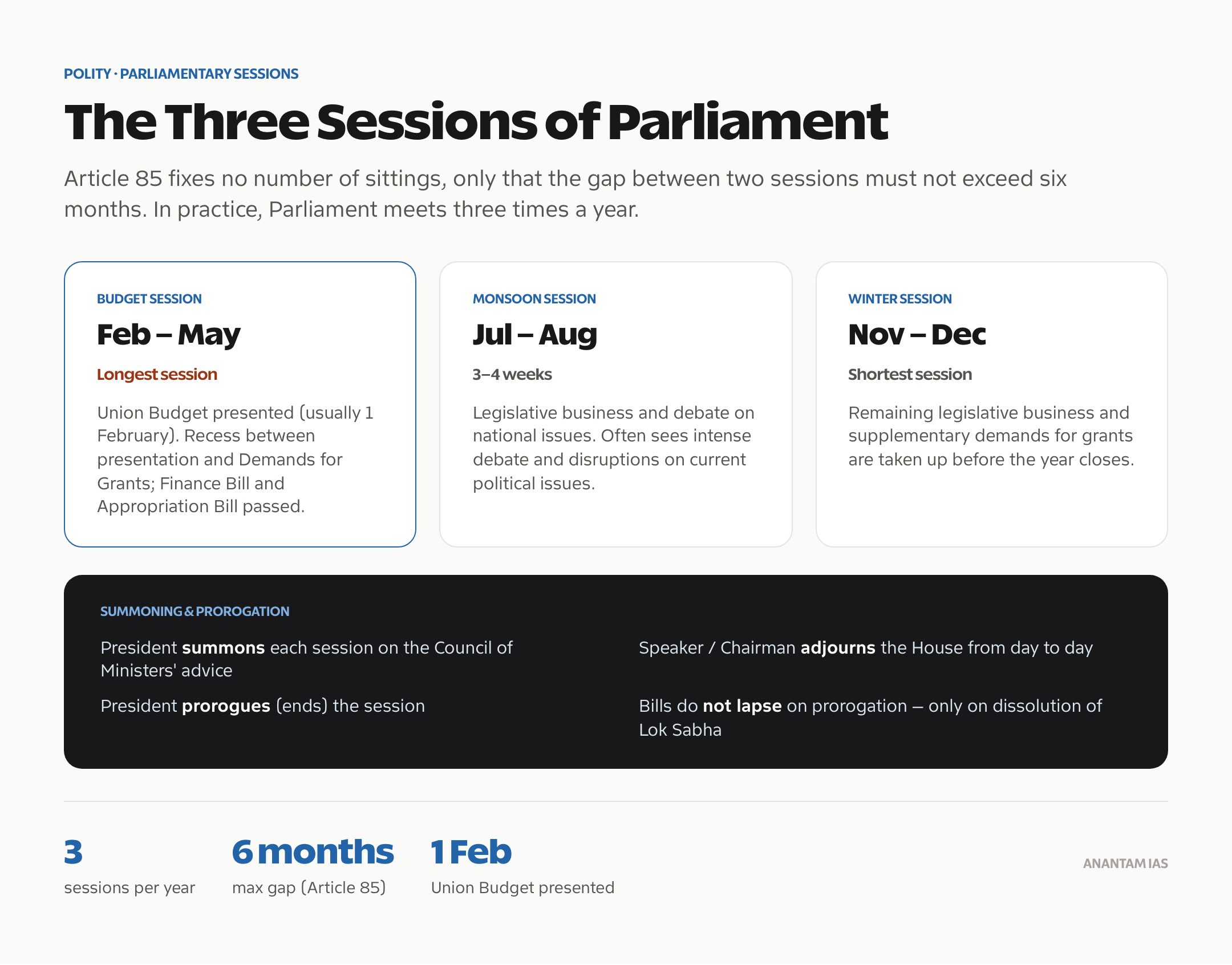
Usually the shortest session. Remaining legislative business and supplementary demands for grants are taken up.
Session Summoning and Prorogation
- The President summons each session on the advice of the Council of Ministers
- The Speaker (Lok Sabha) or Chairman (Rajya Sabha) adjourns the House from day to day
- The President prorogues the session (ends it)
- All pending notices, motions, and resolutions lapse on prorogation (except bills)
- Bills pending in Parliament don’t lapse on prorogation — they lapse on dissolution of Lok Sabha
Functions of Parliament
Legislative Function
Parliament makes laws on subjects in the Union List (97 subjects) and Concurrent List (52 subjects). In certain circumstances, it can also legislate on State List subjects:
- When Rajya Sabha passes a resolution under Article 249 by two-thirds majority
- During a national emergency (Article 250)
- When two or more states request Parliament to legislate (Article 252)
- For implementing international treaties (Article 253)
- During President’s Rule in a state (Article 356)
Financial Function (Power of the Purse)
No tax can be levied or collected without the authority of law. No expenditure can be incurred from the Consolidated Fund of India except with Parliament’s approval. Key financial instruments include:
- Annual Financial Statement (Budget): Article 112 requires the President to lay before Parliament a statement of estimated receipts and expenditure
- Demands for Grants: Presented to Lok Sabha after general discussion
- Appropriation Bill: Authorises withdrawal from the Consolidated Fund
- Finance Bill: Contains taxation proposals
- Supplementary/Excess/Vote on Account: Additional financial mechanisms
Executive Accountability
Parliament holds the executive accountable through:
Question Hour: The first hour of every parliamentary sitting. Three types of questions:
- Starred Questions (oral answers, supplementary questions allowed)
- Unstarred Questions (written answers only)
- Short Notice Questions (less than 10 days’ notice, on urgent matters)
Zero Hour: Begins immediately after Question Hour. Members raise urgent matters without prior notice. Not mentioned in Rules of Procedure — it’s a parliamentary convention since 1962.
Motions:
- No-Confidence Motion (Article 75): Only in Lok Sabha. If passed, the government must resign
- Censure Motion: Against the government or individual ministers
- Adjournment Motion: To discuss a definite matter of urgent public importance
- Calling Attention Motion: To draw a minister’s attention to an urgent matter
- Short Duration Discussion: Discussion of urgent importance (not exceeding 2.5 hours)
Constituent Function
Parliament can amend the Constitution under Article 368. Most amendments require a special majority — a majority of total membership and two-thirds of members present and voting in each House.
Electoral Function
Parliament participates in electing the President and Vice President and can impeach the President or remove judges of the Supreme Court and High Courts.
Judicial Function
Parliament can:
- Impeach the President (Article 61)
- Remove Vice President
- Remove judges of Supreme Court and High Courts
- Punish members or outsiders for breach of privilege or contempt
The Legislative Process
Ordinary Bills
- Introduction (First Reading): Bill introduced in either House. Leave is granted, bill is published in the Gazette
- Committee Stage: Bill referred to a Standing Committee or Select Committee for detailed examination
- Second Reading: Clause-by-clause discussion and voting on amendments
- Third Reading: Debate confined to acceptance or rejection. Bill passed by simple majority
- Transmission to Other House: Same process in the second House
- Presidential Assent: President may assent, withhold assent, or return the bill (except Money Bills)
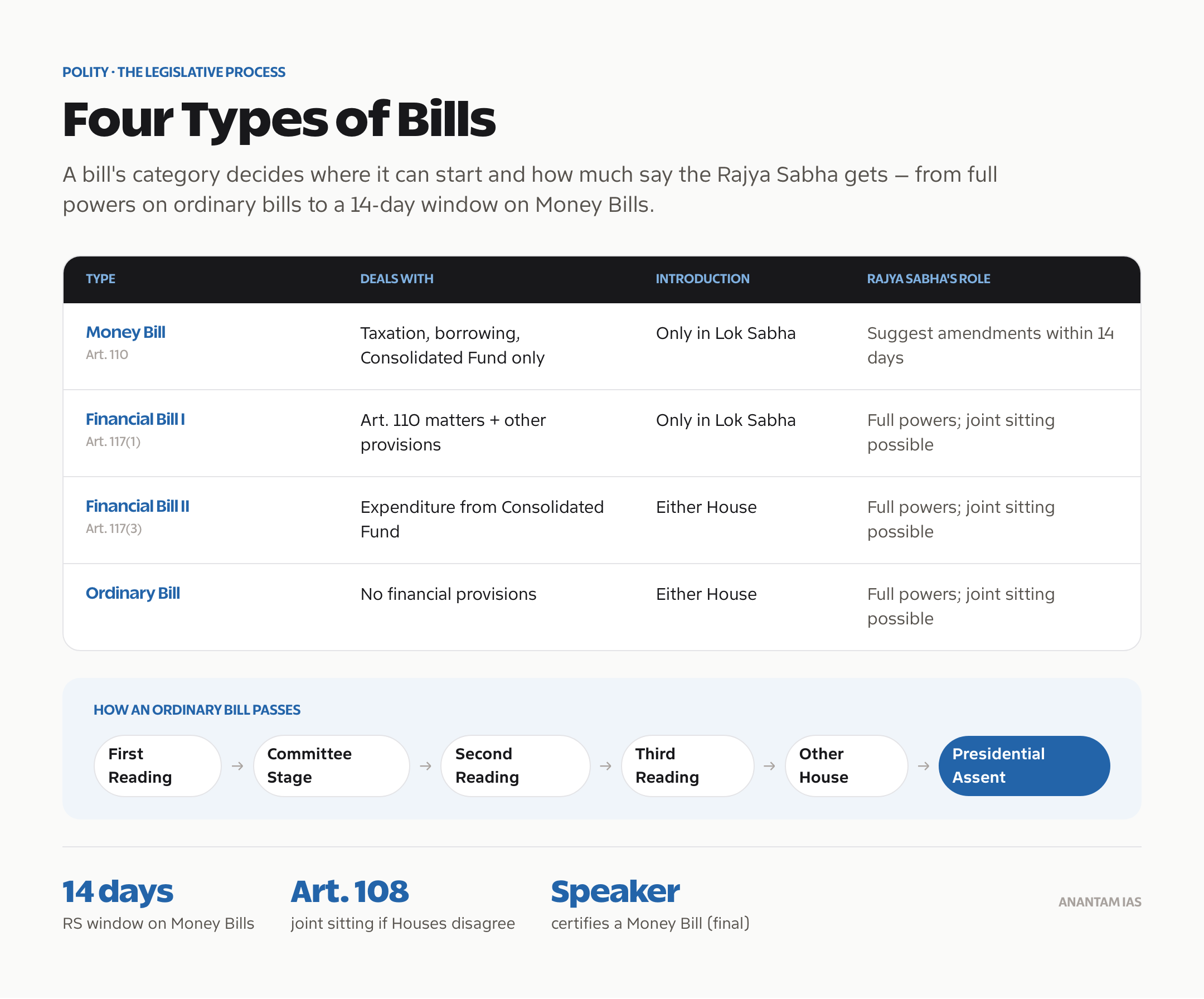
If the two Houses disagree, the President may summon a joint sitting under Article 108. The bill is passed by a majority of total members present and voting. Joint sitting is presided over by the Speaker of Lok Sabha.
Money Bills (Article 110)
A Money Bill can only be introduced in Lok Sabha and only on the President’s recommendation. After Lok Sabha passes it, Rajya Sabha has 14 days to make recommendations (not amendments). Lok Sabha may accept or reject those recommendations. The Speaker’s certification that a bill is a Money Bill is final.
Financial Bills
| Type | Definition | Introduction | Rajya Sabha’s Role |
|---|---|---|---|
| Money Bill (Art. 110) | Exclusively deals with taxation, borrowing, Consolidated Fund | Only in Lok Sabha | Can suggest amendments within 14 days |
| Financial Bill Type I (Art. 117(1)) | Contains Art. 110 matters + other provisions | Only in Lok Sabha | Full powers; joint sitting possible |
| Financial Bill Type II (Art. 117(3)) | Expenditure from Consolidated Fund | Either House | Full powers; joint sitting possible |
| Ordinary Bill | No financial provisions | Either House | Full powers; joint sitting possible |
Parliamentary Privileges
Articles 105 and 194 grant privileges to Parliament and state legislatures respectively. These are broadly classified as:
Individual Privileges
- Freedom of speech in Parliament (Article 105(1))
- Immunity from court proceedings for anything said or any vote given in Parliament
- Exemption from jury service when Parliament is in session
- Freedom from arrest in civil cases during and 40 days before and after the session
Collective Privileges
- Right to publish debates and proceedings
- Right to exclude strangers from proceedings
- Right to punish members or outsiders for breach of privilege or contempt
- Right to make rules for regulating its own procedure
Parliamentary privileges haven’t been codified. Article 105(3) provides that privileges shall be those enjoyed at the commencement of the Constitution until Parliament defines them by law. Parliament hasn’t yet enacted such a law.
Parliamentary Committees
Parliamentary committees are vital for detailed legislative scrutiny. They’re classified as Standing Committees (permanent) and Ad Hoc Committees (temporary).
Key Standing Committees
Departmental Standing Committees (24): Each committee covers related ministries, examines demands for grants, and reviews bills referred to them. 16 committees are under Lok Sabha and 8 under Rajya Sabha.
Financial Committees:
- Public Accounts Committee (22 members: 15 Lok Sabha + 7 Rajya Sabha) — examines CAG reports
- Estimates Committee (30 members, all from Lok Sabha) — examines budget estimates
- Committee on Public Undertakings (22 members: 15 LS + 7 RS) — examines public sector enterprises
Other Important Committees: Business Advisory Committee, Rules Committee, Privileges Committee, Committee on Petitions, and Ethics Committee.
Anti-Defection Law (Tenth Schedule)
Added by the 52nd Amendment (1985), the Tenth Schedule seeks to prevent political defection. A member is disqualified if they voluntarily give up party membership or vote contrary to party direction without prior permission.
Exceptions: A merger is permitted if at least two-thirds of the members of a legislative party agree. The Speaker/Chairman decides disqualification cases, and this decision is subject to judicial review (Kihoto Hollohan v. Zachillhu, 1992).
The 91st Amendment (2003) removed the provision allowing a split by one-third members, tightening anti-defection norms.
Recent Developments
The New Parliament Building, inaugurated in May 2023, provides expanded capacity — 888 seats in Lok Sabha (expandable to 1,272 for joint sessions) and 384 in Rajya Sabha. It was designed to accommodate increased membership after the delimitation exercise planned post-2026.
Productivity of Parliament remains a concern. Lok Sabha’s productivity has fluctuated significantly — from over 100% in some sessions to below 20% during disruption-heavy sessions. The Presiding Officers’ Conference regularly discusses measures to improve parliamentary functioning.
President of India Constitutional Amendment Process Money Bill vs Finance Bill Anti-Defection Law
Frequently Asked Questions
How many members are there in Indian Parliament?
Lok Sabha has a maximum strength of 552 members (currently 543 effective) and Rajya Sabha has a maximum of 250 members (currently 245). Together with the President, who is an integral part of Parliament under Article 79, the total parliamentary structure includes both elected and nominated members representing India’s democratic governance.
What is the difference between Question Hour and Zero Hour?
Question Hour is the first hour of parliamentary sitting where members ask pre-submitted questions to ministers — it’s governed by Rules of Procedure with starred, unstarred, and short notice questions. Zero Hour follows Question Hour and allows members to raise urgent matters without prior notice. Question Hour has constitutional backing while Zero Hour is a parliamentary convention.
Can Rajya Sabha reject a Money Bill?
No. Rajya Sabha cannot reject or amend a Money Bill. It can only make recommendations within 14 days of receiving the bill. Lok Sabha may accept or reject those recommendations at its discretion. If Rajya Sabha doesn’t return the bill within 14 days, it’s deemed passed by both Houses. The Speaker’s certification of a Money Bill is final and cannot be questioned.
What is a joint sitting of Parliament?
A joint sitting under Article 108 is called by the President when the two Houses disagree on an ordinary bill. It’s presided over by the Speaker of Lok Sabha, and the bill is passed by a majority of total members present and voting. Joint sittings have occurred only three times — for the Dowry Prohibition Bill (1961), Banking Service Commission Bill (1978), and Prevention of Terrorism Bill (2002).
How many sessions does Parliament have in a year?
Parliament typically meets for three sessions: Budget Session (February–May), Monsoon Session (July–August), and Winter Session (November–December). The Constitution mandates under Article 85 that the gap between two sessions must not exceed six months. The number isn’t constitutionally fixed — three sessions is a convention, and additional sessions can be called.