Indo-Pacific Geopolitics — India’s Vision, Quad, AUKUS & UPSC Notes (UPSC International Relations)
UPSC guide to Indo-Pacific geopolitics: origin of the term, India's SAGAR & Indo-Pacific vision, Quad, AUKUS, 2024-26 developments, ASEAN centrality.
The Indo-Pacific is the most consequential maritime theatre of the 21st century. It stretches from the east coast of Africa to the western Pacific, holding more than half of world trade, three of the four largest economies, and the critical chokepoints — Malacca, Hormuz, Bab-el-Mandeb — that move energy and containers. For UPSC GS-II International Relations and essay, the Indo-Pacific is a recurring theme that ties together India’s Act East, Quad, SAGAR, maritime security, and the contest with China.
Origin of the term
The term “Indo-Pacific” in its modern geopolitical sense is often traced to an article by Indian naval thinker Captain Gurpreet Khurana (2007). It entered mainstream diplomacy through Japanese Prime Minister Shinzo Abe’s “Confluence of the Two Seas” speech to the Indian Parliament in August 2007, which proposed a broader Asia knit together by the Indian and Pacific Oceans.
The term entered India's official lexicon around 2014 and received institutional recognition in 2019 when the Ministry of External Affairs set up a dedicated Indo-Pacific Division. The United States formally replaced "Asia-Pacific" with "Indo-Pacific" in its 2017 National Security Strategy, and its Pacific Command was renamed Indo-Pacific Command in 2018.
Why the Indo-Pacific matters
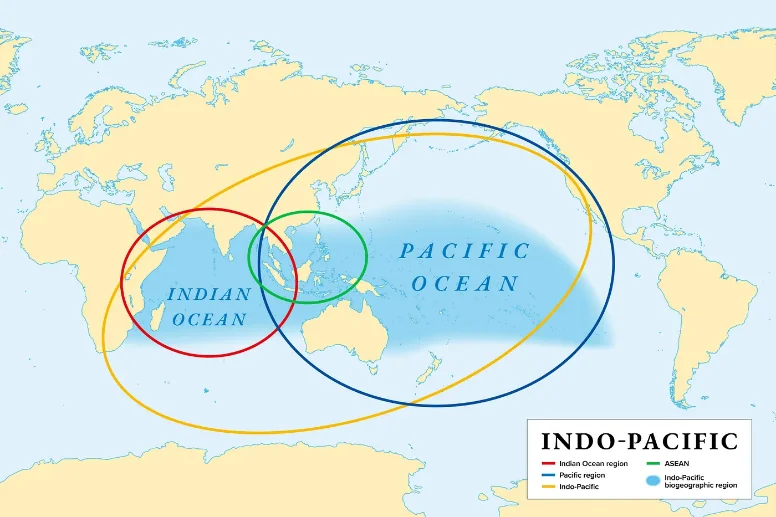
- Trade: Roughly 60% of global maritime trade passes through the Indo-Pacific; the South China Sea alone carries an estimated US$3.4-5 trillion annually.
- Energy: 80% of China’s and 65% of India’s oil imports transit through the Indian Ocean.
- Economies: 7 of the world's 10 largest economies by 2030 are projected to be Indo-Pacific littoral states.
- Security: China's nine-dash line claim in the South China Sea, naval build-up, artificial islands, and the expanding PLA-Navy port footprint (Gwadar, Hambantota, Djibouti) directly affect India's interests.
Competing visions of a Free and Open Indo-Pacific
The phrase "Free and Open Indo-Pacific" (FOIP) is shared rhetoric, but each major actor means something different.
Japan
Japan's FOIP strategy, articulated under Abe and continued under Kishida and Ishiba, focuses on connectivity between the Pacific and Indian Oceans — maritime rule of law, quality infrastructure, and strategic coordination with India, the US and Australia.
United States
The US Indo-Pacific Strategy (2022) rests on three pillars — economic engagement, governance, and security. It seeks to keep the region free from coercion, uphold international law, and preserve American primacy against Chinese challenges. The 2022 Indo-Pacific Economic Framework (IPEF) is the economic spine of this strategy.
ASEAN
ASEAN adopted its ASEAN Outlook on the Indo-Pacific (AOIP) in 2019. Its central fear is that big-power rivalry — US-China, India-China, Quad vs BRI — turns the region into closed blocs. ASEAN insists on inclusivity, dialogue, and ASEAN centrality.
China
China has not formally endorsed "Indo-Pacific". It prefers the Asia-Pacific framing and views FOIP as a US-led containment project. Its own vision centres on the Belt and Road Initiative (BRI), the Maritime Silk Road, and more recently the Global Security Initiative (GSI) and Global Development Initiative (GDI).
India's vision of the Indo-Pacific
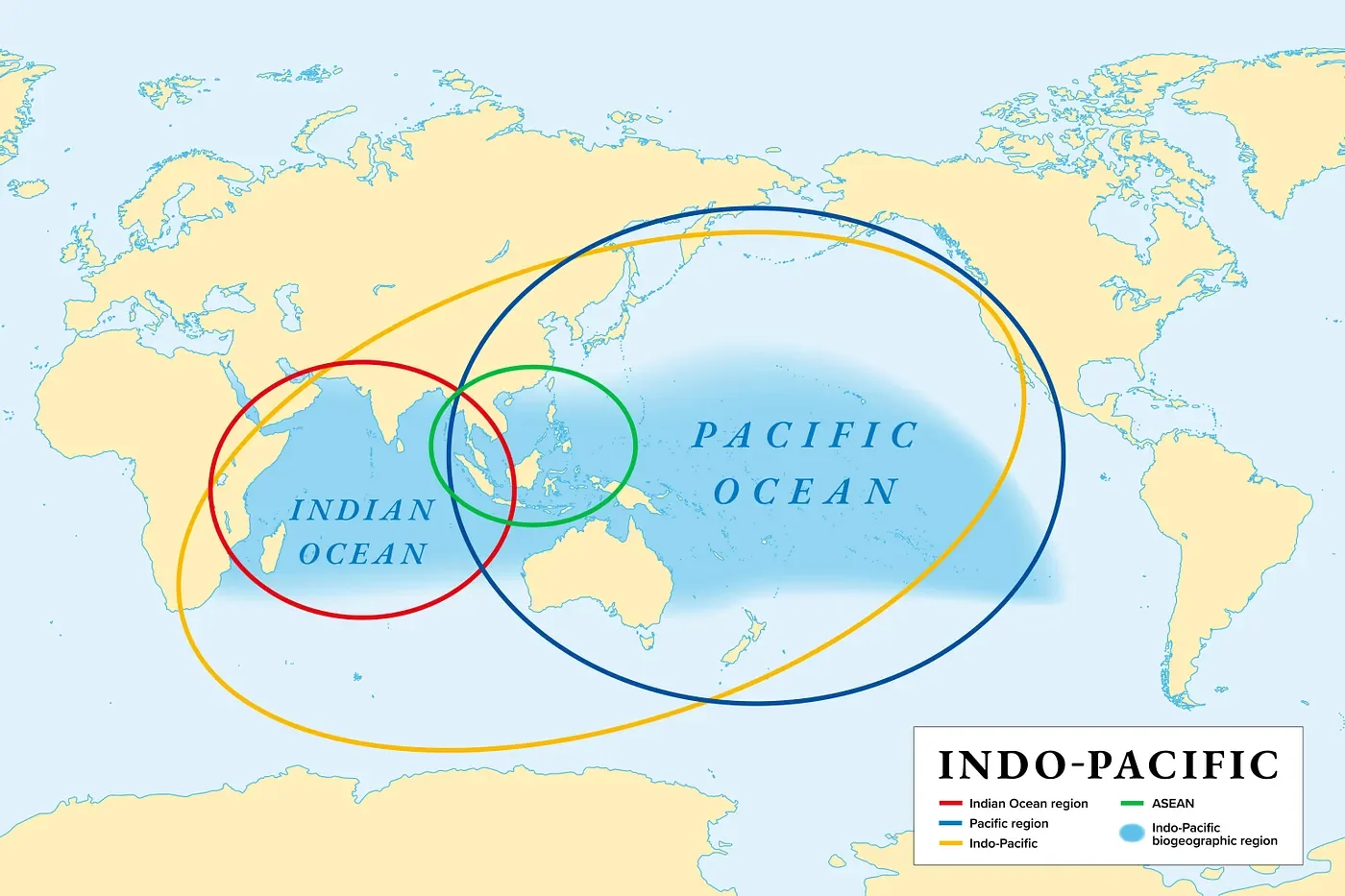
India's Indo-Pacific doctrine was formally articulated by Prime Minister Modi at the Shangri-La Dialogue in Singapore (June 2018). Its core tenets are:
- Inclusive, not exclusive — all countries in the region are partners; no containment against any state.
- ASEAN centrality at the heart of the Indo-Pacific architecture.
- Rule of law and freedom of navigation, anchored in UNCLOS.
- Strategic autonomy — India will not be part of an alliance system; partnerships like Quad are need-based.
- SAGAR (Security and Growth for All in the Region, 2015) as the operating philosophy for the Indian Ocean.
The Indo-Pacific Oceans Initiative (IPOI), launched at the 2019 East Asia Summit, operationalises the vision through seven pillars — maritime security, maritime ecology, maritime resources, capacity building, disaster management, S&T cooperation, and trade-connectivity. Different countries lead different pillars, making it a genuinely plurilateral architecture.
Major Indo-Pacific minilaterals
| Grouping | Members | Focus |
|---|---|---|
| Quad | India, US, Japan, Australia | Maritime security, critical tech, vaccines, IPMDA |
| AUKUS | Australia, UK, US | Nuclear-powered submarines, advanced capabilities |
| I2U2 | India, Israel, UAE, US | Food security, water, space, energy |
| Trilateral | India, Japan, US | Strategic coordination, maritime domain awareness |
| Malabar | India, US, Japan, Australia | Annual naval exercise |
| IPEF | 14 members incl. India | Trade, supply chains, clean energy, tax |
Differences in Indian and Western visions
- Geography: Japan and the US focus on the South China Sea and East Asia; India’s security priority is the Bay of Bengal and Arabian Sea.
- No alliances: India does not join military alliances. AUKUS, for example, is a formal defence pact; Quad is not.
- China: The US often couches FOIP as explicit China containment; India avoids naming China and sees its Indo-Pacific engagement as not anti-China.
- Continental dimension: India sees itself as both a maritime and continental power (hence SCO, INSTC, Chabahar). Japan and the US are purely maritime actors.
Latest developments (2024-26)
- Quad Summit, Wilmington (Sept 2024): Joint Coast Guard Ship Rider Program, MAITRI (Maritime Initiative for Training in the Indo-Pacific Region), cancer moonshot, and US$2+ billion in Quad-led ports and cable investments. The 2025 Quad summit is hosted by India.
- India-Maldives reset (2024-25): After a tense 2024, the Muizzu-Modi joint vision document in October 2024 restored financial support, infrastructure cooperation and defence ties, recalibrating India's Indian Ocean posture.
- Red Sea crisis (2024-26): Houthi strikes on shipping pushed Asia-Europe container traffic around the Cape of Good Hope. The Indian Navy ran the largest anti-piracy deployment in its history — Operations Sankalp and Op Sagar — with over 5,000 personnel deployed.
- Israel-Hamas war and Gaza ceasefire (Jan 2025): Disrupted IMEC (India-Middle East-Europe Economic Corridor), forced recalibration of India's West Asia posture.
- US political transition (Jan 2025): Trump 2.0 has reiterated Indo-Pacific primacy but is more transactional on alliances — reviving questions on burden-sharing with Japan and South Korea.
- BRICS expansion (2024): Addition of Egypt, Iran, UAE, Saudi Arabia and Ethiopia has created a new Global South bloc that crosses the Indo-Pacific, complicating simple US-China framing.
- Philippines-China friction: Repeated Chinese Coast Guard clashes with Philippine vessels at Second Thomas Shoal and Scarborough Shoal have hardened ASEAN perceptions in 2024-25.
- Russia-Ukraine war spillover: Russia's deepening pivot to Asia (China, India, North Korea, Iran) has injected Eurasian dynamics into Indo-Pacific calculations.
- AI Summit Paris (Feb 2025): India and France co-chaired the AI Action Summit; India is now positioning AI governance as part of Indo-Pacific critical-tech cooperation.
Challenges for India
- China's grey-zone tactics — salami-slicing, maritime militia, dual-use infrastructure at Indian Ocean ports.
- ASEAN centrality vs minilaterals — balancing deeper Quad activity without sidelining ASEAN.
- Capacity gap — India's navy is roughly one-third the size of China's PLA-N; modernisation is lagging.
- Strategic autonomy balancing act — Russia, Iran, BRICS on one side; Quad, US, Europe on the other.
- Economic architecture — India opted out of RCEP and has not signed the IPEF trade pillar, limiting deeper integration.
Way forward
- Fast-track naval modernisation: indigenous aircraft carriers, submarines, long-range maritime patrol aircraft.
- Deepen Quad deliverables beyond declarations — ports, subsea cables, MDA.
- Scale IPOI with concrete project pipelines.
- Use IMEC to anchor India's position as a bridge between the Indo-Pacific and Europe-Atlantic systems.
- Operationalise the SAGAR-2 / MAHASAGAR doctrine for the wider Indian Ocean.
UPSC Relevance
GS-II: "Bilateral, regional and global groupings involving India." GS-III: Internal security — maritime security. Essay: Strategic autonomy; Asian century; multipolarity.
Probable questions
- "The Indo-Pacific is less a geographical fact than a strategic construct." Discuss India's vision and role. (15 marks)
- How does India reconcile ASEAN centrality with minilateral groupings like the Quad? (10 marks)
- Examine the impact of the Red Sea crisis and India-Maldives reset on India's Indian Ocean strategy. (15 marks)
Prelims trigger words — SAGAR, IPOI, MAITRI, IPMDA, AUKUS, I2U2, IPEF, AOIP, Shangri-La Dialogue, Malabar.
The Indo-Pacific is where India's neighbourhood, extended neighbourhood, and great-power strategy converge. A coherent Indo-Pacific answer in the Mains paper must combine doctrine (SAGAR, IPOI), geography (Malacca, Hormuz, Bab-el-Mandeb), institutions (Quad, ASEAN, BIMSTEC), and current events (Red Sea, Maldives reset, Quad 2024).