Integrated Guided Missile Development Programme (IGMDP): How India Built Its Missile Backbone Under APJ Abdul Kalam
A complete UPSC GS-III explainer on the Integrated Guided Missile Development Programme. Covers the five missile families, APJ Abdul Kalam's leadership, DRDO architecture, induction status of Prithvi, Agni, Akash, Trishul, Nag, and the post-IGMDP missile programmes.
In July 1983, the Indian government approved a programme that quietly redrew the country’s defence map. The Integrated Guided Missile Development Programme, abbreviated IGMDP, was a single coordinated effort to develop five different classes of missile under one roof. It pulled together what had until then been a scatter of small projects across the Defence Research and Development Organisation. It put a young aerospace engineer named APJ Abdul Kalam in charge. And it gave India a path to indigenous strategic and tactical missile capability at a time when the country was effectively shut out of the global missile market by export-control regimes.
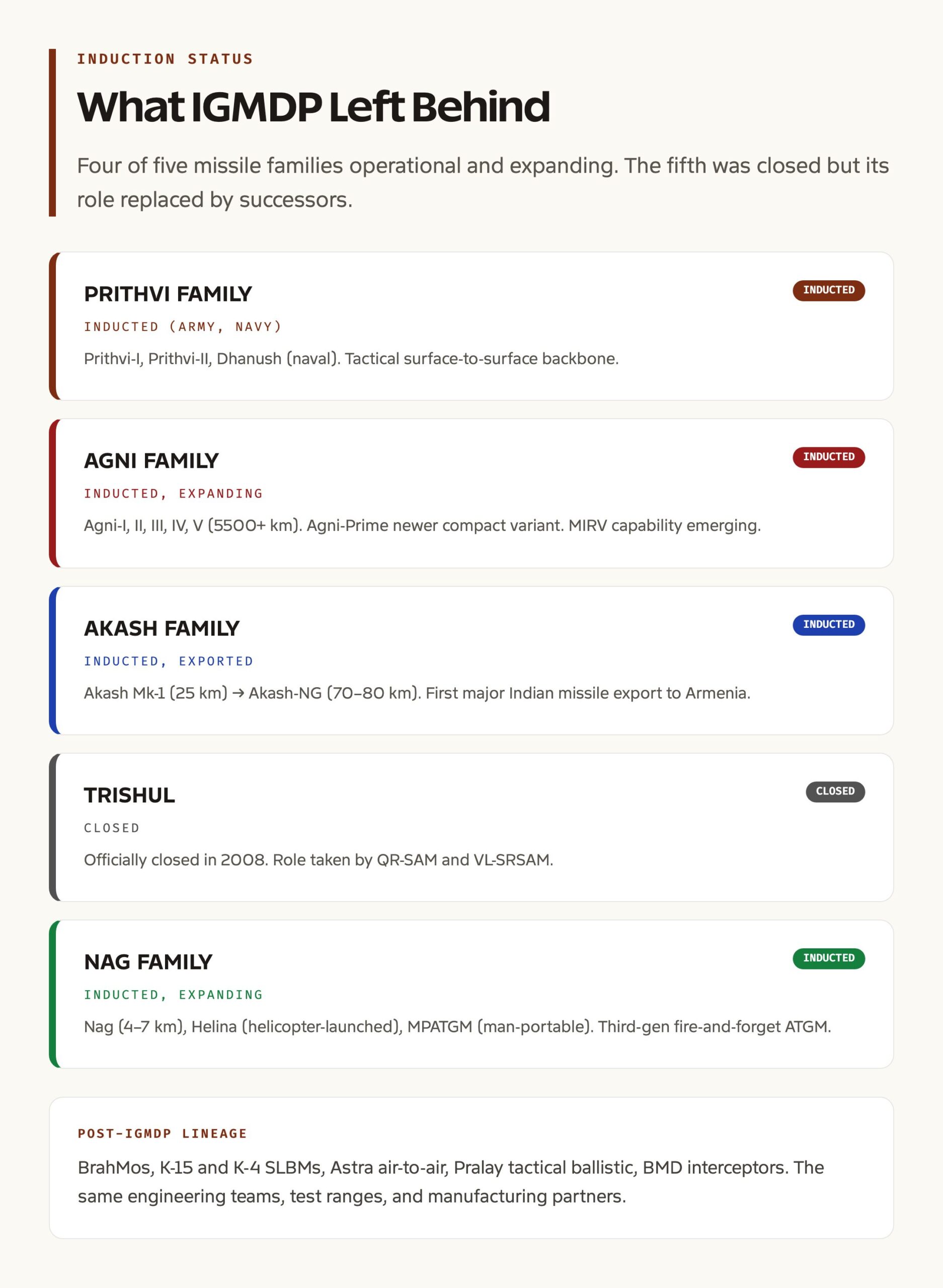
The programme ran formally for twenty-five years. It officially closed in 2008, declared successful by the government with most of its missile families inducted into service or in late-stage development. The five missiles that came out of it, Prithvi, Agni, Akash, Trishul, and Nag, are still recognisable names in the Indian military lexicon today, even though three of them have evolved into much larger families and one, Trishul, was eventually wound up. The programme also left behind something more durable than any individual missile. It left behind a missile-development capability, with engineers, test ranges, propellant plants, and systems-integration discipline that has since produced BrahMos, the Agni-V, the K-15 and K-4 submarine-launched missiles, and a long pipeline of follow-on systems.
For UPSC purposes, IGMDP sits at the intersection of defence technology, strategic deterrence, internal security, and India’s broader self-reliance agenda. This article walks through what the programme was, what each of the five missiles does, how the programme worked, and what came after.
Quick Facts on IGMDP
The Integrated Guided Missile Development Programme was a missile-development effort approved by the Government of India in July 1983 and run by the Defence Research and Development Organisation. The aim was to achieve self-reliance in five categories of guided missile by combining what had been a set of separate projects into a single coordinated programme.
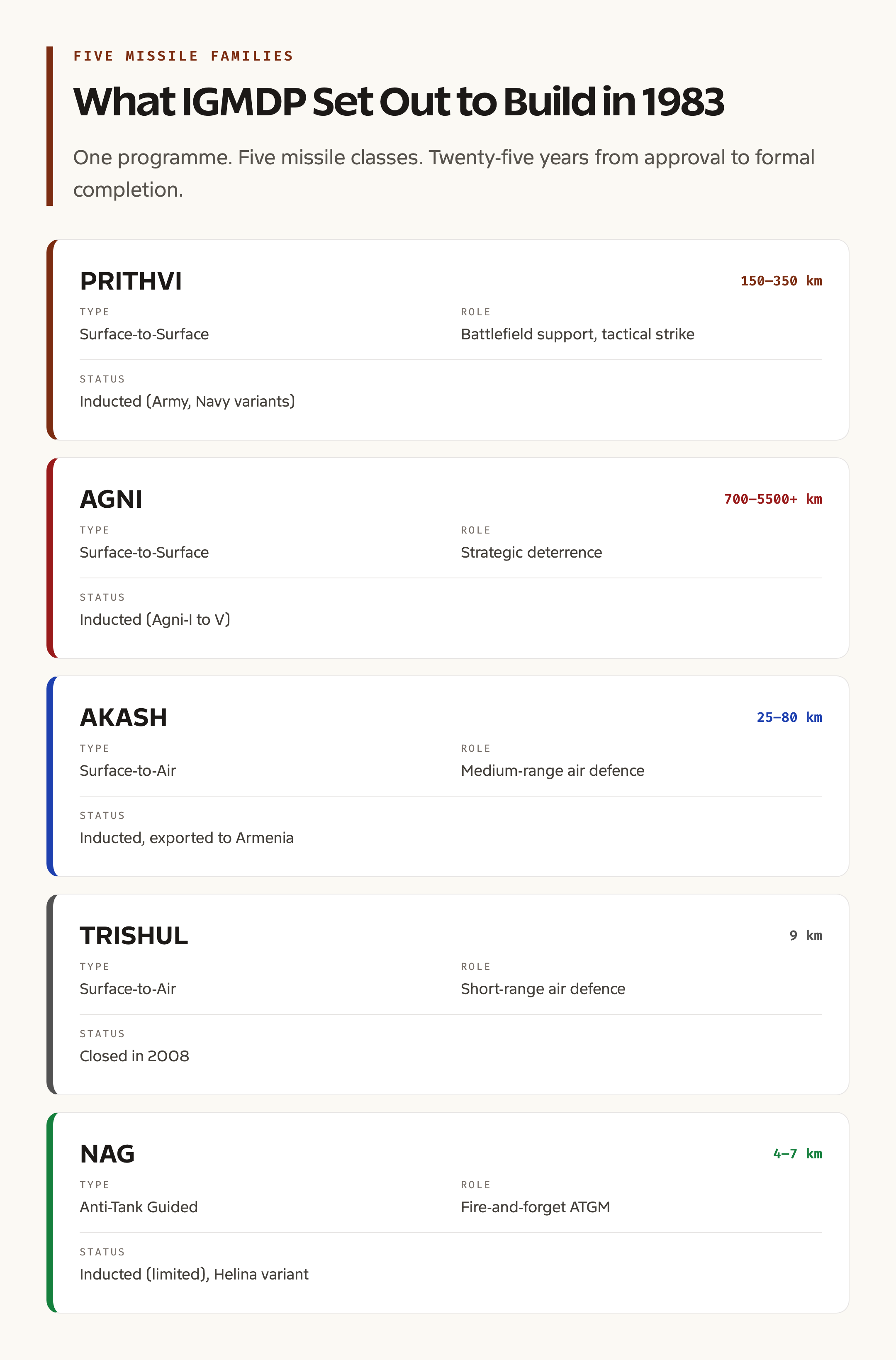
The five missile classes covered were a short-range surface-to-surface tactical missile (Prithvi), a long-range surface-to-surface ballistic missile (Agni), a medium-range surface-to-air missile (Akash), a short-range surface-to-air missile (Trishul), and a third-generation anti-tank guided missile (Nag).
The programme was led by APJ Abdul Kalam, who served as Project Director from 1983 to 1992 and later as Director of DRDO and Scientific Adviser to the Defence Minister. The programme was formally declared completed in 2008. By that point, Prithvi and Agni had been inducted, Akash had begun induction, Nag was in late-stage development, and Trishul had been closed.
What IGMDP Actually Was
A guided missile is a substantially harder engineering object than an unguided rocket. It needs propulsion, structural design, aerodynamic control, an inertial navigation or other guidance system, a warhead, and the systems integration that makes all of these work together at supersonic or hypersonic speeds. Each of these is a distinct technical discipline. A country that does not already have missile capability has to build the disciplines first and then learn to integrate them.
IGMDP solved this by treating five missile programmes as a single technology base. Propulsion, materials, electronics, and software developed for one missile could feed into the others. A test range built for one project could serve all of them. Engineers trained on one programme could rotate to the others. The integration savings were significant. Many systems, including the inertial navigation, propellant chemistry, and warhead architecture, were genuinely shared across the five missile types.
The programme was based at DRDO’s Defence Research and Development Laboratory in Hyderabad, with extensive support from the Research Centre Imarat, the Advanced Systems Laboratory, the High Energy Materials Research Laboratory in Pune, and the Integrated Test Range at Chandipur in Odisha. Manufacturing partners included Bharat Dynamics Limited, the public-sector defence manufacturer responsible for the eventual production of several IGMDP missiles.
Background and Historical Context
Before 1983, India’s missile work was scattered. The Devil and Valiant projects of the 1970s had explored short-range surface-to-air and intermediate-range surface-to-surface technology with mixed results. The Project Devil work, in particular, fed forward into IGMDP. SLV-3, the satellite launch vehicle developed under Vikram Sarabhai’s leadership and with Kalam as Project Director, gave India proven solid-propulsion experience that translated directly to ballistic missile design.
The strategic context was the Missile Technology Control Regime, established in 1987, which restricted export of missile technology and components to countries outside the regime. India was outside. So was Pakistan. The decision to launch IGMDP in 1983 anticipated this restriction. The programme committed India to indigenous development at a time when import was about to become much harder. The 1998 nuclear tests sharpened the strategic logic further. A nuclear deterrent without delivery vehicles is incomplete. The Agni programme, originally classified as a technology demonstrator, was recategorised as a strategic system after 1998.
The programme drew technical inspiration from international systems but built indigenous designs. Prithvi shares conceptual ancestry with the Soviet Scud family but has Indian propulsion and guidance. Agni borrows nothing directly from any foreign system, although the broader logic of the programme echoes early French and Israeli work. Akash and Nag are largely original designs.
The Five Missiles of IGMDP
Each of the five missiles plays a distinct role in the Indian armed forces.
| Missile | Type | Range | Role | Induction Status |
|---|---|---|---|---|
| Prithvi | Surface-to-Surface | 150 to 350 km | Battlefield support, tactical strike | Inducted (Army, Navy variants) |
| Agni | Surface-to-Surface | 700 to 5500 km plus | Strategic deterrence | Inducted (Agni-I to Agni-V) |
| Akash | Surface-to-Air | 25 to 30 km (Mk-1); 70 to 80 km (NG) | Medium-range air defence | Inducted (Army, Air Force) |
| Trishul | Surface-to-Air | 9 km | Short-range air defence | Closed |
| Nag | Anti-Tank Guided | 4 to 7 km | Fire-and-forget ATGM | Inducted (limited) |
Prithvi is a short-range ballistic missile in three primary variants. Prithvi-I has a 150 kilometre range and was developed for the Army. Prithvi-II extends to 250 to 350 kilometres and is also Army-operated. Dhanush is the naval variant. The Prithvi family was India’s first inducted ballistic missile and gave the Indian armed forces practical experience in operating guided strategic systems.
Agni began as a re-entry vehicle technology demonstrator. The first Agni-I tested in 1989 and the system has since grown into a five-member family. Agni-I has a range of around 700 kilometres. Agni-II extends to 2000 to 3000 kilometres. Agni-III reaches 3000 to 5000 kilometres. Agni-IV extends further. Agni-V, first tested in 2012 and inducted in 2018, has a range above 5000 kilometres and brings most of mainland China within reach. Agni-Prime is a newer compact variant under development. The full Agni family anchors India’s strategic deterrent.
Akash is a medium-range surface-to-air missile. The original Akash Mk-1, with a range of around twenty-five kilometres, was inducted by the Indian Army and the Indian Air Force from 2014 onwards. Akash-NG, the next-generation variant, extends the range to seventy to eighty kilometres and uses a new active radar seeker. Akash has been exported to Armenia in a high-profile defence sale.
Trishul was a short-range surface-to-air missile intended for ship and shore defence. It encountered persistent technical challenges and was officially closed in 2008. Its short-range air defence role is now filled by other systems, including imported and co-developed missiles.
Nag is a third-generation fire-and-forget anti-tank guided missile. It uses imaging infrared seekers and can engage tanks at ranges up to seven kilometres. The Nag has been inducted in limited numbers. The Helina, a helicopter-launched variant, and the man-portable MPATGM follow-on extend the family.
APJ Abdul Kalam and the Programme Architecture
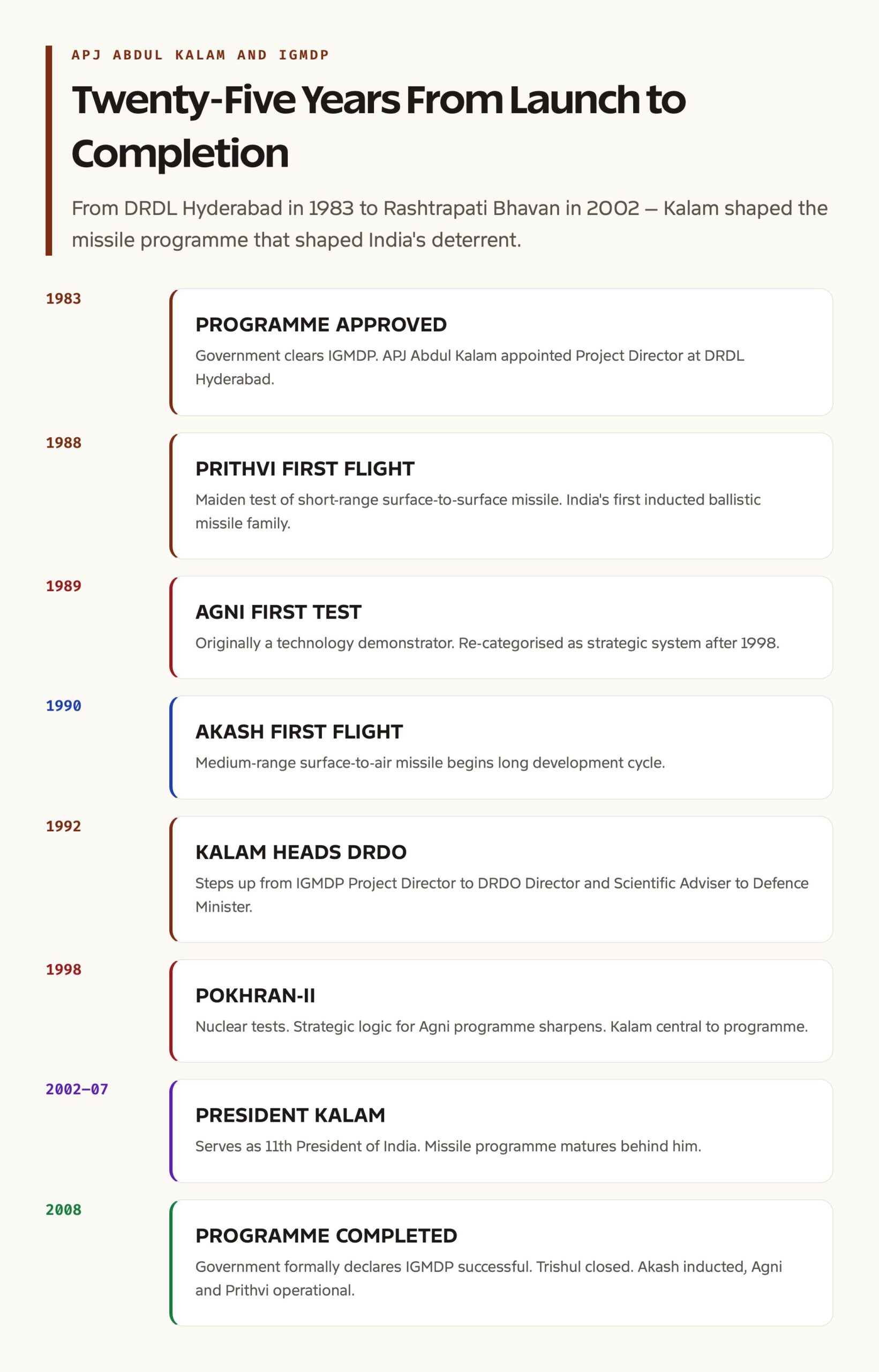
The programme is inseparable from APJ Abdul Kalam. Kalam, who came to DRDO from ISRO and the SLV-3 launch vehicle programme, served as Project Director of IGMDP from 1983 to 1992. He brought the project-management discipline that ISRO had developed into a defence environment that had previously been more fragmented.
Kalam’s contribution had three layers. The first was technical leadership across the five missile programmes, pulling them into a coherent integrated effort. The second was institutional. He helped build the partnerships between DRDO labs, public-sector manufacturers like Bharat Dynamics Limited, and private-sector vendors that became increasingly important over the programme’s life. The third was a public-facing role that gave the missile effort visibility and political support. Kalam later served as Scientific Adviser to the Defence Minister, as Principal Scientific Adviser to the Government of India, and from 2002 to 2007 as President of India.
The programme architecture also rested on a network of test ranges, propellant plants, and integration laboratories that have served Indian missile development long after IGMDP’s formal close. The Integrated Test Range at Chandipur, the Wheeler Island launch facility (now Abdul Kalam Island), and the Hyderabad-based DRDL and RCI campuses are direct legacies of this architecture.
Why IGMDP Mattered
The programme mattered for four reasons.
First, it built strategic capability that import alone could not provide. Indian missile development was effectively closed off by international export controls after 1987. Without IGMDP, India would have had no path to a credible strategic deterrent or to a tactical missile force.
Second, it delivered self-reliance at a level that few countries achieve. India today designs, develops, manufactures, and operates strategic ballistic missiles, surface-to-air missiles, and anti-tank missiles indigenously. Components are increasingly indigenous as well. The path to that capability runs through IGMDP.
Third, it built engineering depth. The cohort of engineers who learned missile development inside IGMDP carried that capability forward into BrahMos, the K-class submarine-launched missiles, the Astra air-to-air missile, the BMD ballistic missile defence programme, and the long pipeline of follow-on systems.
Fourth, it built export capability. Akash to Armenia, BrahMos to the Philippines, and ongoing discussions with several other countries reflect the maturation of Indian missile development from import substitution to a defence export base.
Detailed Comparison: IGMDP versus Post-IGMDP Programmes
The post-IGMDP era has produced missiles with broader scope and more demanding performance requirements.
| Programme | Era | Scope | Examples |
|---|---|---|---|
| IGMDP | 1983 to 2008 | Five missile classes, ranges to 5000 km | Prithvi, Agni I-III, Akash, Trishul, Nag |
| Post-IGMDP strategic | 2008 onward | Long-range, MIRV, submarine-launched | Agni-V, Agni-Prime, K-15, K-4 |
| Post-IGMDP tactical | 2008 onward | Cruise, hypersonic, BMD, naval | BrahMos, BrahMos-NG, Pralay, Pinaka, BMD interceptors |
| Co-developed | 2010s onward | Joint development with partners | BrahMos (with Russia), MR-SAM (with Israel), QR-SAM |
The shape of the post-IGMDP programme is broader and more diverse, but the lineage to IGMDP is direct. The same engineering teams, test ranges, and manufacturing partners run the new programmes.
Challenges and Lessons
IGMDP took longer than originally planned and faced repeated setbacks. Trishul never met its specifications. Nag took two decades to mature. Akash was delayed multiple times before induction. The lessons drawn from these difficulties shaped Indian programme management in defence.
The first lesson was that subsystem maturity drives missile maturity. A missile is only as good as its propulsion, guidance, and seeker, and each of these is a deep engineering problem in its own right. Investing in subsystem development in parallel with system integration has become the standard model for Indian programmes since.
The second lesson was that test infrastructure matters as much as design. The expansion of the Chandipur range, the construction of the Wheeler Island facility, and the buildup of telemetry and analysis capability were as important to programme success as missile design itself.
The third lesson was that public-sector and private-sector collaboration requires deliberate institutional design. The path from IGMDP towards the current Defence Acquisition Procedure, the Strategic Partnership Model, and the iDEX innovation programme reflects three decades of learning about how to organise defence development.
Way Forward
Three threads define the post-IGMDP missile agenda. The first is hypersonic and manoeuvrable systems, where the BrahMos-II, the Hypersonic Technology Demonstrator Vehicle, and emerging glide-vehicle programmes carry forward the strategic-deterrence logic. The second is integrated air defence, where the QR-SAM, MR-SAM, Akash-NG, and BMD interceptors form a layered shield. The third is co-development, where partnerships with Russia, Israel, and France complement indigenous development.
For UPSC, the takeaway is that IGMDP is more than a list of five missiles. It is the institutional foundation on which the current Indian missile establishment rests. Understanding that foundation explains why India can produce a BrahMos or an Agni-V today.
Frequently Asked Questions
What does IGMDP stand for and when was it launched?
IGMDP stands for Integrated Guided Missile Development Programme. It was approved by the Government of India in July 1983 under the Defence Research and Development Organisation, with APJ Abdul Kalam as Project Director.
Which five missiles came under IGMDP?
The five missile classes were Prithvi (short-range surface-to-surface), Agni (long-range ballistic), Akash (medium-range surface-to-air), Trishul (short-range surface-to-air), and Nag (anti-tank guided missile).
What was APJ Abdul Kalam’s role in IGMDP?
APJ Abdul Kalam served as Project Director of IGMDP from 1983 to 1992 and continued to lead Indian missile development as Director of DRDL, Scientific Adviser to the Defence Minister, and Principal Scientific Adviser to the Government of India before becoming President in 2002.
Has IGMDP been completed?
Yes. The programme was formally declared complete in 2008. By that point, Prithvi and Agni were inducted, Akash had begun induction, Nag was in late-stage development, and Trishul had been closed.
What replaced Trishul as a short-range surface-to-air missile?
Trishul’s role has been filled by a combination of imported systems and indigenous follow-ons including the QR-SAM and the VL-SRSAM developed jointly by DRDO and the Israeli industry, and by upgraded variants of older systems.