Intellectual Property Rights in India (UPSC Science & Tech)
UPSC guide to IPR India: patents, copyrights, trademarks, GIs, TRIPS, National IPR Policy 2016, CRI guidelines, and 2024-26 reforms.
Intellectual Property Rights (IPR) are legal rights granted to creators and innovators over their inventions, literary and artistic works, designs, and symbols. IPR has emerged as a measure of a country’s innovation capacity. India has systematically reformed its IPR ecosystem since the National IPR Policy (2016). For UPSC, IPR falls under GS Paper III (Science & Technology, Economy) and GS Paper II (International Relations — TRIPS, WTO, USTR Special 301).
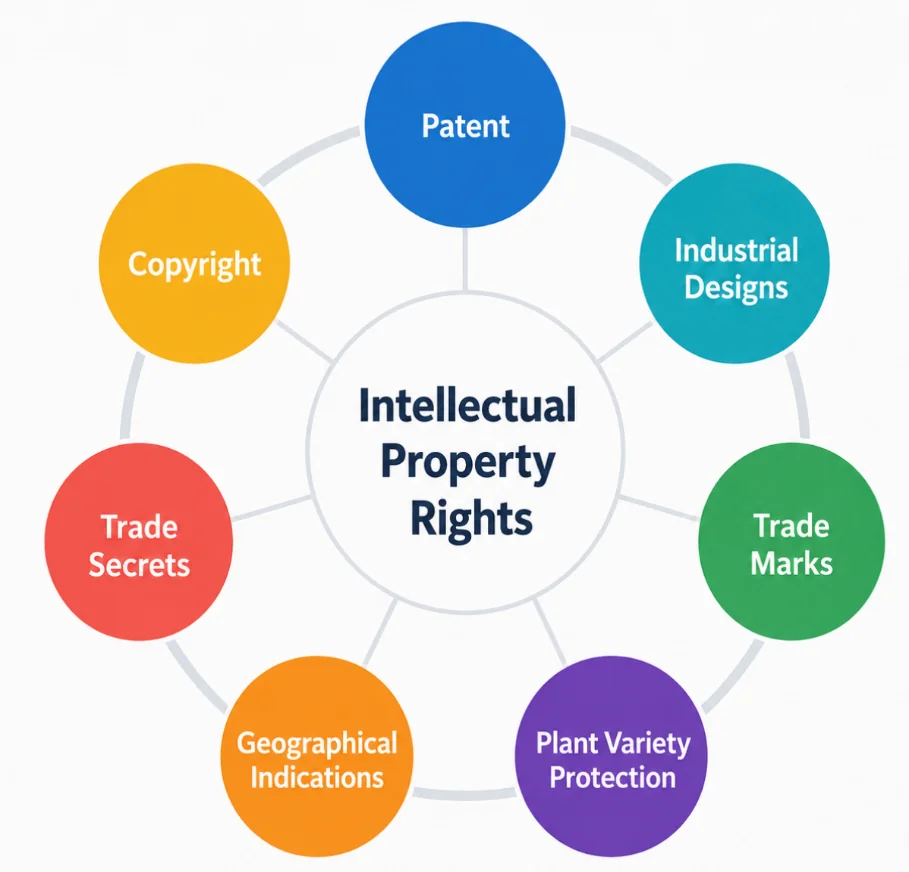
Types of IP
| IP Type | Law | What it protects | Term |
|---|---|---|---|
| Patent | Patents Act, 1970 | Inventions (novel, non-obvious, useful) | 20 years |
| Copyright | Copyright Act, 1957 | Literary, dramatic, musical, artistic works, software, films | Life + 60 years |
| Trademark | Trade Marks Act, 1999 | Brand names, logos, sounds, shapes | 10 years (renewable) |
| Design | Designs Act, 2000 | Aesthetic/industrial designs | 10 + 5 years |
| Geographical Indication (GI) | GI Act, 1999 | Region-specific products | 10 years (renewable) |
| Plant variety | PPVFR Act, 2001 | New and extant plant varieties | 15-18 years |
| Semiconductor IC layout | SICLD Act, 2000 | IC design layouts | 10 years |
| Trade secrets | Common law / contract | Confidential know-how | Indefinite |
| Traditional Knowledge | TKDL Database | Indian traditional systems | Sui generis |
Global architecture
- WIPO (World Intellectual Property Organization) — UN specialised agency.
- TRIPS (1995) — WTO agreement; minimum IP standards; India compliant since 2005 after Patents Act amendments.
- Paris Convention (industrial property), Berne Convention (copyright), PCT (patents), Madrid Protocol (trademarks), Hague (designs), Marrakesh Treaty (accessible format).
- Nagoya Protocol / CBD — fair benefit-sharing of genetic resources and traditional knowledge.
India is member of WIPO, all above conventions, TRIPS (part of WTO).
Indian patent regime — key features
- Product patents restored (2005) after process-only era (Patents Act, 1970; amendments 1999, 2002, 2005).
- Section 3(d) — prohibits "ever-greening" by denying patents on incremental changes without therapeutic efficacy. Upheld in Novartis v. Union of India (2013) — Glivec case.
- Section 3(k) — excludes mathematical methods, business methods, algorithms and computer programs per se. CRI Guidelines (2017) clarify software + hardware inventions can be patentable.
- Section 84 — compulsory licensing after 3 years if patented drug not reasonably affordable/available. Bayer's Nexavar licence to Natco (2012) was India's first.
- Section 100 & 92 — government use and emergency CL powers.
- Bolar-like provision (Section 107A) — allows research use of patented products.
Copyright
- Copyright Act, 1957 (amended 2012, 2022 proposed).
- Automatic protection on creation; registration optional.
- Fair use (Section 52) — research, private use, criticism, parody, education.
- Collective administration — IPRS (music), Screenwriters Association, PPL.
- Marrakesh Treaty (2014) — India adopted; accessible format for print-disabled.
Trademarks
- Trade Marks Act, 1999 — conventional and non-conventional (sound, shape).
- Well-known marks registry under 2017 Rules.
- Madrid Protocol since 2013 — international applications from India.
Geographical Indications — India's strength
- GI Act, 1999; tags issued since 2004.
- ~650+ Indian GI tags by 2025 — Darjeeling Tea, Basmati rice, Banarasi saree, Mysore sandal, Kanjeevaram silk, Kashmir pashmina, Alphonso mango, Pochampally ikat, Rasogolla (West Bengal), Kashmiri saffron, Manipuri black rice.
- 2024-25 additions include several handicraft and millet GIs.
- GIs protect collective rural producers — strong link to rural livelihoods, Make-in-India, "One District One Product".
National IPR Policy 2016
Seven objectives:
- IP awareness — outreach & promotion.
- Generation of IP — stimulate creation.
- Legal and legislative framework — balance rights and public interest.
- Administration and management — modern IP office.
- Commercialisation — technology transfer.
- Enforcement and adjudication — tribunals, IP cells.
- Human capital development — training, research.
Key implementing body: Cell for IPR Promotion and Management (CIPAM) under DPIIT.
Reforms and achievements since 2016
- Patent examination time reduced from ~64 months (2014) to ~19 months (2024).
- Patent filings crossed 90,000 in FY 2023-24, with resident filings exceeding non-resident for the first time.
- Trademark pendency down from 13 months to 4-5 months.
- WIPO Global Innovation Index (GII) rank: India rose from 81 (2015) to 38-39 (2024).
- Startup Intellectual Property Protection (SIPP) scheme — 80% rebate on patent fees.
- Abolition of IPAB (2021) — appeals now handled by High Courts and newly constituted IP Divisions (Delhi, Madras HCs).
- Patents (Amendment) Rules, 2024 — simplified forms, grace period, restored time limits, reduced compliance.
Computer-related Inventions (CRI) and AI
- CRI Guidelines (2017) — software per se is not patentable but "technical contribution" makes it patentable.
- AI inventorship — India's Patent Office maintains the DABUS position: AI cannot be named inventor. Law under watch as courts globally diverge.
Traditional Knowledge Digital Library (TKDL)
- Collaboration of CSIR and AYUSH; documents Ayurveda, Unani, Siddha, Yoga, Sowa-Rigpa in patent-searchable form.
- Opened to public in 2022 — global patent offices can reject claims on Indian TK.
- Prevented bad patents on turmeric, neem, basmati historically.
Concerns and debates
| Issue | Detail |
|---|---|
| Access to medicines | Section 3(d), compulsory licensing must balance innovation and affordability |
| Evergreening | Pharma attempts to extend monopoly via trivial modifications |
| Biopiracy | Unauthorised patenting of traditional knowledge (neem, turmeric, basmati cases) |
| USTR Priority Watch List | India consistently listed; calls 3(d) an "outlier" |
| Enforcement | Counterfeit goods in offline and online marketplaces |
| SEP and FRAND | Standard-essential patent disputes (Ericsson v. Xiaomi/Lava) |
| Plant variety & farmer rights | Balancing private breeders with seed sovereignty |
| AI-generated content | Authorship, ownership, training-data use |
| Software patenting | Debate on whether CRI guidelines are too liberal |
IPR and the SDGs
IPR supports SDG 3 (health), SDG 9 (innovation), SDG 17 (partnerships), while it raises tensions with SDG 1 (poverty) and SDG 4 (education) on affordability.
Latest developments (2024-26)
- Patents (Amendment) Rules, 2024 — grace period (12 months) for public disclosure before filing; simplified Form-27 working statement; reduced fees for educational institutions.
- Patent Prosecution Highway (PPH) — India-Japan pilot extended; India-US, India-UK being negotiated.
- Madrid Protocol e-filing — seamless international trademark applications.
- CGPDTM Annual Report 2023-24 — patent grants exceed 1,03,000 (2023-24) — an all-time high.
- DPIIT Special Purpose Vehicle for IP commercialisation (2024).
- GI tags for millets, indigenous cattle breeds, Manipuri black rice, Majuli mask etc.
- Draft Digital India Act and Copyright Amendment consultations (2024-25).
- AI Action Summit, Paris (Feb 2025) — India raised AI training data and IPR concerns.
- India Semiconductor Mission — IP strategy for design and fabrication critical.
- DeepTech Policy 2024 — incentives and IP support for deep-tech startups.
- National Quantum Mission (2024) and Gaganyaan progress / Chandrayaan-4 plan — India filing more critical tech patents abroad.
- SEP policy discussions (2024-25) on FRAND royalty caps in Indian telecom.
UPSC Relevance
GS Paper III — Science & Technology / Economy
- Patent, GI, trademark, IPR policy, WIPO GII rank.
GS Paper II — International Relations
- TRIPS, WIPO, USTR 301, Indo-Pacific IP cooperation.
GS Paper II — Governance
- IP offices, IP Division of High Courts post-IPAB.
GS Paper IV — Ethics
- Access vs incentive; biopiracy; AI authorship ethics.
Essay
- "The knowledge economy: protecting ideas while sharing progress."
Prelims pointers — Section 3(d), Section 84, Novartis judgment, Madrid, TKDL, GII 2024 rank, Patents Rules 2024, IPAB abolition (2021), CIPAM.
Interview probes — access to medicines vs innovation; evergreening; India's stance at WTO TRIPS Council; AI-authored inventions; GIs and rural development.
IPR is a quiet, technical field with outsized consequences for innovation, culture, agriculture and public health. India's balance between strong rights and strong safeguards is increasingly watched as a model for the Global South.