The World Intellectual Property Organization is the United Nations agency for intellectual property. It was established in 1967, became a specialised agency of the United Nations in 1974, and now sits at the centre of the global IP system. Headquartered in Geneva, with 193 member states, WIPO administers 26 international treaties and runs the global registries that companies and governments use to file for patents, trademarks, and design rights across jurisdictions.
For most of its history, WIPO was best understood as the secretariat of the international IP order. It ran the Madrid system for trademarks, the Patent Cooperation Treaty for patents, and the Hague system for industrial designs. It published the Global Innovation Index. It mediated between developed and developing countries on access to medicines, plant variety rights, and traditional knowledge. The 2024 adoption of the Treaty on Intellectual Property, Genetic Resources and Associated Traditional Knowledge, the first WIPO treaty in over a decade, has shifted the agency back to the centre of the GS-III syllabus. The treaty answers, partially, the long-running Indian and developing-country complaint about biopiracy.
This article explains what WIPO is, what it does, what the 26 treaties cover, what the 2024 treaty changes, and what role India plays in the agency.
Quick Facts on WIPO
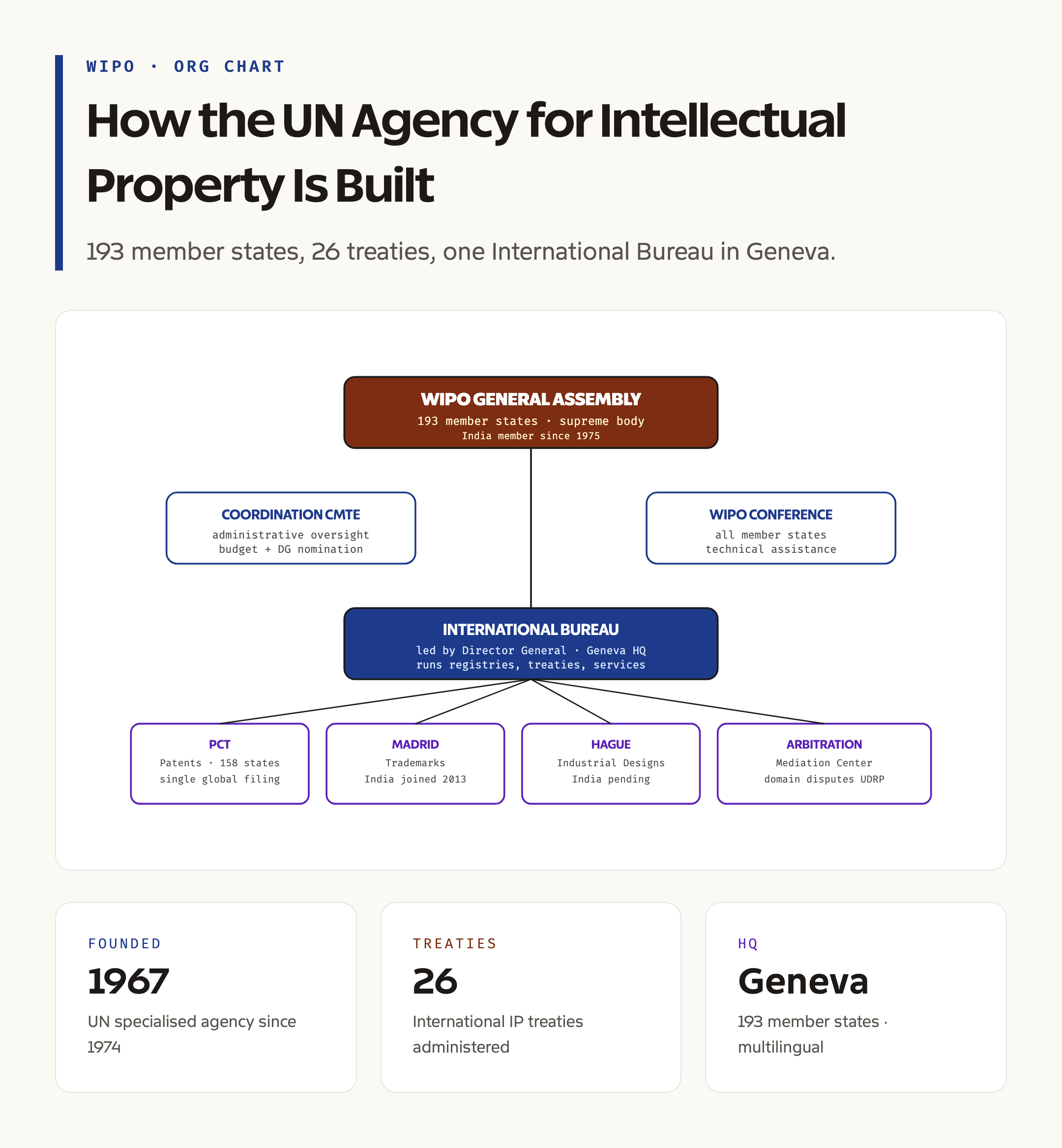
WIPO is a specialised agency of the United Nations, headquartered in Geneva, Switzerland. It was created by the WIPO Convention in 1967 and became a UN specialised agency in 1974. It currently has 193 member states. India has been a member since 1975.
WIPO’s core mandate is to promote the protection of intellectual property worldwide through cooperation among states and, where appropriate, through collaboration with other international organisations. The mandate has three operational arms. The first is treaty administration, where WIPO is the depositary and secretariat for 26 international IP treaties. The second is service delivery, where WIPO runs international registration systems for patents, trademarks, and designs. The third is policy and capacity building, where WIPO supports developing countries in building IP frameworks and runs forums for global IP debate.
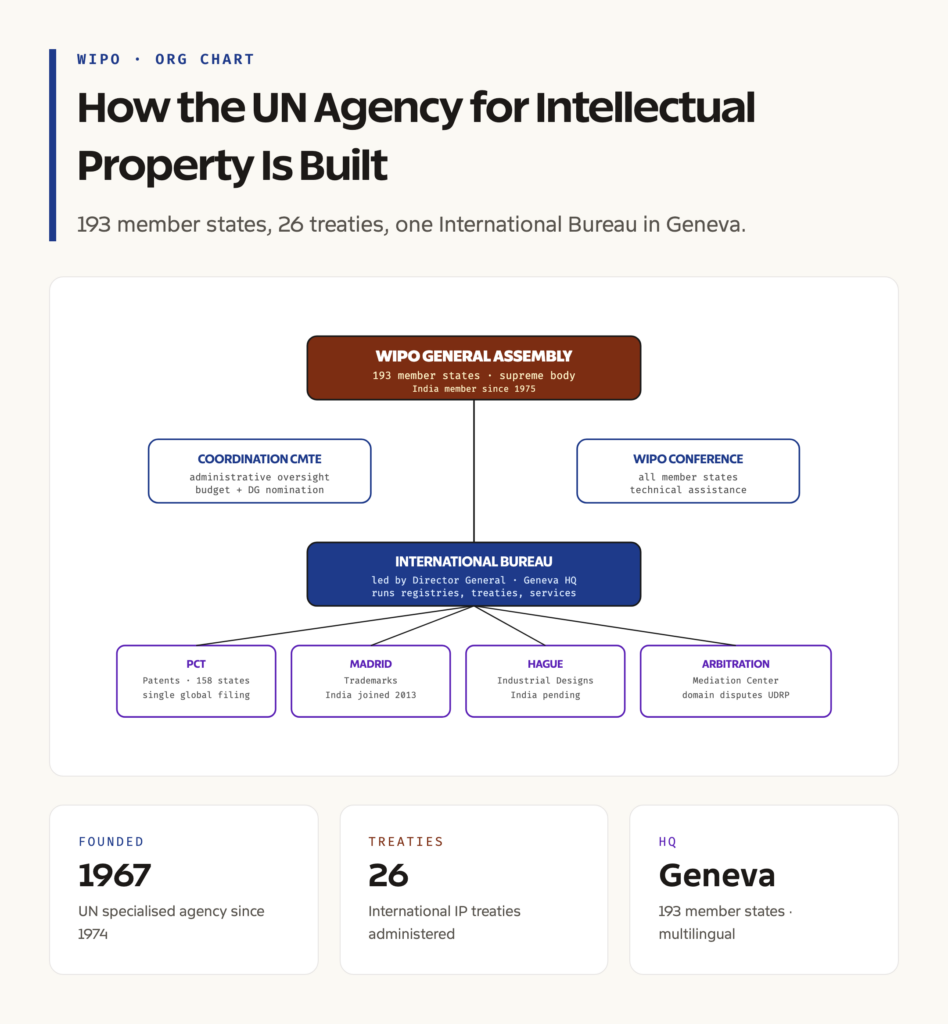
WIPO’s governing structure is built around the General Assembly of all member states, the Coordination Committee, and the WIPO Conference, with day-to-day administration run by an International Bureau headed by the Director General.
What WIPO Actually Does
The most concrete WIPO function is the registry. The Patent Cooperation Treaty, signed in 1970 and in force since 1978, lets an applicant file a single international patent application that has the same legal effect as filing in each of 158 contracting states. The Madrid System for the international registration of marks does the same for trademarks. The Hague System covers industrial designs. The Lisbon System covers appellations of origin and geographical indications.
Indian filers use these systems heavily. Indian inventors filed over twenty thousand PCT applications in 2024. Indian companies and individuals filed thousands of trademark designations through Madrid. The Hague System has been less used by India, partly because India joined late, but participation is rising.
The second function is dispute resolution. The WIPO Arbitration and Mediation Center handles a substantial share of global domain name disputes under the Uniform Domain Name Dispute Resolution Policy. Indian rights holders use the centre regularly to recover infringing domains.
The third function is data and research. WIPO publishes the Global Innovation Index every year, ranking countries on innovation performance. India has climbed steadily on the index, from rank 81 in 2015 to rank 39 in 2024.
The fourth function is the policy forum. WIPO standing committees on patents, copyright, trademarks, and traditional knowledge negotiate the substantive treaty text. The Intergovernmental Committee on Genetic Resources, Traditional Knowledge and Folklore, established in 2000, is the body that produced the 2024 treaty.
The 26 Treaties WIPO Administers
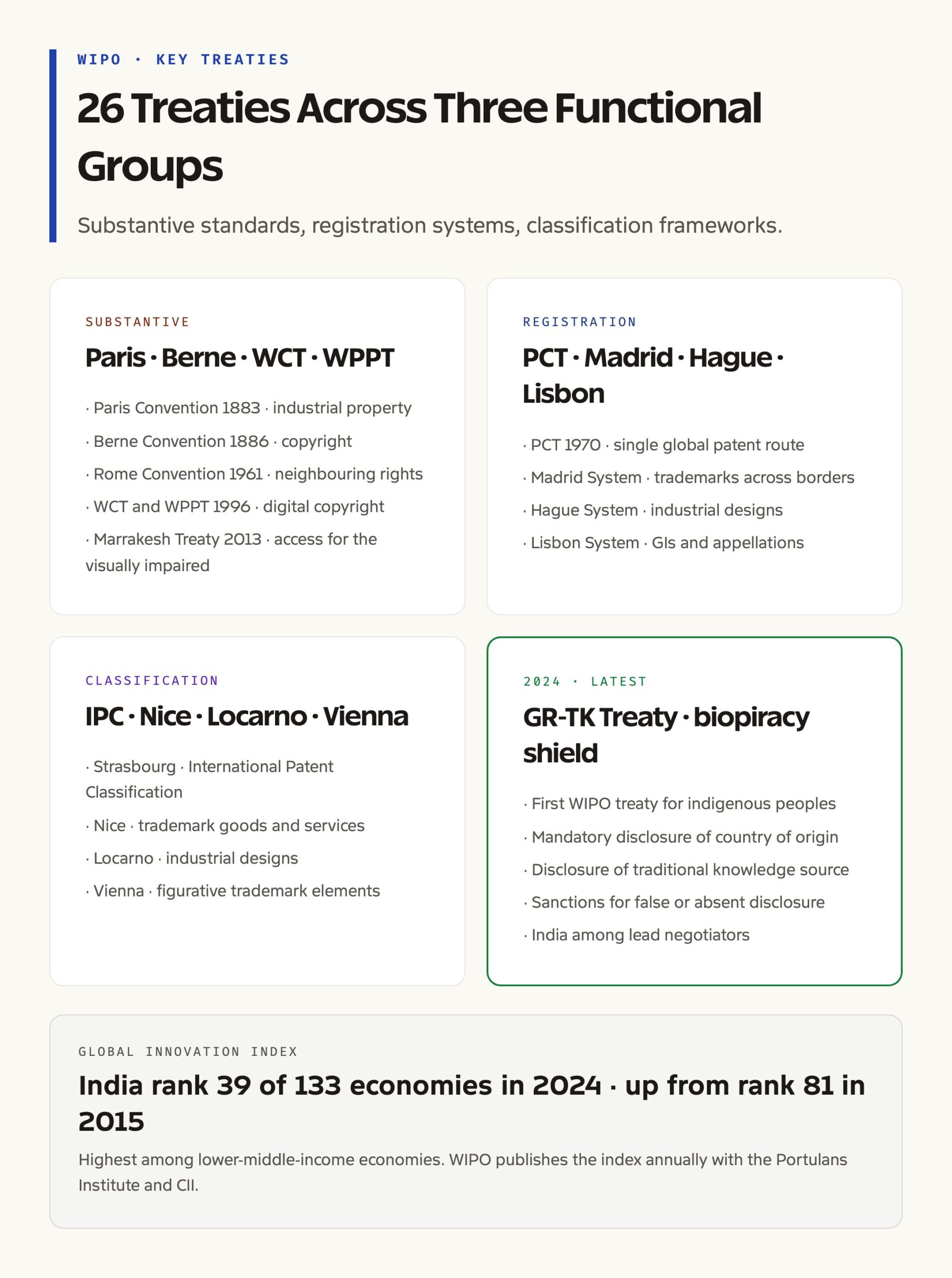
The treaty count of 26 is the standard figure cited in WIPO documents and is worth memorising. The treaties fall into three groups.
The first group sets the substantive standards of intellectual property. The Paris Convention for the Protection of Industrial Property, signed in 1883, covers patents, trademarks, and industrial designs. The Berne Convention for the Protection of Literary and Artistic Works, signed in 1886, covers copyright. The Rome Convention of 1961 covers performers, producers of phonograms, and broadcasting organisations. The WIPO Copyright Treaty and the WIPO Performances and Phonograms Treaty, both 1996, extend these protections to the digital environment.
The second group sets up the global registration systems. The Patent Cooperation Treaty, the Madrid Agreement and Protocol, the Hague Agreement, and the Lisbon Agreement form this group. Each provides a single international filing route into multiple national jurisdictions.
The third group covers classification systems. The Strasbourg Agreement on the International Patent Classification, the Nice Agreement on the classification of goods and services for trademarks, and the Locarno Agreement on the classification of industrial designs let national offices use a single technical taxonomy.
The 2024 Treaty on Intellectual Property, Genetic Resources and Associated Traditional Knowledge is now part of the substantive standards group, though it had not entered into force at the time of writing.
The 2024 Treaty on Genetic Resources and Traditional Knowledge
The 2024 treaty is the first WIPO treaty to include provisions specifically aimed at indigenous peoples and local communities. It is also the first WIPO treaty to address biopiracy directly. It was adopted at a diplomatic conference in Geneva in May 2024, after more than two decades of negotiation in the Intergovernmental Committee.
The core provision is a disclosure requirement. Where an invention claimed in a patent application is based on genetic resources, the applicant must disclose the country of origin or the source of those genetic resources. Where the invention is based on traditional knowledge associated with genetic resources, the applicant must disclose the indigenous peoples or local communities that provided the knowledge or, failing that, the source.
The disclosure requirement is mandatory for contracting parties. A party that joins the treaty must implement domestic legislation to enforce it. Sanctions are required for non-disclosure and for false disclosure. The treaty stops short of allowing patent revocation purely on disclosure grounds, but it builds the documentary base on which downstream remedies can rest.
The treaty addresses the Indian and developing-country grievance about biopiracy. Indian negotiators have for two decades cited cases such as the turmeric, neem, and basmati patents, where Indian traditional knowledge was used in foreign patent applications without acknowledgment or benefit-sharing. India’s response, alongside the diplomatic effort at WIPO, has been the Traditional Knowledge Digital Library, which documents Indian traditional knowledge in the languages used by patent examiners and effectively pre-empts wrongful grants.
India’s Engagement with WIPO
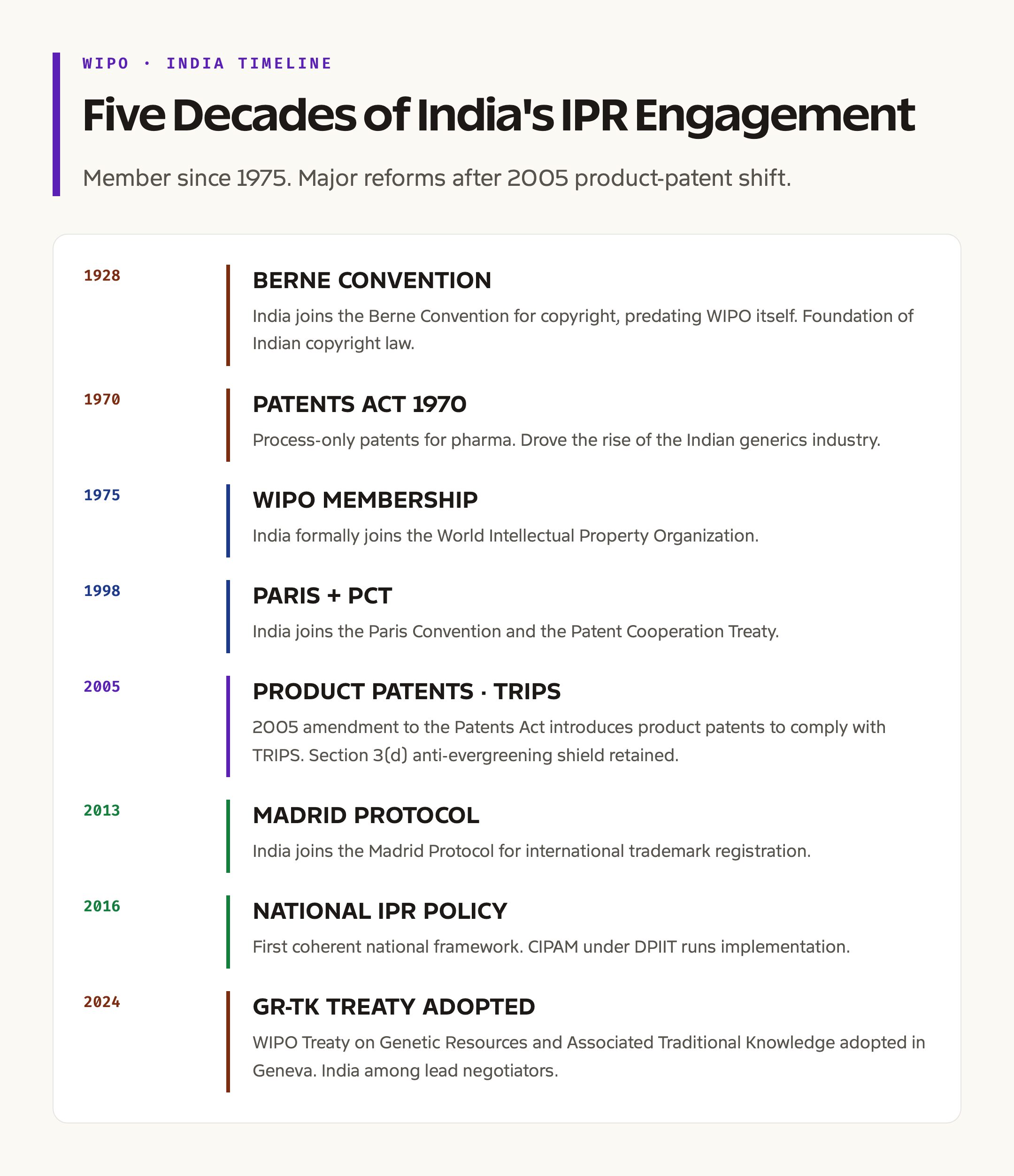
India joined WIPO in 1975. It is a party to most of the major WIPO treaties. India is a member of the Paris Convention since 1998, the Berne Convention since 1928, the Patent Cooperation Treaty since 1998, the Madrid Protocol since 2013, and the WIPO Copyright Treaty since 2018. India is not yet a member of the Hague System for industrial designs but has signalled an intention to join.
India’s domestic IP regime has converged with WIPO standards in stages. The Patents Act of 1970, with its product-patent exclusion for pharmaceuticals, was the foundation. The 2005 amendment introduced product patents to comply with the TRIPS Agreement. The Patents Amendment Rules 2024 refined examination procedures and pre-grant opposition rules.
The National IPR Policy of 2016 set out a coherent national framework for the first time. It covers IP creation, legal and legislative reform, administration and management, commercialisation, enforcement and adjudication, and human capital development. The Cell for IPR Promotion and Management, part of the Department for Promotion of Industry and Internal Trade, runs implementation.
For genetic resources and traditional knowledge, India has been a leading negotiator inside the WIPO Intergovernmental Committee. The 2024 treaty is, in substantial part, a result of two decades of Indian, African, and Latin American advocacy. India is expected to ratify the treaty once domestic implementation legislation is in place.
WIPO and the TRIPS Relationship
The relationship between WIPO and the World Trade Organization‘s Trade Related Aspects of Intellectual Property Rights agreement, known as TRIPS, is a recurring exam question. WIPO predates TRIPS. WIPO sets the international standards. TRIPS, signed in 1994 as part of the Uruguay Round, made compliance with most WIPO substantive standards a condition of WTO membership and added enforcement obligations.
The two regimes are complementary. WIPO writes the rules. TRIPS makes the rules enforceable through WTO dispute settlement. India sits inside both. Indian patent law, copyright law, and trademark law all reflect WIPO standards as channelled through TRIPS.
A formal cooperation agreement between WIPO and the WTO, signed in 1995, covers technical cooperation, legal assistance for developing countries, and joint training programmes for IP officials. The Marrakesh Treaty of 2013, which WIPO administers, is one of the recent additions to the substantive standards and was implemented in India through the 2017 amendment to the Copyright Act.
Global Innovation Index and India’s Climb
The Global Innovation Index, published annually by WIPO with the Portulans Institute and Confederation of Indian Industry as partners, ranks economies on innovation inputs and outputs. The 2024 edition placed India at rank 39 out of 133 economies, the highest ever for India and the highest among lower-middle-income economies. India was rank 81 in 2015. The climb is regularly cited in policy speeches as evidence of the success of the National IPR Policy and the Atal Innovation Mission.
The index uses 78 indicators across seven pillars. India scores particularly well on knowledge and technology outputs, on market sophistication, and on creative outputs. Weak points are infrastructure and human capital. WIPO’s analysis is widely used in domestic IP policy planning.
Why This Matters for the UPSC Syllabus
For prelims, the safe set of facts is that WIPO is a specialised agency of the United Nations, headquartered in Geneva, established in 1967, with 193 member states, administering 26 international treaties. India has been a member since 1975. The 2024 treaty on Genetic Resources and Associated Traditional Knowledge is the latest treaty and the first to include provisions for indigenous peoples.
For mains, WIPO appears in answers on global IP governance, biopiracy, traditional knowledge protection, India’s National IPR Policy, and the WIPO-WTO interface. It pairs with the Traditional Knowledge Digital Library, the Geographical Indications regime, and the Section 3(d) anti-evergreening shield.
Frequently Asked Questions
What is WIPO?
The World Intellectual Property Organization is a specialised agency of the United Nations. It is headquartered in Geneva, was established in 1967, has 193 member states, and administers 26 international intellectual property treaties.
What does the 2024 WIPO treaty on Genetic Resources do?
It introduces a mandatory disclosure requirement. Patent applicants must disclose the country of origin of genetic resources used in an invention and, where applicable, the indigenous peoples or local communities whose traditional knowledge was used. It is the first WIPO treaty to include provisions specifically for indigenous peoples.
Is India a member of WIPO?
Yes. India has been a member of WIPO since 1975 and is a party to most of the major WIPO treaties, including the Paris Convention, the Berne Convention, the Patent Cooperation Treaty, the Madrid Protocol, and the WIPO Copyright Treaty.
How many treaties does WIPO administer?
WIPO administers 26 international treaties covering substantive IP standards, global registration systems, and technical classifications.
How does the WIPO Genetic Resources Treaty address biopiracy?
By forcing disclosure of the source of genetic resources and traditional knowledge in patent applications. The disclosure builds the documentary base needed to challenge wrongful patents and supports benefit-sharing arrangements with provider countries and communities.
Tell Google you want more of this.
Add Anantam IAS as a preferred sourceOne tap, and this site shows up more often in your own Top Stories, AI Overviews and AI Mode. Remove it any time.