ISRO Chairman: Dr V. Narayanan, Appointment, Role and Background
The current ISRO Chairman is Dr V. Narayanan, a propulsion and cryogenic engineer who succeeded S. Somanath on 14 January 2025. Role, appointment, background and UPSC relevance.
The current ISRO Chairman is Dr V. Narayanan, a veteran propulsion and cryogenic engineer who assumed charge on 14 January 2025 as the 11th head of the Indian Space Research Organisation. He succeeded S. Somanath, who had led ISRO through the historic Chandrayaan-3 soft landing and the Aditya-L1 solar mission. Narayanan concurrently serves as Secretary, Department of Space, and Chairman, Space Commission, making him the top civilian authority on India's space programme. His appointment signalled continuity in India's ambitious roadmap, which includes Gaganyaan, Chandrayaan-4, the Bharatiya Antariksh Station, and a planned crewed lunar mission by 2040.
Who Is Dr V. Narayanan
Dr V. Narayanan is a rocket propulsion specialist with nearly four decades at ISRO. He was serving as Director of the Liquid Propulsion Systems Centre (LPSC) in Valiamala, Thiruvananthapuram, before his elevation. LPSC designs the liquid and cryogenic engines that power India's workhorse launchers, including the PSLV, GSLV, and LVM3.
Key facts about Narayanan's profile:
- Educational background: M.Tech and PhD in Cryogenic Engineering from IIT Kharagpur.
- Joined ISRO: 1984, initially with the Vikram Sarabhai Space Centre.
- Known contribution: developing the indigenous CE-20 cryogenic engine used in LVM3, which launched Chandrayaan-3.
- Awards: ASI Gold Medal, numerous national recognitions in aerospace engineering.
His selection followed the standard process by the Appointments Committee of the Cabinet (ACC) for a tenure that is typically two years, extendable.
Role and Powers of the ISRO Chairman
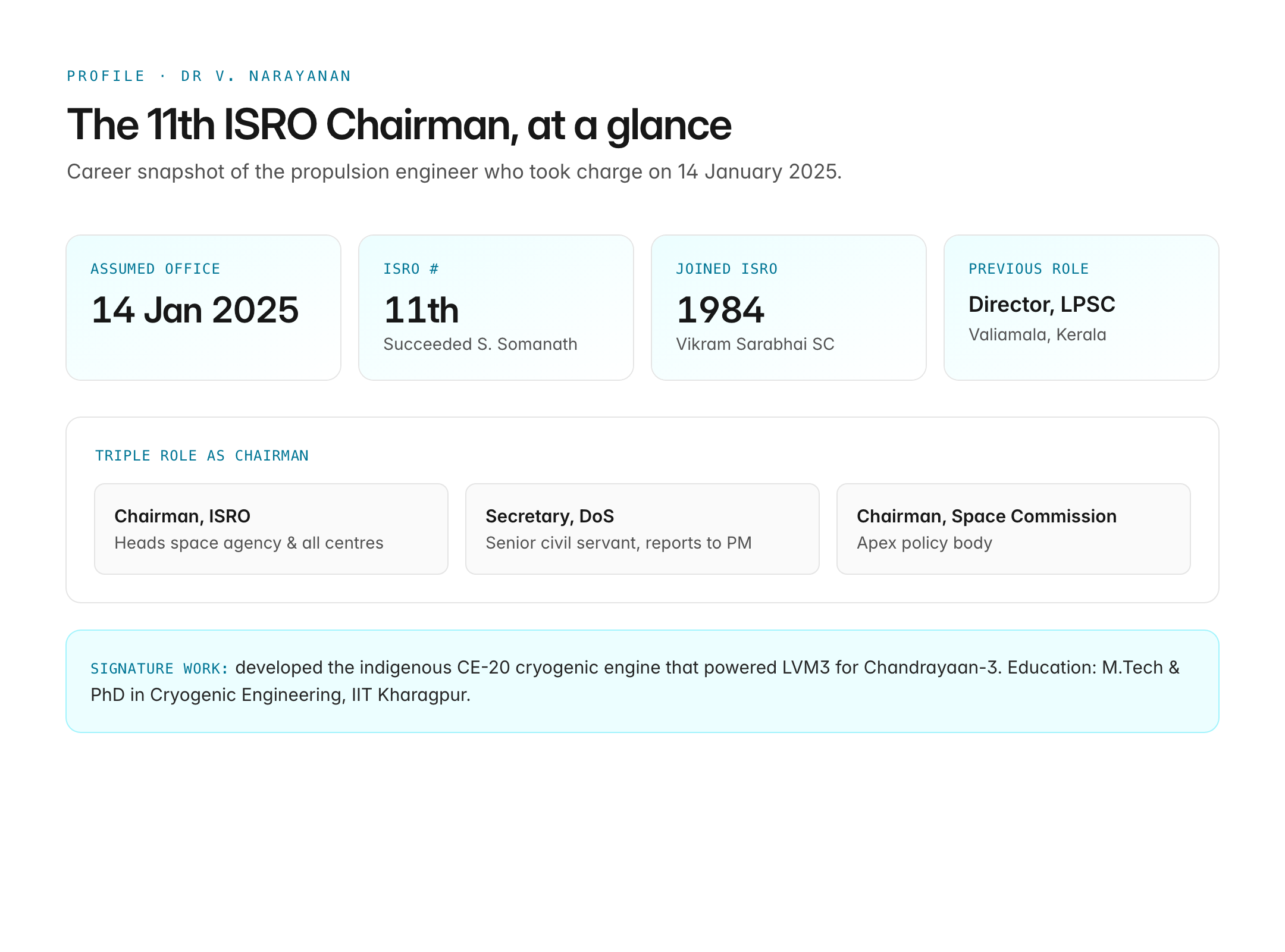
The ISRO Chairman holds a unique triple role that concentrates technical, administrative, and policy authority in one office:
| Role | Responsibility |
|---|---|
| Chairman, ISRO | Heads India's space agency and all operational centres |
| Secretary, Department of Space | Senior-most civil servant in DoS, reports to the PM |
| Chairman, Space Commission | Apex policy body that sets national space strategy |
This structure means the Chairman steers missions, signs international agreements such as NASA–ISRO NISAR, and presents the space budget to Parliament. The Department of Space reports directly to the Prime Minister, giving the office exceptional strategic weight.
List of ISRO Chairmen
Knowing the chronology is useful for Prelims:
| # | Chairman | Tenure |
|---|---|---|
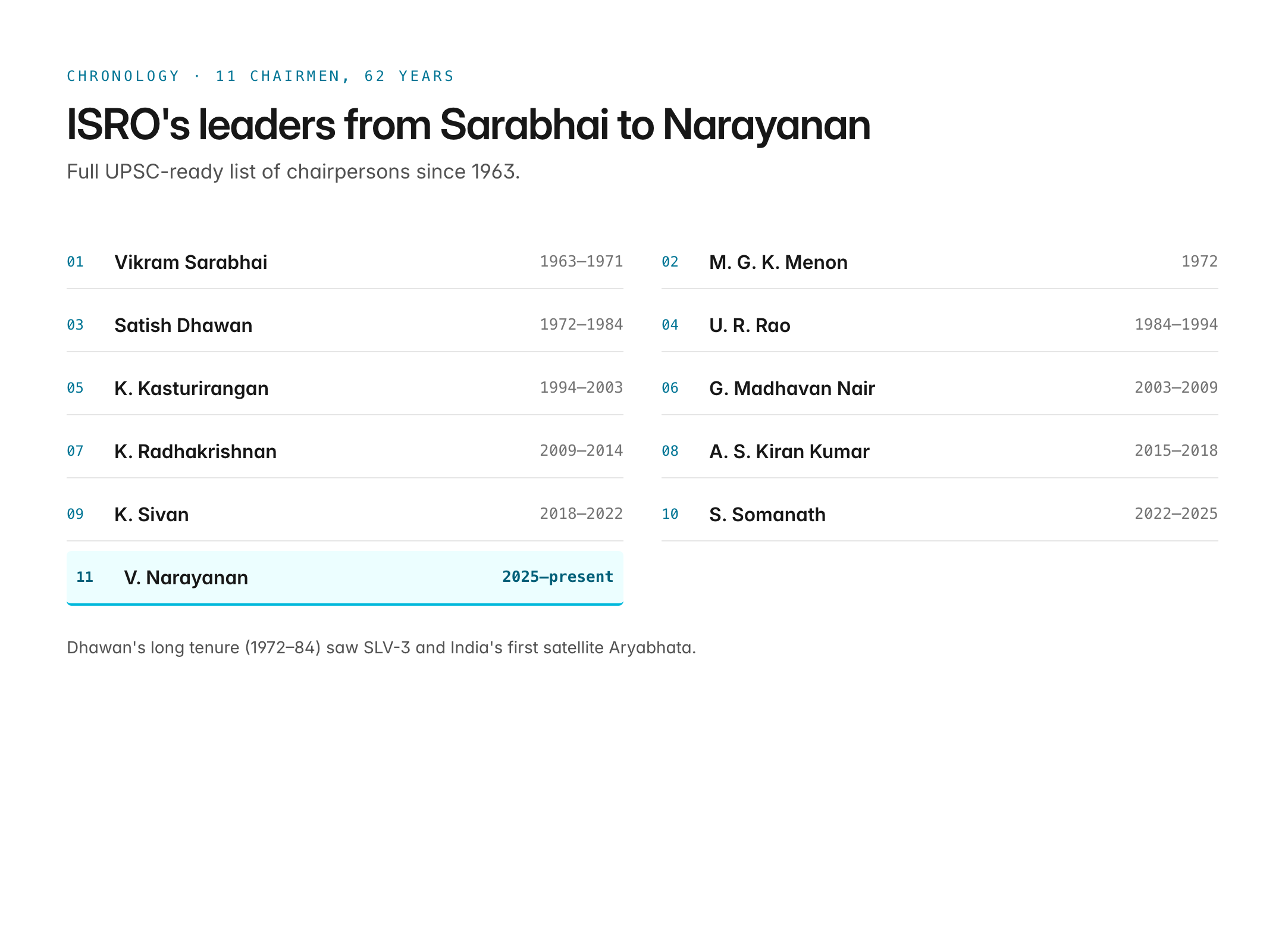
| 1 | Vikram Sarabhai | 1963–1971 |
| 2 | M. G. K. Menon | 1972 |
| 3 | Satish Dhawan | 1972–1984 |
| 4 | U. R. Rao | 1984–1994 |
| 5 | K. Kasturirangan | 1994–2003 |
| 6 | G. Madhavan Nair | 2003–2009 |
| 7 | K. Radhakrishnan | 2009–2014 |
| 8 | A. S. Kiran Kumar | 2015–2018 |
| 9 | K. Sivan | 2018–2022 |
| 10 | S. Somanath | 2022–2025 |
| 11 | V. Narayanan | 2025–present |
Founders Vikram Sarabhai and Satish Dhawan are commonly tested; Dhawan's long tenure included the launch of SLV-3 and India's first satellite Aryabhata.
ISRO's Agenda Under Narayanan
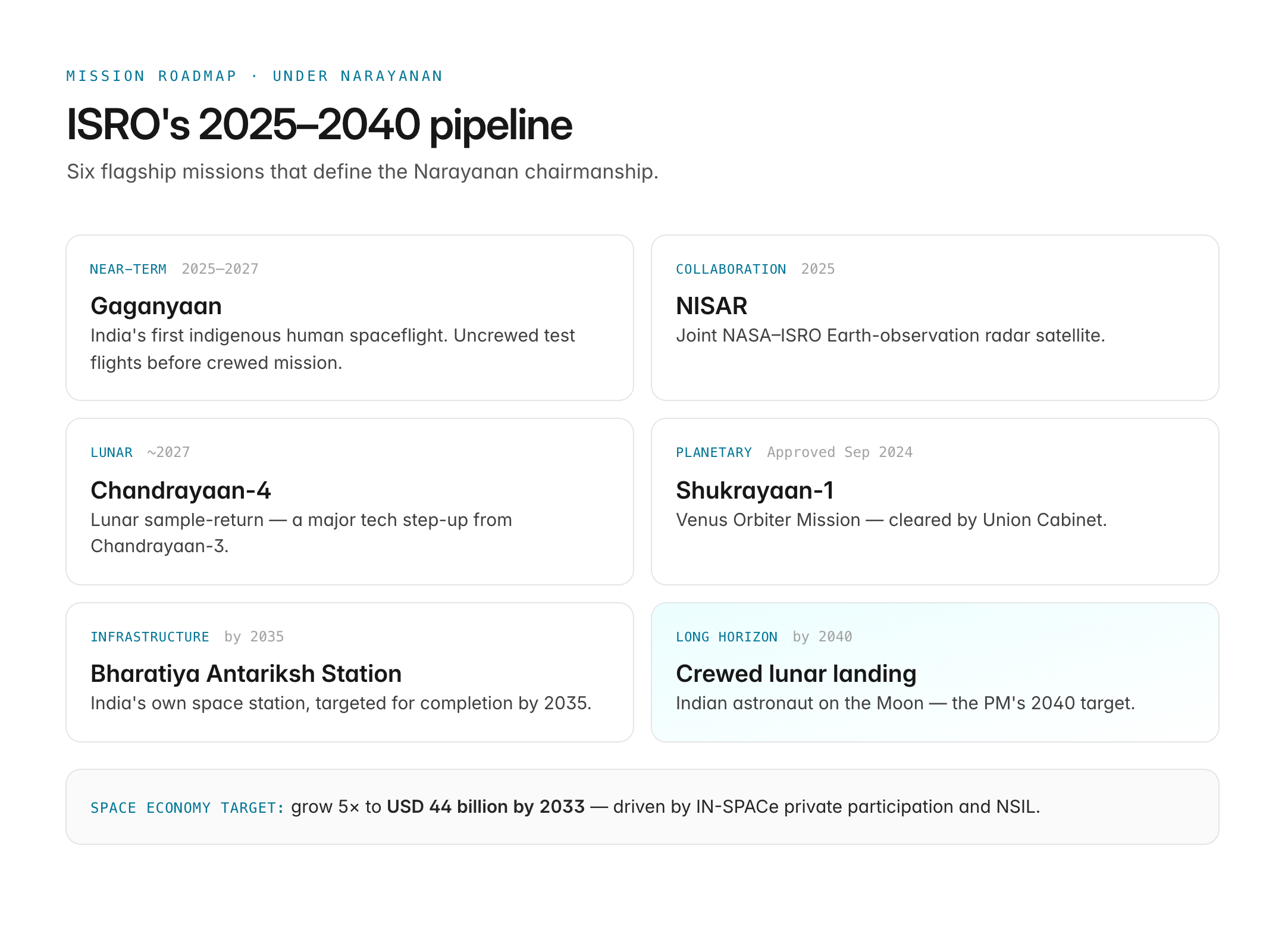
The 2025 chairmanship begins with one of ISRO's most ambitious pipelines. Priority missions include:
- Gaganyaan — India's first indigenous human spaceflight, with uncrewed test flights preceding a crewed mission.
- Chandrayaan-4 — lunar sample-return mission, a major technological step-up.
- Bharatiya Antariksh Station (BAS) — an Indian space station targeted for completion by 2035.
- Venus Orbiter Mission (Shukrayaan-1) — approved by the Union Cabinet in September 2024.
- NISAR — joint NASA–ISRO Earth-observation radar satellite.
- Crewed lunar landing — targeted for 2040 as announced by the Prime Minister.
Narayanan has emphasised propulsion self-reliance, expanded private-sector participation through IN-SPACe, and rapid growth of the NewSpace India Limited (NSIL) commercial arm.
Significance for India's Space Programme
Appointing a propulsion expert at a time when India is scaling up cryogenic and semi-cryogenic engines is strategically significant. Heavy launchers such as LVM3 and the upcoming Next-Generation Launch Vehicle (NGLV) depend on advanced propulsion, and Narayanan's LPSC pedigree aligns the leadership with the technology bottleneck.
His appointment also reinforces the government's emphasis on:
- Atmanirbhar Bharat in strategic technologies.
- Commercialisation of space through startups under IN-SPACe.
- International partnerships with NASA, JAXA, ESA, and Roscosmos.
- Downstream applications in agriculture, disaster management, and telecom.
The Indian space economy is projected by the government to grow fivefold to roughly USD 44 billion by 2033, a target that will hinge significantly on launch-vehicle capability under Narayanan's tenure.
UPSC Relevance
Prelims focus: current ISRO Chairman, date of assumption, predecessor, parent ministry (Department of Space, under PM), headquarters (Bengaluru), and key missions announced in 2024–25 (Gaganyaan, Shukrayaan-1, BAS, NISAR).
Mains GS angle:
- GS III — science and technology, achievements of Indians in indigenisation of technology, space applications.
- GS II — international relations: India's space diplomacy, Artemis Accords signatory status, NISAR collaboration.
- Essay — "Space as the final frontier," technology-led development, self-reliance.
Sample PYQ angle: Past UPSC questions have asked about ISRO's indigenous cryogenic engine development, the role of space technology in socio-economic development, and the implications of space reforms opening the sector to private players. Answers should link Narayanan's propulsion expertise to India's cryogenic self-reliance journey and the 2020 space-sector reforms.