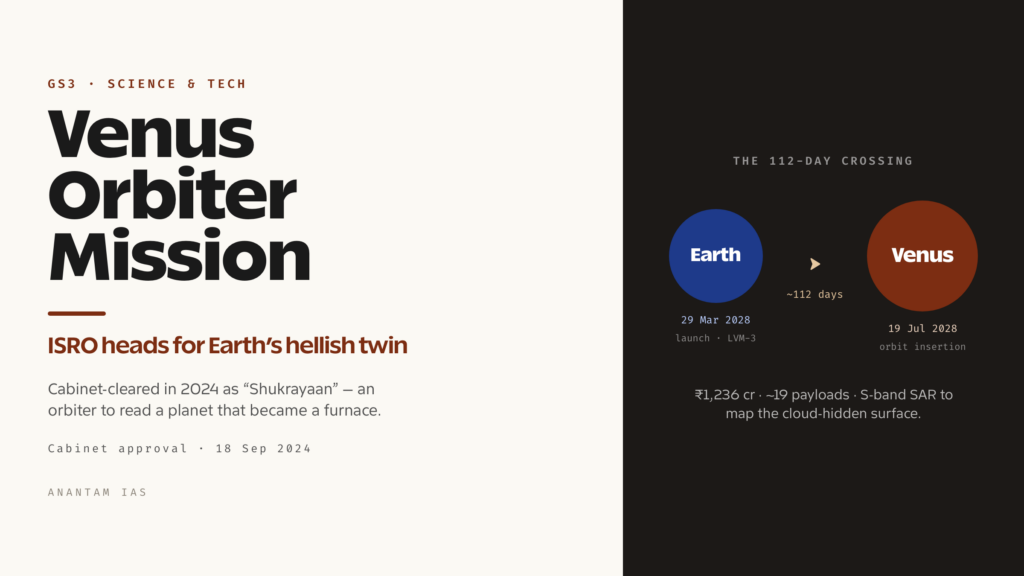
For most of us, Venus is just the bright “evening star” that hangs low after sunset. For ISRO, it’s the next planet on a very deliberate list. In September 2024 the Union Cabinet cleared the Venus Orbiter Mission, informally called Shukrayaan, with an outlay of about Rs 1,236 crore and a target launch in 2028. After the Moon and Mars, India is now formally committing to send a spacecraft to Earth’s nearest planetary neighbour and park it in orbit for years of study.
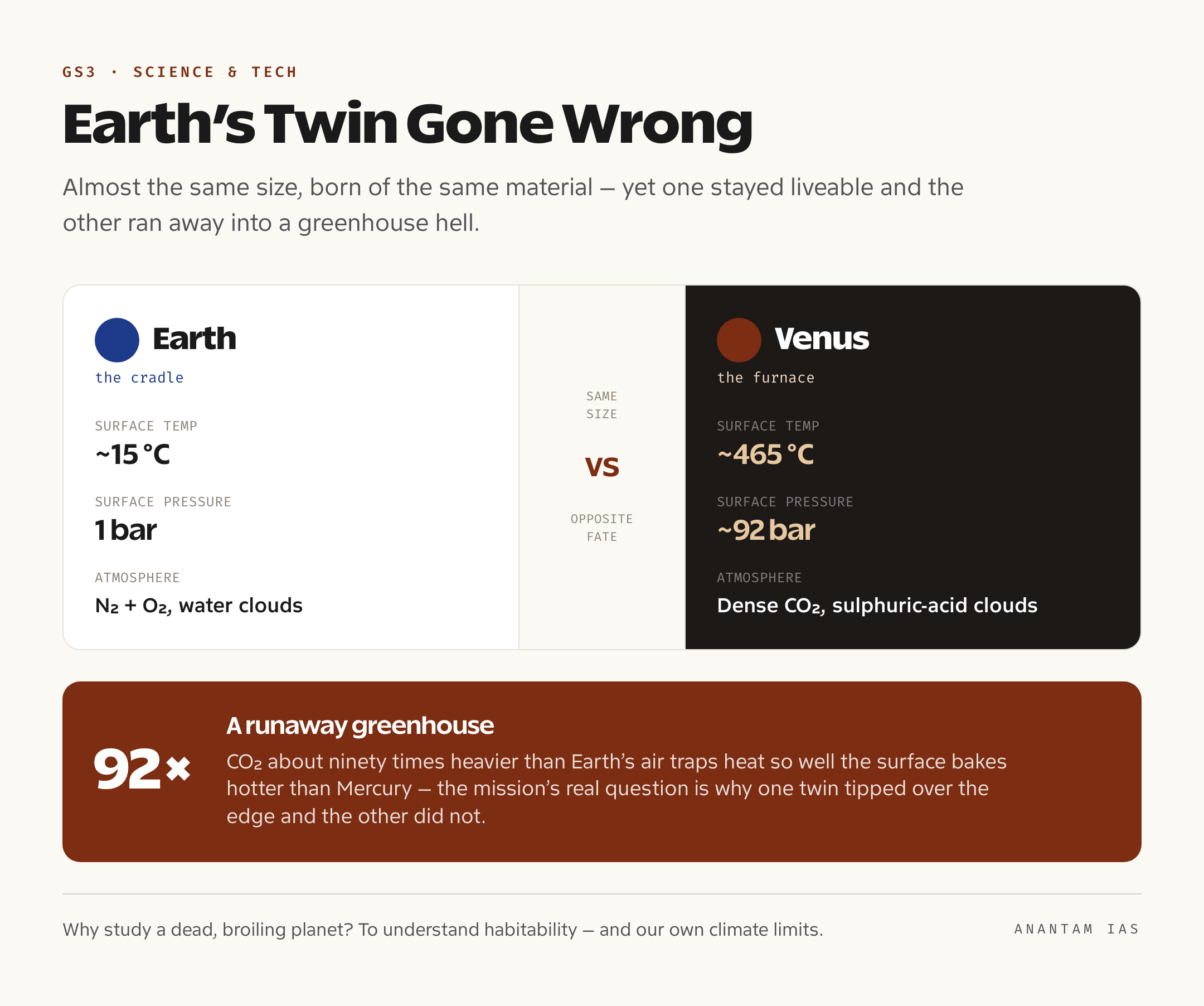
And the choice of Venus is not random. It’s almost exactly Earth’s size and was probably born from the same raw material, yet it turned into a furnace where the surface sits near 465 degrees Celsius and the air crushes down at roughly 92 times Earth’s pressure. So the mission is really a question dressed up as a spacecraft: why did one rocky planet stay liveable while its twin became hell? That question matters for climate science, for the hunt for life beyond Earth, and for India’s standing as a serious deep-space power, which is exactly why it keeps surfacing in UPSC Science and Technology preparation.
What the Venus Orbiter Mission Actually Is
Let’s pin down the basics, because the names get muddled. The official title is the Venus Orbiter Mission, usually shortened to VOM. “Shukrayaan” is the informal nickname the public and the press use, from the Sanskrit Shukra (Venus) and yaana (craft or vehicle), in the same spirit as Chandrayaan for the Moon and Mangalyaan for Mars. ISRO itself tends to say “Venus Orbiter Mission,” so treat Shukrayaan as the popular handle rather than a different project.
It is, as the name says, an orbiter, not a lander. There’s a simple reason for that. The Venusian surface would destroy almost anything you set down on it within hours, so the smart, low-risk way to study the planet is to circle it from above with the right instruments. The spacecraft is designed to enter a wide, stretched-out orbit around Venus and then slowly tighten that orbit until it’s close enough for detailed science. From there it watches the surface, the thick atmosphere and the electrically charged upper layers over an extended mission. The few landers humanity ever managed on Venus, the Soviet Venera probes of the 1970s and 80s, survived only minutes to a couple of hours before the heat and pressure killed them, which is exactly why an orbiter that can work for years is the sensible bet today.
The idea has been on ISRO’s wish-list for years, floated since the mid-2010s and slipped more than once as the agency worked through Chandrayaan and Aditya-L1. What changed in 2024 was money and a mandate. The Cabinet’s approval converted a long-discussed concept into a funded, scheduled mission, with the Department of Space and ISRO directed to build, launch and operate the spacecraft. That distinction matters for an answer: many planetary “missions” you read about are still proposals, whereas Shukrayaan is now a sanctioned programme with a budget line and a launch year.
The Mission Blueprint: Money, Rocket and Timeline
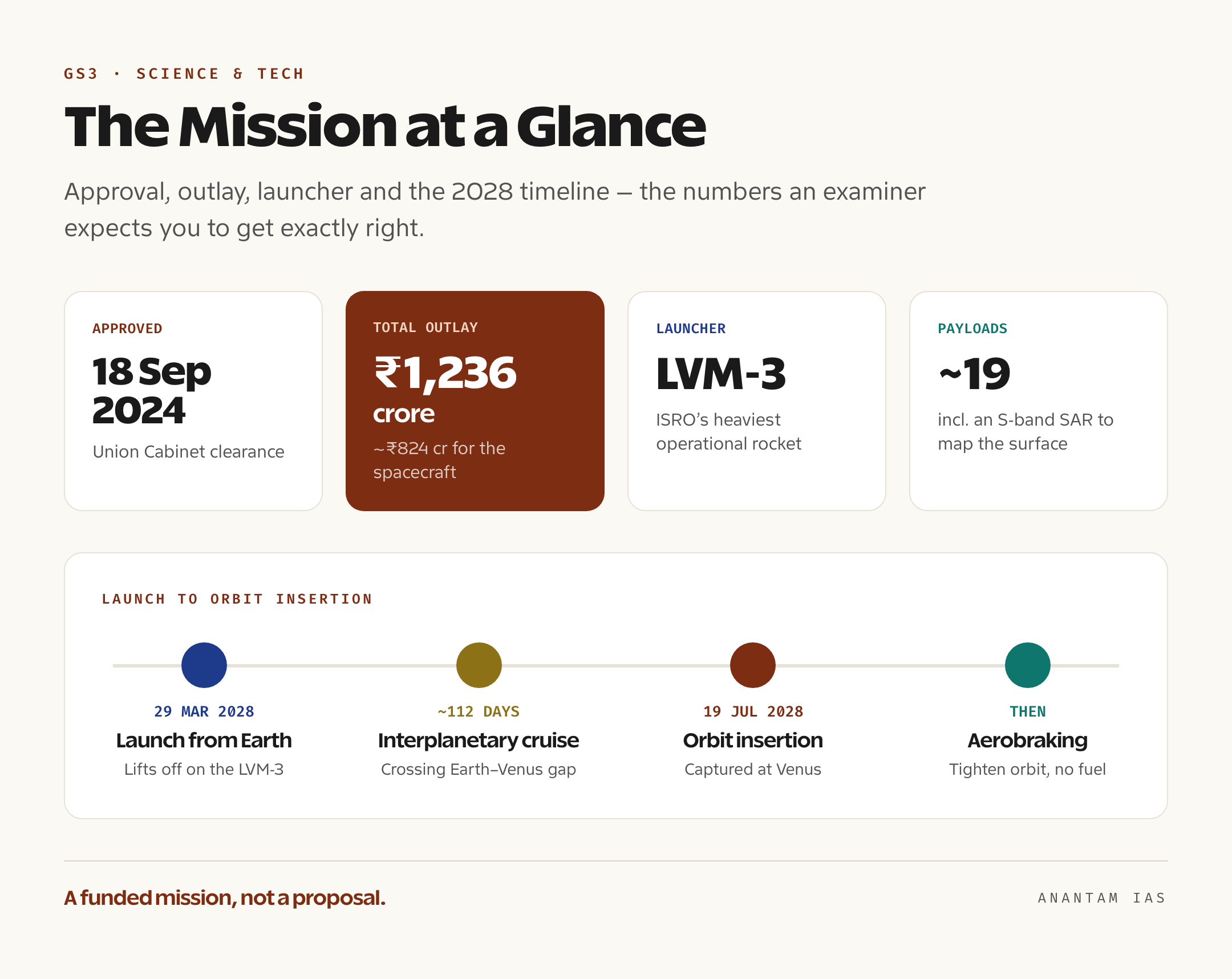
This is the section to get exactly right, because the examiner loves a clean set of numbers. The Cabinet approved the mission on 18 September 2024 with a total outlay of about Rs 1,236 crore. Of that, roughly Rs 824 crore is earmarked for the spacecraft itself, which covers its development, the scientific payloads, and the realisation of specific new technologies. The rest goes towards the launch and the ground systems that fly and track it. So when you quote the cost, the headline figure is Rs 1,236 crore, with the spacecraft accounting for the larger slice.
The ride to space is the LVM-3, ISRO’s heaviest operational rocket (the same Launch Vehicle Mark-3 that lofted Chandrayaan-3 and is rated for human spaceflight under Gaganyaan). Using the heavy launcher matters: Venus is far enough that the spacecraft and its fuel are weighty, so India is sending its most muscular vehicle. ISRO has set the launch for 29 March 2028, with the craft taking around 112 days to cross the gap between the two planets and reaching Venus on about 19 July 2028. The plan is to first capture into a large, elliptical orbit, very roughly 500 kilometres at its closest and tens of thousands of kilometres at its farthest, and then spend months gently lowering it.
That lowering is done by a technique called aerobraking, and it’s worth understanding because it’s half the point of the mission. Instead of burning expensive fuel to shrink the orbit, the spacecraft is allowed to skim the very top of Venus’s atmosphere on each pass; the faint drag of that air slowly bleeds off speed and tightens the loop over many orbits, easing the craft down towards a tighter science orbit a few hundred kilometres up. It saves enormous amounts of propellant, but it’s delicate, since you’re deliberately flying a spacecraft into an atmosphere thick enough to be useful and dangerous in the same breath.
One more timing point that’s easy marks. You can’t launch to Venus on any random date. Because both planets are moving, a fuel-efficient transfer is only possible when Earth and Venus line up in a favourable geometry, and those windows recur only about once every nineteen months, with especially efficient ones spaced years apart. That’s why the date is locked to 2028 rather than “whenever ready,” and why a slip doesn’t just cost weeks, it can cost the better part of two years. ISRO’s earlier target had been in the early 2020s; the planetary clock, as much as engineering, pushed the mission to its current slot.
What Shukrayaan Will Study, and Why Venus Is So Strange
So what is the spacecraft actually looking for? ISRO frames the science around three broad goals: read the planet’s surface and what lies just beneath it, understand its dense and restless atmosphere, and watch how the Sun interacts with Venus’s outer, electrically charged layers. To do that, the orbiter is being built to carry a suite of around nineteen scientific payloads, most of them developed in India, alongside a couple of collaborative and international instruments. You don’t need to memorise the full list; you need to understand what kind of instruments they are and the problem each one solves.
The single most important tool is a synthetic aperture radar, an Indian-built S-band instrument designed to map the surface. Why radar and not a camera? Because Venus is permanently wrapped in cloud, so ordinary cameras see only an unbroken white shroud. Radar pulses punch through the clouds and bounce off the ground, letting the spacecraft draw a detailed map of mountains, plains and possible volcanoes, and even detect whether the surface is changing, a hint of active volcanism. Other payloads probe the atmosphere’s chemistry and movement, study the high-altitude haze and lightning, and a plasma package measures the particles streaming off the Sun and how they strip gas from the top of the atmosphere. Together they’re meant to read Venus as a system, from the rock up to the edge of space.
And the planet they’re reading is genuinely bizarre. Venus is almost Earth’s twin in size and mass, yet its atmosphere is a runaway-greenhouse nightmare: a blanket of carbon dioxide about ninety times heavier than ours, topped by thick clouds of sulphuric acid rather than water. That heavy carbon dioxide traps heat so efficiently that the surface bakes at around 465 degrees Celsius, hot enough to melt lead, hotter even than Mercury despite Venus being farther from the Sun. Stranger still, the whole atmosphere spins right around the planet in roughly four Earth-days while the solid planet itself turns once in about 243, a runaway gale called super-rotation that scientists still can’t fully explain. Studying it from up close is one of Shukrayaan’s quiet ambitions.
The deepest reason to go, though, is comparative. Earth and Venus likely started as near-siblings, and one became a cradle for life while the other ran away into a greenhouse hothouse. There’s a live debate about whether Venus once had liquid-water oceans and a temperate spell before its carbon dioxide tipped the climate over an edge it could never come back from, and there have even been disputed claims of phosphine, a gas that on Earth is linked to life, high in its clouds. An orbiter can’t settle those arguments on its own, but better maps of the surface and a closer read of the atmosphere feed directly into them. Working out where and why the two planets’ paths split tells us something uncomfortable and useful about our own world’s climate limits, and it sharpens how scientists judge the thousands of Earth-sized exoplanets now being found, since a world at the right distance from its star can still turn out to be a Venus, not an Earth. So a mission to a dead, broiling planet is, oddly, partly about understanding life and habitability.
How Shukrayaan Fits ISRO’s Bigger Story
Shukrayaan didn’t appear out of nowhere; it’s the next logical step in a planetary programme that has been building for two decades. ISRO announced itself as an interplanetary player in 2013 with the Mars Orbiter Mission, popularly Mangalyaan, which reached Mars on its first attempt and at a cost so low it became a global talking point. The Chandrayaan series carried the lunar story forward, culminating in Chandrayaan-3’s 2023 soft landing near the Moon’s south pole, a feat no country had managed in that region. Aditya-L1, parked at a vantage point about 1.5 million kilometres towards the Sun, added solar observation to the portfolio. Venus is the missing neighbour on that map, and Shukrayaan fills the gap.
It also sits inside a much larger national roadmap. India has committed to the Gaganyaan human-spaceflight programme, with a first crewed flight targeted around 2027 and uncrewed test flights leading up to it. Beyond that lie the Bharatiya Antariksha Station, India’s own space station planned in stages through about 2035, the sample-return Chandrayaan-4, and a long-horizon goal of an Indian crewed Moon landing by 2040. Shukrayaan is the deep-space, robotic-science strand of that wider ambition: it keeps ISRO’s planetary muscles working while the headline-grabbing human programme matures.
It’s worth seeing where India fits among others looking at Venus, because the examiner may ask for global context. Venus has not been a crowded destination lately, but interest is reviving. The European Space Agency’s Akatsuki was actually built by Japan’s space agency JAXA and has been orbiting since 2015; Europe’s earlier Venus Express studied the planet through the 2000s. Now NASA has two missions in the pipeline, DAVINCI, a probe that will plunge through the atmosphere, and VERITAS, a radar mapper, while ESA is preparing EnVision. India’s Shukrayaan adds an independent orbiter to that revival. Crucially, it leans on international collaboration too: Sweden’s Institute of Space Physics is contributing a particle instrument, with French, German and other partners involved, the same model of cost-sharing science that made Mangalyaan and Chandrayaan affordable.
Significance, and the Hard Parts
The strongest case for Shukrayaan is capability, not just curiosity. Reaching Venus and operating there forces ISRO to master skills that pay off across every future deep-space mission: precise interplanetary navigation across more than a hundred days of flight, a clean orbit-insertion burn at a distant planet, thermal management close to the Sun, and especially aerobraking, which India has not done at another planet before. Treating the mission as a technology demonstrator, where the orbit-lowering and survival techniques are themselves a deliverable, is a smart way to frame its value. And it does all this at a fraction of what comparable Western missions cost, extending India’s reputation for frugal, reliable space engineering.
There’s a softer payoff too. A funded Venus mission helps anchor international partnerships, gives Indian universities and the growing private space sector real planetary-science work, and feeds directly into climate research at a moment when understanding greenhouse extremes is anything but academic. For a country positioning itself as a science-and-technology leader, planting a flag at Earth’s twin is a statement of intent as much as a research project.
But the difficulties are real and worth stating plainly. Venus is a hostile place to work near; the heat, pressure and corrosive clouds make even an orbiter’s job harder than at Mars, and aerobraking through that atmosphere carries genuine risk. The 2028 launch is tied to a planetary window, so any slip in building and testing the instruments could push the whole mission by roughly nineteen months, and this programme has already drifted once before. Several payloads are still in development, and an orbiter is only as good as the instruments it carries. So the honest read is that Shukrayaan is ambitious and credible, but not guaranteed; its success will hinge on engineering discipline and on hitting that narrow March-2028 door.
For Your Mains Answer
This topic sits squarely in GS Paper 3, under “developments in science and technology” and “achievements of Indians in science and technology; indigenisation of technology and developing new technology,” with a clear space-programme focus. It can also feed a GS Paper 2 angle on international cooperation, given the partnerships involved, and supply a crisp factual example in the Essay paper on science, ambition or India’s global standing. The trick is to treat Shukrayaan not as a stand-alone “news” item but as a window into India’s whole space strategy.
How to Build the Answer
Lead with what it is and the date and cost, then move outward: scientific objectives, where it fits in ISRO’s planetary arc, why Venus is scientifically valuable, and finally significance balanced against challenges. Anchor the answer in concrete details, the Rs 1,236 crore outlay, the LVM-3, the 2028 launch, aerobraking, the synthetic aperture radar, rather than vague praise. A strong answer reads like an informed brief, not a press release.
Common Mistakes to Avoid
Don’t confuse Shukrayaan with a lander or a sample-return mission; it’s an orbiter. Don’t muddle the figures, the total is about Rs 1,236 crore, not the spacecraft-only Rs 824 crore. Don’t call Venus the “morning planet” and leave it there; show you know the runaway-greenhouse science. And don’t present the mission as flawless, an answer that ignores delays, the harsh environment and instrument readiness reads as uncritical.
A Compact Answer Spine
Cabinet-approved 2024 orbiter to Venus (Rs 1,236 crore, LVM-3, launch 2028) → goals: surface, atmosphere, Sun-Venus interaction → why Venus: Earth-twin gone runaway-greenhouse, 465 C, 92 bar → fits ISRO’s arc (Mangalyaan, Chandrayaan, Aditya-L1) and the Gaganyaan-to-station roadmap → significance: low-cost interplanetary capability, aerobraking and deep-space navigation, climate and habitability science, international collaboration → challenges: harsh environment, narrow launch window, possible delays → conclusion: a credible, capability-building leap, contingent on execution.
Diagram or Flowchart Idea
Sketch a simple flight-path arrow from Earth (March 2028) to Venus (July 2028, 112 days), then a small spiral labelled “aerobraking” tightening from a wide elliptical orbit to a close science orbit. Add a side box listing the three science goals (surface, atmosphere, Sun interaction). A clean process diagram like this signals understanding and is fast to draw.
A Balanced-Conclusion Line
Something like: “Shukrayaan turns a long-held aspiration into a funded mission, and if ISRO clears the 2028 window and the aerobraking challenge, it will deepen both India’s interplanetary capability and the world’s understanding of why Earth’s twin became uninhabitable.”
How to Use Data Without Cramming
Pick three or four numbers and use them with purpose: Rs 1,236 crore (outlay), 2028 (launch), 465 degrees Celsius and about 92 bar (the Venus extremes that justify the mission), and 19 months (the launch-window rhythm). Each number should make a point, the cost shows frugality, the temperature shows scientific stakes, the window shows why timing is unforgiving. That beats listing every payload from memory.
FAQ
What is the Venus Orbiter Mission (Shukrayaan)? It is ISRO’s planned mission to send a spacecraft into orbit around Venus to study the planet’s surface, atmosphere and its interaction with the Sun. The Union Cabinet approved it in September 2024 with an outlay of about Rs 1,236 crore, and “Shukrayaan” is the informal nickname, from Shukra (Venus) and yaana (craft).
When will Shukrayaan launch and how will it get to Venus? ISRO has targeted a launch on 29 March 2028 using the LVM-3, its heaviest operational rocket. The spacecraft is expected to take about 112 days to reach Venus, arriving around 19 July 2028, after which it will use aerobraking, skimming the upper atmosphere to slowly tighten its orbit, instead of burning large amounts of fuel.
Why is ISRO going to Venus and not somewhere else? Because Venus is nearly Earth’s twin in size yet became a runaway-greenhouse furnace, with a surface near 465 degrees Celsius and pressure about 92 times Earth’s. Understanding why the two planets diverged informs Earth’s own climate science and the search for habitable worlds, making Venus one of the most scientifically valuable nearby targets.
How does Shukrayaan fit into India’s space programme? It is the next step in ISRO’s planetary programme after the Mars Orbiter Mission (Mangalyaan, 2013), the Chandrayaan lunar missions and Aditya-L1, and it runs alongside the larger roadmap of Gaganyaan human spaceflight, the planned Bharatiya Antariksha Station and Chandrayaan-4. It keeps India’s deep-space and robotic-science capability advancing while the human-spaceflight programme matures.
Practice Questions
Prelims MCQs
- With reference to ISRO’s Venus Orbiter Mission (informally Shukrayaan), consider the following statements about its key parameters: it was approved by the Union Cabinet in 2024; it is planned to be launched on the PSLV; and it is designed primarily as a lander on the Venusian surface.
How many of the above statements are correct?
(a) Only one
(b) Only two
(c) All three
(d) None
Answer: (a) Only the 2024 Cabinet approval is correct; the mission uses the LVM-3, not the PSLV, and it is an orbiter, not a lander. - The Venus Orbiter Mission is intended to be launched on which Indian launch vehicle?
(a) PSLV-XL
(b) GSLV Mk-II
(c) LVM-3
(d) SSLV
Answer: (c) ISRO has identified the LVM-3, its heaviest operational launcher, as the vehicle for the mission. - Consider the following about the planet Venus: its surface temperature is around 465 degrees Celsius; its atmosphere is dominated by carbon dioxide with sulphuric-acid clouds; and its surface pressure is roughly 92 times that of Earth.
Which of the statements are correct?
(a) 1 and 2 only
(b) 2 and 3 only
(c) 1 and 3 only
(d) 1, 2 and 3
Answer: (d) All three are correct and together describe the runaway-greenhouse conditions on Venus. - The technique of “aerobraking,” relevant to the Venus Orbiter Mission, refers to which of the following?
(a) Using a parachute to land on the surface
(b) Using atmospheric drag to gradually lower and tighten a spacecraft’s orbit
(c) Firing engines to escape a planet’s gravity
(d) Cooling instruments using onboard radiators
Answer: (b) Aerobraking uses repeated passes through the upper atmosphere so drag slowly reduces orbital speed, saving fuel. - Which of the following correctly pairs an ISRO mission with its target?
(a) Mangalyaan – the Moon
(b) Aditya-L1 – Mars
(c) Chandrayaan-3 – the Moon
(d) Shukrayaan – the Sun
Answer: (c) Chandrayaan-3 landed near the Moon’s south pole; Mangalyaan went to Mars, Aditya-L1 studies the Sun, and Shukrayaan targets Venus.
Mains Practice Questions
- “India’s Venus Orbiter Mission is as much a technology demonstrator as a science mission.” Discuss the key technological capabilities the mission seeks to develop and their value for India’s future deep-space programme. (15 marks, 250 words)
- Examine the scientific rationale for studying Venus, and explain how understanding Earth’s “twin” can inform climate science and the search for habitable worlds. (15 marks, 250 words)
- Trace the evolution of India’s planetary exploration programme from the Mars Orbiter Mission to the Venus Orbiter Mission, and assess how these missions advance India’s standing in global space science. (15 marks, 250 words)
- International collaboration has been central to India’s low-cost interplanetary missions. Discuss this with reference to the Venus Orbiter Mission and ISRO’s broader approach to cost-effective space exploration. (10 marks, 150 words)
- The Venus Orbiter Mission faces significant technical and scheduling challenges. Critically analyse these challenges and suggest how ISRO can manage the risks of an interplanetary mission to a hostile planet. (10 marks, 150 words)
Tell Google you want more of this.
Add Anantam IAS as a preferred sourceOne tap, and this site shows up more often in your own Top Stories, AI Overviews and AI Mode. Remove it any time.