Kaveri Engine DRDO: India’s Indigenous Aero-Engine Programme Explained
Kaveri Engine DRDO is GTRE's indigenous aero-engine programme for Indian fighter jets. History, dry/wet thrust, Kaveri Dry Engine for Ghatak UCAV, Safran tie-up, UPSC notes.
The Kaveri is India’s indigenous fighter-class jet engine, developed by DRDO’s Gas Turbine Research Establishment (GTRE) since 1989. Originally meant to power the Tejas Light Combat Aircraft, it was formally delinked from Tejas in 2008 and now lives on as the non-afterburning Kaveri Dry Engine (also called the Kaveri Derivative Engine, KDE), being readied to power the Ghatak stealth combat drone.
The Kaveri Engine DRDO programme is India’s longest-running attempt at building a fighter-class aero-engine entirely at home. It began in 1989 at the Gas Turbine Research Establishment (GTRE) in Bengaluru, was meant to power the Light Combat Aircraft Tejas, missed that target, was officially delinked from Tejas in 2008, and has since been reborn as the Kaveri Dry Engine (KDE) intended to power the stealth unmanned combat air vehicle Ghatak. Few defence projects compress as much aspiration, frustration, and learning into one acronym.
For UPSC aspirants, the Kaveri Engine DRDO story is the canonical case study of indigenous high-technology development. It cuts across Science and Technology (gas turbine design, single-crystal blades, metallurgy), Defence and Security (combat aircraft self-reliance, AMCA roadmap), and Economy (sanctions, technology denial regimes, dual-use exports). It also explains why India is now talking to Safran of France about a 100 percent technology-transfer co-development for a sixth-generation engine.
This piece walks through what the Kaveri actually is, why it took so long, what works and what does not, and where the programme stands now under the Aeronautical Development Agency umbrella.
Quick Facts at a Glance
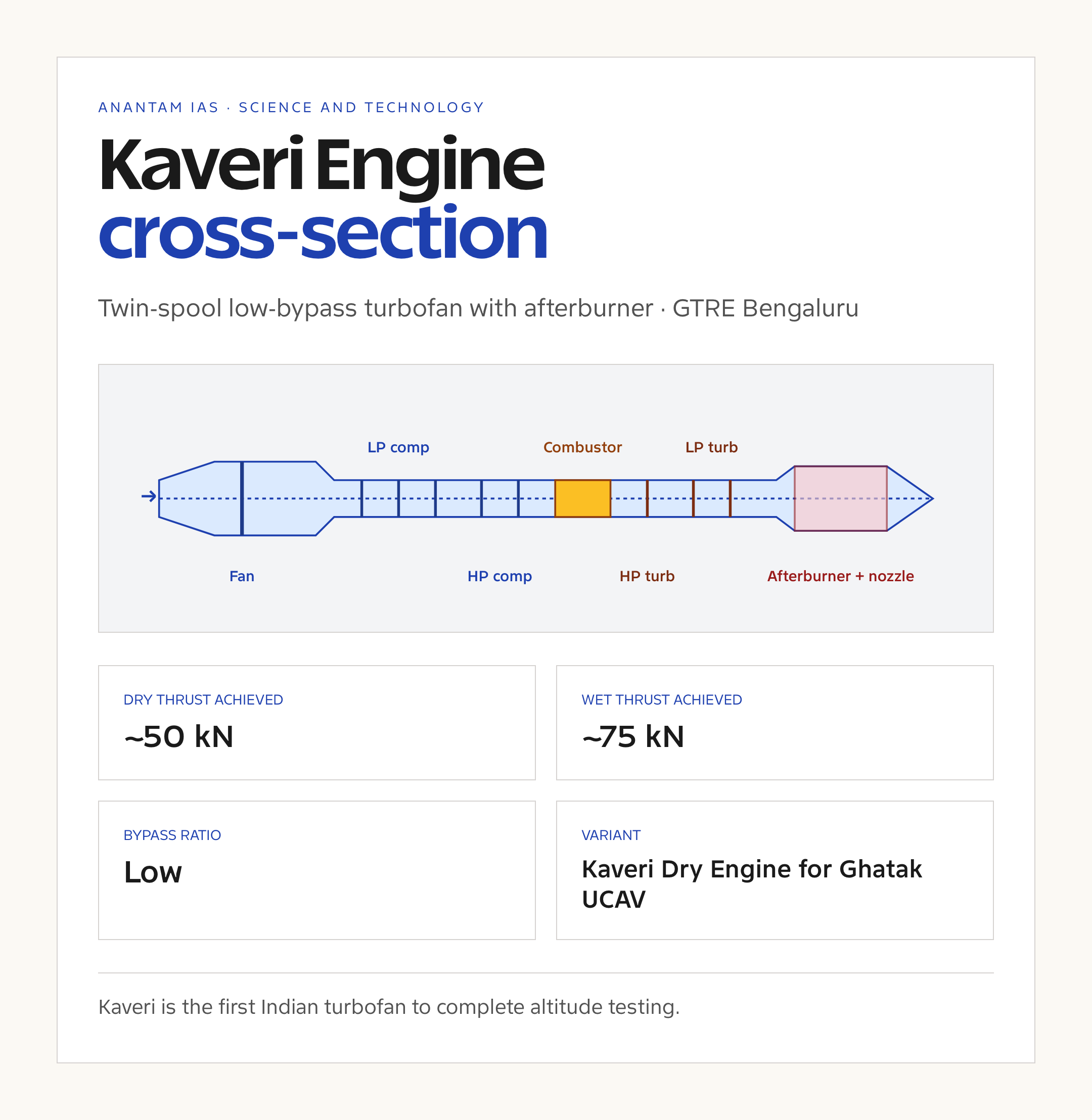
- Programme: Kaveri (GTX-35VS) gas turbine engine
- Lead agency: Gas Turbine Research Establishment (GTRE), DRDO, Bengaluru
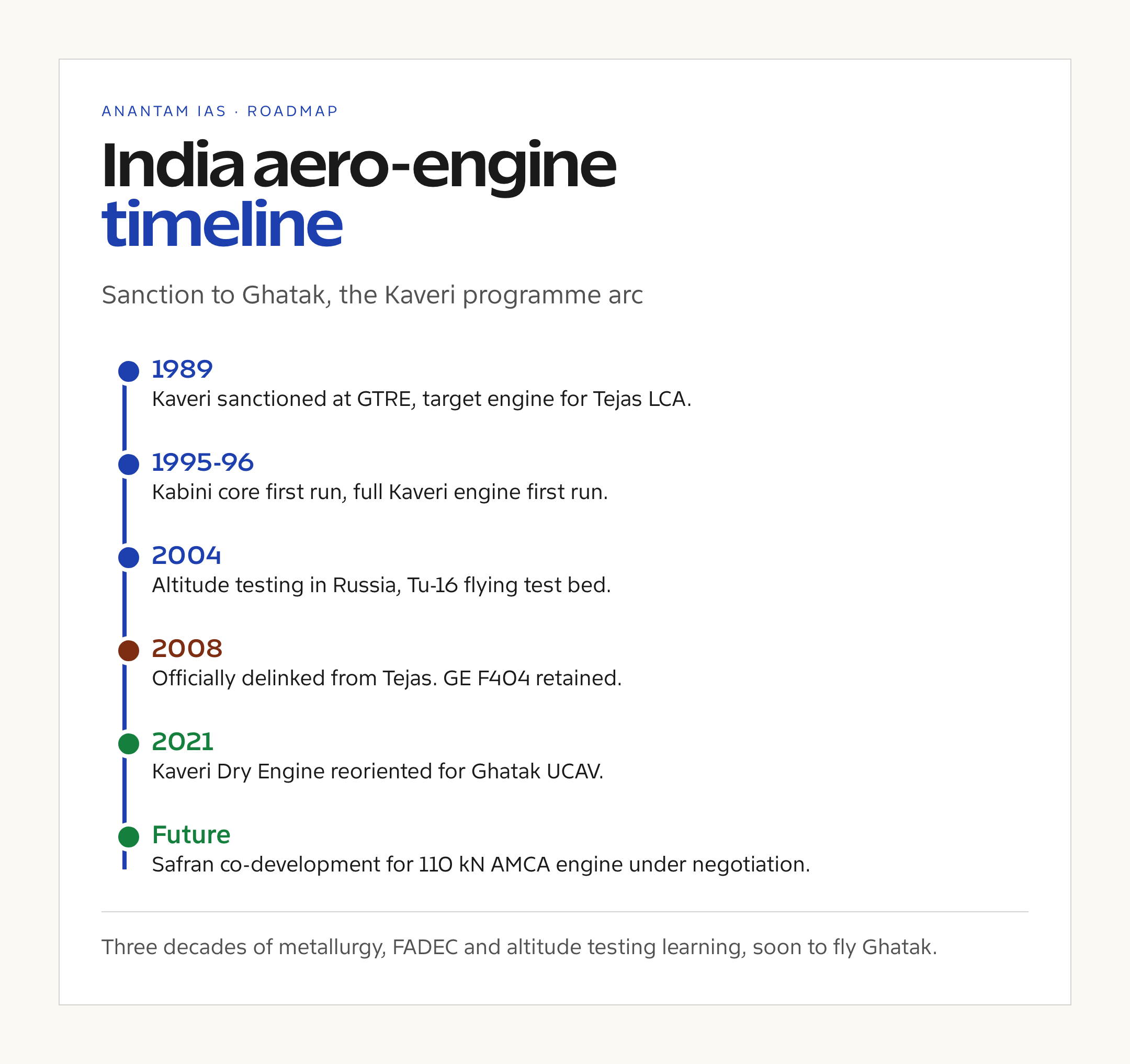
- Sanctioned: 1989
- Original target: Power the Tejas Light Combat Aircraft
- Configuration: Twin-spool, low-bypass turbofan with afterburner
- Dry thrust achieved: roughly 49 to 52 kN on test
- Wet (reheat) thrust: about 70 to 75 kN, short of the Tejas requirement of around 80 to 85 kN
- Status: Delinked from Tejas in 2008; reoriented to Kaveri Dry Engine for Ghatak UCAV
- Joint development partner: Safran (France) under discussion for a new high-thrust engine
- Strategic relevance: First Indian engine to undergo full high-altitude testing
- Related projects: Kabini core, AMCA engine, AURA / Ghatak unmanned platform
- Custodian today: GTRE under DRDO, working with Aeronautical Development Agency (ADA)
What the Kaveri Engine Actually Is
The Kaveri Engine DRDO project is a twin-spool, low-bypass turbofan with an afterburner. In plain terms, it is the kind of engine you would expect in a 4th or 4.5 generation fighter aircraft. Air enters the fan, is compressed in stages by low-pressure and high-pressure compressors, mixed with fuel and burned in a combustor, expanded through high-pressure and low-pressure turbines that drive the compressors and the fan, then accelerated through a variable nozzle. For combat manoeuvres, raw fuel is injected into the exhaust and burned again in the afterburner section, briefly pushing thrust 40 to 50 percent above the dry rating.
Building such an engine requires mastery over single-crystal turbine blades that survive temperatures above the melting point of their own alloy through internal cooling, full-authority digital engine control (FADEC), variable stator vanes, thermal barrier coatings, and tight tolerances on rotating components turning at over 10,000 rpm. India has reached every one of these capabilities partially through the Kaveri Engine DRDO programme, even if the full engine has not yet been certified for a fighter.
Background and Historical Context
How the Kaveri Programme Evolved
The Kaveri sanction in 1989 came alongside the formal Tejas LCA programme. The plan was straightforward on paper. ADA would build the airframe and avionics; GTRE would build the engine; HAL would integrate them. By the mid-1990s, however, US sanctions after the 1998 Pokhran tests cut India off from the GE F404 turbofan that had been bought as an interim engine for Tejas prototypes. That same sanctions wave hit the Kaveri programme indirectly because critical alloys, test bed access, and high-altitude flying test bed (FTB) services had to be sourced under restrictions.
GTRE first ran the Kaveri core in 1995 and the full engine in 1996. By 2004 the Kaveri completed altitude testing in Russia at the Gromov Flight Research Institute, paired with a Tu-16 flying test bed. The engine ran, but it could not consistently hit the thrust-to-weight and reheat reliability that a single-engine fighter needs. By 2008 the decision was formally taken to delink Kaveri from Tejas. The aircraft programme moved ahead with GE F404 (Mk1, Mk1A) and the F414 selected for Tejas Mk2. The engine programme moved sideways into a more achievable role.
That sideways move turned out to be productive. The Kaveri core, called Kabini, became a technology demonstrator. The non-afterburning version, now called the Kaveri Dry Engine (KDE), was reoriented to power the Ghatak stealth unmanned combat air vehicle. With no need for a reheat section or supersonic dash, the KDE’s roughly 49 to 52 kN dry thrust suddenly looked appropriate rather than inadequate.
As of 2026, the Kaveri Dry Engine has moved from bench to flight validation. GTRE has logged roughly 70 hours of ground runs at Bengaluru and around 75 hours of in-flight trials on an Il-76 testbed in Russia, and the first production-standard Dry Kaveri (D1) was handed over in September 2025. In December 2025 the Ministry of Defence mandated certification in 2026, tying it to clearance for the Ghatak UCAV.
Key Features of the Kaveri Engine
The Kaveri Engine DRDO programme delivered several technologies that did not exist in India before 1989.
- Twin-spool architecture: Independent low-pressure and high-pressure shafts allow each section to spin at its own optimum.
- Variable inlet guide vanes: Adjust airflow at different throttle settings, critical for stall margin.
- Annular combustor: A continuous ring-shaped combustor rather than separate cans, lighter and more efficient.
- FADEC controls: Digital management of fuel flow, nozzle position, and bleed schedules.
- Single-crystal turbine blades: Cast with no grain boundaries, allowing higher turbine entry temperatures.
- Indigenous afterburner: Variable convergent-divergent nozzle integrated with reheat fuel manifolds.
- Modular construction: Engine can be split into fan module, core, and turbine module for line maintenance.
The Kaveri Dry Engine variant strips out the afterburner and reheat fuel system, simplifies the nozzle, and tunes the FADEC for sustained subsonic operation. That makes it lighter and gives it better fuel burn at cruise, exactly what an unmanned platform like Ghatak needs.
Why the Kaveri Engine Matters
Aero-engine self-reliance is the single hardest capability in military aerospace. Only five countries in the world build modern fighter-class engines from clean-sheet design: the United States, Russia, the United Kingdom, France, and to some extent China. India joining that list is the difference between strategic autonomy and permanent dependence on foreign suppliers for combat aircraft.
The Kaveri Engine DRDO programme matters because it built the metallurgy, the test infrastructure (high-altitude test bed at GTRE, full-scale altitude facility at Bangalore), the simulation tools, and most importantly the human capital. The Ghatak UCAV depends on the Kaveri Dry Engine. The Advanced Medium Combat Aircraft (AMCA) programme depends on either a Safran co-developed engine or an evolved Kaveri-class core. Indian Navy’s deck-based fighter and any future sixth-generation programme will depend on the technology base that Kaveri leaves behind.
Compare this to the wider defence budget India trajectory, where roughly 70 percent of capital acquisitions are aimed at indigenous platforms by 2026-27. A jet engine programme is the upstream constraint on that target.
Detailed Analysis: Engineering and Programme Lessons
The Kaveri Engine DRDO programme delivered a working prototype that could run, fly on a test bed, and produce thrust. What it did not deliver was the reliability and performance margin a single-engine fighter pilot demands. There are three honest engineering reasons.
First, weight crept up. The Kaveri ended up about 100 kg heavier than its design target, which directly hurts the thrust-to-weight ratio that matters for combat manoeuvres. Second, turbine entry temperatures could not be pushed as high as the design required because indigenous single-crystal blades took longer than expected to mature. Third, the integration with Tejas demanded a tight bleed-air budget for the aircraft’s environmental control system; the Kaveri’s bleed schedule was not optimised early enough.
The programme management lesson is just as important. The Kaveri was tied to Tejas with a hard schedule, which meant that the engine was forced to “freeze” architecture before its metallurgy was ready. When Tejas needed an engine, GE F404 was available off the shelf. When Kaveri caught up, Tejas had moved on. Decoupling engine and airframe schedules, the way the United States runs the F135 and F119 programmes, is the standard learning that Indian planners are now applying to AMCA and Ghatak.
For aspirants tracking India’s broader space and defence ecosystem, also see ISRO missions and space technology for how high-temperature materials and propulsion know-how cross-pollinate between civilian launch vehicles and military aero-engines.
Comparative: Kaveri Against Contemporary Engines
| Engine | Country | Aircraft | Dry thrust | Wet thrust | Status |
|---|---|---|---|---|---|
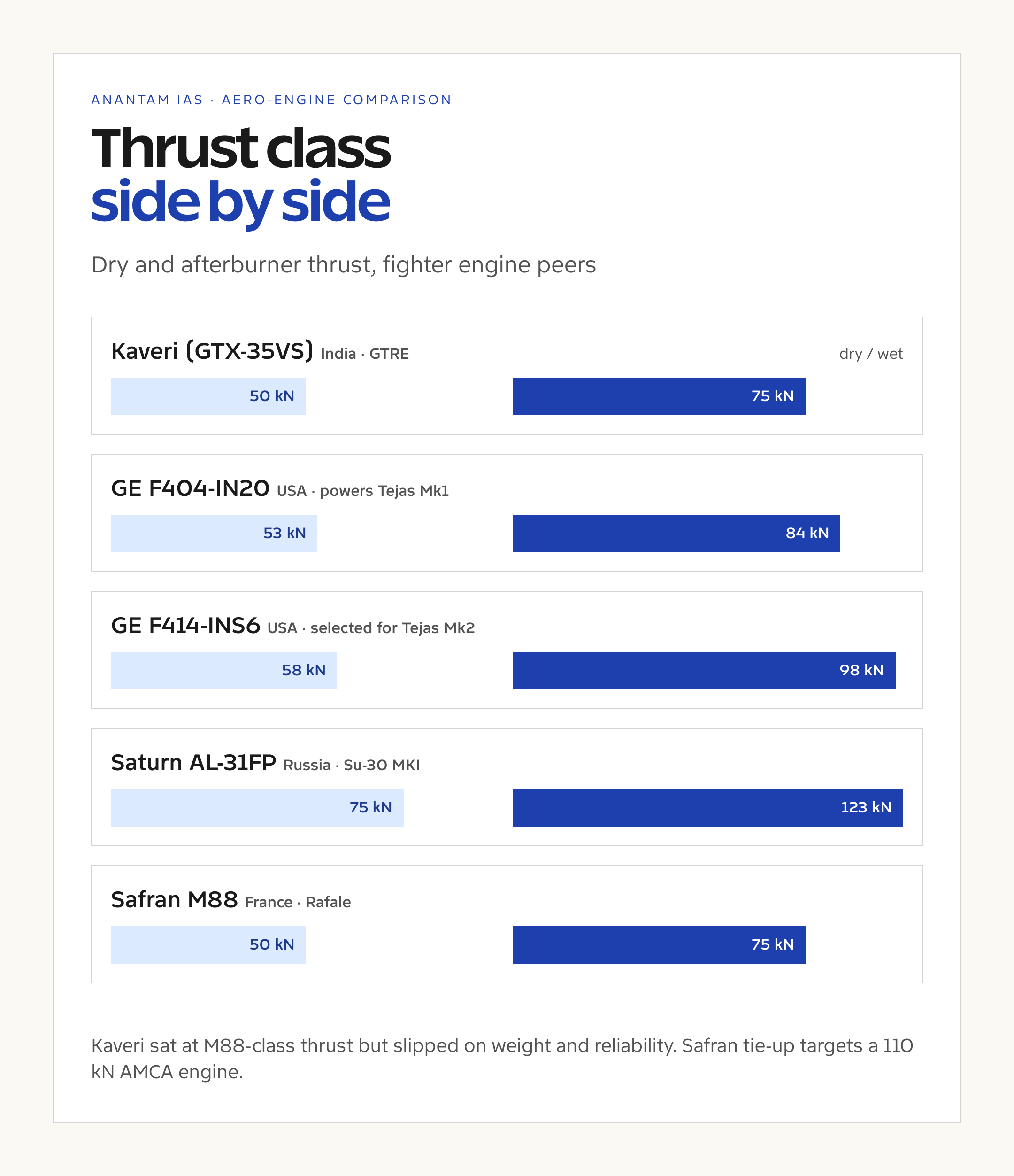
| Kaveri (GTX-35VS) | India | Originally Tejas, now Ghatak (KDE) | ~50 kN | ~75 kN | KDE in development |
| GE F404-IN20 | USA | Tejas Mk1 / Mk1A | 53 kN | 84 kN | In service |
| GE F414-INS6 | USA | Tejas Mk2 | 58 kN | 98 kN | Selected, license production planned |
| Saturn AL-31FP | Russia | Su-30 MKI | 75 kN | 123 kN | In service, licence-built at HAL Koraput |
| Eurojet EJ200 | UK / Germany / Italy / Spain | Eurofighter Typhoon | 60 kN | 90 kN | In service |
| Safran M88 | France | Rafale | 50 kN | 75 kN | In service, basis for Safran-India talks |
The Safran M88 sits at roughly the thrust class the Kaveri was aiming for. That is why the Safran proposal for a 100 percent technology-transfer co-development of a 110 kN engine for AMCA is being taken seriously. France has previously transferred Mirage 2000 and Rafale technologies and, unlike the United States, has fewer restrictions on full IP transfer.
Challenges Ahead
- Single-crystal blade metallurgy at higher temperatures: Each 50 K rise in turbine entry temperature is a multi-year metallurgical effort.
- Full-scale altitude testing infrastructure: India relies partially on Russian facilities; an indigenous full-scale altitude facility is under construction at GTRE.
- Industrial base: Engines need a long supply chain of precision-cast components, FADEC suppliers, and test rig builders.
- AMCA engine decision: Whether to back a Safran co-development, a Rolls-Royce proposal, or an evolved Kaveri core is a billion-dollar choice.
- Skilled workforce: GTRE needs deep retention of propulsion engineers who otherwise migrate to civilian aviation or abroad.
- Funding rhythm: Aero-engine R&D needs decade-long stable funding rather than year-to-year sanctions.
Prelims Pointers
- Kaveri is a project of GTRE, a DRDO laboratory in Bengaluru.
- Sanctioned in 1989, originally meant for the Light Combat Aircraft Tejas.
- Officially delinked from Tejas in 2008.
- The dry variant, Kaveri Dry Engine (KDE), is being developed for the Ghatak stealth UCAV.
- The Kaveri core is called Kabini.
- Flight testing on a Tu-16 / IL-76 flying test bed was carried out in Russia at the Gromov Flight Research Institute.
- Safran (France) is the leading international partner under discussion for the AMCA engine.
- Tejas currently flies on the GE F404; Tejas Mk2 will use the GE F414.
- Aero-engine development requires mastery of single-crystal turbine blades, FADEC, and afterburner technology.
Mains Practice Questions
- “Aero-engine development is the most demanding technology in modern military aerospace.” In the light of the Kaveri Engine DRDO programme, examine India’s progress and the constraints it faces. (GS Paper III, 250 words)
- Discuss how the Kaveri programme has shaped India’s broader self-reliance agenda in defence manufacturing under the Atmanirbhar Bharat framework. (GS Paper III, 250 words)
- Critically analyse the role of international technology partnerships, particularly with France, in accelerating India’s combat aero-engine capabilities. (GS Paper II / III, 150 words)
- Trace the evolution of the Kaveri Engine from a Tejas powerplant to the Kaveri Dry Engine for the Ghatak UCAV. What does this transition tell us about realistic technology absorption? (GS Paper III, 250 words)
Way Forward
The next decade of Indian aero-engine work has three pillars. First, finish certifying the Kaveri Dry Engine and integrate it with the Ghatak UCAV to demonstrate a complete weapon system that runs on indigenous propulsion. Second, sign and execute a clean technology-transfer co-development with Safran or another partner for the AMCA 110 kN class engine, with Indian metallurgy and FADEC content rising steadily across production batches. Third, build the full-scale altitude test facility at GTRE so that future engines, including potential variants for naval fighters and sixth-generation platforms, can be qualified without flying to Russia.
A parallel push on civilian small turbofans and turbo-props for regional aviation would broaden the supplier ecosystem and give GTRE-trained engineers continuous employment between fighter-engine programmes. The Kaveri Engine DRDO story is not over. It has simply shifted from a single high-profile failure to a series of carefully scoped wins that, together, may yet give India a fully indigenous fighter engine before 2040.
Frequently Asked Questions
What is the Kaveri Engine DRDO programme?
The Kaveri Engine DRDO programme is an indigenous twin-spool turbofan with afterburner developed by Gas Turbine Research Establishment (GTRE) under DRDO. Sanctioned in 1989, it was originally meant to power the Tejas Light Combat Aircraft and has since been reoriented as the Kaveri Dry Engine for the Ghatak UCAV.
Why was the Kaveri engine not used in Tejas?
The Kaveri Engine fell short of the thrust-to-weight ratio Tejas needed, and weight crept up by roughly 100 kg. Sanctions after Pokhran 1998 and slower than expected progress in single-crystal blade metallurgy added delays. In 2008 it was formally delinked from Tejas, which kept flying on the GE F404.
What is the Kaveri Dry Engine?
The Kaveri Dry Engine (KDE) is a non-afterburning variant of the Kaveri intended to power the Ghatak stealth unmanned combat air vehicle. It produces around 49 to 52 kN of dry thrust and is tuned for sustained subsonic flight rather than supersonic combat manoeuvres.
What is GTRE?
The Gas Turbine Research Establishment (GTRE) is a DRDO laboratory in Bengaluru responsible for designing and developing aero-engines, gas turbines, and propulsion systems for Indian defence platforms.
What is the Safran deal about?
Safran of France has proposed a 100 percent technology-transfer co-development of a new 110 kN class fighter engine for the Advanced Medium Combat Aircraft (AMCA). Negotiations cover IP transfer, manufacturing share, and indigenous content escalation across production batches.
What is the Ghatak UCAV?
Ghatak is India’s stealth unmanned combat air vehicle being developed by ADA and DRDO. It will use a flying-wing layout and is being designed around the Kaveri Dry Engine for propulsion.
How does the Kaveri compare to the GE F404?
The GE F404-IN20 used in Tejas produces about 53 kN dry and 84 kN with afterburner. The Kaveri achieved roughly 50 kN dry and around 75 kN wet, short of what a single-engine Tejas needed but adequate for a twin-engine or unmanned platform.
What is the Kabini engine?
Kabini is the core of the Kaveri, used as a technology demonstrator for the high-pressure compressor, combustor, and high-pressure turbine sections. It allows GTRE to validate core technology independently of the full engine.
Why does aero-engine self-reliance matter for India?
Combat aircraft cannot operate without engines, and engine spares and overhauls are the longest-lead, most sanction-vulnerable items in defence logistics. Indigenous aero-engine capability is therefore central to strategic autonomy and to programmes like AMCA and Ghatak.
Where does the Kaveri Engine fit in India’s broader defence roadmap?
The Kaveri Engine sits at the heart of India’s propulsion roadmap, feeding directly into the Ghatak UCAV programme and indirectly into AMCA through shared metallurgy, FADEC, and test infrastructure. It also informs naval fighter engine planning and future high-altitude UAV propulsion.