Keoladeo National Park: Location, Birds & UPSC Notes
Complete guide to Keoladeo National Park (Bharatpur Bird Sanctuary) — location, avifauna, UNESCO status, Ramsar designation, and UPSC Prelims & Mains relevance.
Introduction
Keoladeo National Park, historically known as the Bharatpur Bird Sanctuary, is one of the most celebrated wetland ecosystems in the world. Located in eastern Rajasthan, the park is a UNESCO World Heritage Site, a Ramsar wetland, and a winter home to hundreds of migratory bird species, including the once-regular Siberian crane. For UPSC aspirants, Keoladeo is a recurring topic across Prelims MCQs on biodiversity, wetlands, and conservation.
This guide covers the park's location, history, biodiversity, conservation status, threats, and UPSC relevance.
Location and Geography
- Location: Near the town of Bharatpur, in the Bharatpur district of Rajasthan.
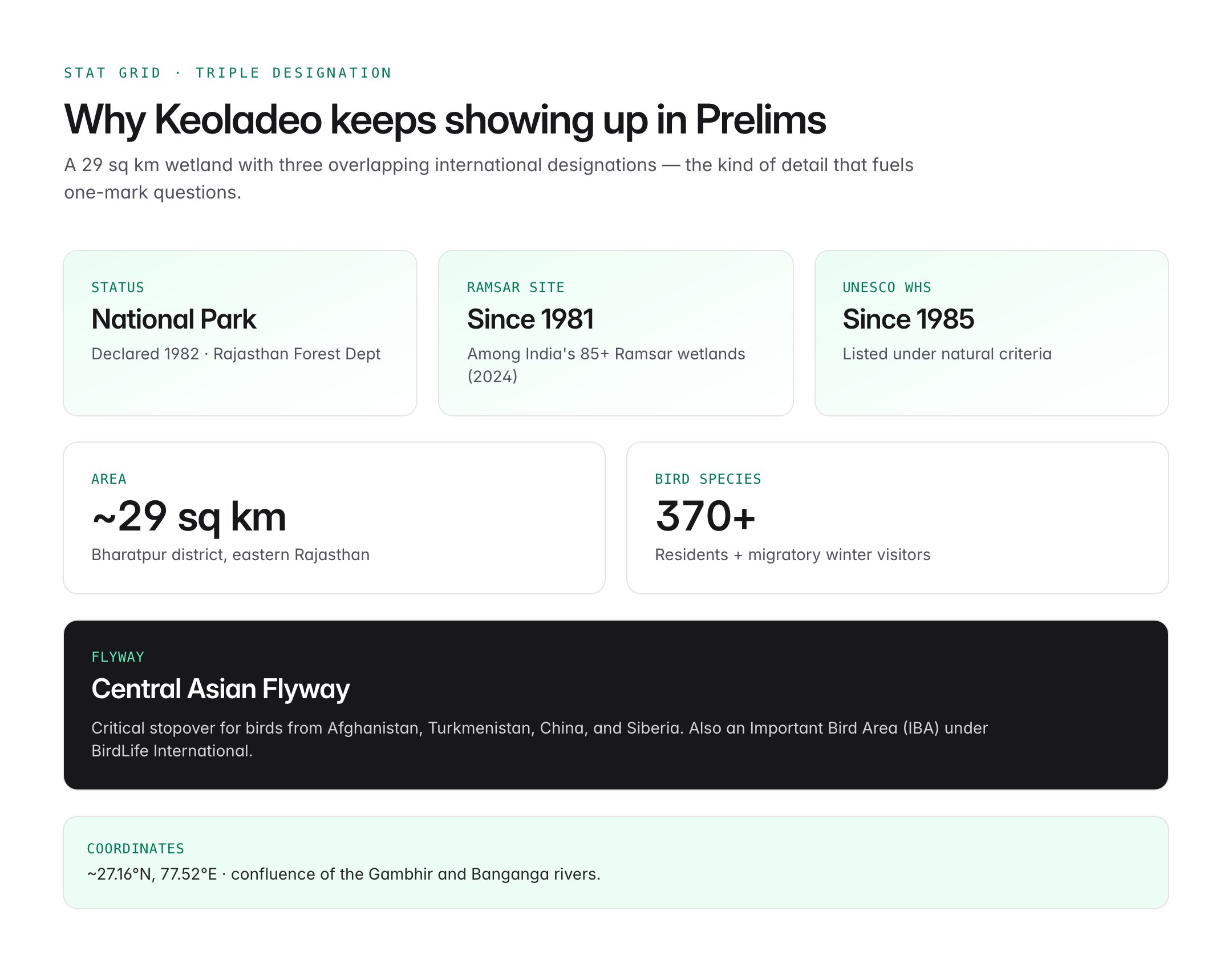
- Area: Approximately 29 sq km.
- Coordinates: Roughly 27.16°N, 77.52°E — at the confluence of the Gambhir and Banganga rivers.
- Situated on the flyway from Afghanistan, Turkmenistan, China, and Siberia, making it a critical stopover on the Central Asian Flyway.
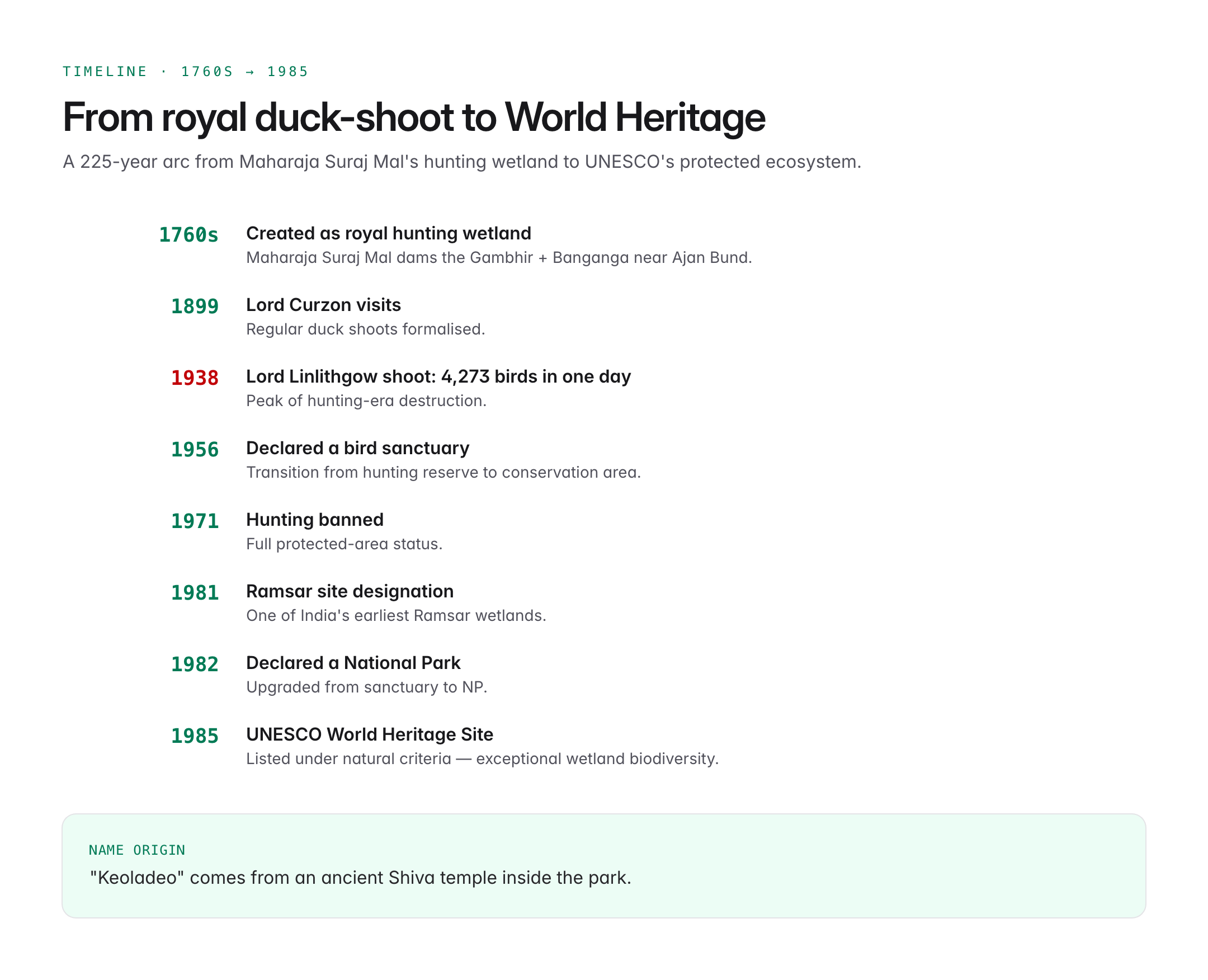
The park is a human-made wetland, originally created in the 1760s by Maharaja Suraj Mal of Bharatpur by damming the confluence of the Gambhir and Banganga rivers near the Ajan Bund. Initially designed as a hunting reserve, it later transitioned into a sanctuary and then a national park.
Historical Timeline
| Year | Status |
|---|---|
| 1760s | Created as royal hunting wetland by Maharaja Suraj Mal |
| 1899 | Lord Curzon's visit; regular duck shoots begin |
| 1938 | Lord Linlithgow shoot recorded 4,273 birds in a day |
| 1956 | Declared a bird sanctuary |
| 1971 | Protected area (hunting banned) |
| 1981 | Designated a Ramsar site |
| 1982 | Declared a National Park |
| 1985 | Declared a UNESCO World Heritage Site |
The name "Keoladeo" derives from an ancient temple of Lord Shiva (Keoladeo) inside the park.
Biodiversity
Avifauna
Keoladeo hosts over 370 bird species, split between residents and migratory visitors:
- Painted stork, Asian openbill, Black-necked stork, Oriental darter, Spoonbill, Greater flamingo.
- Bar-headed goose, Greylag goose, Common teal, Northern pintail, Northern shoveler.
- Sarus crane (the world's tallest flying bird) — seen year-round.
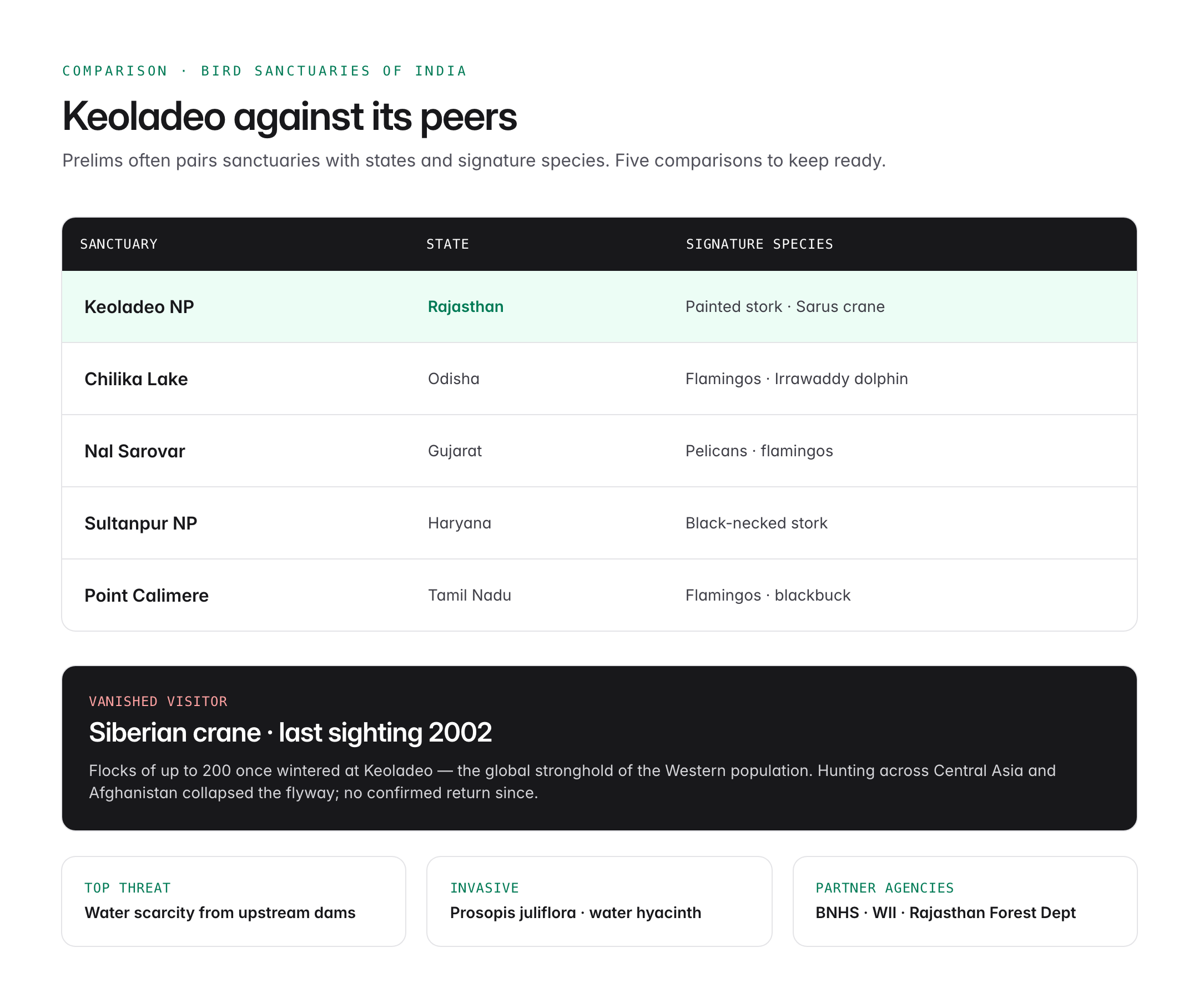
- Siberian crane — historically wintered here in flocks of up to 200, but last confirmed sighting was in 2002.
- Rare sightings of Dalmatian pelican, Greater spotted eagle, and Imperial eagle.
Mammals and Other Fauna
- Sambar, chital, nilgai, wild boar, jungle cat, jackal, fishing cat.
- Indian rock python, monitor lizard, Indian cobra.
- Over 50 species of fish in the wetland ecosystem.
Flora
- Acacia nilotica (babool), Ber (Ziziphus), Kadam (Anthocephalus) woodlands.
- Hydrophytes — lotus, water lily, hydrilla.
- Grasslands and wet marshes that support grazing herbivores and feeding waders.
Conservation Significance
Keoladeo demonstrates several important conservation themes:
- Human-made wetlands can achieve UNESCO-grade ecological value if managed well.
- Migratory bird flyways cross political borders — requiring international cooperation.
- Water security is the single greatest determinant of wetland health.
- Community partnerships around the park mitigate poaching and fuelwood collection.
Water Issues and Ecological Stress
The park's hydrology has been its biggest vulnerability. Water historically came from:
- Ajan Bund holding monsoon runoff from the Gambhir and Banganga rivers.
- The Panchana Dam in Karauli district.
A prolonged water crisis in the 2000s reduced the wetland to a dust bowl in some years. Key milestones in restoring flow:
- Release of water from Panchana Dam resumed after 2010.
- Govardhan drain now supplies treated Yamuna water during dry spells.
- Water management committees coordinate releases each monsoon.
Threats
- Water scarcity due to upstream damming and evaporation.
- Invasive species — especially Prosopis juliflora (vilayati babool) overtaking native vegetation.
- Invasive aquatic weeds — water hyacinth reducing open water for waterbirds.
- Pollution from agricultural runoff and nearby urban growth.
- Habitat fragmentation from cattle grazing and encroachment.
- Climate change altering migratory patterns.
The Siberian Crane Story
Keoladeo was once the global stronghold for the Western population of the Siberian crane (Leucogeranus leucogeranus). The population declined sharply due to hunting in Central Asia and Afghanistan. The last confirmed wintering pair in Keoladeo was recorded in 2002, making the species functionally extinct on this flyway. Conservationists continue to monitor for returns using GPS-tagged birds, but no crane has confirmed returned.
Research and Management
- Managed by the Rajasthan Forest Department with inputs from the Bombay Natural History Society (BNHS) and Wildlife Institute of India (WII).
- Long-term monitoring programs track water quality, bird arrivals, and vegetation shifts.
- An Interpretation Centre and rickshaw-based eco-tourism model support livelihoods without motor pollution.
Ramsar and UNESCO Status
- Ramsar Convention: Keoladeo was designated in 1981 as one of India's earliest Ramsar sites. India currently has over 85 Ramsar sites (as of 2024).
- UNESCO World Heritage: Listed in 1985 under natural criteria for its exceptional wetland biodiversity.
- The park is also an Important Bird Area (IBA) under BirdLife International.
Comparison with Other Bird Sanctuaries
| Sanctuary | State | Notable species |
|---|---|---|
| Keoladeo NP | Rajasthan | Painted stork, Sarus crane |
| Chilika Lake | Odisha | Flamingos, Irrawaddy dolphin |
| Nal Sarovar | Gujarat | Pelicans, flamingos |
| Sultanpur NP | Haryana | Black-necked stork |
| Point Calimere | Tamil Nadu | Flamingos, blackbuck |
UPSC Relevance
Prelims angle: Remember Keoladeo is a national park, Ramsar site, and UNESCO World Heritage Site — a triple designation tested in MCQs. Know it is located in Rajasthan (Bharatpur), was originally a man-made wetland, lies on the Central Asian Flyway, and once hosted the Siberian crane. Questions pairing parks with states are standard.
Mains GS III angle: Use Keoladeo in answers on wetland conservation, Ramsar Convention, migratory species, human-wildlife trade-offs in water management, and eco-tourism models. Link to the National Wetlands Conservation Programme, CMS (Bonn Convention), and the Central Asian Flyway Action Plan.
PYQ angle:
- "How does biodiversity vary in India? How is the Biological Diversity Act, 2002 helpful in conservation of flora and fauna?" (Mains 2018) — use Keoladeo as example.
- Prelims 2017: MCQ on Ramsar wetlands.
- Prelims 2023: MCQ on Central Asian Flyway sites.
Keoladeo is a high-yield micro-topic — a few hours of study gives returns across multiple UPSC sections.