
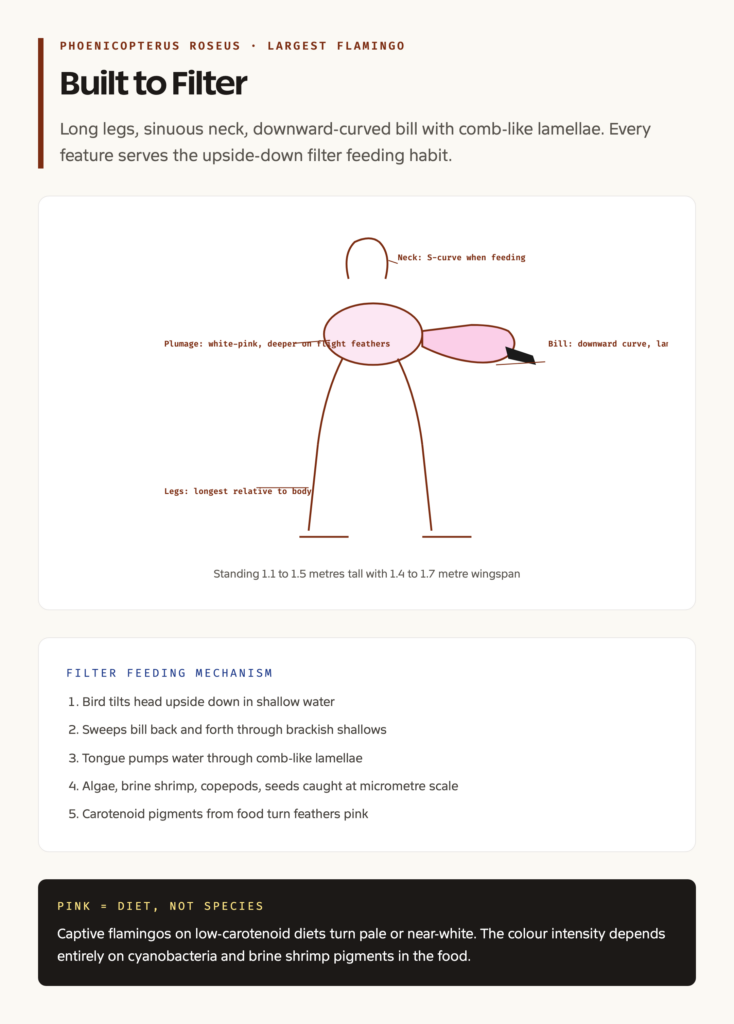
The greater flamingo, scientific name Phoenicopterus roseus, is the largest of the world’s six flamingo species and the one that draws Indian birdwatchers to brackish wetlands every winter. A standing greater flamingo can be over 1.5 metres tall, with the longest legs and longest neck relative to body size of any bird. Its plumage looks white at rest and pink in flight, when the under-wing coverts and flight feathers reveal a rose tint. The pink colour, contrary to a common assumption, comes from the diet — carotenoid-rich algae and brine shrimp — and not from the species itself. A flamingo on a low-carotenoid diet will turn nearly white.
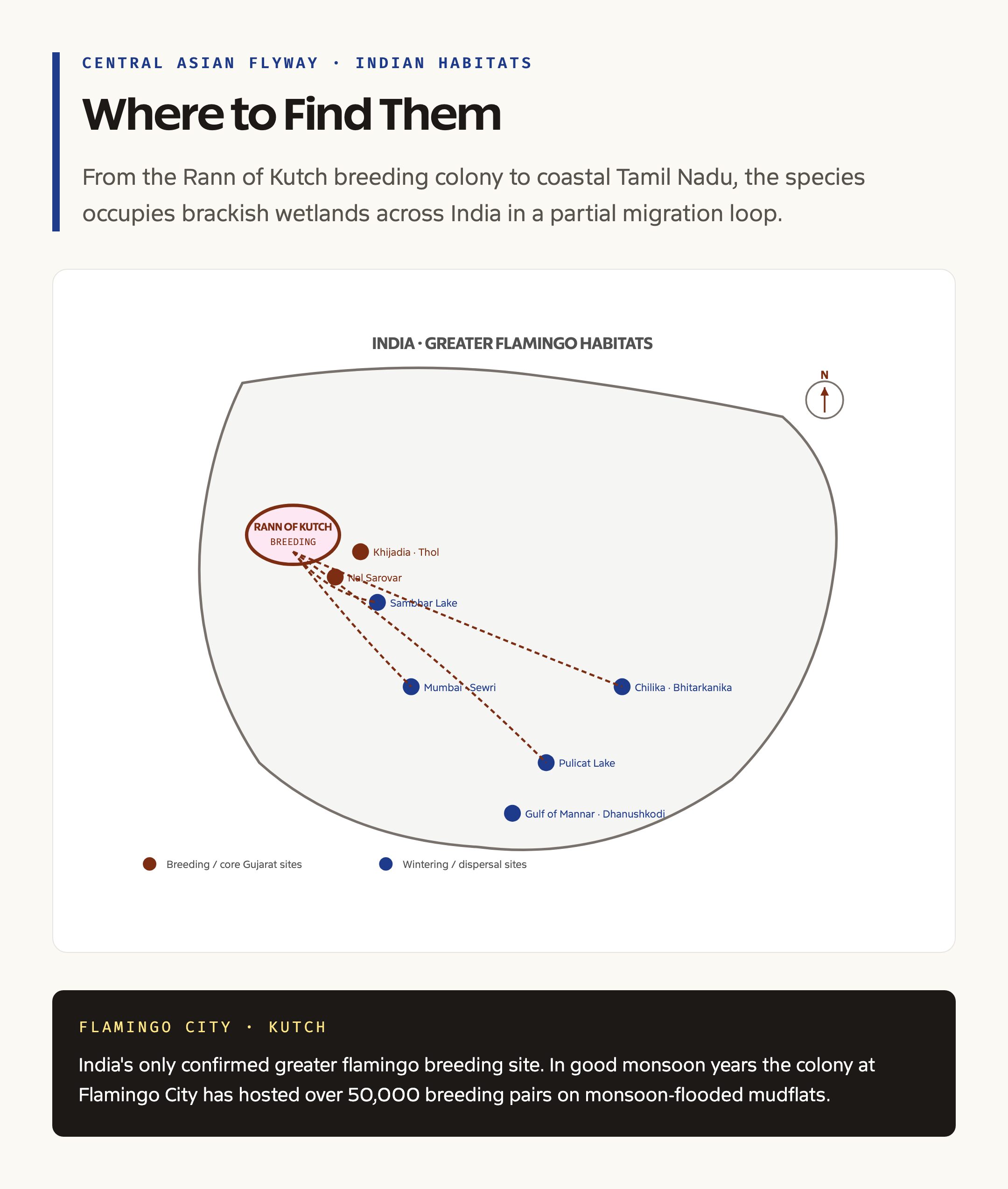
In India, the greater flamingo is a winter visitor and partial resident. It breeds in the Rann of Kutch in Gujarat, the only confirmed breeding site in South Asia, and disperses across coastal lagoons, salt pans, and inland saline lakes. Pulicat Lake, Sambhar Lake, Chilika, the Mumbai wetlands, the Gulf of Mannar, the Sundarbans fringe, and the Thol and Nal Sarovar reserves all host flocks of varying sizes. The species is listed as Least Concern by the IUCN globally but is treated as a flagship for wetland conservation across its range, and it is protected in India under Schedule IV of the Wildlife Protection Act, 1972.
This guide unpacks the biology, the Indian habitat picture, the IUCN and WPA status, the migration patterns, and the policy and conservation hooks relevant to UPSC.
Quick Facts
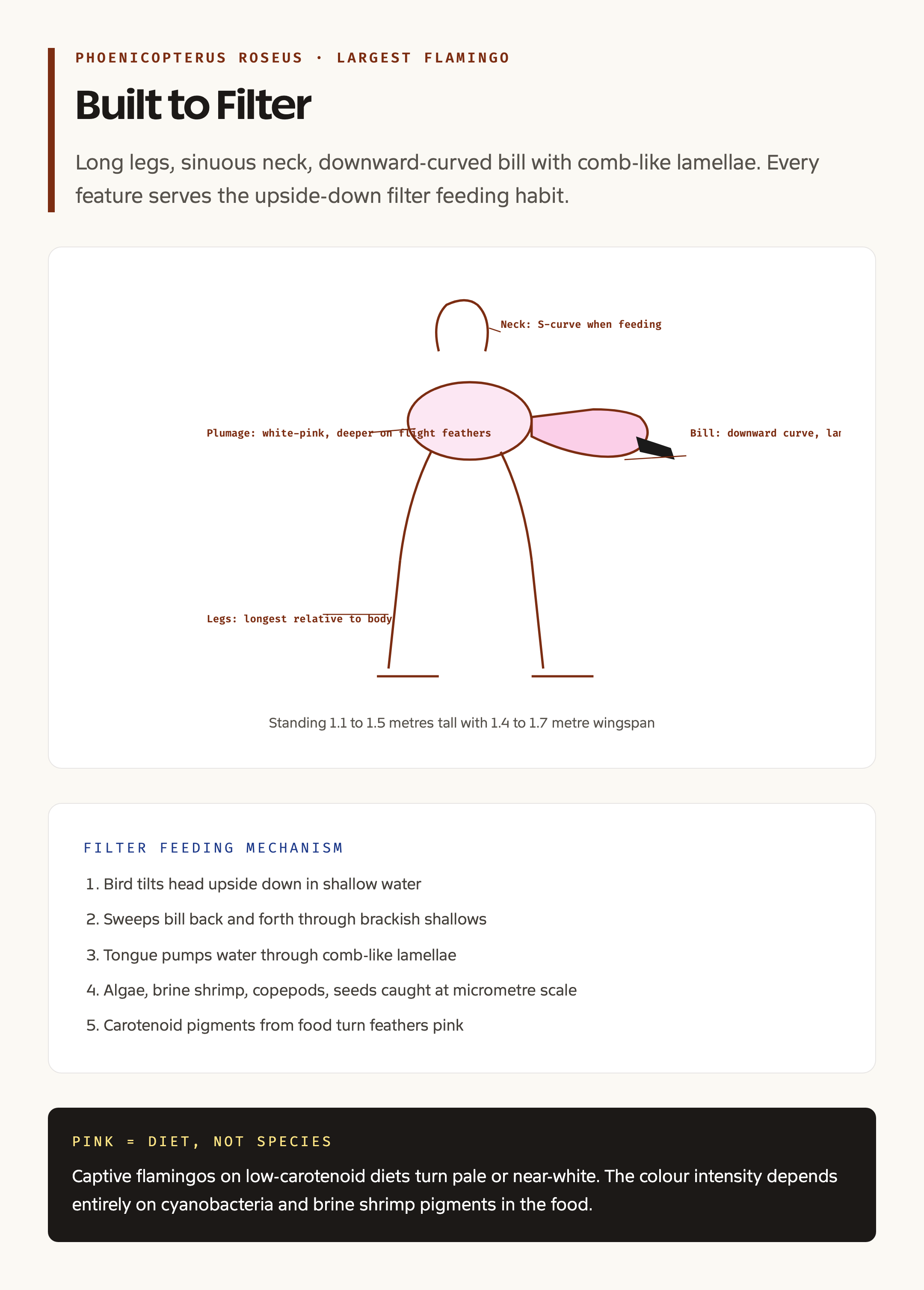
- Scientific name: Phoenicopterus roseus
- Family: Phoenicopteridae
- Largest flamingo species by height and weight
- Height: 1.1 to 1.5 metres standing
- Wingspan: 1.4 to 1.7 metres
- Plumage: White-pink overall, deeper pink on flight feathers
- Beak: Pink with black tip, downward-curved, lamellate
- Diet: Algae, brine shrimp, small molluscs, plant seeds, small crustaceans
- Feeding: Filter feeding with bill held upside down
- Habitat in India: Brackish lagoons, salt pans, saline lakes, mudflats
- Breeding site in India: Great Rann of Kutch (only confirmed)
- IUCN status: Least Concern (LC)
- CITES: Appendix II
- Indian protection: Schedule IV, Wildlife Protection Act, 1972
- CMS Convention: Listed under Convention on Migratory Species
Biology and Identification
The greater flamingo is unmistakable when seen at close range. The body is slim, the legs are stilt-like, the neck is sinuous, and the bill curves downward in a smooth arc. The upper mandible is smaller than the lower mandible, and both carry rows of fine lamellae — comb-like ridges that filter food from water. When feeding, the bird tilts its head upside down, sweeps the bill back and forth through shallow water, and pumps water through the lamellae with its tongue. Tiny algae, copepods, brine shrimp, and seeds are caught in the filter and swallowed.
Sexual dimorphism is mild: males are slightly larger than females. Juveniles are dull grey-brown for the first two years, gaining pink colour as their diet shifts. Mature plumage colour intensity depends entirely on the carotenoid content of food, especially the pigments from cyanobacteria and brine shrimp. Captive flamingos at zoos that lack carotenoid-rich diets often appear pale.
The voice is a goose-like honking, more melodic than a goose, and is used in flock cohesion calls and alarm. Greater flamingos are highly gregarious, forming flocks from a few dozen to tens of thousands. Pre-breeding congregations include synchronised marching displays — head-flagging, wing-saluting, and twist-preening — that prepare the colony for breeding.
Habitat and Distribution
The greater flamingo has the widest range of any flamingo species, spanning Africa, southern Europe, the Middle East, Central Asia, and South Asia. Within India, the species shows up wherever shallow saline or brackish water supports its food source. The classic Indian habitats are:
- Great Rann of Kutch (Gujarat): Only confirmed Indian breeding site. The Flamingo City colony forms in monsoon-flooded mudflats and can host tens of thousands of breeding pairs.
- Nal Sarovar (Gujarat): Important winter site, Ramsar designated.
- Khijadia and Thol Lake (Gujarat): Smaller flocks year-round.
- Sambhar Lake (Rajasthan): Inland saline lake, post-monsoon flocks.
- Mumbai wetlands and Sewri mudflats (Maharashtra): Significant urban wintering site.
- Pulicat Lake (Andhra Pradesh and Tamil Nadu): Annual Flamingo Festival site.
- Gulf of Mannar and Dhanushkodi (Tamil Nadu): Southern wintering grounds.
- Chilika (Odisha) and Bhitarkanika fringe: East coast wintering.
- Sambhar, Didwana, Pachpadra (Rajasthan): Inland saline lakes.
Outside India, key sites include Lake Nakuru in Kenya, the Camargue in France, the Doñana in Spain, and the Coastal Black Sea wetlands. The global population is estimated at 1 to 2 million, with the largest concentrations in East Africa.
Migration Patterns
Greater flamingos are partial migrants. Some populations are largely sedentary, others travel several thousand kilometres a year. South Asian flamingos move between the Rann of Kutch (breeding), coastal Gujarat and Rajasthan (post-monsoon dispersal), and the wintering grounds along both Indian coasts. Some birds reach Pakistan, Iran, and the Persian Gulf.
The migration is opportunistic rather than strict. Greater flamingos respond to water availability rather than fixed seasonal cues. Years with poor monsoons in Kutch see breeding failure and longer-distance dispersal. Years with strong monsoons see flooded mudflats and bumper colonies. The species sits within the Central Asian Flyway and is relevant to the Convention on Migratory Species, where India is a party.
Diet and the Pink Question
The greater flamingo diet drives the pink colour. The species filters cyanobacteria, diatoms, brine shrimp, copepods, small molluscs, plant seeds, and detritus from shallow saline water. The carotenoids in cyanobacteria and brine shrimp pigment the feathers as they grow. Diet variation across populations explains why some greater flamingos look pale pink while others look intense rose. The principle is identical to how flamingo chicks turn white when raised on standard zoo pellets without carotenoid supplementation.
The bill structure is the most specialised in any bird’s filter feeder. The lamellae work like the baleen of whales but at a much finer scale, sieving particles down to a few micrometres. Feeding is energetically costly, and flamingos can spend more than half their waking hours filter feeding.
Breeding
The greater flamingo nest is a conical mound of mud, raised above the water by about 30 to 50 centimetres, built by both parents. The female lays a single egg in most years; rarely two. Incubation lasts about 27 to 31 days, and both parents share duties. Chicks hatch with grey down, straight bills, and pink legs. They feed on a “crop milk” produced by both parents — a high-fat, high-protein secretion from the upper digestive tract that is unique among birds outside of pigeons.
Chicks form crèches within a few days of hatching. The crèche, which can include thousands of chicks, is supervised by a small number of adult guards. Parents identify their own chick by call, even within massive crèches. Fledging takes about 75 to 90 days, after which young birds gradually develop flight and the ability to feed independently.
The Rann of Kutch breeding colony is one of the largest of the species in Asia. Successful years have recorded over 50,000 breeding pairs at Flamingo City alone. The success of any year depends on monsoon strength, salinity, predator pressure (jackals, raptors), and human disturbance.
Conservation Status
Globally the greater flamingo is listed as Least Concern by the IUCN, with a stable to slightly increasing population trend. The CITES listing on Appendix II controls international trade. The species is included in the Convention on Migratory Species under Appendix II, requiring range state cooperation on conservation.
In India, the greater flamingo is on Schedule IV of the Wildlife Protection Act, 1972. Schedule IV provides protection but with lower penalties than the strictest Schedule I. The species also benefits indirectly from Ramsar designation of key wetlands like Nal Sarovar, Khijadia, and Chilika; from sanctuary status of Pulicat, Bhitarkanika, and others; and from BirdLife International’s Important Bird and Biodiversity Area network.
| Convention | Status | Implication |
|---|---|---|
| IUCN Red List | Least Concern | Globally not threatened |
| CITES | Appendix II | International trade regulated |
| CMS | Appendix II | Range states cooperate on conservation |
| WPA 1972 | Schedule IV | Protected in India with penalties |
| Ramsar | Many sites | Wetland habitat protected |
Threats
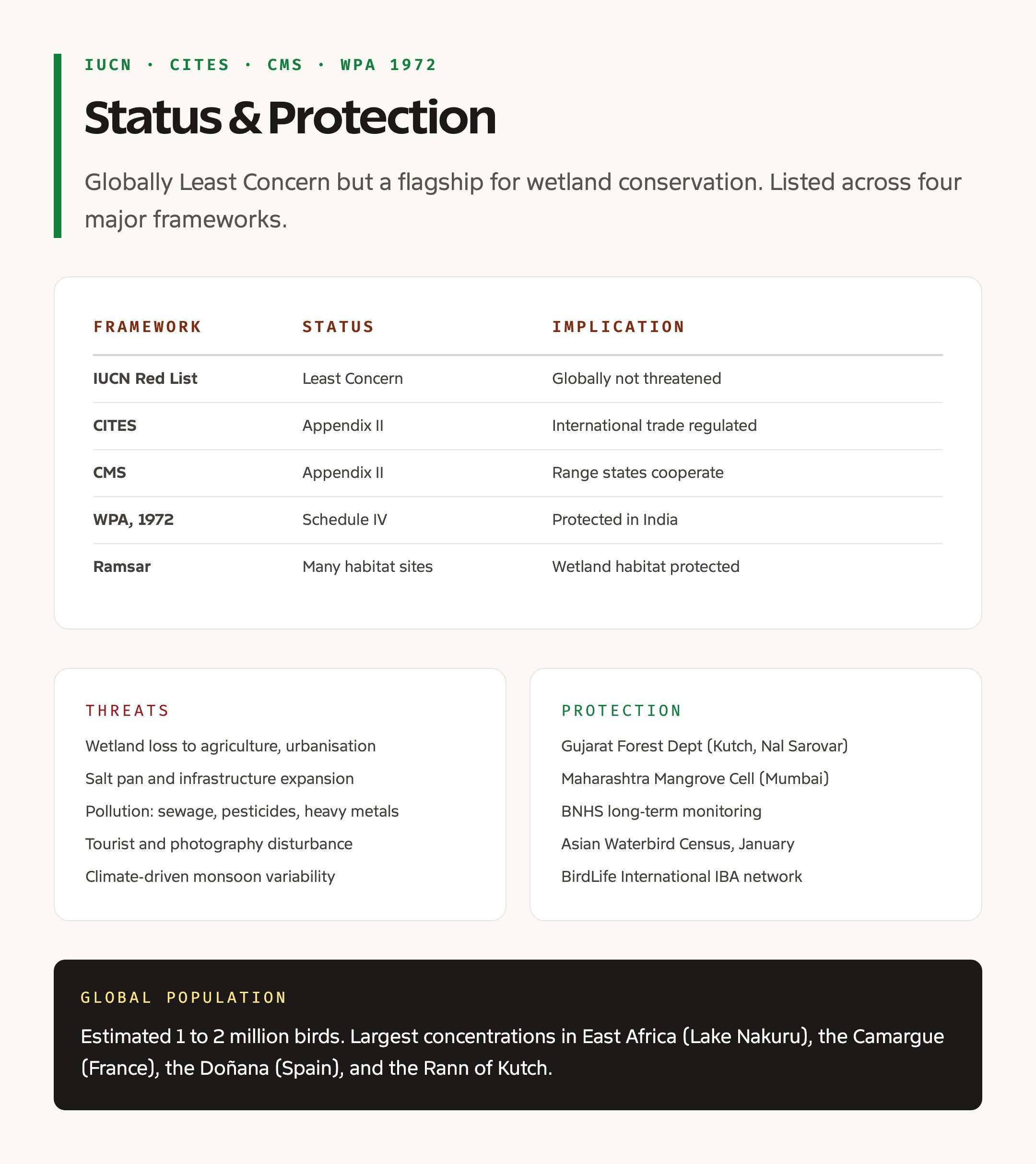
The greater flamingo faces a familiar set of threats. Wetland loss to agriculture, salt pans (when poorly managed), urbanisation, and industrial discharge reduces habitat. Pollution from sewage, pesticide runoff, and heavy metals can poison food sources or accumulate in tissues. Disturbance from tourism boats, photography, and infrastructure works can trigger breeding abandonment.
In India, the Rann of Kutch breeding colony has periodically lost productive years to weak monsoons, salt pan extensions, and tourist pressure. Mumbai’s flamingo flocks at Thane Creek and Sewri face pressure from coastal road and bridge construction; activists, the BNHS, and the state mangrove cell have intervened repeatedly. Sambhar Lake saw a significant flamingo die-off in 2019 attributed to avian botulism amplified by water quality issues.
Climate change adds a slow but real pressure. Sea level rise affects coastal wetlands. Monsoon variability affects inland saline lake hydrology. Heatwaves stress nesting colonies. The conservation playbook needs to integrate climate adaptation with traditional habitat protection.
Conservation Initiatives in India
Several agencies and organisations protect Indian flamingo habitats. The Gujarat Forest Department manages the Kutch breeding colony and the Nal Sarovar sanctuary. The Maharashtra Mangrove Cell protects Mumbai’s Thane Creek and Sewri mudflats and has been active in opposing damaging infrastructure. The Tamil Nadu and Andhra Pradesh forest departments jointly manage Pulicat. The Rajasthan Forest Department manages Sambhar.
Civil society contributions include the Bombay Natural History Society, Wetlands International, BirdLife International affiliates, and dozens of local birding clubs who run the Asian Waterbird Census every January. The state-run flamingo festivals at Pulicat and elsewhere combine tourism revenue with awareness work.
Linkages and Multi-Topic Connections
The greater flamingo connects naturally to wetland topics, migratory bird topics, and species protection topics. See Pulicat Lake for one of the key Indian habitats, latest Ramsar sites for related wetland status, global wetland outlook for the international frame, Bombay Natural History Society for the major Indian conservation actor, and BirdLife International for the global IBA framework.
For prelims, the species is a regular factual subject. Memorise the scientific name, the IUCN status, the WPA schedule, the breeding site (Rann of Kutch), and the major Indian habitats. For mains, the species can be cited in answers on wetland conservation, migratory species governance, the role of community-based conservation, and the integration of urban infrastructure with wildlife habitat.
Way Forward
The way forward is incremental rather than dramatic. Maintain monsoon-based hydrology in the Rann of Kutch by managing upstream diversion and salt pan expansion. Strengthen the Mumbai mangrove and mudflat protection mechanism. Push Pulicat toward Ramsar designation. Expand the Asian Waterbird Census coverage to cover under-monitored sites in Gujarat, Rajasthan, and Andhra Pradesh. Use Mission LiFE messaging to bring flamingo-friendly tourism into the mainstream. And maintain the cross-border CMS framework for the Central Asian Flyway, which the species depends on outside Indian waters.
UPSC Relevance
For prelims, candidates should remember: scientific name Phoenicopterus roseus; largest flamingo species; IUCN Least Concern; Schedule IV of the Wildlife Protection Act, 1972; only Indian breeding site at Great Rann of Kutch; key habitats in Sambhar, Pulicat, Mumbai wetlands, and the Gulf of Mannar; pink colour is diet-derived; under CMS Appendix II.
For mains, the greater flamingo can be used as a flagship species in answers on wetland conservation, migratory bird governance, urban-wildlife coexistence, and the role of state forest departments and civil society. The species also illustrates the difference between Schedule I (highest protection, like the Great Indian Bustard) and Schedule IV (general protection) under the WPA.
Frequently Asked Questions
What is the scientific name of the greater flamingo?
The scientific name of the greater flamingo is Phoenicopterus roseus. It belongs to the family Phoenicopteridae and is the largest of the six flamingo species in the world.
Where do greater flamingos breed in India?
The only confirmed Indian breeding site for greater flamingos is the Great Rann of Kutch in Gujarat. The colony, often called Flamingo City, forms in monsoon-flooded mudflats and can host tens of thousands of breeding pairs in good years.
What is the IUCN status of the greater flamingo?
The greater flamingo is listed as Least Concern (LC) by the IUCN, with a stable to slightly increasing global population trend. It is also listed under CITES Appendix II and the Convention on Migratory Species Appendix II.
Why are flamingos pink?
The pink colour comes from the diet, not the species. Greater flamingos eat carotenoid-rich algae (especially cyanobacteria) and brine shrimp; the pigments concentrate in feathers as they grow. Captive flamingos on low-carotenoid diets turn pale.
Under which schedule of the Wildlife Protection Act is the greater flamingo listed?
The greater flamingo is listed under Schedule IV of the Wildlife Protection Act, 1972. Schedule IV provides protection from hunting and trade, with penalties lower than Schedule I but still significant.
What is the unique feeding behaviour of greater flamingos?
Greater flamingos are filter feeders. They tilt their heads upside down in shallow water and use comb-like lamellae in the bill to sieve out algae, brine shrimp, copepods, small molluscs, and plant seeds while pumping water through with their tongue.
Tell Google you want more of this.
Add Anantam IAS as a preferred sourceOne tap, and this site shows up more often in your own Top Stories, AI Overviews and AI Mode. Remove it any time.





