Kuchipudi Dance Which State: Origin, Features & UPSC Notes
Kuchipudi dance belongs to Andhra Pradesh, named after Kuchipudi village. Learn its origin, Siddhendra Yogi, features, exponents, and UPSC notes.
Kuchipudi dance belongs to the state of Andhra Pradesh, taking its name from the village of Kuchelapuram (Kuchipudi) in Krishna district where it evolved in the 17th century under the Vaishnava saint Siddhendra Yogi. Recognised as one of India's eight classical dance forms by the Sangeet Natak Akademi, Kuchipudi blends nritta (pure dance), nritya (expressive dance), and natya (dance-drama) with roots in the Natya Shastra of Bharata Muni. For UPSC Prelims and GS-I Mains, Kuchipudi is part of the classical-dance cluster that is asked almost every year, either through one-liner state matching or through deeper questions on cultural synthesis in India.
| Quick Facts | Detail |
|---|---|
| State | Andhra Pradesh |
| Village of origin | Kuchelapuram (Kuchipudi), Krishna district |
| Reformer | Siddhendra Yogi (17th century) |
| Signature item | Tarangam (dance on the rim of a brass plate) |
| Language of lyrics | Telugu (with Sanskrit slokas) |
| Music system | Carnatic |
| Recognised by | Sangeet Natak Akademi (one of India's classical dances) |
Kuchipudi Belongs to Which State
Kuchipudi originated in the village of Kuchelapuram (modern Kuchipudi) in the Krishna district of Andhra Pradesh, on the banks of the river Krishna. The form is named after this village. Today, Kuchipudi is performed across India and the world, but the village itself remains its spiritual headquarters, housing the traditional Bhagavata Mela families and the Siddhendra Kala Kshetram.
Andhra Pradesh also gave India the Andhra Natyam and Vilasini Natyam temple traditions, but Kuchipudi remains the state's best-known classical form.
Origin and the Siddhendra Yogi Tradition
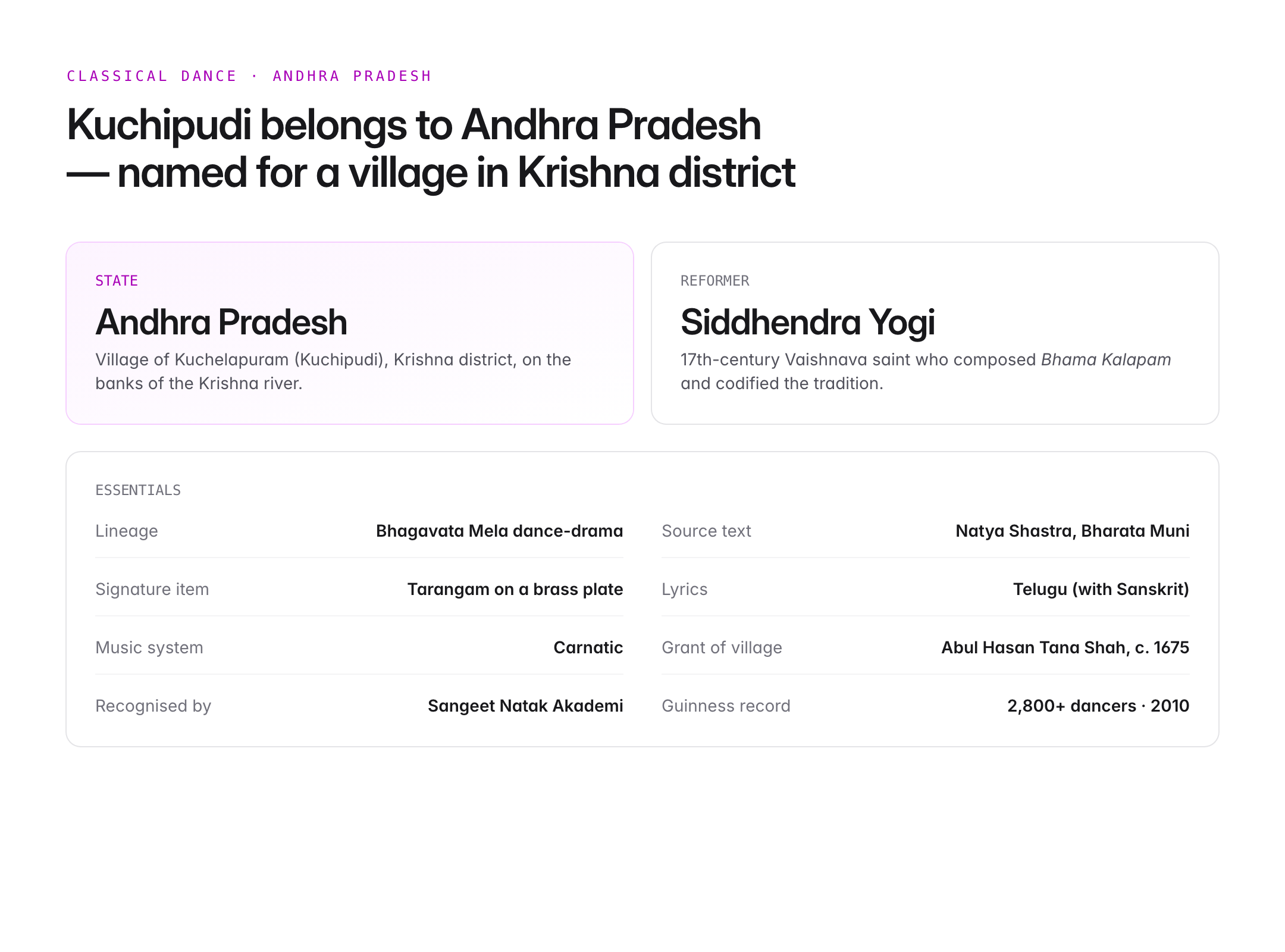
Kuchipudi draws from the Natya Shastra (2nd century BCE – 2nd century CE). Its immediate predecessor was Bhagavata Mela, a Telugu-Tamil dance-drama tradition of itinerant brahmin performers enacting stories of Vishnu and Krishna. In the 17th century, the Vaishnava saint Siddhendra Yogi reformed and codified the tradition by composing the Bhama Kalapam, a dance-drama about Krishna and Satyabhama.
Siddhendra Yogi's key contributions:
- Consolidated scattered Bhagavata Mela performances into a village-based school at Kuchipudi.
- Restricted performance rights to brahmin male performers of the village who vowed to enact the heroine Satyabhama at least once.
- Received the village of Kuchipudi as a land grant (agraharam) from the Golconda Nawab Abul Hasan Tana Shah (c. 1675).
In the 20th century, masters like Vedantam Lakshminarayana Sastry, Vempati Chinna Satyam, and Dr. Vempati Chinna Satyam transformed Kuchipudi from an all-male dance-drama into a solo dance form performed by women, women and men, while retaining the troupe-based natya tradition.
Key Features of Kuchipudi
Kuchipudi is distinctive because it sits at the crossroads of dance and theatre. Its hallmarks:
- Storytelling through dance-drama — traditionally an entire evening's performance with dialogue, song, and dance.
- Brisk, rounded, swaying movements — lighter-footed than Bharatanatyam.
- Tarangam — the iconic item where the dancer performs on the rim of a brass plate, often balancing a pot of water or a lamp on the head.
- Mandukasabdam — frog-like movements mimicking Krishna's leela.
- Jathiswaram, Sabdam, Varnam, Tillana — shared with other South Indian classical forms.
- Abhinaya — strong use of facial expression (mukhabhinaya), especially for sringara (love) rasa.
- Language of lyrics — primarily Telugu, with Sanskrit slokas.
- Music — Carnatic system; instruments include mridangam, violin, flute, veena, tambura, and cymbals.
Costume, Makeup, and Stagecraft
Female costume:
- A fan-pleated pyjama-style dress or a pleated saree, often Kanchipuram silk.
- A peacock-feathered jewellery set, jada (hair braid ornament), rakudi, jhumkas, ankle bells (ghungroos).
Male costume:
- Dhoti worn Andhra-style, topless or with an angavastram.
- Head ornament and heavy facial makeup for dance-drama roles.
Makeup is vivid, with aharya abhinaya (costume-based expression) being a core feature — the same performer may portray male and female characters within a single piece.
Repertoire Structure
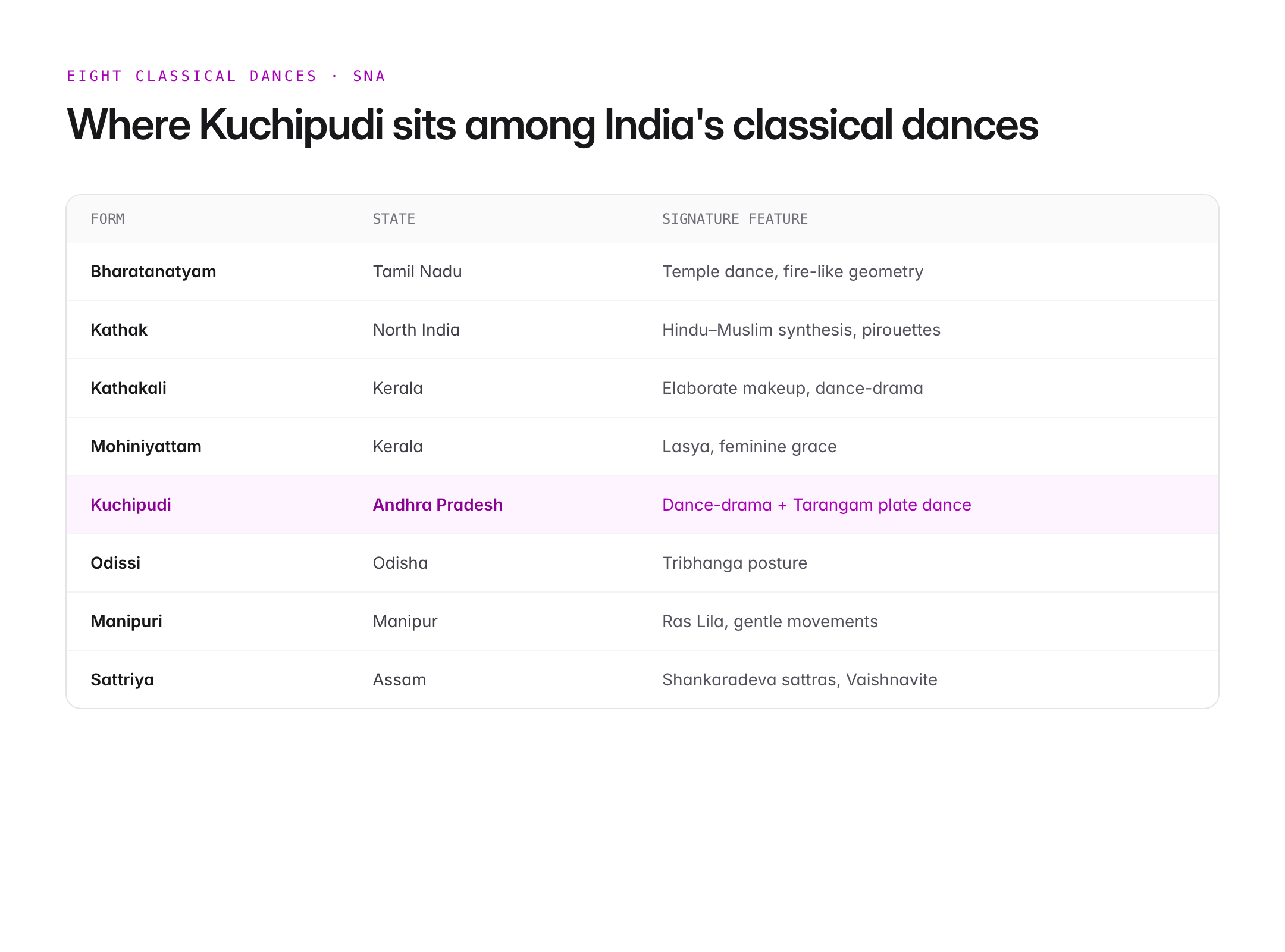
A traditional Kuchipudi recital follows an arc similar to Bharatanatyam's margam:
| Item | Purpose |
|---|---|
| Pushpanjali / Ganesha Stuti | Invocation |
| Jathiswaram | Pure nritta, rhythmic patterns |
| Sabdam | Narrative with rhythmic syllables |
| Varnam | Central, longest piece — nritta + abhinaya |
| Padam / Javali | Lyrical abhinaya |
| Tarangam | Signature plate dance |
| Tillana | Joyous concluding nritta |
Dance-dramas like Bhama Kalapam, Usha Parinayam, Prahlada Charitram, Gollakalapam survive in troupe format.
Comparison With Other Classical Dances
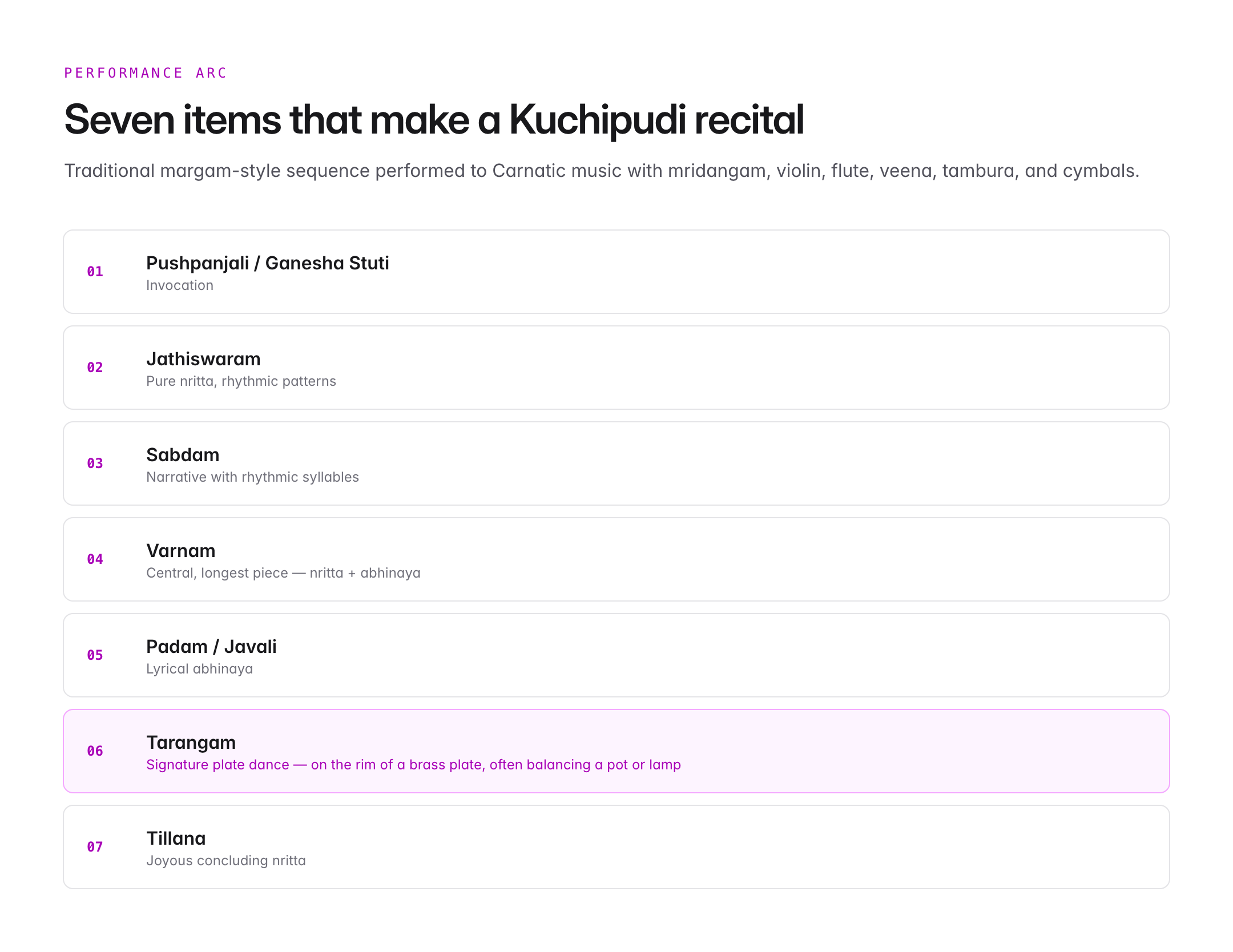
| Form | State | Key Feature |
|---|---|---|
| Bharatanatyam | Tamil Nadu | Temple dance, fire-like geometry |
| Kathak | North India | Hindu-Muslim synthesis, pirouettes |
| Kathakali | Kerala | Elaborate makeup, dance-drama |
| Mohiniyattam | Kerala | Lasya, feminine grace |
| Kuchipudi | Andhra Pradesh | Dance-drama + Tarangam plate dance |
| Odissi | Odisha | Tribhanga posture |
| Manipuri | Manipur | Ras Lila, gentle movements |
| Sattriya | Assam | Vaishnavite monasteries (sattras), Shankaradeva |
Major Exponents
- Vedantam Lakshminarayana Sastry (1886–1956) — revived the tradition in the early 20th century.
- Vempati Chinna Satyam (1929–2012) — Padma Bhushan; founded the Kuchipudi Art Academy, Chennai; choreographed over 15 dance-dramas.
- Raja and Radha Reddy — Padma Bhushan awardees; popularised the duet format globally.
- Yamini Krishnamurthy — one of the earliest solo women performers.
- Shobha Naidu — Padma Shri; disciple of Vempati Chinna Satyam.
- Swapnasundari — revived the Vilasini Natyam tradition alongside Kuchipudi.
- Vyjayanthi Kashi, Kamala Reddy, Sasikala Penumarthi — noted contemporary exponents.
Institutional and Cultural Recognition
- Sangeet Natak Akademi officially recognises Kuchipudi among the eight classical dances.
- Siddhendra Kalakshetra, Kuchipudi village — central teaching institution.
- Kuchipudi Art Academy, Chennai — founded by Vempati Chinna Satyam.
- UNESCO has documented Kuchipudi under intangible cultural heritage studies.
- The Natya Tarangini festival and Silicon Andhra International Kuchipudi Convention (which set a Guinness record in 2010 with over 2,800 dancers performing together) popularise the form.
UPSC Relevance
Prelims focus:
- Kuchipudi is from Andhra Pradesh; named after Kuchipudi village in Krishna district.
- Founder/reformer: Siddhendra Yogi, author of Bhama Kalapam.
- Signature item: Tarangam (dance on the rim of a brass plate).
- Language of lyrics: Telugu; musical system: Carnatic.
- Classical dances list under Sangeet Natak Akademi and their states.
Mains GS-I angle:
- Role of classical dance traditions in preserving Indian cultural heritage and linguistic diversity.
- Temple and agraharam origins of Indian classical forms and their modernisation.
- Gender transformation of Kuchipudi — from an all-male brahmin tradition to a female-dominant form in the 20th century.
Sample PYQ angle: "How do the Indian debates on secularism differ from the dominant western notion of secularism?" — while that question isn't directly cultural, GS-I has asked "Safeguarding the Indian art heritage is the need of the moment. Discuss." Here, Kuchipudi serves as a case of successful revival and adaptation, balancing tradition with contemporary performance, and the role of Sangeet Natak Akademi and community-based academies in safeguarding intangible heritage.