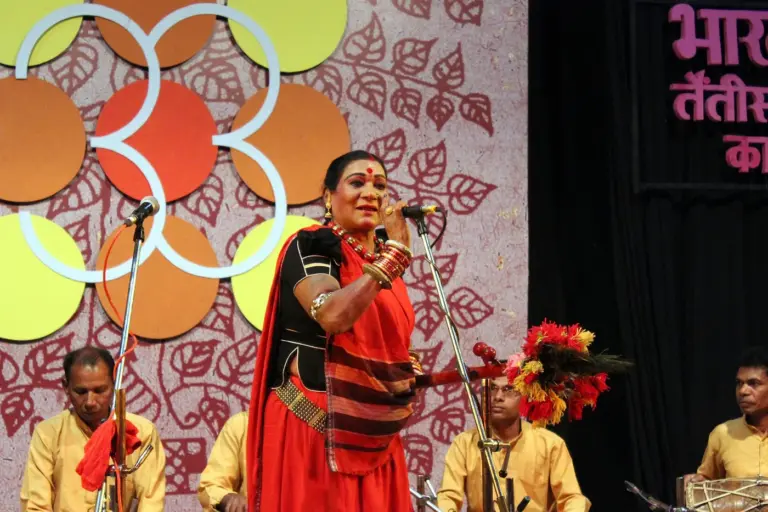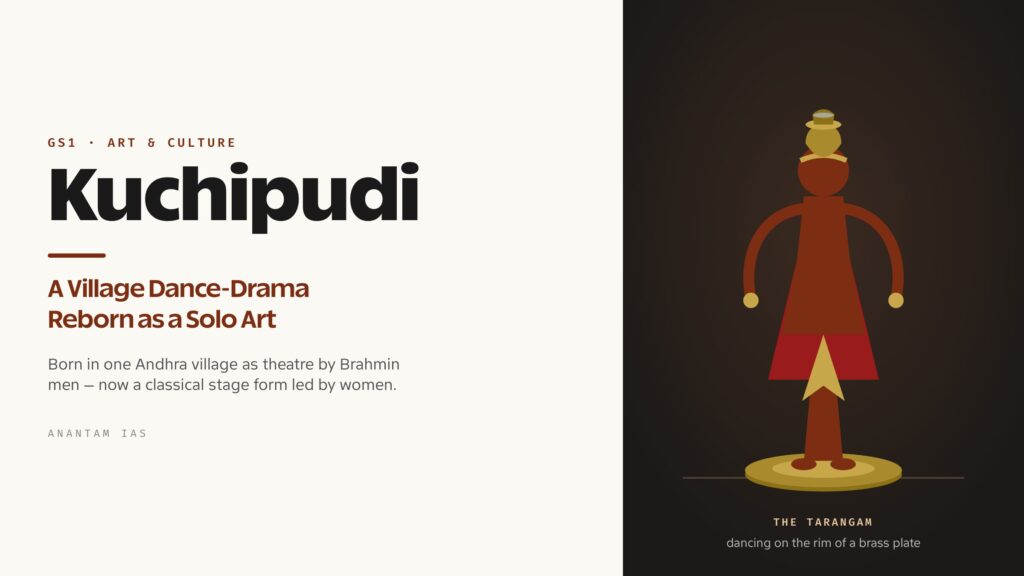
Watch a Kuchipudi recital reach its climax and you’ll see something no other Indian classical dance asks of its performer. The dancer steps onto the upturned rim of a small brass plate, balances a brass pot brimming with water on her head, and then dances — clean, fast rhythmic footwork on a surface barely wider than her two feet, the pot never trembling. This is the Tarangam, the signature that audiences wait for, and it tells you in one image what Kuchipudi is: precision worn lightly, virtuosity dressed up as grace.
Kuchipudi is one of the eight classical dance forms recognised by the Sangeet Natak Akademi, India’s national academy for music, dance and drama. But its real distinction is its origin story. Most of India’s classical dances grew up in temples or courts as offerings. Kuchipudi grew up in a single village in Andhra Pradesh as theatre — a dance-drama performed by troupes of Brahmin men who acted, sang and danced the stories of Krishna. How that village theatre became a solo art performed on the world’s biggest stages, and what it kept along the way, is a story worth knowing far beyond the exam hall.
What Kuchipudi Actually Is
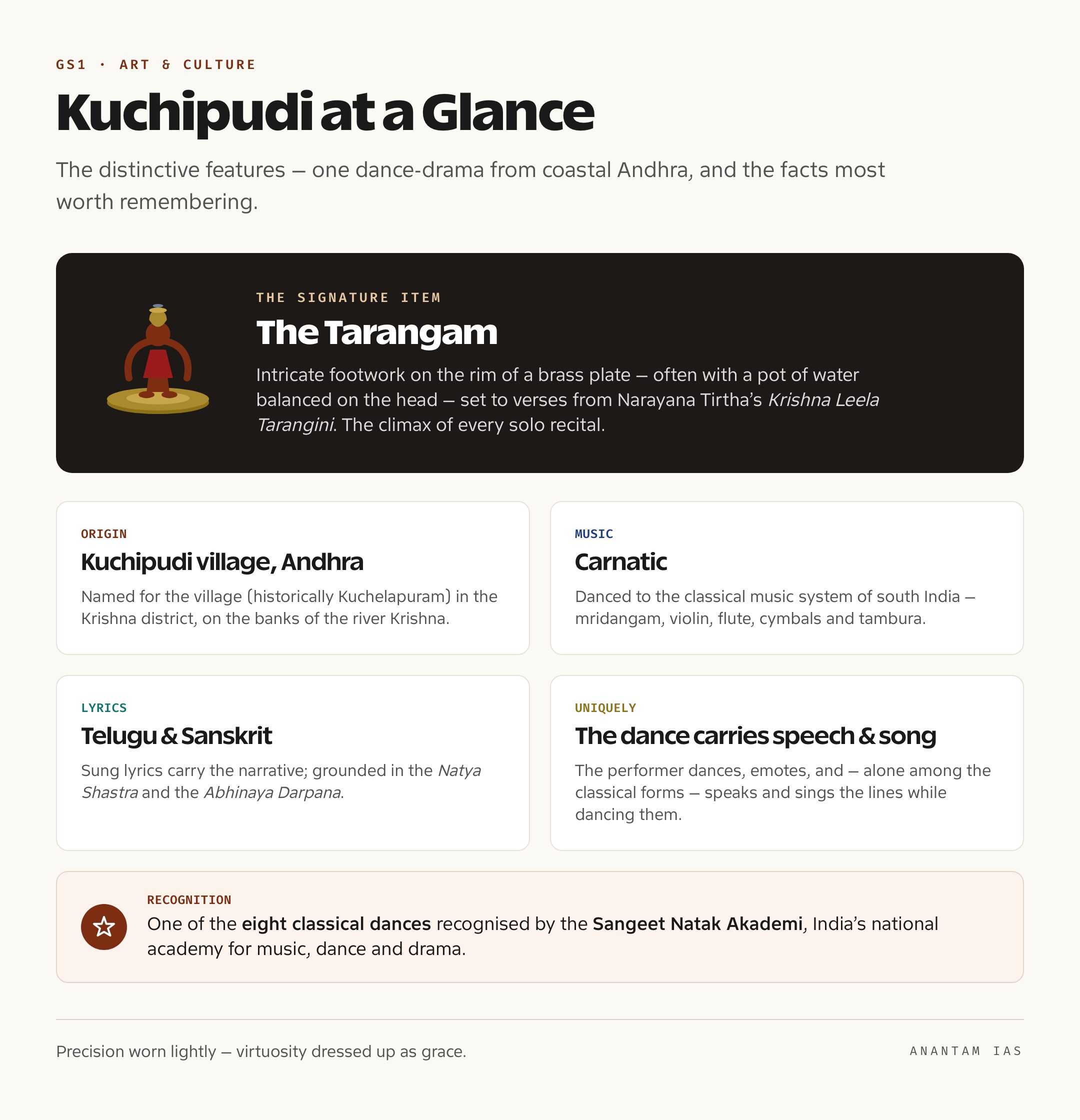
Before the history, a clear picture of the form. Kuchipudi is a dance-drama tradition from coastal Andhra Pradesh, performed to Carnatic music — the classical music system of south India — with the lyrics sung in Telugu and Sanskrit. Like every Indian classical dance, it draws on Bharata’s Natya Shastra, the ancient Sanskrit treatise on the performing arts, and on the Abhinaya Darpana, the later manual of gesture and expression attributed to Nandikeshvara.
What makes Kuchipudi itself, though, is how it blends the three building blocks of classical dance. Nritta is pure dance — rhythm and movement for their own sake, no story. Nritya is expressive dance, where gesture and facial expression carry meaning. And Natya is full dramatic narrative, with characters and plot. Bharatanatyam leans heavily on the first two; Kuchipudi keeps all three alive, because it never stopped being theatre. A Kuchipudi performer is expected to dance, to emote, and — uniquely among the classical forms — to speak and sing the lines while dancing them. The dance carries dialogue.
So the texture of Kuchipudi is distinct. The footwork is quicksilver and the tempo runs fast. The postures are rounded and fluid rather than sharply geometric. And running underneath every item is a storyteller’s instinct: even the most abstract passage is on its way to a scene, a character, a moment of devotion. That dramatic spine is the thread to follow through everything that comes next.
Origins in a Village, and the Saint Who Shaped It
The form takes its name from its birthplace — the village of Kuchipudi (historically Kuchelapuram) in the Krishna district of Andhra Pradesh, on the banks of the river Krishna. There were dance-drama traditions in the Telugu country long before, part of the wider Bhagavata Mela current of devotional theatre in which Brahmin men staged the stories of Vishnu and his avatars. But the Kuchipudi we recognise today is credited to a 17th-century saint-poet, Siddhendra Yogi, a Vaishnava devotee who studied under the Advaita scholar Tirtha Narayana Yati.
Siddhendra Yogi’s gift to the form was the Bhama Kalapam, a dance-drama built around Satyabhama, one of Krishna’s wives, and the arc of her pride, separation and reunion with the god. He gathered the young Brahmin men of Kuchipudi village into a troupe to perform it, and — tradition holds — extracted a vow that every Brahmin family in the village would give at least one son to the dance in each generation. That vow is why a whole village became, in effect, a single hereditary theatre company. The performers were called Bhagavatulu — the men of the Bhagavata tradition — and they played every role, women’s parts included.
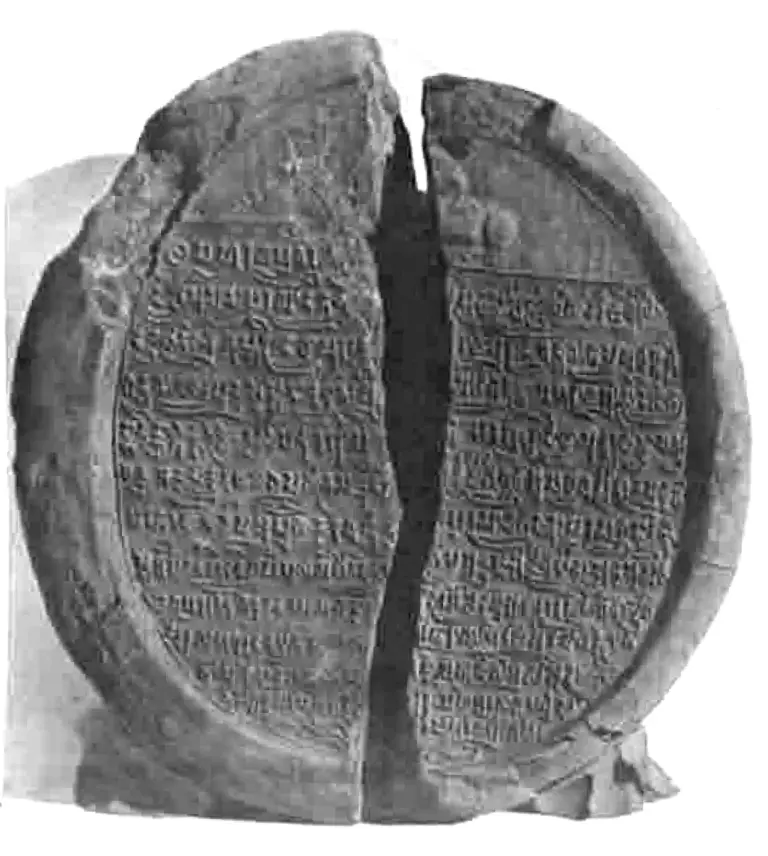
This was no fringe folk practice. Court records of the Vijayanagara Empire, famous for its patronage of the arts, note Bhagavata troupes from Kuchipudi performing at the royal court, and copper-plate inscriptions point to the dance-drama being known to royalty through the 16th century. The decisive moment of patronage came in the 17th century, when Abul Hasan Tana Shah, the last ruler of the Golconda-based Qutb Shahi dynasty, was so moved by a performance of the Bhama Kalapam that he is said to have granted the village itself to the Brahmin families who kept the art alive. A Muslim sultan endowing a Hindu devotional dance is a small, telling reminder of how layered Deccan cultural history really is.
How a Village Theatre Became a Solo Art
For most of its life, Kuchipudi was exactly what Siddhendra Yogi made it — a community dance-drama, performed by men, in and around its home village. The 20th century changed it almost completely, and the change is the most interesting thing about the form for a modern reader.
The pivot was the guru Vedantam Lakshminarayana Sastry, who lived through the first half of the century and began opening the male troupe tradition to women and to the solo stage. Where the old form was a group telling a single story across an evening, the new one could be a single dancer presenting a sequence of items — invocation, pure dance, narrative piece, the Tarangam, a closing flourish — in the format of a concert recital. That structural shift, borrowing the solo-margam idea that Bharatanatyam had already refined, is what let Kuchipudi leave the village courtyard for the proscenium stage.
Two events sealed the transition. In 1958, the Sangeet Natak Akademi’s landmark All India Dance Seminar put Kuchipudi in front of a national audience and effectively confirmed its place among the recognised classical forms. And in 1963, the guru Vempati Chinna Satyam founded the Kuchipudi Art Academy in Madras, now Chennai, where he choreographed a vast solo and dance-drama repertoire and trained a generation of dancers. Between them, the seminar and the academy turned a hereditary village rite into a national classical discipline taught in cities across India and abroad.
The signature items survived the move intact. The Tarangam — the dance on the rim of the brass plate, set to verses from Narayana Tirtha’s Krishna Leela Tarangini, sometimes with a pot of water balanced on the head and lit lamps held in the hands — became the show-stopper of the solo recital. So did displays such as dancing while writing letters or tracing patterns with the feet. What had been one virtuosic flourish inside a long drama became the climax audiences now come for.
The Repertoire and Its Great Exponents
A full Kuchipudi solo recital, or margam, moves through a familiar arc. It opens with an invocation — a Pushpanjali or Ganesha Vandana. It builds through Jatiswaram, pure rhythmic dance, and Sabdam, narrative movement set to sung lyrics, into a central expressive piece — a Varnam or a passage of the old Kalapam dance-drama, where storytelling and abhinaya (expressive acting) are richest. Then come lyrical Padams and Javalis, the spectacular Tarangam, and a closing Tillana or Mangalam to send the audience home. Throughout, a live Carnatic ensemble — mridangam, violin, flute, cymbals and tambura — drives the rhythm, while a vocalist (often the dancer too) carries the song.
The 20th-century renaissance rode on the shoulders of a remarkable lineage. Vedantam Lakshminarayana Sastry expanded the role of women and the solo form. Vempati Chinna Satyam codified the modern solo style and built its leading institution. Yamini Krishnamurthy, one of the first great solo women performers, brought Kuchipudi star power on the national stage. The husband-and-wife duo Raja and Radha Reddy turned the duet into a celebrated form and carried Kuchipudi around the world. Sobha Naidu, Swapna Sundari and Vyjayanthi Kashi, among many others, extended the tradition into the present. Their reach is why a dance that began in one Telugu village is now taught through cultural centres run by Indian missions abroad and by gurus who have set up academies in the United States, the United Kingdom, Singapore and the Gulf.
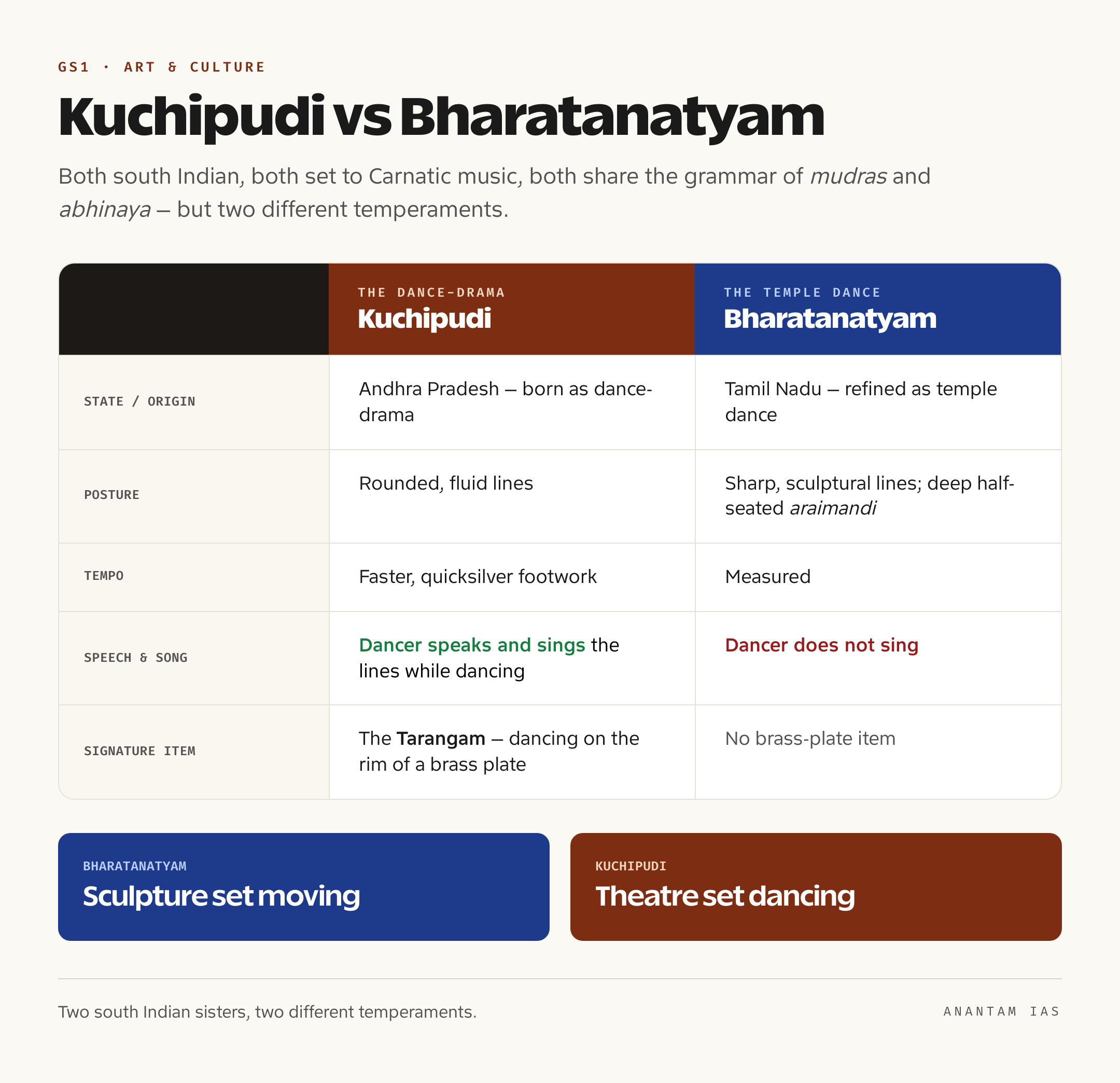
It helps to set Kuchipudi against its closest relative. Both Kuchipudi and Bharatanatyam are south Indian, both are danced to Carnatic music, and both share the same grammar of mudras and abhinaya, so beginners often confuse them. But the temperament differs. Bharatanatyam, a temple dance refined in Tamil Nadu, favours sharp, sculptural lines and the deep half-seated araimandi; its tempo is measured, and the dancer does not sing. Kuchipudi, born as Andhra dance-drama, favours rounded, fluid postures and a faster tempo; it keeps the spoken and sung word inside the dance, and it carries that one-of-a-kind brass-plate Tarangam. Put simply, Bharatanatyam is sculpture set moving, while Kuchipudi is theatre set dancing.
Where Kuchipudi Stands Today, and Why It Matters
A century of change has left Kuchipudi visibly healthy and quietly anxious at the same time. It is healthy because it is everywhere — performed in solo recitals, taught in conservatories, supported by Sangeet Natak Akademi awards and Padma honours, and sustained by the Ministry of Culture’s Guru-Shishya Parampara scheme, which funds masters to train disciples in the old apprenticeship way. The transformation from a closed, male, hereditary village rite into an open art performed and led by women is one of the clearest stories of social change in the Indian performing arts, and it happened within living memory.
The anxiety is the flip side of that success. The traditional guru-shishya transmission — years of daily, unhurried apprenticeship — is hard to sustain in an age of weekend classes and exam-grade certificates. The dance-drama heritage, the very thing that makes Kuchipudi distinct, is harder to stage and fund than the crowd-pleasing solo, so the long Kalapam risks being remembered mainly through its highlights. And the pressure to fuse with contemporary and film idioms can dilute the form even as it widens its audience.
For a student of Indian culture, that tension is the real lesson. Kuchipudi shows how a living art survives — not by freezing itself, but by changing its form (village to stage), its performers (men to women) and its scale (community rite to national discipline) while holding on to its essence, the dramatic, devotional, Krishna-centred storytelling at its heart. The brass plate still turns; what it carries has quietly been reinvented. That is how tradition stays alive in India: continuity through change, not in spite of it.
For Your Mains Answer
Kuchipudi sits squarely in GS Paper 1, under “salient aspects of Art Forms, Literature and Architecture from ancient to modern times.” It also feeds the broader Indian Society and social change themes, because its 20th-century shift from a male hereditary rite to a women-led classical art is a textbook case of how performing traditions evolve. Treat it as a concrete example, not a list of features — examiners reward a candidate who can tie facts to an argument about continuity and change.
How to Build the Answer
Open with what makes Kuchipudi distinct, not with a definition everyone writes: it is the one classical form that kept its dance-drama spine, where the performer dances, emotes, sings and speaks the part. Then move outward in order — origin (Kuchipudi village, Siddhendra Yogi, Bhama Kalapam, the Bhagavatulu troupes), evolution (the 20th-century shift to women and solo, the 1958 SNA seminar, Vempati Chinna Satyam’s academy), distinctive features (nritta-nritya-natya blend, fast footwork, the Tarangam, Carnatic music), and finally significance. Close on continuity-through-change.
Common Mistakes to Avoid
Don’t confuse Kuchipudi with Bharatanatyam — name the differences (rounded versus geometric posture, faster tempo, use of speech and song, the brass-plate Tarangam). Don’t call it merely “a dance from Andhra”; the dance-drama origin is the marks-winning point. Don’t list every exponent; two or three anchored names beat a roll-call. And don’t skip the social-change angle — the men-to-women shift is exactly what lifts a culture answer above a fact-dump.
A Compact Answer Spine
One of eight SNA-recognised classical dances → Kuchipudi village, Andhra, on the Krishna → Siddhendra Yogi and the Bhama Kalapam, performed by male Brahmin Bhagavatulu troupes → 20th-century rebirth as solo art led by women (Vedantam Lakshminarayana Sastry; Vempati Chinna Satyam’s 1963 academy; 1958 SNA seminar) → features: nritta-nritya-natya, fast footwork, dance carries speech and song, Carnatic music, the Tarangam → significance: living tradition, continuity through change.
Diagram or Flowchart Idea
Draw a simple two-stage arrow. Left box: “Village dance-drama — male Brahmin troupes, Bhama Kalapam, group performance.” Right box: “Solo classical art — women exponents, proscenium stage, Tarangam climax.” Label the arrow between them “20th-century transformation (Sastry → Vempati → SNA 1958).” A clean before-and-after like this earns marks fast and shows you understood the evolution, not just the facts.
A Balanced-Conclusion Line
Close with the idea that Kuchipudi’s survival lies in its willingness to change everything but its essence — form, performers and scale all shifted, yet the devotional, dramatic, Krishna-centred storytelling held — making it a living example of how Indian classical traditions renew themselves rather than fossilise.
How to Use Data Without Cramming
You don’t need a wall of dates. Three anchors do the work: the 17th century (Siddhendra Yogi and the Bhama Kalapam), 1958 (the SNA All India Dance Seminar that nationalised the form), and 1963 (Vempati Chinna Satyam’s Kuchipudi Art Academy in Chennai). Drop those three precisely and let the argument carry the rest.
FAQ
Which state does Kuchipudi belong to, and how did it get its name? Kuchipudi is from Andhra Pradesh. It takes its name from the village of Kuchipudi (historically Kuchelapuram) in the Krishna district, on the banks of the river Krishna, where the dance-drama tradition was organised in the 17th century and where hereditary Brahmin troupes performed it for generations.
Who is considered the founder of Kuchipudi? The 17th-century saint-poet Siddhendra Yogi, a Vaishnava devotee and disciple of Tirtha Narayana Yati, is credited with shaping Kuchipudi into its recognisable form. He composed the Bhama Kalapam, a dance-drama on Krishna’s wife Satyabhama, and organised the Brahmin men of Kuchipudi village into troupes to perform it.
What is the Tarangam in Kuchipudi? The Tarangam is Kuchipudi’s signature item, in which the dancer performs intricate rhythmic footwork while balancing on the rim of a brass plate, often with a pot of water on the head and sometimes lit lamps in the hands. It is set to verses from Narayana Tirtha’s Krishna Leela Tarangini and is usually the climax of a solo recital.
How is Kuchipudi different from Bharatanatyam? Both are south Indian and set to Carnatic music, but Kuchipudi began as Andhra dance-drama while Bharatanatyam began as Tamil temple dance. Kuchipudi uses rounder, more fluid postures, a faster tempo, and lets the dancer sing and speak the lines while dancing, plus the brass-plate Tarangam. Bharatanatyam favours sharper, more sculptural lines, a slower tempo, and the dancer does not sing.
Practice Questions
Prelims MCQs
- Kuchipudi originated in a village on the banks of which river?
(a) Godavari
(b) Krishna
(c) Tungabhadra
(d) Kaveri
Answer: (b) — Kuchipudi (historically Kuchelapuram) lies in the Krishna district of Andhra Pradesh on the river Krishna. - Who is credited with shaping Kuchipudi into its recognisable form and composing the Bhama Kalapam?
(a) Nandikeshvara
(b) Vempati Chinna Satyam
(c) Siddhendra Yogi
(d) Tirtha Narayana Yati
Answer: (c) — The 17th-century saint-poet Siddhendra Yogi composed the Bhama Kalapam and organised the village’s Brahmin men into troupes. - The Tarangam, Kuchipudi’s signature item, is set to verses from which work?
(a) Natya Shastra
(b) Abhinaya Darpana
(c) Gita Govinda
(d) Krishna Leela Tarangini
Answer: (d) — The Tarangam, danced on the rim of a brass plate, is set to verses from Narayana Tirtha’s Krishna Leela Tarangini. - Which of the following best distinguishes Kuchipudi from Bharatanatyam?
(a) Use of Carnatic music
(b) The dancer sings and speaks the lines while dancing
(c) Use of mudras
(d) South Indian origin
Answer: (b) — Uniquely among classical forms, the Kuchipudi performer dances, emotes, sings and speaks the part; the other options are shared with Bharatanatyam. - The 1958 event that helped confirm Kuchipudi’s place among recognised classical forms was organised by which body?
(a) Ministry of Culture
(b) Sangeet Natak Akademi
(c) Lalit Kala Akademi
(d) Kuchipudi Art Academy
Answer: (b) — The Sangeet Natak Akademi’s All India Dance Seminar of 1958 put Kuchipudi before a national audience.
Mains Practice Questions
- Trace the evolution of Kuchipudi from a male hereditary village dance-drama into a women-led solo classical art, and explain why this transformation is a significant example of social change in the Indian performing arts. (15 marks, 250 words)
- “Kuchipudi is theatre set dancing, while Bharatanatyam is sculpture set moving.” Discuss this distinction with reference to posture, tempo, and the use of speech and song. (10 marks, 150 words)
- Examine the role of patronage, from the Vijayanagara court to the Qutb Shahi ruler Abul Hasan Tana Shah, in sustaining the Kuchipudi tradition. (10 marks, 150 words)
- Discuss how Kuchipudi blends the three elements of nritta, nritya and natya, and why its retention of the dramatic spine sets it apart from other classical forms. (15 marks, 250 words)
- “A living art survives by changing its form, performers and scale while holding on to its essence.” Critically analyse this statement in the context of Kuchipudi’s present-day health and challenges. (15 marks, 250 words)
Tell Google you want more of this.
Add Anantam IAS as a preferred sourceOne tap, and this site shows up more often in your own Top Stories, AI Overviews and AI Mode. Remove it any time.