Indian Polity by M. Laxmikanth: 8th Edition Reading Plan for UPSC
A practical reading plan for M. Laxmikanth's Indian Polity 8th edition: 92 chapters, 8 appendices, priority topics, revision cycles, and common mistakes.
Indian Polity by M. Laxmikanth is a book to study, question and revisit, not a reading target you finish once. Aspirants who stall on it are rarely reading too slowly. They are reading it end to end with no recall task, no question practice and no way of telling whether a chapter actually landed.
This guide covers the part that usually gets skipped: how to verify which edition you are holding, what order to read the chapters in, how to turn one chapter into something you can revise, and where the book stops being enough. Every chapter number below comes from the publisher’s own contents listing for the current English edition, so you can check it against the copy on your desk.
Verify the edition before you plan around it
McGraw Hill lists the current English edition as Courseware on Indian Polity, 8th edition. Start from the publisher-listed specifications, then confirm them against the copy in your hands.
The 8th edition at a glance
- Title: Courseware on Indian Polity, 8th edition, by M. Laxmikanth.
- Publisher: McGraw Hill Education (India). First published 2008.
- ISBN: 9789364447676.
- Publication date: 28 July 2025.
- Publisher-listed contents: 92 chapters and 8 appendices.
- Previous questions: the last 13 years of Prelims polity questions, including 2025, with answer keys.
The two-minute check when your copy arrives
Copyright page: edition number and printing year. Contents: the last chapter number. Back matter: how many appendices, and which years of previous questions are actually printed.
Write those four numbers on the inside cover. Every reading plan you make afterwards refers to them.
One caveat worth knowing before you quote a chapter count at anyone. McGraw Hill’s English listing says 92 chapters and 8 appendices, and its published contents page does enumerate exactly 92. Its own 8th-edition listings in other languages say something else:
| Edition | ISBN | Publication date | Chapters and appendices listed |
|---|---|---|---|
| English | 9789364447676 | 28 July 2025 | 92 chapters, 8 appendices |
| Hindi (Bharat Ki Rajvyavastha) | 9789364449564 | 19 August 2025 | 95 chapters, 9 appendices |
| Marathi | 9789364440356 | 28 October 2025 | 95 chapters, 9 appendices |
| Telugu | 9789364448581 | 14 February 2026 | 95 chapters, 9 appendices |
Same edition number, different specifications. Some retail listings for the English edition add a third set of figures again. So treat the chapter count as a label on a box, not as a fact about your copy. Open the contents page, count the last chapter number, check the appendix list, and plan around what you actually own.
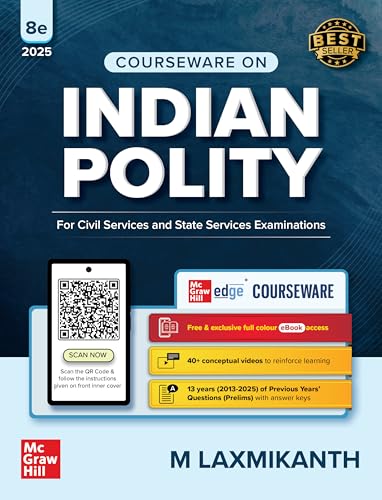
Indian Polity by M. Laxmikanth (8th Edition)
- McGraw Hill, ISBN 9789364447676, published 28 July 2025
- Publisher lists 92 chapters and 8 appendices for the English edition
- Solved Prelims polity questions from the last 13 years, including 2025
An annotated 7th edition is worth more than a clean 8th
The usual advice is to buy the newest edition. I would not give that advice to someone who has already read, marked and argued with a 7th edition. Your annotations are the part that took months to build. A new book does not carry them over.
There is also a specific claim doing the rounds that needs correcting: the 12 new chapters people attribute to the 8th edition were announced by McGraw Hill for the 7th edition, in September 2023. If you own a 7th edition, you already have the Law Commission, Bar Council and Delimitation Commission chapters. Buying the 8th to get them is buying something you own.
Work the decision from evidence instead:
| What to compare | Where to look | What it decides |
|---|---|---|
| Added or reorganised material | Contents page of each edition, side by side | Whether the gap is chapters or only edits |
| Constitutional and legal updates | The relevant passages, not the cover blurb | Whether your copy is stale on something you will be asked |
| Previous questions | The question section: which Prelims and Mains years are printed | Whether you need the book or a separate PYQ source |
| Digital access | Whether the code is unused, and what it unlocks | Whether the videos and eBook matter to how you study |
| Cost of switching | How many hours of your own notes live in the old copy | Usually the deciding factor |
The book is a reference, not a syllabus
Laxmikanth covers the Constitution, the institutions it creates and the political process around them. It does not cover the whole of General Studies Paper II, and treating it as if it does is how people arrive at the Mains hall with a constitutional vocabulary and nothing to say about welfare delivery.
| What you need | What the book gives you | What you add |
|---|---|---|
| Constitutional concepts and institutions | A complete core reference | Recall drills, comparison sheets, question practice |
| Current constitutional and political developments | The background that makes the development legible | Primary sources and a short, maintained update sheet |
| Mains analysis | The structural skeleton of an answer | Examples, counter-arguments, implementation problems, a conclusion |
| The rest of GS-II | One component of it | Governance, social justice, welfare and international relations, mapped to the syllabus |
So the honest answer to “is Laxmikanth enough” is: enough for the polity core, not enough for the paper. Read it against the GS-II notes and topic coverage rather than in place of them.
The chapter map of the 8th edition, as the publisher lists it
The book is not organised into Parts that mirror the Constitution, and the chapters are not grouped under section headings in the contents. It runs as a single numbered sequence from 1 to 92. The blocks below are our grouping of that sequence, added to make it plannable. The chapter numbers and titles are the publisher’s.
| Chapters | What is in them |
|---|---|
| 1 to 7 | Historical Background, Making of the Constitution, Concept of Constitution, Salient Features, Preamble, Union and its Territory, Citizenship |
| 8 to 12 | Fundamental Rights, Directive Principles, Fundamental Duties, Amendment of the Constitution, Basic Structure |
| 13 to 17 | Parliamentary System, Federal System, Centre-State Relations, Inter-State Relations, Emergency Provisions |
| 18 to 25 | President, Vice-President, Prime Minister, Central Council of Ministers, Cabinet Committees, Parliament, Parliamentary Committees, Parliamentary Group |
| 26 to 29 | Supreme Court, Judicial Review, Judicial Activism, Public Interest Litigation |
| 30 to 38 | Governor, Chief Minister, State Council of Ministers, State Legislature, High Court, Subordinate Courts, Tribunals, National Consumer Disputes Redressal Commission, Lok Adalat and other courts |
| 39 to 42 | Panchayati Raj, Municipalities, Union Territories, Scheduled and Tribal Areas |
| 43 to 55 | Election Commission, UPSC, State PSCs, Finance Commission, GST Council, NCSC, NCST, NCBC, Special Officer for Linguistic Minorities, CAG, Attorney General, Advocate General, Constitutional Prescriptions |
| 56 to 71 | NITI Aayog, NHRC, SHRC, NCW, NCPCR, NCM, CIC, SIC, CVC, CBI, Lokpal and Lokayuktas, NIA, NDMA, Bar Council, Law Commission, Delimitation Commission |
| 72 to 77 | Co-operative Societies, Official Language, Public Services, Rights and Liabilities of the Government, Special Provisions Relating to Certain Classes, Special Provisions for Some States |
| 78 to 84 | Political Parties, Role of Regional Parties, Elections, Election Laws, Electoral Reforms, Voting Behaviour, Coalition Government |
| 85 to 92 | Anti-Defection Law, Pressure Groups, National Integration, Foreign Policy, National Commission to Review the Working of the Constitution, Landmark Judgements, Important Doctrines of Constitutional Interpretation, World Constitutions |
A few chapter numbers are worth memorising because you will look them up constantly: Fundamental Rights is Chapter 8, Directive Principles Chapter 9, Basic Structure Chapter 12, Federal System Chapter 14, Centre-State Relations Chapter 15, Emergency Provisions Chapter 17, Parliament Chapter 23, the Supreme Court Chapter 26, the Governor Chapter 30, and the Finance Commission Chapter 46.
Our recommended reading order, which is not the book’s order
Reading 1 to 92 straight through works, but it separates things that only make sense together. The Governor arrives 15 chapters after the President. Judicial review sits far from the Fundamental Rights it enforces. This is the order we teach instead, and it is ours, not the publisher’s:
- Concepts first. Chapters 1 to 7. What the Constitution is, where it came from, who it applies to. Slow here pays for speed everywhere else.
- Rights, duties and the limits of amendment. Chapters 8 to 12, read as one arc. Fundamental Rights, Directive Principles and Basic Structure are a single argument split across five chapters.
- Rights plus their enforcement. Pull Chapters 26 to 29 forward and read them here. A right you cannot enforce is a sentence in a book, and writ jurisdiction and the five writs is where that becomes concrete.
- The federal frame. Chapters 13 to 17. Parliamentary system, federalism, Centre-State relations, emergency provisions.
- Institutions, Union then State, in pairs. Chapters 18 to 25 and 30 to 38, read President against Governor, Prime Minister against Chief Minister, Parliament against State Legislature. Comparison is how these are tested and how they are remembered.
- Local government and special areas. Chapters 39 to 42.
- The bodies. Chapters 43 to 71. Long but shallow. Read for the distinguishing feature of each body: who appoints, what tenure, constitutional or statutory, reports to whom.
- Process and practice. Chapters 72 to 92. Services, parties, elections, defection, doctrines, landmark judgements.
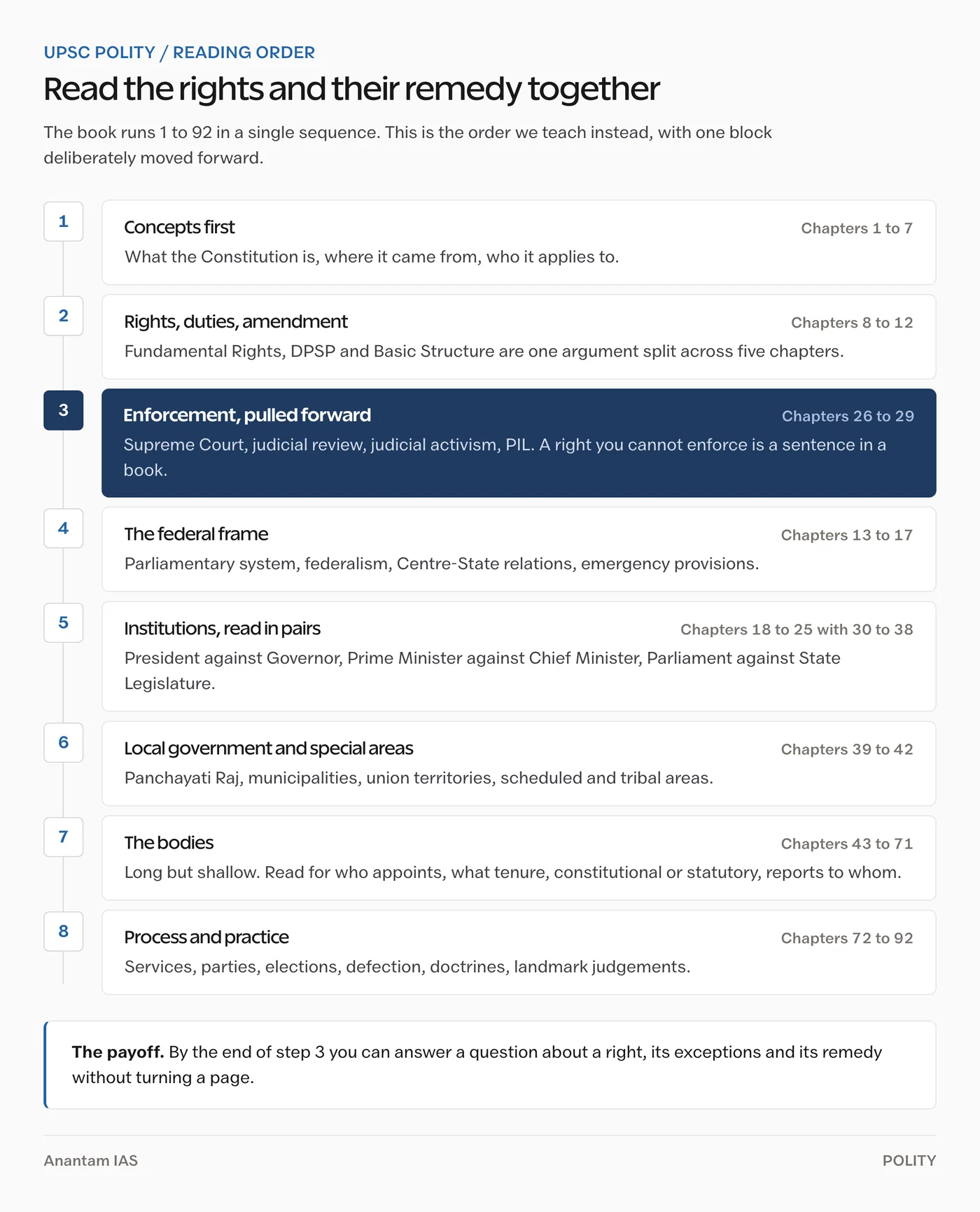
The payoff of the reordering is specific: by the end of step 3 you can answer a question about a right, its exceptions and its remedy without turning a page.
A 90-day plan that survives contact with a real week
Treat this as an adjustable template, not a promise. It assumes roughly 90 to 120 minutes of polity work a day, which is 135 to 180 hours of scheduled time across the 90 days. It does not assume you will understand everything in one pass, and it does not treat every chapter as an equal unit of work.
| Days | Work | What you should have at the end |
|---|---|---|
| 1 to 7 | Read the syllabus. Attempt a set of topic-wise polity PYQs cold, before studying. Close the most basic conceptual gaps. | A topic checklist and the first entries in an error log |
| 8 to 24 | Chapters 1 to 12. Foundations, rights, duties, amendment, basic structure. | Recall prompts per chapter and one FR versus DPSP comparison sheet |
| 25 to 40 | Chapters 13 to 29. Federal frame, central government, judiciary. | Institution comparison sheets and attempted questions on each |
| 41 to 52 | Chapters 30 to 42. States, courts below, local government, special areas. | President versus Governor and Parliament versus State Legislature sheets |
| 53 to 66 | Chapters 43 to 71. Constitutional and non-constitutional bodies. | One table covering appointment, tenure, status and reporting line for every body |
| 67 to 76 | Chapters 72 to 92. Services, parties, elections, doctrines, judgements. | A completed first-pass checklist with weak areas marked |
| 77 to 90 | Revision of weak topics, mixed timed practice, current developments, Mains outlines. | A final revision pack and an explicit list of remaining gaps |
Adjust after the first week, not at the end. If Chapters 8 to 12 are taking twice the planned time, extend that block and compress the bodies later. The bodies chapters genuinely are shorter. Rushing the rights arc to protect a calendar is the single most common way this plan fails.
Start question practice in week one, not on day 61. You cannot tell which chapters are weak until something has tested them.
What one chapter actually looks like when you study it
Take Chapter 15, Centre-State Relations. Most people read it once, remember that there are three kinds of relations, and lose the marks anyway. Here is a full session on it, which is roughly 100 minutes.
One session on Chapter 15, start to finish
- Set the objective before reading. Not “read Chapter 15” but “be able to explain legislative, administrative and financial relations, and name the mechanism that handles disputes in each.”
- Read once, without a highlighter, about 35 minutes. Mark only the places you did not follow.
- Close the book and answer five recall questions in writing. Which List carries residuary powers, and which Article puts them there. What happens to a State law that conflicts with a Union law on a Concurrent List subject. Which Article lets Parliament legislate on a State subject in the national interest. What the Inter-State Council is created under, and whether it is constitutional or statutory. Which body recommends the division of tax revenue, and on whose appointment.
- Check your answers and log the misses. The misses are the chapter. Everything you got right needed no session.
- Build one comparison sheet: legislative, administrative and financial relations as three columns, with the Articles, the mechanism and the usual friction point in each.
- Attempt one real Mains question on it, in outline form, in 10 minutes.
The payoff. You leave the session with a written record of what you got wrong, which is the only part worth revisiting in week 11.
Use previous questions as a reading instrument
A past question tells you what the examiner wanted done with the material, which is different from what the chapter contains. Take the Centre-State question from the 2024 General Studies Paper II, which carried 15 marks and a 250-word limit.
Splitting one question into what the book gives and what you bring
What changes has the Union Government recently introduced in the domain of Centre-State relations? Suggest measures to be adopted to build the trust between the Centre and the States and for strengthening federalism.
Notice what it is not. It is not “describe Centre-State relations.” It has two separate demands, and Chapter 15 supplies only part of one of them.
| Demand in the question | Where the answer comes from |
|---|---|
| Recent changes introduced by the Union Government | Not the textbook. Current developments in fiscal devolution, tax structure and Union legislation on State subjects. |
| Measures to build trust and strengthen federalism | Chapter 15 and Chapter 16 give you the machinery: Inter-State Council, zonal councils, Finance Commission, Article 263. You supply the argument for using them. |
| The framing that holds the two together | Chapter 14, the federal system, and its account of what a strong Centre was designed to do. |
Run that split on every question you practise. Two columns: what the book gives me, what I have to bring. After twenty questions you will stop expecting the textbook to answer the paper, which is the single most useful thing a book guide can teach you.
Make notes proportionate to your mistakes, not to the chapters
The standard advice is one page per chapter. That produces 92 pages of even-weight notes in which the chapter you understand perfectly takes as much space as the one that keeps catching you out. It also takes weeks.
Write three things instead, and let their length follow the difficulty:
- An error log. Every question you got wrong, the reason in four words, and the correct point. This is the document you revise from in the last fortnight.
- Comparison sheets. One per pair of institutions or concepts that you keep confusing. President and Governor. Article 352, 356 and 360. Constitutional and statutory bodies. Emergency and President’s Rule.
- An update sheet. One running page of developments that change something you have already studied, with the date and the source.
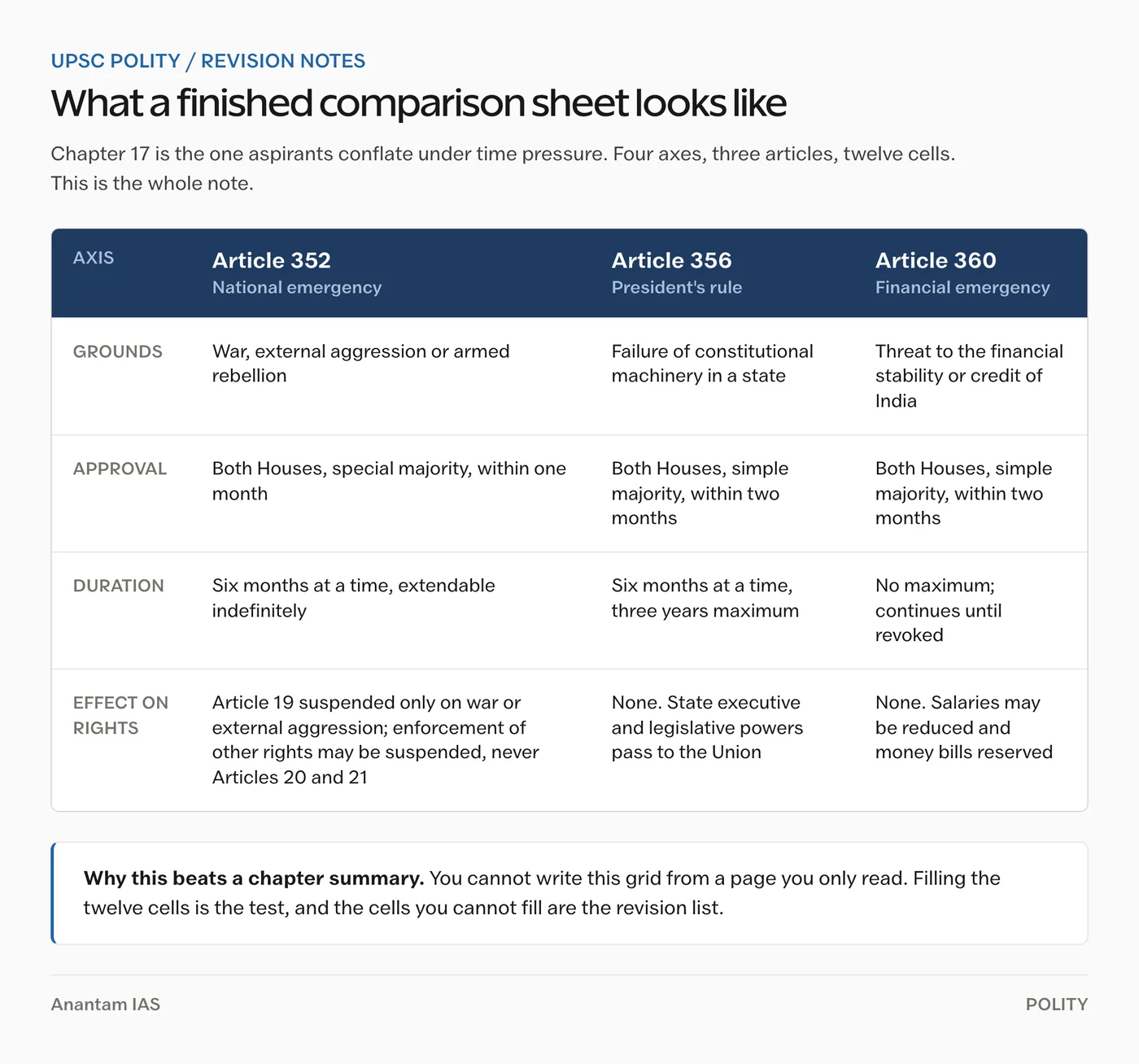
A chapter you can already explain out loud needs no note at all. Skipping it is not laziness, it is triage.
Three chapters that reliably cost marks
- Chapter 8, Fundamental Rights. People memorise the six rights and skip the exceptions inside each article. The reasonable restrictions under Article 19(2) are tested more than Article 19(1)(a) itself.
- Chapter 15, Centre-State Relations. Read once, and the legislative, administrative and financial strands blur into one. The administrative relations are the ones people cannot reconstruct under time pressure.
- Chapter 17, Emergency Provisions. Articles 352, 356 and 360 get conflated on grounds, procedure, duration and effect on rights. Four axes, three articles, twelve cells. Build the grid once and the confusion stops.
What redoing these three carefully buys you is not a predictable number of marks. It is the removal of three known failure points, which is a claim I can actually stand behind.
A 30-minute final recall checklist, and what it is not
Some versions of this plan promise a 30-minute revision of the whole book. Check the arithmetic: 92 chapters at three minutes each is 276 minutes, so a genuine skim of the book is closer to five hours than to half an hour. Anything that fits in 30 minutes is a recall checklist for someone who has already studied and already revised.
Thirty minutes, on the morning of the paper
- Ten minutes on your error log. Only the entries you have got wrong more than once.
- Ten minutes on your comparison sheets. The three or four pairs you still hesitate on.
- Ten minutes on your update sheet. Developments since you last revised the relevant chapter, and nothing else.
All three documents are yours. If you have not built them, this checklist has nothing to offer you, and reading the appendices cold at that point will not rescue the morning.
What people get wrong about reading this book
“Regional-language editions are months behind.” Not by the publisher’s own dates. The English 8th edition was published on 28 July 2025 and the Hindi 8th edition on 19 August 2025, a gap of 22 days. Marathi followed on 28 October 2025 and Telugu on 14 February 2026. So the lag is real for some languages and negligible for Hindi. Read in the language you can explain a concept in, then check the edition and contents of the copy you buy.
“Skip the appendices, they are just lists.” The article list, the amendment list and the schedule list are exactly the kind of material that gets asked directly. They are also the fastest thing in the book to revise. Skipping them optimises the wrong variable.
“If I read Laxmikanth I do not need NCERT.” Sometimes true. It depends on whether you can already say what a constitution does before you meet the Indian one. Test it rather than assuming: read Chapter 3 and Chapter 4, then explain federalism and separation of powers out loud. If that is uncomfortable, the NCERT Class XI text Indian Constitution at Work will save you more time than it costs.
“Three readings, minimum.” A reading count is the wrong target. The test is whether you can explain the concept without the book and answer questions on it under time. Some chapters clear that bar on the first pass. Others will take four. Counting passes tells you how busy you were, not what you know.
What to read alongside it, and when
Most aspirants do not need a second polity textbook. They need question practice and a current-affairs habit. The exception is the candidate who keeps losing marks on constitutional reasoning rather than on recall, and who has time to spare.
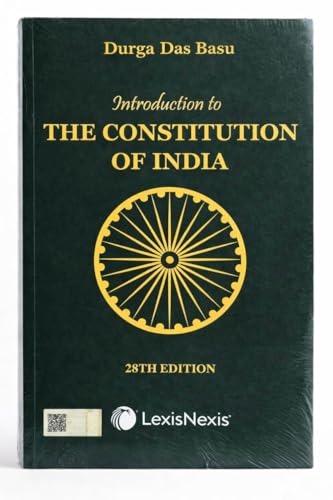
Introduction to the Constitution of India by D.D. Basu (28th Edition)
- LexisNexis, 28th edition, ISBN 9788119403790
- Constitutional reasoning rather than bullet-point summary
- A depth reference for judicial and legal nuance, not a replacement core text
Use it selectively. Reading Basu cover to cover is a project most candidates start and abandon, and abandoning it costs more in confidence than the chapters were worth. Pull the three or four topics where your answers keep reading as description instead of argument, and read only those.
For everything else, the better next step is our Indian Polity concepts and notes, which is built to be read in parallel with the textbook rather than after it.
Frequently Asked Questions
Which edition of Laxmikanth should I buy?
The 8th edition, ISBN 9789364447676, published by McGraw Hill on 28 July 2025. Check the ISBN on the listing before ordering, because older printings stay in circulation. When it arrives, confirm the edition on the copyright page and the last chapter number in the contents.
Can I continue with my 7th edition?
Usually yes, and often you should. Compare the two contents pages to see whether the gap is new chapters or only revisions, check which years of previous questions are printed in your copy, and close those specific gaps from a current source. An annotated 7th edition you have argued with is worth more than a clean 8th you have not. Note that the 12 new chapters often credited to the 8th edition were announced by the publisher for the 7th, in September 2023.
How many chapters does Laxmikanth have?
McGraw Hill’s English listing says 92 chapters and 8 appendices, and its published contents page enumerates exactly 92. Its own Hindi, Marathi and Telugu 8th edition listings say 95 chapters and 9 appendices, and some retail listings differ again. Count the last chapter number in your own copy rather than relying on any of these.
How long should the first reading take?
Plan for about 70 days at 90 to 120 minutes a day, front-loading the first twelve chapters because they are the densest. That is a planning assumption, not a target to defend. If the rights and amendment chapters are taking twice as long as planned, extend them and compress the bodies chapters later, which genuinely are shorter.
Should I read NCERT first?
Test rather than assume. Read Chapters 3 and 4, then try to explain federalism and separation of powers out loud without notes. If that is uncomfortable, read the NCERT Class XI text Indian Constitution at Work first. If it is fine, start straight into Laxmikanth and save yourself two weeks.
Should I make notes during the first reading?
Record doubts and the distinctions you keep confusing. Do not rewrite the chapter. The useful documents are an error log, a set of comparison sheets for the pairs you confuse, and one running update sheet. A chapter you can already explain out loud needs no note.
Can I rely only on Laxmikanth for polity?
For the Prelims polity core, close to it, paired with question practice and current affairs. For General Studies Paper II, no. The paper also covers governance, social justice, welfare and delivery, and international relations, which sit outside a constitutional textbook’s job.
What about D.D. Basu?
Introduction to the Constitution of India is now in its 28th edition from LexisNexis, ISBN 9788119403790. It is a depth reference for constitutional reasoning and legal nuance, not a core text. Use it for the three or four topics where your answers read as description rather than argument, and skip the rest.
Is Laxmikanth enough for State PSC exams?
Yes, with state-specific polity added on top. The publisher positions the 8th edition for Civil Services and State Services examinations alike, but no national text covers your state’s legislature, panchayat act or state commissions. Those you take from state sources.
Is the Hindi edition worth buying?
If Hindi is the language you think and revise in, yes. The Hindi 8th edition, Bharat Ki Rajvyavastha, ISBN 9789364449564, was published on 19 August 2025, 22 days after the English edition. The old advice that Hindi readers accept a lost cycle does not match the publisher’s dates. Its listing does quote a different chapter and appendix count from the English one, so check the contents of the copy you receive.