List of Vice-Presidents of India (1952 to 2026): Complete List and Tenure
The full chronological list of India's Vice-Presidents from 1952 to 2026 with tenures, plus how the office works under Articles 63-71 and the must-know facts UPSC tests.
You can lose an easy mark in Prelims by mixing up two simple things: who came first and who served longest. The Vice-President of India is one of those high-yield, low-effort topics where the examiner rewards aspirants who have actually memorised the chronological list rather than guessed. The office began with Dr S. Radhakrishnan in 1952 and, as of 2026, the chair belongs to C.P. Radhakrishnan, the 15th Vice-President.
This page is your single reference for both halves of the topic: the complete list of all 15 Vice-Presidents with exact tenures, and the constitutional machinery behind the office under Articles 63 to 71. Bookmark it, revise it twice before Prelims, and you will never fumble a VP-related question again.
What the Office of the Vice-President Actually Is
The Vice-President is India’s second-highest constitutional office, and the post is created directly by Article 63, which simply states that “there shall be a Vice-President of India.” That one line matters more than it looks, because it means the office is not optional or ceremonial decoration. It is a permanent fixture the Constitution insists on.
The job has two faces. First, under Article 64, the Vice-President is the ex-officio Chairman of the Rajya Sabha (the Council of States). Think of it like a school where the deputy head also runs the senior assembly every day. The VP presides over the Upper House, rules on points of order, and keeps the debate orderly, but is not a member of the House and so does not vote except to break a tie. Second, under Article 65, the Vice-President steps in as acting President when the President’s office falls vacant due to death, resignation, removal, or otherwise, and serves until a new President is elected within six months. This is the “spare key” function of the office.
One nuance trips up everyone: the VP draws a salary as Chairman of the Rajya Sabha, not as Vice-President, because the Constitution gives the office no separate emoluments for the VP role itself. When the VP acts as President, though, the presidential salary and privileges apply for that period. If you want to compare the two top offices side by side, our explainer on the President of India walks through the same machinery for the head of state.
How the Vice-President Is Elected, and the Term
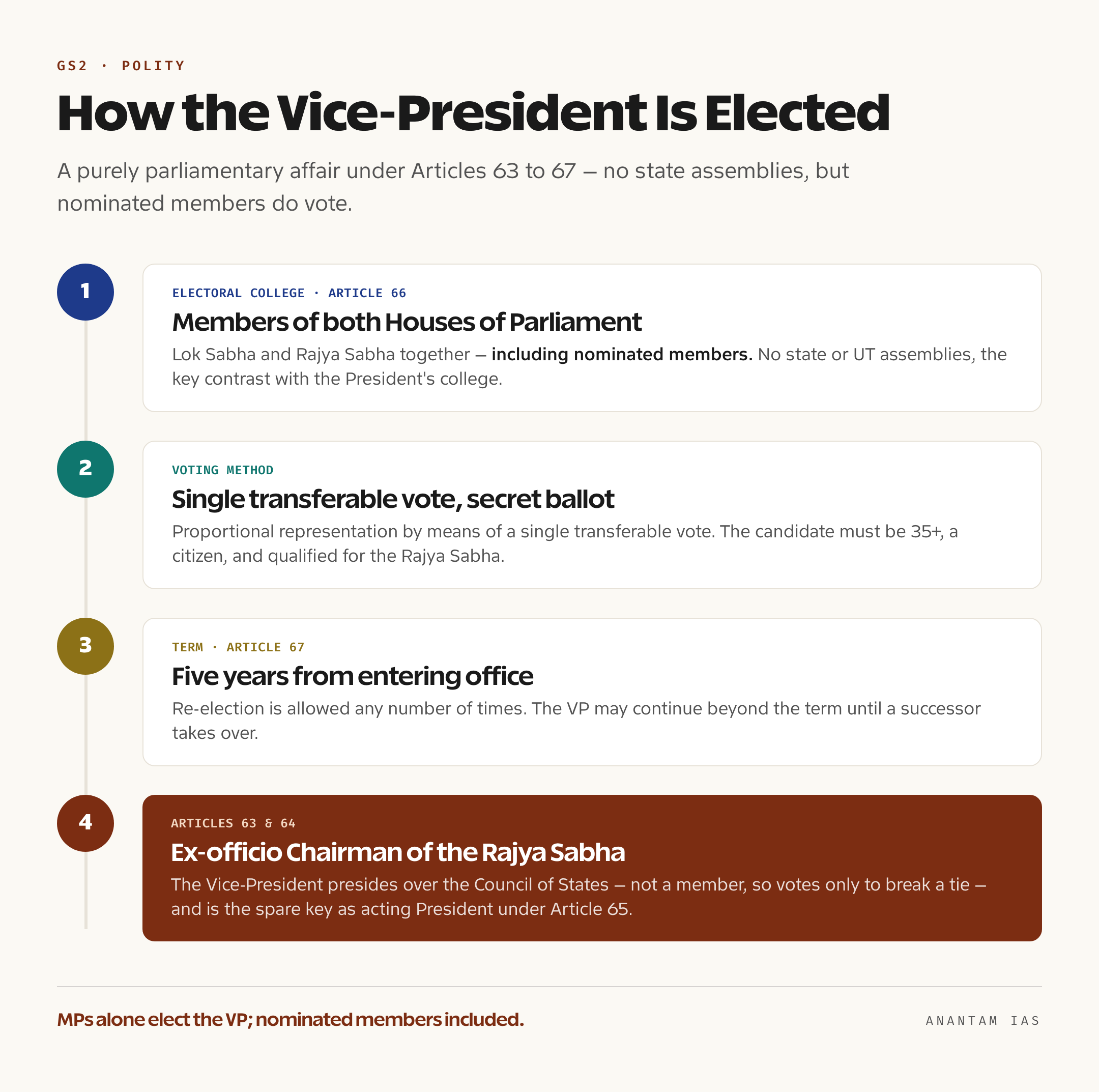
The Vice-President is elected by an electoral college consisting of the members of both Houses of Parliament, voting by proportional representation through a single transferable vote, with a secret ballot. This is the rule under Article 66, and it is the single most tested fact about the office. So slow down here.
Two details earn marks. One, the electoral college includes nominated members of both the Lok Sabha and the Rajya Sabha. That is the key contrast with the President’s election, where nominated members cannot vote. Two, the VP’s college is narrower than the President’s: only Members of Parliament take part, with no involvement of state or Union Territory legislative assemblies. The President is elected by elected MPs plus the elected members of all state and UT assemblies; the Vice-President is a purely parliamentary affair. Get that contrast straight and you have locked down a recurring Prelims trap. For the wider mechanics of the Upper House the VP presides over, see our note on the Rajya Sabha.
To be eligible, a candidate must be a citizen of India, have completed 35 years of age, and be qualified for election as a member of the Rajya Sabha. The VP must not hold any office of profit. The term is five years from the date of entering office (Article 67), but the VP can resign to the President, can continue beyond the term until a successor takes over, and can stand for re-election any number of times. Removal is deliberately harder to start than a President’s impeachment in one respect and easier in another: a resolution must be passed by the Rajya Sabha by an effective majority (a majority of all the then members) and then agreed to by the Lok Sabha, with 14 days’ notice required. No formal grounds or charges are needed, unlike presidential impeachment, which requires a “violation of the Constitution.”
Complete List of Vice-Presidents of India (1952 to 2026)
Here is the full chronological list of every Vice-President of India, from the philosopher-statesman Dr S. Radhakrishnan in 1952 to C.P. Radhakrishnan, who took office in September 2025 and holds the chair in 2026. Read it as a story, not a wall of dates: the early VPs were towering intellectuals, several went on to Rashtrapati Bhavan, and the recent years brought the office its first mid-term resignation.
| # | Vice-President | Tenure (from-to) | Notable for |
|---|---|---|---|
| 1 | Dr Sarvepalli Radhakrishnan | 13 May 1952 – 12 May 1962 | First VP; served two full terms; later 2nd President |
| 2 | Dr Zakir Husain | 13 May 1962 – 12 May 1967 | Later became the 3rd President of India |
| 3 | V.V. Giri | 13 May 1967 – 3 May 1969 | Resigned to contest and win the presidency |
| 4 | Gopal Swarup Pathak | 31 Aug 1969 – 30 Aug 1974 | First VP from a legal-administrative background |
| 5 | B.D. Jatti | 31 Aug 1974 – 30 Aug 1979 | Acted as President in 1977 |
| 6 | Mohammad Hidayatullah | 31 Aug 1979 – 30 Aug 1984 | Former Chief Justice of India |
| 7 | R. Venkataraman | 31 Aug 1984 – 24 July 1987 | Later became the 8th President |
| 8 | Shankar Dayal Sharma | 3 Sept 1987 – 24 July 1992 | Later became the 9th President |
| 9 | K.R. Narayanan | 21 Aug 1992 – 24 July 1997 | Later became the 10th President; first Dalit VP and President |
| 10 | Krishan Kant | 21 Aug 1997 – 27 July 2002 | Died in office |
| 11 | Bhairon Singh Shekhawat | 19 Aug 2002 – 21 July 2007 | Resigned after losing the 2007 presidential race |
| 12 | Mohammad Hamid Ansari | 11 Aug 2007 – 10 Aug 2017 | Longest-serving VP; two consecutive terms |
| 13 | M. Venkaiah Naidu | 11 Aug 2017 – 10 Aug 2022 | Completed one full term |
| 14 | Jagdeep Dhankhar | 11 Aug 2022 – 21 July 2025 | First VP to resign mid-term, citing health |
| 15 | C.P. Radhakrishnan | 12 Sept 2025 – present (2026) | Current VP; former Governor of Maharashtra |
A quick caution on the most recent rows, because this is where outdated notes mislead students. Jagdeep Dhankhar became the 14th Vice-President in August 2022 and resigned on 21 July 2025, citing health reasons, which made him the first VP to step down mid-term. The vacancy was filled through the 2025 vice-presidential election held on 9 September 2025, in which C.P. Radhakrishnan defeated B. Sudershan Reddy and was sworn in on 12 September 2025 as the 15th Vice-President. If you want the blow-by-blow of that contest, our Vice-President election 2025 post covers the candidates, numbers, and result.
The Must-Know Facts and Records
Beyond the raw list, the examiner loves a handful of “firsts,” “longests,” and overlaps between the two top offices. These are the lines that turn up year after year, so commit them to memory.
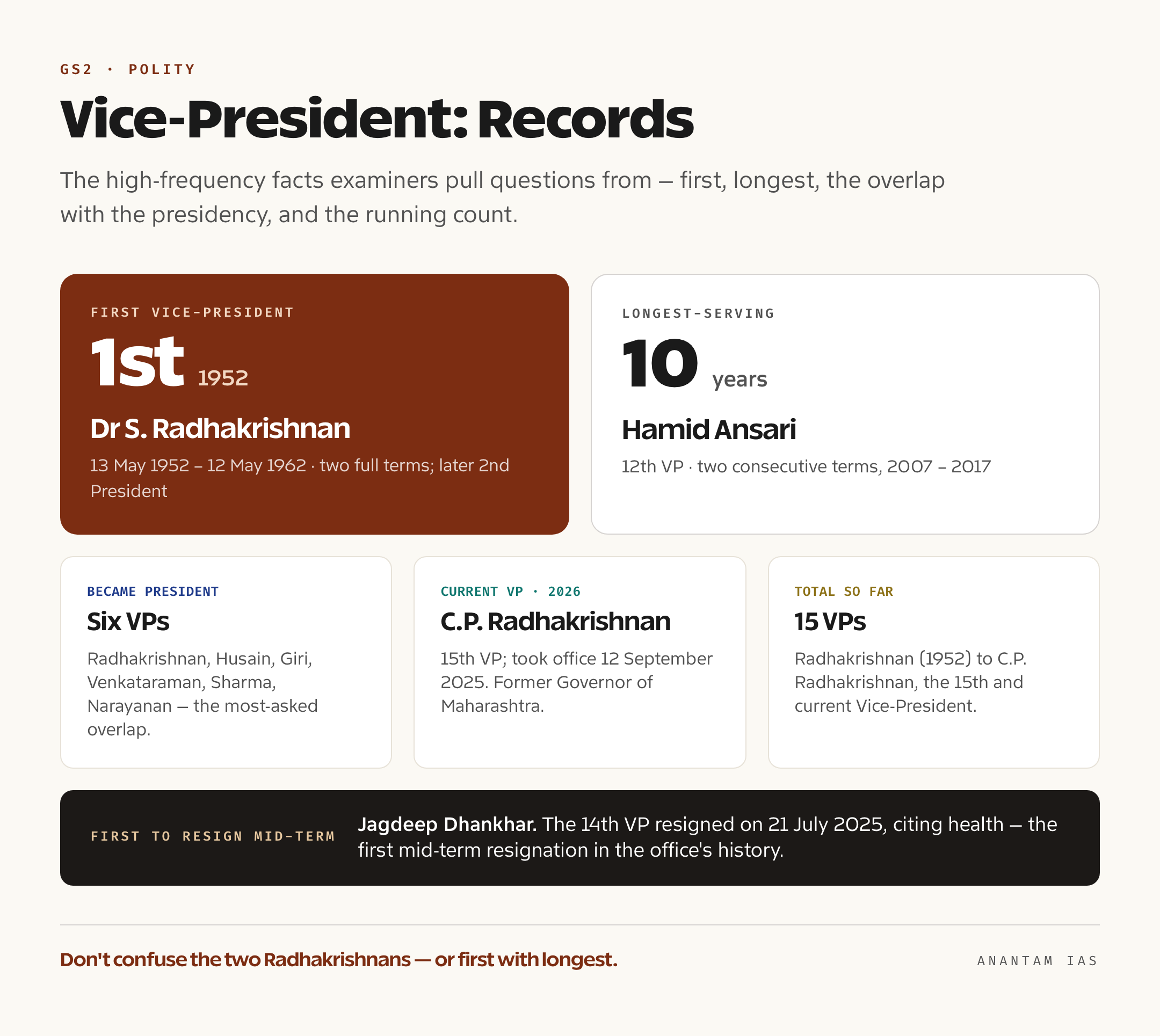
Six Vice-Presidents have gone on to become President of India. This is the most asked overlap in the topic. The six are Dr S. Radhakrishnan, Dr Zakir Husain, V.V. Giri, R. Venkataraman, Shankar Dayal Sharma, and K.R. Narayanan. Notice that these are six different people, not six terms, and that all of them are clustered in the earlier decades. No VP since Narayanan has moved up to the presidency, which is itself a small examiner favourite.
The table below pins down the records most likely to be tested. The trick is to separate “first” from “longest,” because both Radhakrishnans (S. and C.P.) and both the count of terms and the count of years can be confused under time pressure.
| Record | Holder | Detail |
|---|---|---|
| First Vice-President | Dr S. Radhakrishnan | 1952 to 1962; served two terms |
| Longest-serving VP | Mohammad Hamid Ansari | 2007 to 2017; two consecutive terms |
| VPs who later became President | Six in total | Radhakrishnan, Husain, Giri, Venkataraman, Sharma, Narayanan |
| First VP to resign mid-term | Jagdeep Dhankhar | Resigned 21 July 2025, citing health |
| VPs who died in office | Krishan Kant | Died in 2002 while serving |
| Current Vice-President (2026) | C.P. Radhakrishnan | 15th VP; took office 12 September 2025 |
Two more easy points to bank. Dr S. Radhakrishnan and Hamid Ansari are the only Vice-Presidents to have served two full terms each, but Radhakrishnan was the first and Ansari is the longest-serving because his two terms ran back to back with no gap. And although B.D. Jatti acted as President in 1977 after the death of President Fakhruddin Ali Ahmed, he never became President in his own right, so do not add him to the list of six.
How to Study This for UPSC
Treat this as a memorise-then-apply topic, not a reading topic. The smartest order is to first lock the constitutional articles (63 to 71), then the election and removal rules, and only then the chronological list, because Prelims questions cluster around the first two. Read the bare text of Articles 63, 64, 65, 66, and 67 once from the Constitution itself, then rely on a standard polity text such as Laxmikanth to fix the comparisons with the President.
For Prelims, the high-frequency hooks are the electoral college (both Houses, including nominated members, by single transferable vote), the contrast with the President’s college (which excludes nominated members and adds state assemblies), the 35-year age bar, the removal procedure (Rajya Sabha effective majority, agreed by Lok Sabha, 14 days’ notice), and the records table above. You can safely skip memorising every VP’s home state or party; the examiner rarely goes that deep. What you cannot skip is the list of the six VPs who became President and the first-versus-longest distinction.
For Mains, the VP rarely gets a standalone question, but it feeds GS Paper 2 answers on parliamentary functioning, the Rajya Sabha’s role, and checks-and-balances. The 2025 mid-term resignation is a fresh, citable example of constitutional continuity in action, so keep it in your notes. Practise writing the office in two clean sentences, and you will have a ready building block for any Parliament-related answer. If you are still building your foundation, start with our wider UPSC syllabus guide and slot polity into your timetable early.
Frequently Asked Questions
Who is the current Vice-President of India in 2026? C.P. Radhakrishnan is the current Vice-President of India. He is the 15th VP, took office on 12 September 2025, and continues to serve in 2026. He was earlier the Governor of Maharashtra.
Who was the first Vice-President of India? Dr Sarvepalli Radhakrishnan was the first Vice-President, serving from 13 May 1952 to 12 May 1962 across two full terms. He later became the second President of India.
Who is the longest-serving Vice-President of India? Mohammad Hamid Ansari is the longest-serving Vice-President, holding office for two consecutive terms from 11 August 2007 to 10 August 2017, a total of ten years.
How many Vice-Presidents later became President of India? Six. They are Dr S. Radhakrishnan, Dr Zakir Husain, V.V. Giri, R. Venkataraman, Shankar Dayal Sharma, and K.R. Narayanan.
How is the Vice-President of India elected? Under Article 66, the Vice-President is elected by an electoral college of the members of both Houses of Parliament, including nominated members, through proportional representation by a single transferable vote and a secret ballot.
Practice Questions
Prelims MCQs
- Who among the following was the first Vice-President of India? (a) Dr Zakir Husain (b) V.V. Giri (c) Dr S. Radhakrishnan (d) Gopal Swarup Pathak Answer: (c) Dr S. Radhakrishnan served as the first VP from 1952 to 1962 and later became President.
- The Vice-President of India is elected by an electoral college consisting of: (a) elected members of both Houses of Parliament only (b) all members of both Houses of Parliament, including nominated members (c) members of both Houses plus state legislative assemblies (d) the Rajya Sabha alone Answer: (b) Article 66 includes nominated members; state assemblies are not involved, unlike in the President’s election.
- Which Vice-President of India served for the longest period? (a) Dr S. Radhakrishnan (b) Hamid Ansari (c) Venkaiah Naidu (d) K.R. Narayanan Answer: (b) Hamid Ansari served two consecutive terms from 2007 to 2017.
- With reference to the office of the Vice-President, consider the following: the Vice-President is the ex-officio Chairman of the Rajya Sabha under which Article? (a) Article 63 (b) Article 64 (c) Article 66 (d) Article 67 Answer: (b) Article 64 makes the VP the ex-officio Chairman of the Council of States.
- Who was the first Vice-President of India to resign before completing the term? (a) V.V. Giri (b) Bhairon Singh Shekhawat (c) Jagdeep Dhankhar (d) Krishan Kant Answer: (c) Jagdeep Dhankhar resigned on 21 July 2025, citing health reasons, the first mid-term resignation by a VP.
Mains Practice Questions
- The office of the Vice-President of India is often described as a position of dignity without much independent power. Critically examine this view with reference to the office’s constitutional functions. (15 marks, 250 words)
- Compare the electoral colleges that elect the President and the Vice-President of India, and explain why the difference matters for the democratic character of each office. (10 marks, 150 words)
- Discuss the role of the Vice-President as the ex-officio Chairman of the Rajya Sabha and its significance for the smooth functioning of the Upper House. (15 marks, 250 words)
- “The Vice-President is the constitutional safety mechanism that ensures continuity in the highest office.” Discuss in the light of the provisions for the Vice-President acting as President. (10 marks, 150 words)
- Examine the procedure for the removal of the Vice-President of India and contrast it with the impeachment of the President. (15 marks, 250 words)
Master this topic and you have turned a frequently asked, easily confused area into guaranteed marks. The whole secret is to revise the list in one direction (first to current), keep the records table on a single flashcard, and never let the two Radhakrishnans or the first-versus-longest pairing slip. Do that, and any VP question in Prelims becomes a tick, while your polity answers in Mains gain a clean, factual anchor.