Macaulay’s Minute (1835): Anglicist-Orientalist Debate, English Education Act and Its Legacy
Macaulay's Minute of 2 February 1835 made English the medium of higher education in colonial India. What it argued, what followed, and why the policy defeated its own purpose.
Macaulay’s Minute on Indian Education, dated 2 February 1835, is the document that made English the medium of higher education in colonial India. Thomas Babington Macaulay wrote it to break a deadlock inside the East India Company’s Committee of Public Instruction, and the decision it forced shaped Indian schooling, the courts and the bureaucracy for more than a century. Understanding the Minute matters because almost every later debate about medium of instruction, elite access and vernacular education traces back to it.
What the Minute Was Responding To
The Minute was not written in a vacuum. It was an intervention in a specific administrative dispute with a specific pot of money attached.
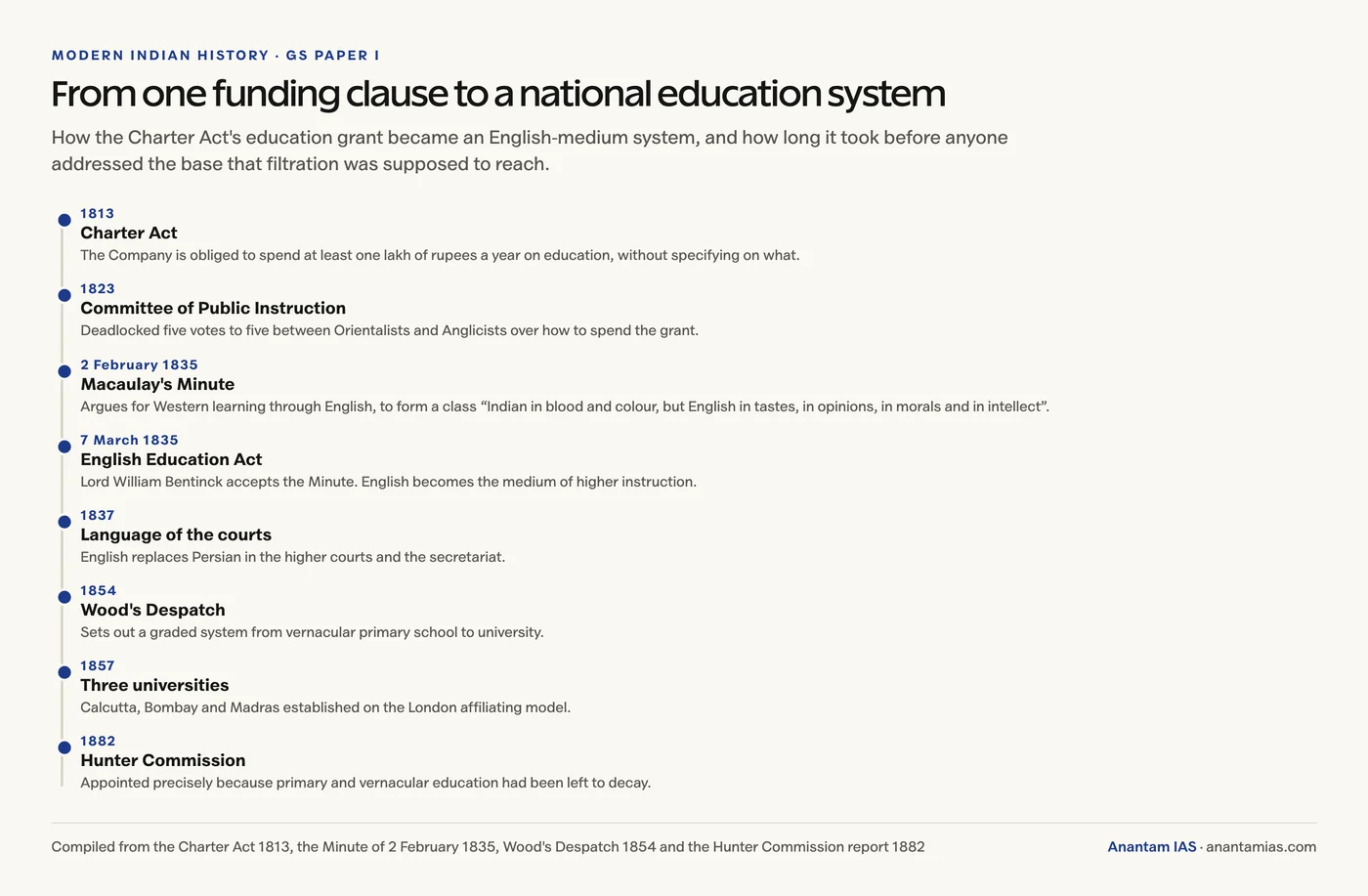
- The Charter Act of 1813 obliged the Company to spend at least one lakh of rupees a year on education, but did not say on what kind.
- The Committee of Public Instruction was split. Orientalists (H. T. Prinsep, H. H. Wilson) wanted the money spent on Sanskrit, Persian and Arabic learning through existing institutions.
- Anglicists wanted it spent on Western science and literature taught in English.
- The committee had deadlocked five votes to five, so the question went to Macaulay, who was Law Member of the Governor-General’s Council and president of the committee.
What Macaulay Actually Argued
The Minute’s reasoning has three moves, and only the third is the one usually quoted.
- A judgement on value. Macaulay claimed Indian and Arabic learning had little worth beside European scholarship, a claim he made without reading the languages he dismissed.
- An argument from scarcity. Limited funds could not educate a whole population, so they should be concentrated on a small class.
- The filtration class. The aim was to form “a class of persons Indian in blood and colour, but English in tastes, in opinions, in morals and in intellect”, who would in turn refine the vernaculars and carry knowledge downward.
That third move is the downward filtration theory, and it is the part of the Minute with the longest afterlife.
What Followed Immediately
- English Education Act, 1835. Lord William Bentinck accepted the Minute on 7 March 1835, making English the medium of higher instruction and directing funds away from Oriental institutions.
- Language of administration. English replaced Persian as the language of the higher courts and the secretariat in 1837.
- Employment effect. Government service now required English, which turned schooling into the main route into the colonial middle class.
Consequences for Administration and Education
The Minute’s effects split cleanly into what it built and what it starved.
| Area | What the Minute produced |
|---|---|
| Bureaucracy | A cheap, English-literate clerical and subordinate service class for an expanding Company state |
| Judiciary | English-language higher courts, with a lasting gap between the courtroom and the litigant |
| Higher education | The direction later formalised by Wood’s Despatch (1854) and the universities of Calcutta, Bombay and Madras (1857) |
| Mass education | Neglect. Filtration did not happen; literacy stayed under 6 per cent well into the twentieth century |
| Indigenous learning | Withdrawal of patronage from tols, madrasas and pathshalas, weakening a functioning local network |
| Language hierarchy | English as the marker of employability, a hierarchy that outlived the Raj |
The Criticism, and the Part That Backfired
The standard nationalist criticism is that the Minute was culturally contemptuous and socially narrow. Both charges hold. But the more interesting point is that the policy defeated its own purpose.
- English-educated Indians read Mill, Burke, Locke and Mazzini, and turned that liberal vocabulary against the empire.
- Reform movements including the Brahmo Samaj used the new education to argue for social change on Indian terms.
- A shared language of political argument across provinces made an all-India Congress organisationally possible.
- The Hunter Commission (1882) had to be appointed precisely because primary and vernacular education had been left to decay.
Gandhi’s later attack in Hind Swaraj was aimed at exactly this: an education that produced clerks estranged from their own society.
How to Use This in an Answer
- Do not write only about education. Questions on the Minute usually name administration and education, and the administration half carries marks.
- Name the dispute (Anglicist versus Orientalist) and the enabling law (Charter Act 1813) to show you know why the Minute existed.
- Use downward filtration as the analytical hinge, then show it failed empirically.
- Close on the unintended consequence. That is where the evaluative marks sit.
Frequently Asked Questions
What is Macaulay’s Minute on Indian Education?
It is a policy note written by Thomas Babington Macaulay on 2 February 1835, arguing that the East India Company’s education funds should be spent on Western learning taught through English rather than on Sanskrit, Persian and Arabic scholarship. Lord William Bentinck accepted it, and the English Education Act of 1835 gave it effect.
What is the downward filtration theory?
It is the assumption that educating a small English-speaking elite would cause knowledge to trickle down to the wider population through the vernaculars. It underpinned colonial education spending for decades and did not work; mass literacy remained below 6 per cent well into the twentieth century.
Who opposed Macaulay’s Minute?
The Orientalist faction on the Committee of Public Instruction, led by H. T. Prinsep and supported by H. H. Wilson, argued for continued state support to classical Indian learning. The committee was deadlocked five to five before Macaulay intervened.
What was the Anglicist-Orientalist controversy?
It was the dispute over how the education grant mandated by the Charter Act of 1813 should be spent. Orientalists favoured Sanskrit, Persian and Arabic learning; Anglicists favoured Western science and literature in English. Macaulay’s Minute settled it in favour of the Anglicists.
How did Macaulay’s Minute affect Indian administration?
It made English the language of higher courts and the secretariat, and created an English-literate Indian clerical class that staffed the lower rungs of the colonial administration cheaply. It also entrenched a linguistic hierarchy in public employment that survived independence.
Did Macaulay’s Minute help Indian nationalism?
Indirectly, yes. The English-educated class it created read European liberal and nationalist thought and used that vocabulary against colonial rule, while a common language of political debate across provinces made all-India political organisation practical.
Practice Questions
Prelims MCQs
1. Macaulay’s Minute on Indian Education was written in which year?
- (a) 1813
- (b) 1833
- (c) 1835
- (d) 1854
Answer: (c) 1835
2. The statutory obligation to spend on education in India was first created by:
- (a) Regulating Act, 1773
- (b) Charter Act of 1813
- (c) Charter Act of 1833
- (d) Wood’s Despatch, 1854
Answer: (b) Charter Act of 1813
3. Who accepted Macaulay’s Minute and gave it legal effect in 1835?
- (a) Lord Cornwallis
- (b) Lord William Bentinck
- (c) Lord Dalhousie
- (d) Lord Canning
Answer: (b) Lord William Bentinck
4. The ‘downward filtration theory’ refers to:
- (a) Transfer of revenue from provinces to the centre
- (b) Spread of education from an elite class to the masses
- (c) Devolution of judicial powers to district courts
- (d) Gradual Indianisation of the civil services
Answer: (b) Spread of education from an elite class to the masses
5. Which commission was appointed in 1882 largely because primary and vernacular education had been neglected?
- (a) Sadler Commission
- (b) Sargent Commission
- (c) Hunter Commission
- (d) Raleigh Commission
Answer: (c) Hunter Commission
Mains Questions
- Discuss the impact of Macaulay’s Minute on colonial administration and education in India.
- “The downward filtration theory failed on its own terms.” Examine with reference to nineteenth-century Indian education policy.
- Evaluate the argument that colonial education policy inadvertently supplied the intellectual tools of Indian nationalism.
- Compare the Orientalist and Anglicist positions on Indian education and assess which better served Indian society.
- Trace the evolution of colonial education policy from the Charter Act of 1813 to the Hunter Commission of 1882.