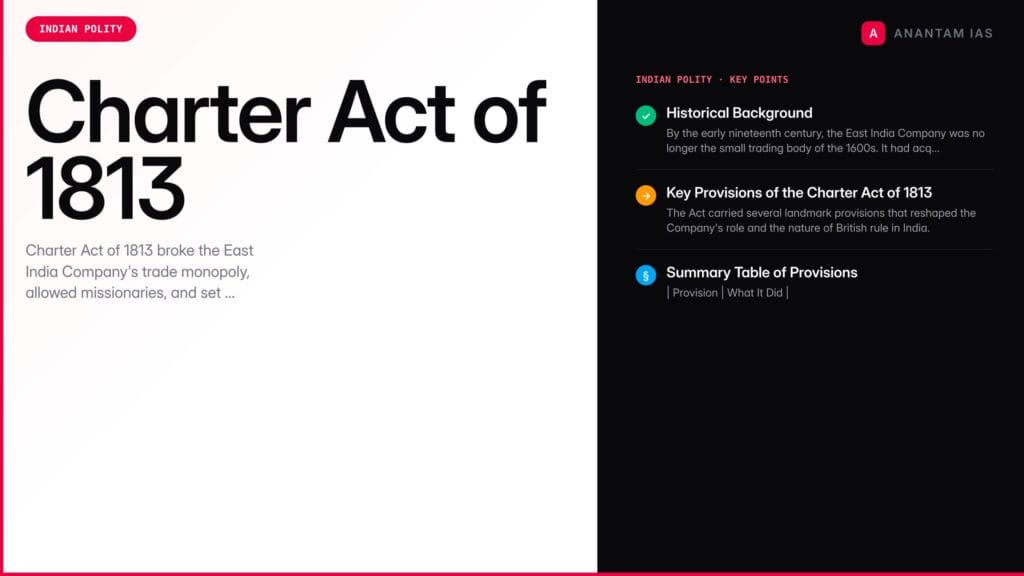
The Charter Act of 1813, formally titled the East India Company Act 1813, was the second in the series of Charter Acts passed by the British Parliament to renew the East India Company's charter for another twenty years. It marked a decisive turning point in the constitutional and economic history of British India because it ended the Company's century-old commercial monopoly, opened India to Christian missionary activity, and, for the first time, committed public funds to Indian education. For UPSC aspirants, the Act is a high-yield Prelims and Mains topic that links colonial economic policy, modern Indian education, and the assertion of British Crown sovereignty.
Historical Background
By the early nineteenth century, the East India Company was no longer the small trading body of the 1600s. It had acquired territories through Plassey (1757), Buxar (1764), and the Maratha wars, yet its commercial privileges remained intact. Three forces pushed Parliament to renew the charter on tougher terms in 1813.
| Factor | Explanation |
|---|---|
| Continental System | Napoleon's blockade closed European markets to British goods; British manufacturers demanded access to Indian markets. |
| Industrial Revolution | Lancashire textile lobby wanted to export machine-made cloth to India, which the Company's monopoly blocked. |
| Evangelical pressure | Clapham Sect and William Wilberforce pushed for missionary access, arguing for the "moral duty" of the empire. |
| Free trade ideology | Adam Smith's arguments against monopoly had gained wide currency in Parliament. |
The Company's charter was set to expire in 1813, giving Parliament leverage to restructure its privileges.
Key Provisions of the Charter Act of 1813
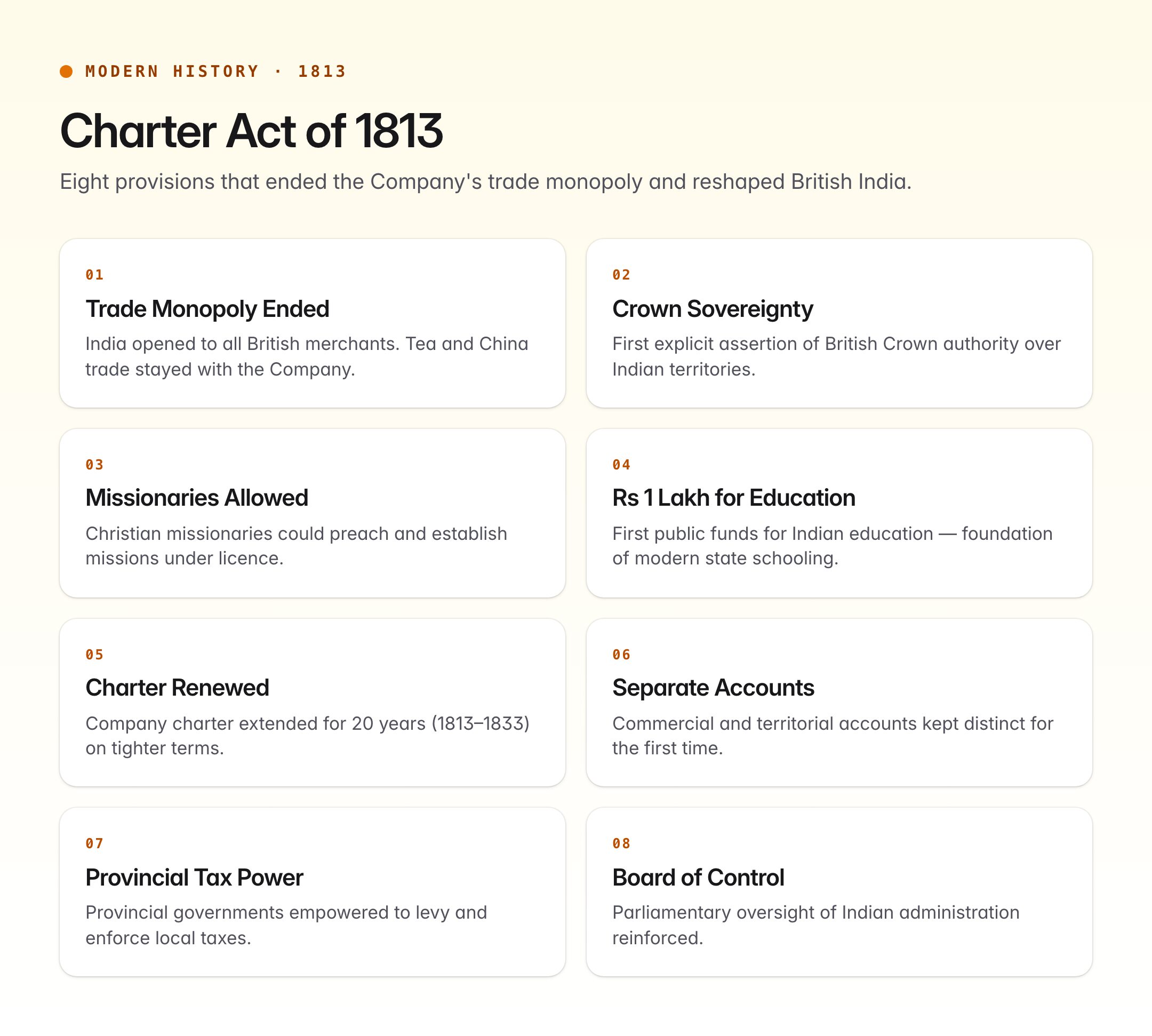
The Act carried several landmark provisions that reshaped the Company's role and the nature of British rule in India.
1. End of the Trade Monopoly
The Act abolished the East India Company's monopoly over trade with India, throwing Indian commerce open to all British merchants under a licensing system. However, the Company retained its monopoly over the tea trade and trade with China for another twenty years. The partial nature of this liberalisation reveals how Parliament balanced free-trade demands against the Company's fiscal dependence on the lucrative China trade.
2. Assertion of British Crown Sovereignty
For the first time, the Act explicitly asserted the sovereignty of the British Crown over the Company's Indian territories. Until 1813, the Company had ruled in the name of the Mughal emperor. This clause legally relocated ultimate authority in Britain, paving the way for direct Crown rule in 1858. This was the most important constitutional change the Act introduced.
3. Permission for Christian Missionaries
The Act opened India to Christian missionaries by requiring the Company to grant them licences to preach and establish missions. Earlier Company policy had discouraged missionaries to avoid offending Indian religious sentiments after the experience of the Vellore Mutiny of 1806. The new clause reflected the evangelical lobby's political strength.
4. Grant of Rs 1 Lakh for Education
Section 43 of the Act directed that "a sum of not less than one lakh of rupees in each year shall be set apart and applied to the revival and improvement of literature and the encouragement of the learned natives of India, and for the introduction and promotion of a knowledge of the sciences among the inhabitants of the British territories in India." This was the first explicit commitment of public funds to Indian education by the British government and the foundation of modern state education in India.
5. Financial Separation
The Act required the Company to keep its commercial and territorial accounts separate, reflecting Parliament's recognition that the Company was no longer a pure trading body.
6. Extension of Charter
The Company's charter was renewed for a further twenty years (1813–1833), but on significantly tighter terms.
7. Local Government Powers
Provincial governments in India were empowered to levy taxes on persons subject to their jurisdiction. Persons not paying such taxes could be punished.
8. Board of Control Reinforced
The authority of the Board of Control, set up under Pitt's India Act of 1784, was strengthened and clarified, tightening parliamentary oversight of Indian administration.
Summary Table of Provisions
| Provision | What It Did |
|---|---|
| Trade monopoly | Abolished for India; retained for tea and China |
| Crown sovereignty | First explicit assertion over Indian territories |
| Missionaries | Allowed under licence |
| Education grant | Rs 1 lakh annually for Indian education |
| Charter | Renewed for 20 years |
| Accounts | Commercial and territorial kept separate |
| Tax powers | Given to provincial governments |
| Board of Control | Authority reinforced |
Significance of the Charter Act of 1813
The Act marked several "firsts" that give it long-term historical weight.
Economic transformation. The end of the monopoly flooded India with cheap British manufactured goods, particularly textiles from Lancashire. Indian weavers lost their markets, and the country's deindustrialisation accelerated. India became a supplier of raw cotton and a captive market for British industry, a pattern that defined the colonial economy for the next century.
Birth of modern education. The Rs 1 lakh clause, however modest, launched a public system of education. Debates over how to spend it culminated in the Orientalist–Anglicist Controversy and Macaulay's Minute of 1835, which tilted state support towards English-medium education and Western sciences.
Missionary impact. The arrival of missionaries brought not only religious activity but also schools, colleges, printing presses, and Indian-language translations of scientific texts. It also, however, contributed to social friction that later fed into the Revolt of 1857.
Constitutional foundation. The explicit declaration of Crown sovereignty laid the legal groundwork for the Government of India Act 1858, which abolished Company rule after the Revolt.
Limitations and Criticisms
The Act was progressive only in limited ways. Indians had no say in its framing. The monopoly over tea and China trade kept Company profits intact. The education grant was too small to fund meaningful change and went largely unspent in its early years. Missionary activity was paternalistic and often disruptive of Indian society. The Act served British commercial and evangelical interests far more than Indian welfare.
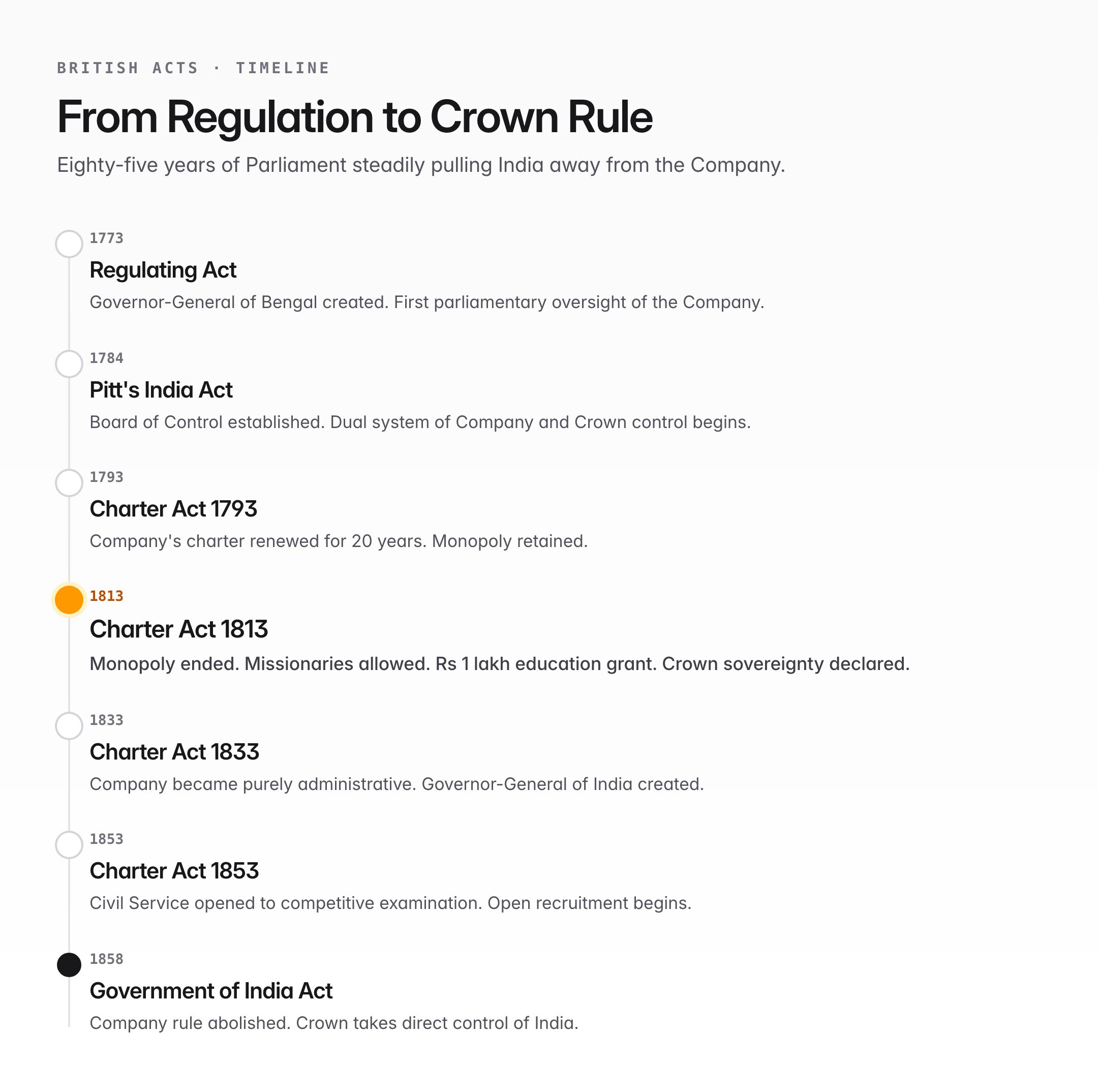
Charter Acts at a Glance
| Act | Year | Headline Change |
|---|---|---|
| Regulating Act | 1773 | Governor-General of Bengal created |
| Pitt's India Act | 1784 | Board of Control set up |
| Charter Act | 1793 | Company's charter renewed for 20 years |
| Charter Act | 1813 | Monopoly ended (except tea/China); education grant; missionaries allowed; Crown sovereignty declared |
| Charter Act | 1833 | Company became purely administrative; Governor-General of India created |
| Charter Act | 1853 | Civil Service opened to competitive examination |
UPSC Relevance
The Charter Act of 1813 appears frequently in the Prelims under Modern Indian History, usually as a matching or statement-based question on its provisions. Aspirants must remember the exact figure of Rs 1 lakh for education, the tea and China trade exception to the monopoly, and the declaration of Crown sovereignty. For GS Paper I in Mains, the Act is relevant to questions on the economic impact of British rule, the growth of Western education, and the constitutional evolution towards the Government of India Act 1858. Connect it with the Orientalist–Anglicist debate, Macaulay’s Minute, the deindustrialisation thesis (Dadabhai Naoroji, R. C. Dutt), and the impact of missionary activity on Indian society. Essay aspirants can use it as an example of how imperial law embedded economic exploitation within the language of reform. In Ethics (GS Paper IV), the Act’s contradictions between stated moral purpose and practical exploitation offer a useful case study on colonial paternalism.
Tell Google you want more of this.
Add Anantam IAS as a preferred sourceOne tap, and this site shows up more often in your own Top Stories, AI Overviews and AI Mode. Remove it any time.