Major Constraints in India’s Energy Sector: Problems and Reforms (UPSC)
DISCOM losses, coal monopoly, AT&C losses, RE-PPA disputes, energy taxes — master India's energy sector constraints with 2024-26 reforms for UPSC GS-III.
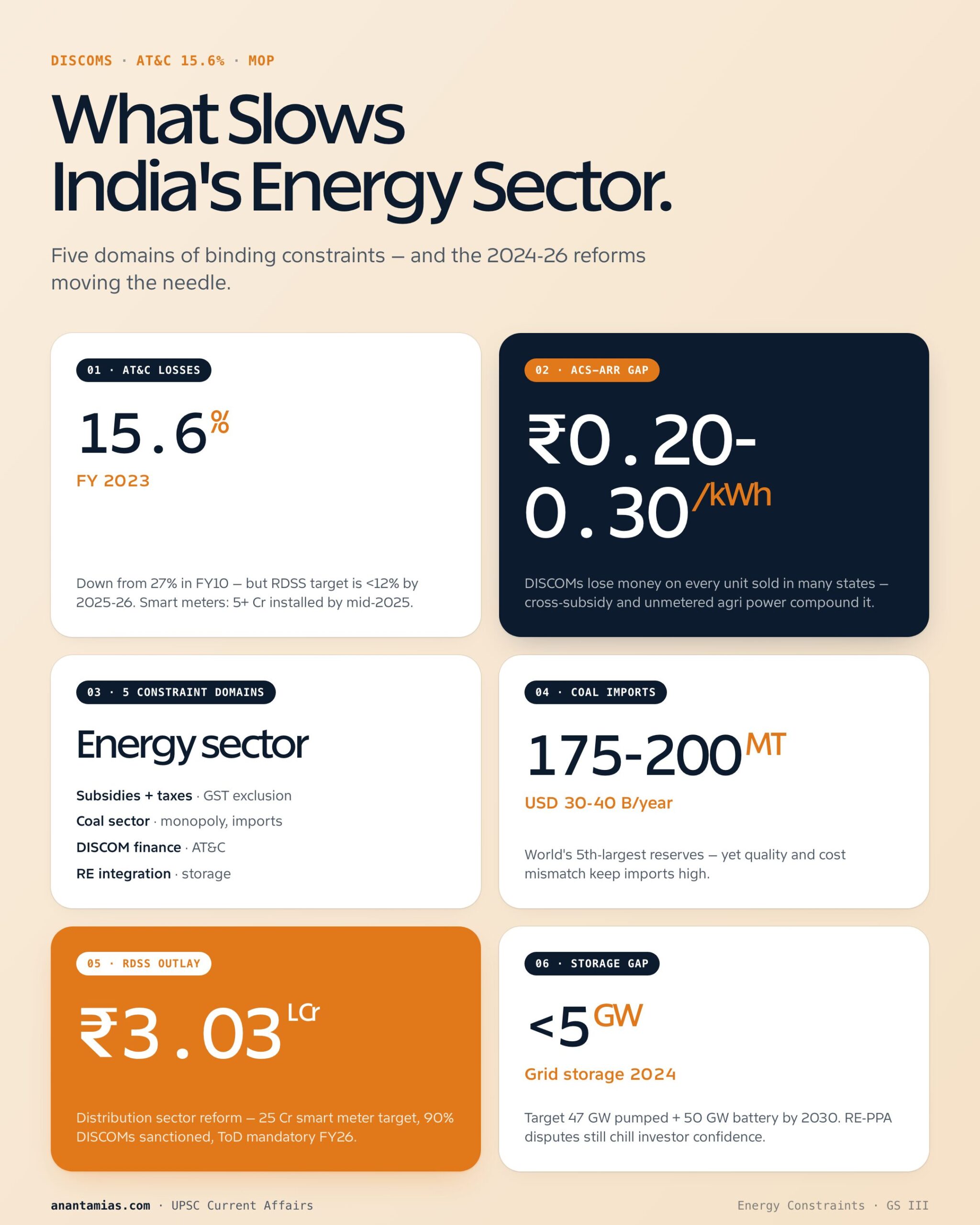
India's energy sector anchors growth, jobs, and welfare — yet remains burdened by structural constraints that have persisted for decades. The headline goal — affordable, reliable, sustainable, and modern energy for all by 2030 — runs into fiscal distortions, regulatory weakness, monopoly hangovers, financial fragility of utilities, and renewable integration challenges. The Economic Survey has repeatedly catalogued these constraints since 2018-19. Even with major progress in renewables (220 GW), electrification (Saubhagya), and clean cooking (Ujjwala), the binding constraints — DISCOM finances, AT&C losses, coal supply mismatch, RE-PPA disputes, and absence of energy taxes from GST — keep India's energy economics fragile. This article unpacks each constraint with 2024-26 data for UPSC GS-III on infrastructure, mineral resources, and the Indian economy.
The Five Domains of Constraints
A useful lens groups energy-sector constraints into five domains:
- Subsidies and Taxes (cross-cutting fiscal distortion).
- Coal sector (supply mismatch, monopoly hangover).
- Power Generation, Transmission & Distribution (DISCOM finances, regulatory weakness).
- Energy Efficiency (capital, awareness, market depth).
- Renewable Energy (PPA sanctity, grid integration, land).
We address each in turn.
1. Subsidies and Taxes: The Fiscal Distortion
The Problem
A complex web of subsidies and taxes distorts the energy market by:
- Promoting inefficient over efficient fuels (e.g., subsidised kerosene, free electricity for agriculture).
- Cross-subsidising household consumers from industrial/commercial users, raising the cost of doing business for industry.
- Keeping petroleum products outside GST — petrol, diesel, ATF, natural gas, crude — meaning industries pay tax on inputs but get no input tax credit, raising effective tax incidence.
- Energy taxes outside GST mean layered, cascading taxation on industry and exports, eroding competitiveness.
Why It Persists
- Petroleum revenue is critical to both Centre and states — central excise on fuels and state VAT/sales tax together raise Rs 8-10 lakh crore annually.
- States resist GST inclusion of petroleum products as it would surrender revenue autonomy.
- Free agriculture electricity is politically protected.
Implications
- Indian exports carry embedded energy taxes, hurting competitiveness.
- Domestic manufacturing incurs higher input costs than competitors in countries where energy is GST/VAT-creditable.
- Electricity consumers face non-uniform tariffs with cross-subsidy distortions.
2. Coal Sector Constraints
Monopoly and Demand-Supply Mismatch
- Coal India Limited (CIL) still produces about 80 percent of India's domestic coal — long-standing monopoly hangover.
- Domestic production (~997 MT in FY24) lags demand (~1,150 MT), forcing imports of 175-200 MT annually.
- Plant Load Factor (PLF) of thermal power plants remains in the 65-67 percent range — improved but still well below the 75-80 percent of mature global utilities.
- Imports cost USD 30-40 billion annually, stressing the current account.
Land Acquisition Delays
- Mining requires forest clearance, environment clearance, R&R for displaced communities — each step takes years.
- Land Acquisition, Rehabilitation and Resettlement Act, 2013 raises the cost of acquisition.
- Hasdeo Aranya, Saranda controversies show conservation–mining tensions.
Bias Toward Open-Cast Mining
- Indian coal industry has historically expanded open-cast mining even where reserves better suit underground operations.
- Open-cast is cheaper short-term but causes larger surface footprint, deforestation, water table disruption.
- Underground mining accounts for less than 5 percent of production.
Outdated Technology
- Many CIL mines still use older blasting and trucking techniques.
- Longwall mining, continuous miners, and CCUS lag global benchmarks.
Financial Knock-On
- Coal shortages forced thermal plants to import expensive coal, reducing margins.
- This contributed to NPAs in the banking sector during 2015-19, since power was a major distressed sector.
3. Power Generation, Transmission and Distribution: DISCOM Crisis
Old, Inefficient Plants Still Run
- Many old thermal plants (~25-30 GW capacity) operate at low efficiency while newer, more efficient supercritical plants are underutilised — a merit-order problem.
- Must-run legal status for older PPAs prevents efficient dispatch.
Weak Regulatory Framework
- Although State Electricity Regulatory Commissions (SERCs) are legally independent, they often face political pressure to keep agriculture and household tariffs low.
- This prevents cost-recovery tariffs.
State Power Utilities' Poor Financial Health
- Discoms in many states (UP, MP, Bihar, J&K, Tamil Nadu) carry accumulated losses and high debt.
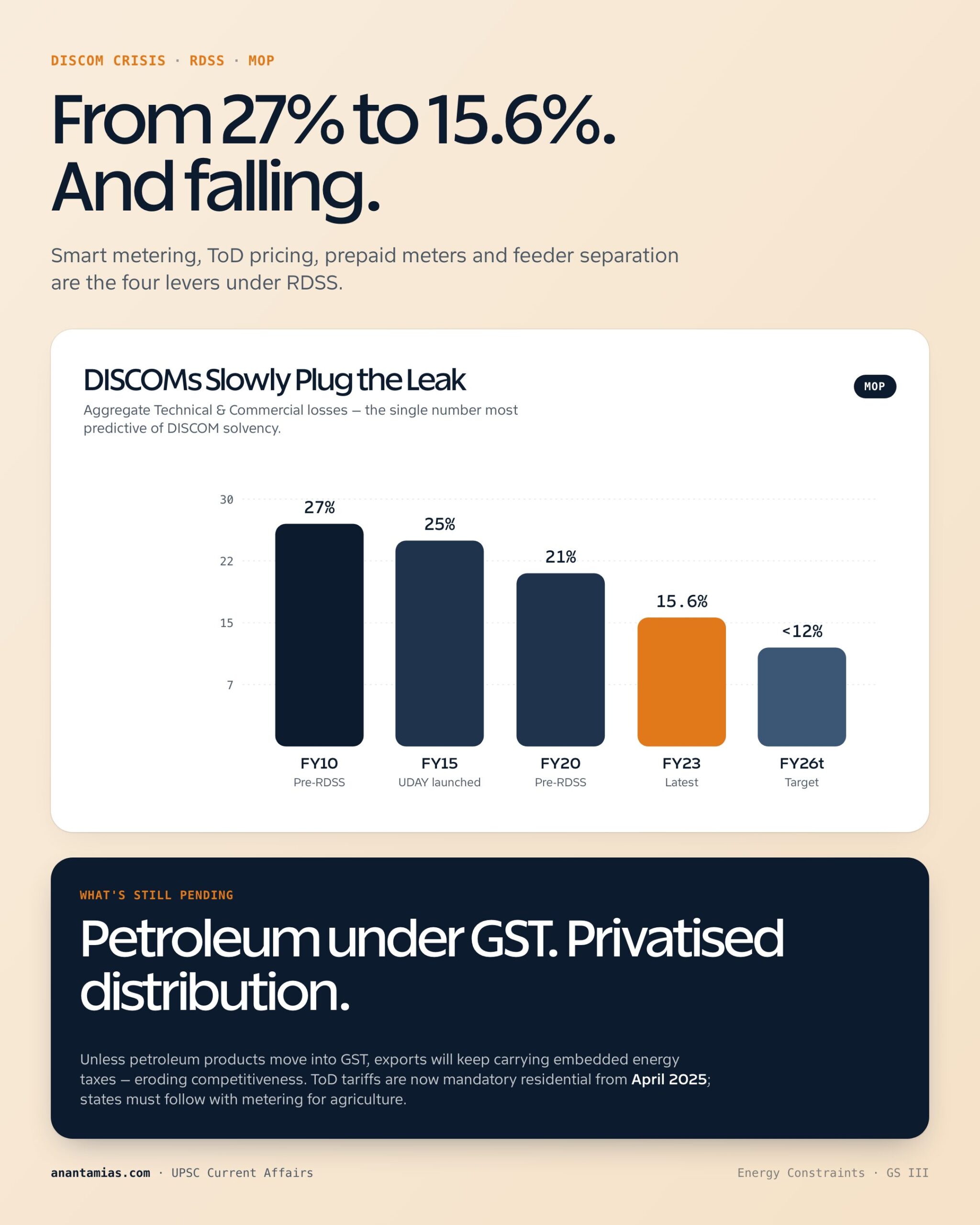
- The Aggregate Technical & Commercial (AT&C) losses averaged 15.6 percent in FY23, target is <12 percent by 2025-26.
- The gap between Average Cost of Supply (ACS) and Average Revenue Realised (ARR) stood at Rs 0.20-0.30/kWh for many states in FY24 — meaning losses on every unit sold.
Unmetered Agriculture Power
- Free electricity (Punjab, Karnataka, Tamil Nadu) and unmetered agricultural connections mean farmers have no incentive to conserve.
- Drives groundwater depletion and DISCOM losses.
Cross-Subsidy Pressure
- High industrial and commercial tariffs (often 1.5-2x cost of supply) cross-subsidise residential and agricultural consumers.
- This erodes industrial competitiveness and pushes large users to captive generation, further reducing DISCOM revenue base.
4. Energy Efficiency Constraints
Limited Technical Capabilities
- SMEs lack energy management expertise.
- Few energy auditors and ESCOs (Energy Service Companies).
High Capital Costs
- Initial capex for energy-efficient equipment (LED, BLDC motors, VFDs, solar pumps) higher than conventional alternatives.
- Payback periods often 3-5 years, beyond SME planning horizons.
Limited Market Depth
- Few standardised products with verified energy savings.
- Limited financing instruments for ESCO contracts.
- Banks reluctant to lend for efficiency projects given perceived risk.
Policy Friction
- PAT (Perform, Achieve, Trade) scheme under National Mission on Enhanced Energy Efficiency has improved compliance but credits trade thinly.
- ECBC for buildings adoption uneven across states.
Awareness Gap
- Households often unaware of life-cycle savings from BEE-star-rated appliances.
- Ujala scheme distributed 36+ crore LED bulbs but residential efficiency push for ACs, fans, refrigerators is still uneven.
5. Renewable Energy Constraints
PPA Sanctity Issues
- High-cost old PPAs (signed at Rs 7-12/unit when solar was nascent) are increasingly renegotiated or reneged by states (Andhra Pradesh, Tamil Nadu) when newer solar comes at Rs 2.50-3.00/unit.
- This erodes investor confidence and raises the cost of capital for renewables.
Grid Integration
- Variable RE (solar, wind) needs grid balancing — pumped storage, batteries, gas peakers.
- India had <5 GW of grid-scale storage in 2024; target is 47 GW pumped + 50 GW batteries by 2030.
Land Acquisition
- Solar parks need 2-2.5 hectares per MW; wind farms 0.4 ha/MW.
- Land aggregation is challenging in densely populated regions.
Transmission Infrastructure
- Renewable-rich states (Rajasthan, Gujarat, Tamil Nadu) need green energy corridors to evacuate power to consumption centres.
- Inter-State Transmission System (ISTS) charges are subsidised through 2030 to incentivise projects.
Domestic Manufacturing Gap
- Solar PV cell and module imports still substantial despite PLI for solar manufacturing and ALMM (Approved List of Models and Manufacturers).
- China dominance in solar supply chain is a strategic concern.
Recent Developments (2024-26)
DISCOM Reform
- Revamped Distribution Sector Scheme (RDSS, 2021): Rs 3.03 lakh crore over 5 years.
- Smart metering: 25 crore target; 5+ crore installed by mid-2025.
- Loss reduction projects sanctioned across 90 percent of DISCOMs.
- AT&C losses fell to 15.6 percent in FY23 (from 27 percent in FY10).
Energy Conservation Amendment Act, 2022
- Enables Carbon Credit Trading Scheme.
- CCTS notification 2024 establishes domestic compliance market.
- Mandates green hydrogen and biofuels in industries.
Coal Sector Liberalisation
- 120+ commercial blocks auctioned by 2025.
- Mission Coking Coal target 140 MT by 2030.
- Coal gasification target 100 MT by 2030.
Renewable Energy
- PM Surya Ghar Muft Bijli (Feb 2024): 1 crore households target.
- Green Energy Open Access Rules 2022 enable C&I consumers to procure RE directly.
- Pumped Hydro Storage policies finalised.
Just Transition
- Ministry of Coal working on Just Transition framework for coal districts.
- Energy Transition Pathway under preparation by Power Ministry.
Budget 2025-26
- Power capex sustained.
- Nuclear Energy Mission for SMRs.
- Critical Minerals Mission operationalised.
- MNRE allocation: Rs 26,549 crore.
A Snapshot of Constraints and Reform Status
| Constraint | Status (2024-26) |
|---|---|
| Petroleum outside GST | Pending; council deliberations |
| CIL coal monopoly | Eased — commercial auctions completed |
| AT&C losses | 15.6% (FY23) — target <12% by 2025-26 |
| Cross-subsidy | Ongoing reform under RDSS |
| RE-PPA disputes | Lower frequency but persists in some states |
| Storage gap | 47 GW pumped + 50 GW battery by 2030 |
| Solar import dependence | Reducing via PLI for cells/modules |
| Energy efficiency awareness | Improving via Ujala 2.0, S&L, PAT |
Way Forward
- Bring petroleum under GST in phases (e.g., natural gas first; ATF; then diesel/petrol).
- Reform DISCOM tariffs: ToD pricing, smart metering, prepaid meters, agriculture metering.
- Privatisation of distribution franchises in struggling utilities.
- Storage push: Pumped hydro, lithium-ion, sodium-ion batteries, Battery Energy Storage Systems (BESS) PLI.
- Coal sector: Mission Coking Coal scale-up, underground push, just transition planning.
- Transmission: Green energy corridors II completion; inter-state HVDC links.
- Energy efficiency: PAT III deepening; ECBC mandatory for new commercial buildings; appliance star labels expansion.
- Renewable financing: Sovereign green bonds, mid-stage de-risking for storage and offshore wind.
UPSC Relevance
GS-III Mapping
- Infrastructure: Energy, Ports, Roads, Airports, Railways.
- Indian economy and issues relating to planning, mobilization of resources.
- Conservation, environmental pollution, and degradation.
- Effects of liberalization on the economy.
Prelims Pointers
- AT&C losses target: <12 percent under RDSS.
- PAT Scheme under National Mission on Enhanced Energy Efficiency.
- Energy Conservation (Amendment) Act, 2022 — enables CCTS.
- National Coal Index — 2020.
- Approved List of Models and Manufacturers (ALMM) for solar.
- Coal monopoly ended by 2020 commercial auctions.
Mains Hooks
- "Examine the structural constraints in India's energy sector and the reforms needed to overcome them." (GS-III)
- "Discuss the financial fragility of state electricity distribution companies and policy responses." (GS-III)
- "How does the absence of petroleum products from GST distort India's energy market and competitiveness?"
- "Why does India still import coal despite being the world's third-largest producer? Suggest reforms."
India's energy-sector reforms are a continuous agenda, not a one-time event. The constraints — DISCOM finances, coal mismatch, energy-tax distortion, weak regulation, RE integration — are stubborn, but the 2020-2026 reform package (commercial auctions, RDSS, Energy Conservation Amendment, PM Surya Ghar, Green Hydrogen Mission, Critical Minerals Mission) has moved the needle. For UPSC, structure your answer around the five domains of constraints, the latest data (AT&C, PLF, imports), and the reforms in motion — and you will write strong, evidence-based GS-III answers on India's most consequential infrastructure sector.