Mission Amrit Sarovar — Objectives, Progress & UPSC Governance Guide
Complete UPSC guide to Mission Amrit Sarovar — launched in 2022 under Azadi Ka Amrit Mahotsav, targeting 75 ponds per district for water conservation.
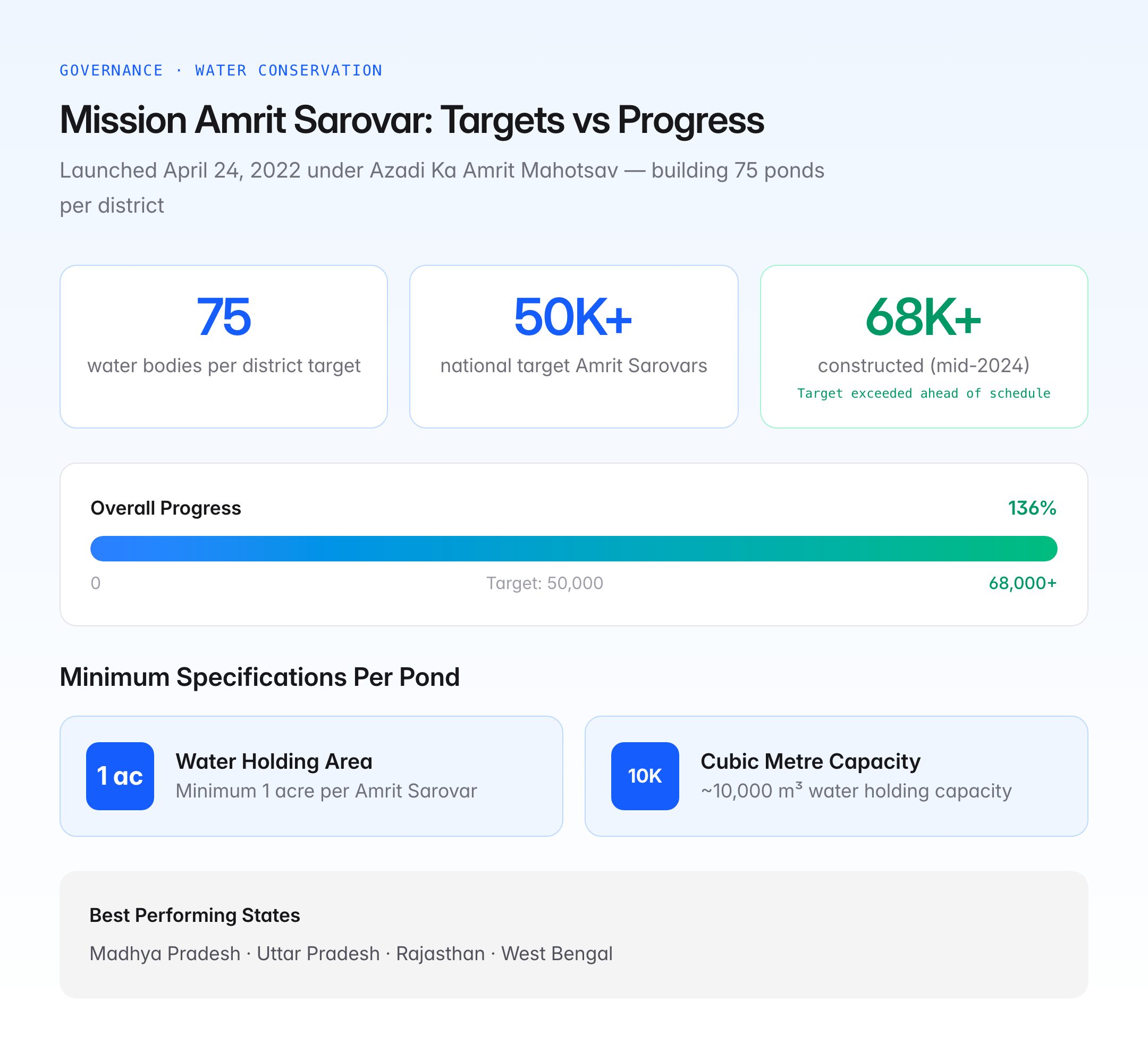
Mission Amrit Sarovar is a nationwide water conservation initiative launched on April 24, 2022 by the Government of India as part of the Azadi Ka Amrit Mahotsav celebrations marking 75 years of independence. The mission aims to develop and rejuvenate 75 water bodies (ponds/tanks) in every district across the country, creating a network of at least 50,000 Amrit Sarovars nationwide.
For UPSC, Mission Amrit Sarovar is relevant to Governance (GS Paper II) for government schemes and to Environment (GS Paper III) for water conservation and groundwater recharge.
Background and Launch
The mission was announced by Prime Minister Narendra Modi during his Mann Ki Baat address, connecting water conservation to the spirit of the 75th anniversary of Indian independence. The initiative recognised that India faces a growing water crisis — with declining groundwater tables, erratic monsoons, and increasing urban and agricultural demand.
Traditional village ponds and tanks have historically been critical water infrastructure in rural India, serving as sources for drinking water, irrigation, livestock, and groundwater recharge. However, decades of neglect, encroachment, and siltation have rendered thousands of these water bodies defunct.
Objectives
| Objective | Detail |
|---|---|
| Primary target | Develop and rejuvenate at least 75 water bodies in each district |
| National target | Create approximately 50,000 Amrit Sarovars across India |
| Minimum size | Each Amrit Sarovar must have a water holding area of at least 1 acre with a water holding capacity of about 10,000 cubic metres |
| Water conservation | Augment rainwater harvesting and groundwater recharge |
| Community ownership | Foster community participation through people's movement (Jan Andolan) |
| Convergence | Leverage multiple existing schemes (MGNREGS, Watershed Development, etc.) |
Implementation Framework
Nodal Ministry
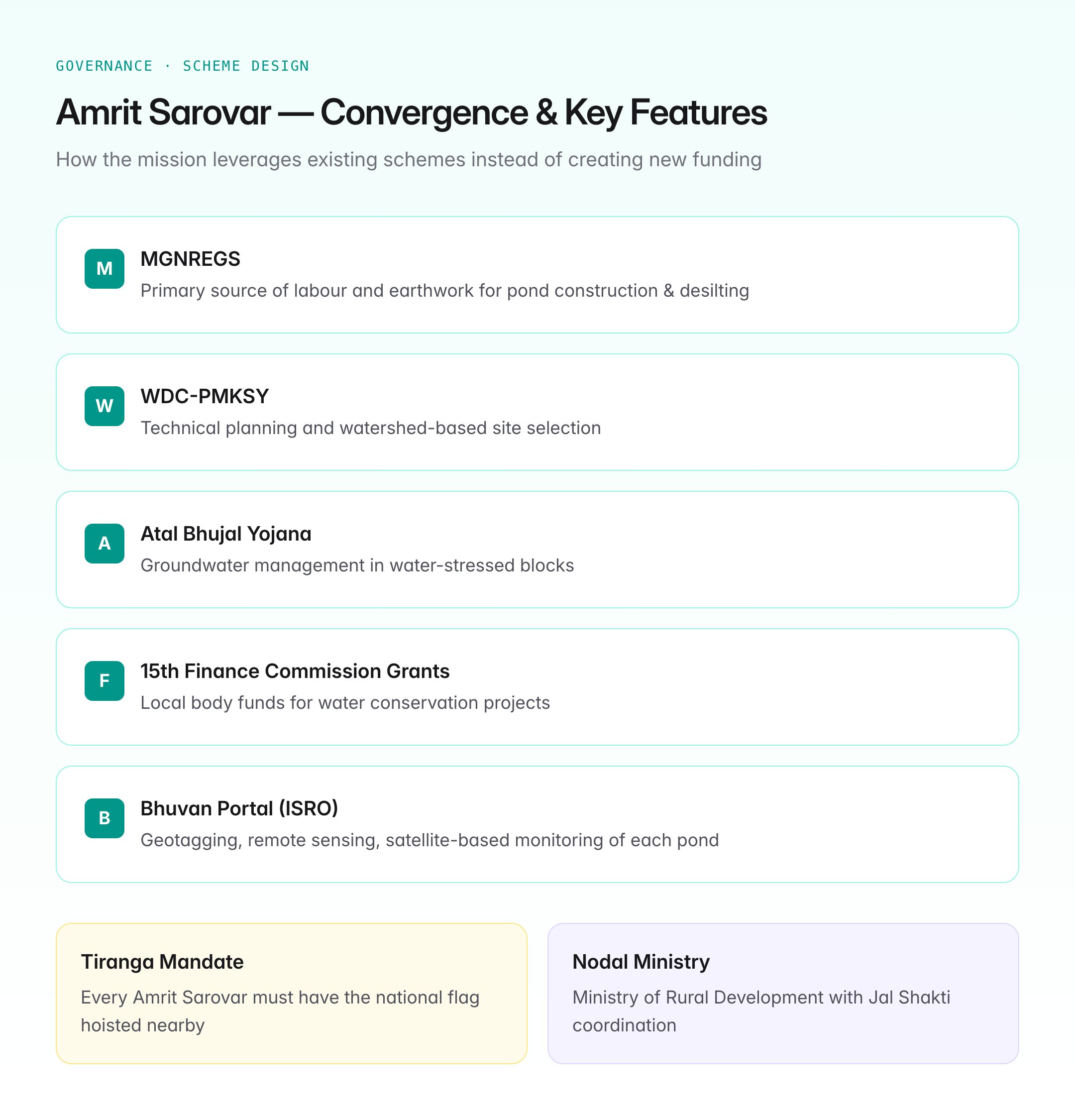
The mission operates under the Department of Rural Development, Ministry of Rural Development, with coordination across multiple ministries and state governments. The Department of Land Resources and the Ministry of Jal Shakti are key partners.
Convergence of Schemes
A critical design feature of Mission Amrit Sarovar is convergence — rather than creating a new standalone funding mechanism, the mission leverages resources from existing central and state schemes:
| Scheme/Programme | Role in Amrit Sarovar |
|---|---|
| MGNREGS (Mahatma Gandhi National Rural Employment Guarantee Scheme) | Primary source of labour and earthwork for pond construction and desilting |
| Watershed Development Component (WDC) of PMKSY | Technical planning and watershed-based site selection |
| Atal Bhujal Yojana | Groundwater management in water-stressed blocks |
| PMKSY-Har Khet Ko Pani | Irrigation infrastructure connected to rejuvenated water bodies |
| 15th Finance Commission Grants | Local body funds for water conservation |
| State-specific schemes | Additional state resources and CAMPA (compensatory afforestation) funds |
| CSR and philanthropic funding | Corporate and community contributions |
Site Selection Criteria
Sites for Amrit Sarovars are identified using a combination of:
- Remote sensing and GIS mapping — satellite imagery to identify existing degraded water bodies, potential sites, and watershed boundaries
- Revenue records — identification of common land and government land suitable for pond development
- Community input — local gram sabha consultations to identify priority sites
- Hydrological assessment — ensuring adequate catchment area and water availability
Implementation Steps
- Identification — district administration identifies 75 sites per district using GIS and local inputs
- Planning — technical design of each pond including dimensions, inlet/outlet structures, and bund height
- Execution — construction and desilting primarily through MGNREGS labour
- Beautification — plantation around the water body, fencing, and creation of community spaces
- Jan Bhagidari (people's participation) — involvement of local youth, self-help groups, and elected representatives
- Geotagging — each Amrit Sarovar is geotagged and uploaded to a centralised dashboard for monitoring
Key Features
Mandatory National Flag
Every Amrit Sarovar site is required to have the national flag (Tiranga) hoisted nearby, connecting the water conservation mission to the patriotic spirit of the Azadi Ka Amrit Mahotsav.
Technology Integration
- Bhuvan portal (ISRO) used for geotagging and remote monitoring
- Dashboard-based tracking of physical and financial progress
- Satellite imagery for before-and-after verification of water body development
Community Participation
The mission emphasises Jan Andolan (people's movement) through:
- Freedom fighters and their families are associated with Amrit Sarovar sites in their locality
- School and college students participate in shramdaan (voluntary labour) events
- Self-help groups (SHGs) are involved in maintenance and beautification
- Gram sabhas pass resolutions adopting the mission
Progress and Achievements
Since its launch in April 2022, the mission has achieved significant scale:
| Parameter | Status |
|---|---|
| Amrit Sarovars constructed | Over 68,000 (as of mid-2024 government reports) |
| States/UTs covered | All states and Union Territories |
| Employment generated | Millions of person-days through MGNREGS convergence |
| Best-performing states | Madhya Pradesh, Uttar Pradesh, Rajasthan, West Bengal |
The mission exceeded its initial target of 50,000 Amrit Sarovars ahead of schedule, and the government has since expanded the target.
Link to Jal Shakti and Water Security
Mission Amrit Sarovar is part of India's broader water security architecture, which includes:
- Jal Jeevan Mission — providing functional household tap connections (drinking water)
- Atal Bhujal Yojana — community-led groundwater management
- PMKSY (Pradhan Mantri Krishi Sinchayee Yojana) — irrigation efficiency and water-use optimisation
- Jal Shakti Abhiyan — annual campaign for water conservation during pre-monsoon period
Amrit Sarovars function as decentralised water harvesting infrastructure that feeds into groundwater recharge and supports the surface water availability needed for the Jal Jeevan Mission's tap water connections.
Significance of the Mission
- Decentralised approach — empowers district-level planning rather than relying on mega-projects
- Convergence model — demonstrates how existing schemes can be synergised for a common objective without new budget allocations
- Groundwater recharge — critical for India, where over 60% of irrigation and 85% of rural drinking water depends on groundwater
- Climate resilience — distributed water storage helps communities cope with erratic rainfall and drought
- Employment generation — synergy with MGNREGS creates rural livelihoods alongside infrastructure
Challenges
- Land availability — identifying encroachment-free common land in densely populated districts
- Quality vs. quantity — risk of prioritising numbers over functional water bodies with adequate catchment
- Maintenance — long-term upkeep of ponds after initial construction remains a concern
- Siltation — without watershed treatment upstream, newly desilted ponds may silt up again
UPSC Relevance
GS Paper Mapping
| Paper | Topic | Connection |
|---|---|---|
| GS Paper II | Government Schemes and Policies | Mission design, convergence model, Jan Andolan |
| GS Paper III | Environment — Water Conservation | Groundwater recharge, rainwater harvesting, climate resilience |
| GS Paper III | Agriculture — Irrigation | Surface water augmentation for agricultural use |
| GS Paper I | Geography — Water Resources | Decentralised water storage, watershed management |
Key Points for Prelims
- Mission Amrit Sarovar was launched on April 24, 2022 under the Azadi Ka Amrit Mahotsav
- Target: 75 water bodies per district, totalling approximately 50,000+ nationally
- Each Amrit Sarovar must have a minimum 1-acre water holding area with 10,000 cubic metre capacity
- The mission uses a convergence model — primarily leveraging MGNREGS for execution
- Nodal ministry: Ministry of Rural Development
- Technology: Bhuvan portal (ISRO) for geotagging and satellite monitoring
- The mission exceeded its target of 50,000 Amrit Sarovars ahead of schedule
- It is linked to Jal Jeevan Mission, Atal Bhujal Yojana, and PMKSY