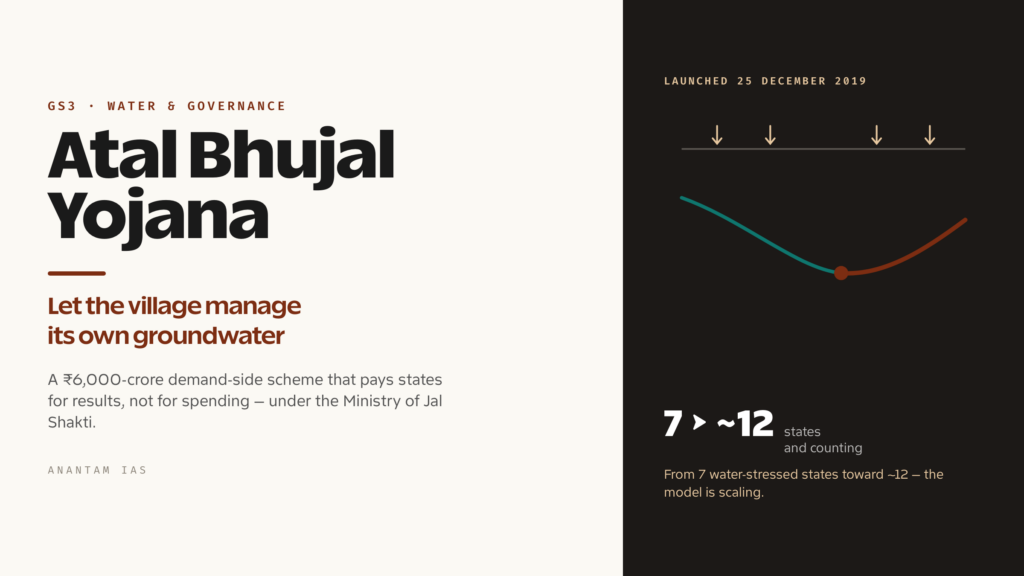
India pumps more groundwater than any other country on earth. The Central Ground Water Board’s reckoning puts national extraction at roughly 247 billion cubic metres a year — close to a quarter of everything humanity draws from beneath its feet — and most of it waters our fields and fills our village taps. For decades the official answer to a falling water table was simple and physical: dig a check dam, line a pond, build another recharge structure, add more supply. Atal Bhujal Yojana — usually shortened to Atal Jal — was the moment the government quietly admitted that supply alone was never going to win. You cannot out-build a problem you are over-pumping.
So the scheme does something unusual for a Centre-driven programme. It hands the steering wheel to the village. Launched by the Prime Minister on 25 December 2019, on what would have been Atal Bihari Vajpayee‘s 95th birthday, and rolled out from April 2020 under the Ministry of Jal Shakti, Atal Jal is a ₹6,000-crore experiment in demand-side, community-led groundwater management. Instead of an engineer deciding how to save an aquifer, a gram panchayat measures its own water, writes its own plan, and earns money for the state only when it shows real results. For UPSC, that design choice is the whole point: this is governance reform dressed as a water scheme, and it sits at the exact crossing of GS Paper 3 (conservation of resources) and GS Paper 2 (participatory governance and centre-state incentives).
What Atal Bhujal Yojana Actually Is
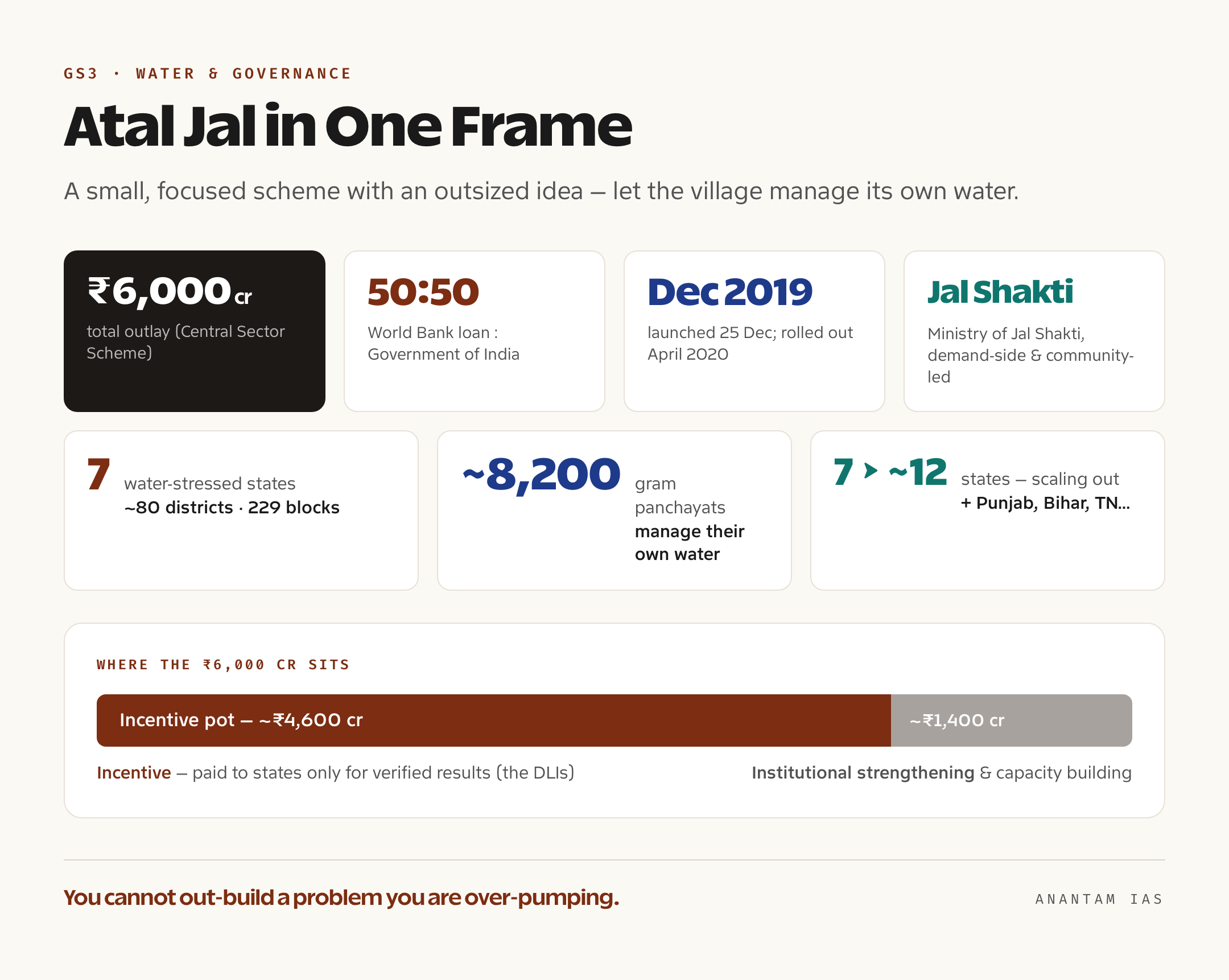
Let’s fix the basics before the argument, because the figures are what an examiner checks first. Atal Jal is a Central Sector Scheme — meaning the Centre, not the states, owns the money — with a total outlay of ₹6,000 crore. Half of that, ₹3,000 crore, is a loan from the World Bank; the other half comes from the Government of India. The World Bank board cleared it back in June 2018, the Union Cabinet approved it in December 2019, and the original implementation window ran five years, from 2020-21 to 2024-25.
The geography was deliberately narrow. Atal Jal did not try to fix the whole country at once. It picked seven of the most water-stressed states — Gujarat, Haryana, Karnataka, Madhya Pradesh, Maharashtra, Rajasthan and Uttar Pradesh — and within them about 80 priority districts, 229 blocks, and roughly 8,200 gram panchayats where the aquifer was already in trouble. These are the belts where farmers chase a sinking water table with deeper and deeper borewells, where free or near-free electricity makes it rational to pump until the well runs dry. That is the patient the scheme was built to treat.
Now the word that carries the most marks: demand-side. Most older water programmes are supply-side — they add water to the system through dams, canals and recharge pits. Atal Jal accepts that you also have to manage how much people take out. So its real tools are behavioural and informational: getting villages to grow less thirsty crops, to switch from flood irrigation to drip and sprinkler, to understand that the borewell is a shared bank account and not a bottomless one. The hardware still gets built — but it follows the plan the community writes, rather than replacing it.
The money is split into two clean buckets, and the split tells you the philosophy. About ₹1,400 crore goes to “institutional strengthening and capacity building” — training people, fixing groundwater monitoring, building the data systems. The larger share, around ₹4,600 crore, is the incentive pot: cash that states do not get for spending or for building, but only for achieving. And that brings us to the cleverest part of the design.
How the Money Actually Reaches a Village
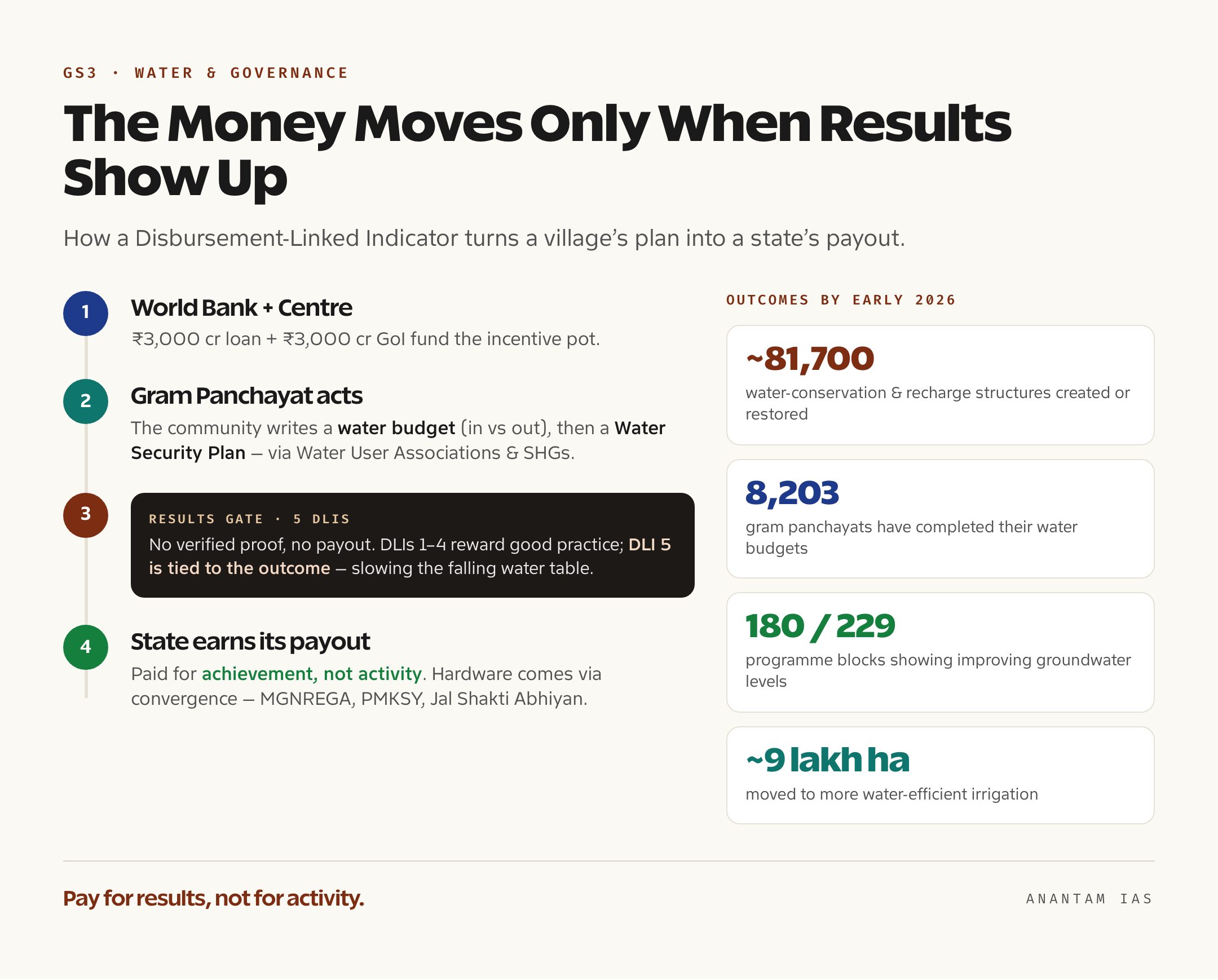
Here is the mechanism that makes Atal Jal different from almost every scheme a candidate has memorised, and it is worth getting exactly right. The incentive money does not flow automatically. It flows through what the World Bank calls Disbursement-Linked Indicators, or DLIs — results that a state has to demonstrate, with verifiable data, before a single rupee is released. As the programme guidelines put it, states are paid only after they prove achievement on the ground. No proof, no payout.
There are five DLIs in all. The first four reward the building blocks of good groundwater governance: making groundwater data public and transparent, preparing and updating community Water Security Plans, spending money sensibly on demand-side measures, and improving how efficiently water is used in agriculture. The fifth DLI is the one that matters most — it is tied to the outcome, the actual improvement in the rate at which the water table is falling. So a state can do everything right on paper and still not earn the full reward unless the aquifer responds. That is rare honesty in scheme design: it refuses to pay for activity and insists on results.
Underneath the DLIs sits the village-level engine, and it runs on two documents. The first is the water budget — a plain-language balance sheet for the gram panchayat that asks how much water comes in (rain, recharge) against how much goes out (irrigation, drinking, industry). Most villages have never seen their water written down as a number, and the moment they do, the over-draft becomes impossible to deny. The second is the Water Security Plan — the village’s own roadmap of what it will do about the gap: which crops to shift, where to put a recharge structure, how to share a borewell. These are drawn up by the community itself, often through Water User Associations and self-help groups, with the scheme’s “Nari Shakti se Jal Shakti” push deliberately putting rural women at the centre of the planning.
And Atal Jal does not pretend to have its own construction budget for all of this. It is built to converge — to braid the village plan into money that already exists. The recharge pits and farm ponds get dug largely through MGNREGA, which routes a big share of its spending into natural-resource works; the micro-irrigation comes via Pradhan Mantri Krishi Sinchayee Yojana; the watershed and catchment works ride on Jal Shakti Abhiyan and the Central Ground Water Board’s programmes. Atal Jal supplies the plan and the incentive; the heavy spending is borrowed from the schemes already running. That convergence is itself an answer to a classic GS2 question on how India can make its many siloed schemes pull in one direction.
The Numbers After Five Years
A scheme this experimental lives or dies on whether the data moved, so look at what the Ministry of Jal Shakti reported by early 2026. Roughly 81,700 water-conservation and recharge structures have been created or restored across the seven states. About 8,203 gram panchayats have completed their water budgets — meaning the over-draft has actually been written down and owned village by village. More than 25 lakh people have gone through capacity-building and training, and close to 9 lakh hectares have moved to more water-efficient irrigation. Behind those totals sit thousands of village plans that did not exist before 2020.
The honest test, though, is the water table itself — and here the picture is cautiously good. In the assessments run in 2023-24 and 2024-25, 180 of the 229 programme blocks showed a measurable improvement in groundwater levels, and the rate of decline slowed in a large share of the rest. Ministry figures point to rising water levels in hundreds of gram panchayats and dozens of blocks where the trend had been steadily downward for years. For a problem as slow and stubborn as a falling aquifer, a turn this visible inside five years is a real signal, not noise.
It worked well enough that the government chose to scale it rather than shut it down. The original window was extended — first to 2026 and then, given that the early years were lost to COVID and that behaviour change is inherently slow, reportedly out to 2027 — and the model is being widened well beyond its first seven states. Atal Jal is now set to expand to around twelve states, bringing in groundwater-stressed regions such as Andhra Pradesh, Bihar, Punjab, Tamil Nadu and Telangana. Punjab is the telling addition: it is the country’s most over-exploited groundwater belt, the place where free power and paddy have pushed the water table down hardest, and taking the scheme there is a statement of intent.
Why It Matters: India’s Groundwater Reckoning
To see why a relatively small ₹6,000-crore scheme carries such weight, you have to sit with the scale of what it is up against. Groundwater is not a side dish in India’s water story — it is the main course. It meets close to 64% of the country’s irrigation needs and about 85% of rural drinking water, and a large slice of urban supply too. We are, quite simply, a civilisation running on what lies beneath the soil.
And we are drawing it down faster than almost anyone. The Central Ground Water Board’s 2025 dynamic assessment estimates total annual recharge at around 448 billion cubic metres and extraction at about 247 billion cubic metres — and while that national ratio looks comfortable, the average hides the danger. Of the country’s 6,762 assessment units, roughly 751 are formally “over-exploited” (pumping more than nature replaces), another 206 are “critical” and 711 “semi-critical.” In Punjab, Haryana, Rajasthan and Delhi, extraction routinely runs past 100% of recharge — the village is spending more than it earns, every single year. That is the structural reason supply-side fixes keep losing: you cannot recharge your way out of a system that is engineered, through free power and water-hungry paddy, to over-pump.
This is also why the World Bank treats Atal Jal as a lesson worth exporting. The Bank’s own evaluators have flagged India as the world’s largest groundwater user precisely to make the wider point: the cheapest, fastest water reform is not concrete, it is behaviour — getting people to want less water in the first place. A scheme that pays states for measurable restraint, rather than for budgets spent, is a template other water-stressed countries are watching. For an Indian aspirant, that reframes Atal Jal from a welfare line-item into a genuine policy innovation with global standing.
The Real Challenges and the Way Forward
A fair examiner wants the limits, not just the brochure, so here they are plainly. The hardest problem is the one the scheme was built to solve: behaviour change is slow, uneven and easy to reverse. A village can write a beautiful Water Security Plan and still see one influential farmer sink a deeper borewell the next summer. The whole edifice rests on reliable data — water budgets are only as honest as the metering behind them, and groundwater metering in rural India remains thin. Then there is the elephant in the field: free or heavily subsidised farm power is a state political commitment that Atal Jal cannot touch, and as long as electricity for pumping is effectively free, the economic signal pushes the wrong way. The scheme nudges; the tariff shoves.
Equity is the quieter risk. Community management can hand the loudest voices — usually the larger, better-connected farmers — control over a shared resource, leaving smallholders and the landless with the thinner share. And scaling honestly is harder than it sounds: it is one thing to run a high-touch, hand-held programme in 8,200 chosen gram panchayats, and quite another to keep that intensity across twelve states without the model thinning into another top-down disbursement. The way forward that most analysts converge on is consistent: pair Atal Jal with real power-sector reform such as feeder separation and metered farm supply, push crop diversification away from paddy and sugarcane in the worst belts, invest in genuine groundwater metering and aquifer mapping, and protect the smallholder’s stake when the village makes its rules. The scheme’s instinct — manage demand, trust the community, pay for results — is right. Its success will be decided by whether the politics around it can be persuaded to stop pulling the other way.
For Your Mains Answer
Atal Bhujal Yojana is a rare topic that pays out in two papers at once. It is a natural fit for GS Paper 3 under conservation of resources, water resources and environmental management, and for GS Paper 2 under government policies, schemes, and especially participatory and decentralised governance. The smartest candidates use it as a crossover example: a single scheme that proves you understand both the hydrology of the problem and the governance of the solution. It also slots cleanly into any question on cooperative federalism, centre-state fiscal incentives, or behaviour-change in public policy.
How to Build the Answer
Open with the paradox, not the definition. State that India is the world’s largest groundwater user yet its policy long stayed supply-side — and that Atal Jal is the demand-side correction. Then move in a clean arc: the problem (over-exploited blocks, free power, paddy), the design (community Water Security Plans, water budgets, DLIs, convergence), the evidence (the 2026 figures and improving blocks), the limits (behaviour, data, power subsidies, equity), and a forward-looking close. Lead with the governance insight — paying for results, not activity — because that is the analytical point examiners reward over a recital of features.
Common Mistakes to Avoid
Don’t describe Atal Jal as a supply-side, construction scheme — that inverts its whole identity and signals you have only skimmed it. Don’t confuse it with Jal Jeevan Mission (piped drinking water) or Jal Shakti Abhiyan (a campaign); they are siblings, not the same thing. Don’t dump every number; two or three anchors are worth more than ten. And don’t write an uncritical eulogy — the free-power contradiction and the equity risk are exactly where higher marks live.
A Compact Answer Spine
India = world’s largest groundwater user, ~25% of global extraction → the failure of supply-side fixes against over-pumping → Atal Jal as demand-side, community-led management (₹6,000 cr, 50:50 World Bank-Centre, seven states, ~8,200 GPs) → mechanism: water budgets + Water Security Plans + five DLIs paying for results + convergence with MGNREGA and PMKSY → outcomes (~81,700 structures, 180 of 229 blocks improving) → challenges (behaviour, metering, free power, equity) → way forward: power reform + crop diversification + scaling honestly.
Diagram or Flowchart Idea
Draw a simple vertical flow: World Bank + Centre → DLIs (results gate) → State → Gram Panchayat → Water Budget → Water Security Plan → falling-water-table reversed. Put a small loop arrow from the village outcome back up to the DLI to show the money only moves when results return. A flow like this captures the entire scheme on one corner of the page and signals you grasp the mechanism, not just the name.
A Balanced-Conclusion Line
Something like: “Atal Bhujal Yojana proves that India’s groundwater crisis is finally being read correctly — as a problem of demand and behaviour, not just supply — but its promise will be redeemed only when the politics of free power is reformed to stop rewarding the very over-pumping the scheme is trying to end.” That holds the achievement and the binding constraint in a single sentence.
How to Use Data Without Cramming
Pick a small, memorable set and attribute it in prose: India draws “about a quarter of the world’s groundwater”; Atal Jal runs across “roughly 8,200 gram panchayats in seven states”; and “by 2026, 180 of its 229 blocks showed improving water levels.” Three figures, woven into argument, read as command of the subject. Ten figures with no argument read as a crammed list — and examiners can tell the difference instantly.
FAQ
What is Atal Bhujal Yojana and what makes it different from earlier water schemes? Atal Bhujal Yojana, or Atal Jal, is a ₹6,000-crore Central Sector Scheme of the Ministry of Jal Shakti, launched in December 2019 and funded 50:50 by the World Bank and the Government of India. What makes it different is that it is demand-side and community-led: instead of mainly building recharge structures, it gets villages to measure their own water through water budgets, write their own Water Security Plans, and use less of it — treating the falling water table as a behaviour problem, not just an engineering one.
Which states and how many gram panchayats does Atal Jal cover? It began in seven water-stressed states — Gujarat, Haryana, Karnataka, Madhya Pradesh, Maharashtra, Rajasthan and Uttar Pradesh — covering about 80 districts, 229 blocks and roughly 8,200 gram panchayats. On the strength of its early results, it is being extended in time and expanded to around twelve states, adding groundwater-stressed regions such as Andhra Pradesh, Bihar, Punjab, Tamil Nadu and Telangana.
What are Disbursement-Linked Indicators in Atal Jal? Disbursement-Linked Indicators, or DLIs, are the results a state must prove before the World Bank releases incentive money — there is no payment for spending or building, only for achievement. Atal Jal has five DLIs: the first four reward good practices like making groundwater data public, preparing Water Security Plans, and improving water-use efficiency, while the fifth is tied to the actual outcome — slowing the decline of the water table.
Why does India need a demand-side groundwater scheme at all? Because India is the world’s largest user of groundwater, drawing roughly 247 billion cubic metres a year — about a quarter of the global total — and groundwater supplies around 64% of irrigation and 85% of rural drinking water. With hundreds of blocks already “over-exploited” and states like Punjab and Haryana pumping past 100% of recharge, simply adding more recharge structures cannot keep pace. The only durable fix is to reduce how much water people take out, which is exactly what Atal Jal sets out to do.
Practice Questions
Prelims MCQs
- With reference to Atal Bhujal Yojana (Atal Jal), consider the following: It is a Central Sector Scheme funded jointly by the World Bank and the Government of India in a 50:50 ratio.
Which of the following statements is correct?
(a) It is a Centrally Sponsored Scheme funded 60:40 by Centre and states
(b) It is funded entirely by the World Bank
(c) It is a Central Sector Scheme with a 50:50 World Bank-Government of India funding pattern
(d) It is funded entirely by the Government of India.
Answer: (c) Atal Jal is a ₹6,000-crore Central Sector Scheme, with ₹3,000 crore as a World Bank loan and ₹3,000 crore from the Government of India. - Atal Bhujal Yojana is implemented under which ministry?
(a) Ministry of Agriculture and Farmers’ Welfare
(b) Ministry of Jal Shakti
(c) Ministry of Rural Development
(d) Ministry of Environment, Forest and Climate Change.
Answer: (b) Atal Jal is run by the Department of Water Resources under the Ministry of Jal Shakti. - Which of the following best describes the core approach of Atal Bhujal Yojana?
(a) Supply-side augmentation through large dams
(b) Inter-basin river linking
(c) Demand-side, community-led groundwater management
(d) Desalination of seawater for coastal states.
Answer: (c) Atal Jal’s defining feature is demand-side management driven by community Water Security Plans rather than supply-side construction alone. - The “Disbursement-Linked Indicators” (DLIs) under Atal Jal are best described as:
(a) Penalties imposed on states for missing targets
(b) Result indicators against which funds are released only after states demonstrate achievement
(c) A list of approved contractors for recharge structures
(d) Tax incentives for farmers using drip irrigation.
Answer: (b) Under the DLI mechanism, incentive funds flow to states only after verified results, with the fifth DLI tied to the actual outcome on groundwater levels. - Atal Bhujal Yojana was originally launched for which set of states?
(a) All states and Union Territories
(b) The seven north-eastern states
(c) Gujarat, Haryana, Karnataka, Madhya Pradesh, Maharashtra, Rajasthan and Uttar Pradesh
(d) Only the coastal states.
Answer: (c) These seven water-stressed states formed the original footprint, before the scheme’s planned expansion to around twelve states.
Mains Practice Questions
- “Atal Bhujal Yojana represents a shift from supply-side augmentation to demand-side management of groundwater.” Examine this statement and assess how far the scheme has succeeded in changing groundwater behaviour in India. (15 marks, 250 words)
- Discuss the architecture of Atal Bhujal Yojana, with particular reference to Water Security Plans, water budgeting and Disbursement-Linked Indicators. How does this design strengthen cooperative federalism and outcome-based governance? (15 marks, 250 words)
- India is the world’s largest user of groundwater, yet a large share of its assessment blocks are over-exploited or critical. Analyse the structural drivers of this crisis and evaluate whether community-led schemes alone can reverse it. (15 marks, 250 words)
- “The success of Atal Jal depends less on the scheme itself and more on the political economy of free farm power and cropping choices.” Critically comment. (10 marks, 150 words)
- Convergence with existing schemes such as MGNREGA and PMKSY is central to Atal Bhujal Yojana’s design. Discuss the opportunities and challenges of such convergence in achieving sustainable groundwater management. (10 marks, 150 words)
Tell Google you want more of this.
Add Anantam IAS as a preferred sourceOne tap, and this site shows up more often in your own Top Stories, AI Overviews and AI Mode. Remove it any time.