Mudumalai Tiger Reserve: Location, Flora, Fauna and UPSC Notes
Complete guide to Mudumalai Tiger Reserve in Tamil Nadu - location in Nilgiris, flora, fauna, elephant corridor, Moyar River, tribal communities and UPSC relevance.
Mudumalai Tiger Reserve (MTR) is one of India’s most ecologically significant protected areas, located in the Nilgiri district of Tamil Nadu at the tri-junction of Tamil Nadu, Kerala and Karnataka. The word “Mudumalai” means “ancient hill range” in Tamil – an apt description for its 65-million-year-old Nilgiri setting. It forms the core of the Nilgiri Biosphere Reserve, the first biosphere reserve of India, and is part of the largest protected elephant habitat in South Asia. Mudumalai is a frequent entry in UPSC Prelims environment questions and a useful case study in Mains on biodiversity conservation.
Location and Geography
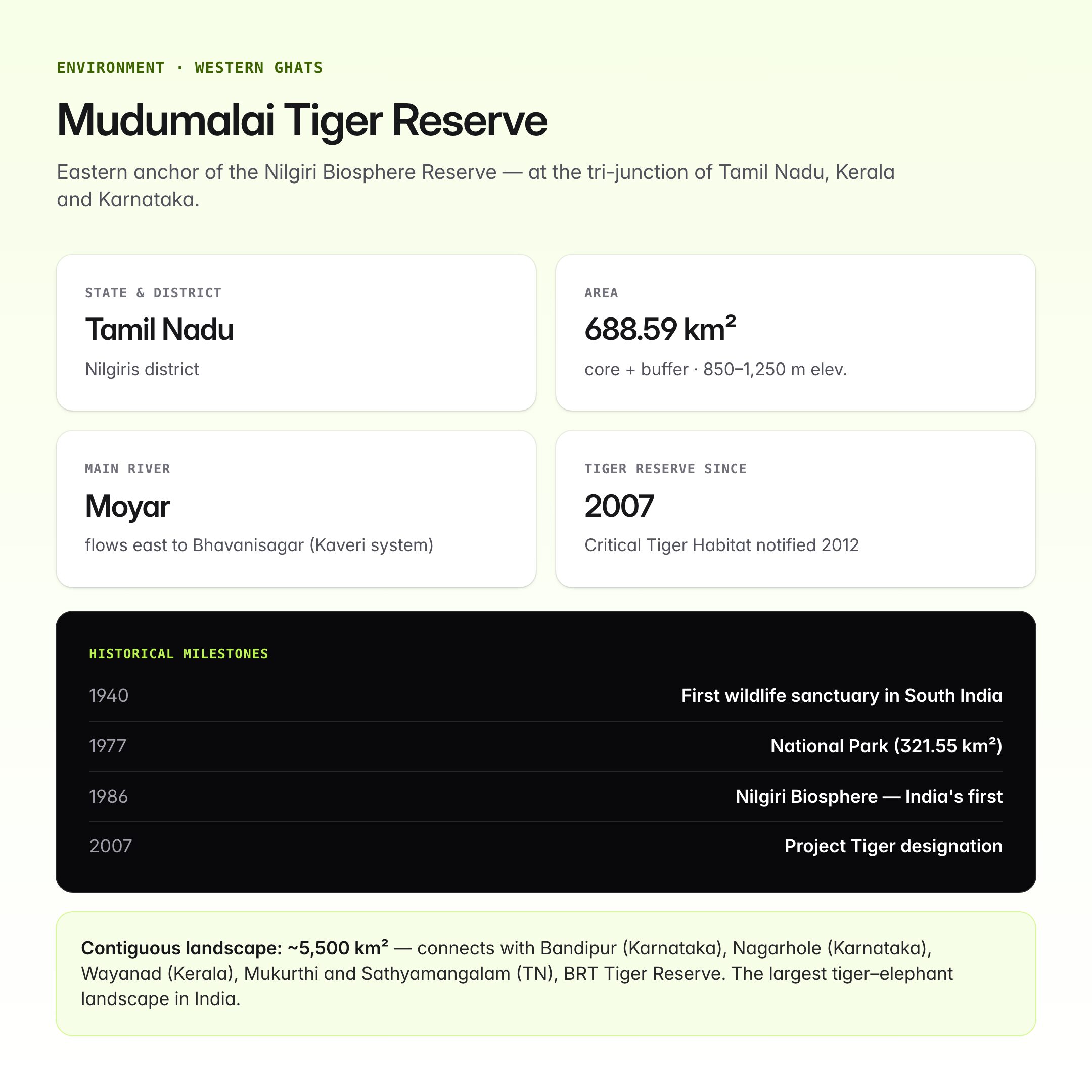
| Aspect | Detail |
|---|---|
| State | Tamil Nadu |
| District | Nilgiris |
| Area | Around 688.59 sq km (core + buffer) |
| Altitude | 850-1,250 m above sea level |
| Boundary | Karnataka (north – Bandipur), Kerala (west – Wayanad), Mukurthi NP (south) |
| Terrain | Rolling hills, plateaus, valleys, escarpments of the Nilgiris |
| Rainfall | 800-2,500 mm (strong east-west gradient) |
| Rivers | Moyar (main), Kekkatty, Benne Hallu |
The reserve sits in the Western Ghats, a UNESCO World Heritage site and one of the world's eight hottest biodiversity hotspots. It shares a continuous forest landscape of about 5,500 sq km with Bandipur (Karnataka), Nagarhole (Karnataka), Wayanad (Kerala), Sathyamangalam (Tamil Nadu) and BRT Tiger Reserve – the largest contiguous tiger and elephant landscape in India.
Historical Timeline
| Year | Milestone |
|---|---|
| 1940 | Declared a wildlife sanctuary (the first in South India) |
| 1977 | Notified as a National Park (321.55 sq km) |
| 1986 | Included in the Nilgiri Biosphere Reserve (India's first biosphere reserve) |
| 2007 | Declared a Tiger Reserve under Project Tiger |
| 2012 | Notified as Critical Tiger Habitat |
| 2023 (Fifth All India Tiger Estimation) | Mudumalai-Bandipur-Wayanad-Nagarhole reported among highest tiger densities in India |
Part of the Nilgiri Biosphere Reserve
Mudumalai is the eastern anchor of the Nilgiri Biosphere Reserve (NBR), spread over Tamil Nadu, Kerala and Karnataka.
| NBR Protected Areas | State |
|---|---|
| Mudumalai Tiger Reserve | Tamil Nadu |
| Mukurthi National Park | Tamil Nadu |
| Silent Valley National Park | Kerala |
| Wayanad Wildlife Sanctuary | Kerala |
| Nagarhole National Park | Karnataka |
| Bandipur National Park | Karnataka |
| Bannerghatta (adjacent) | Karnataka |
Flora
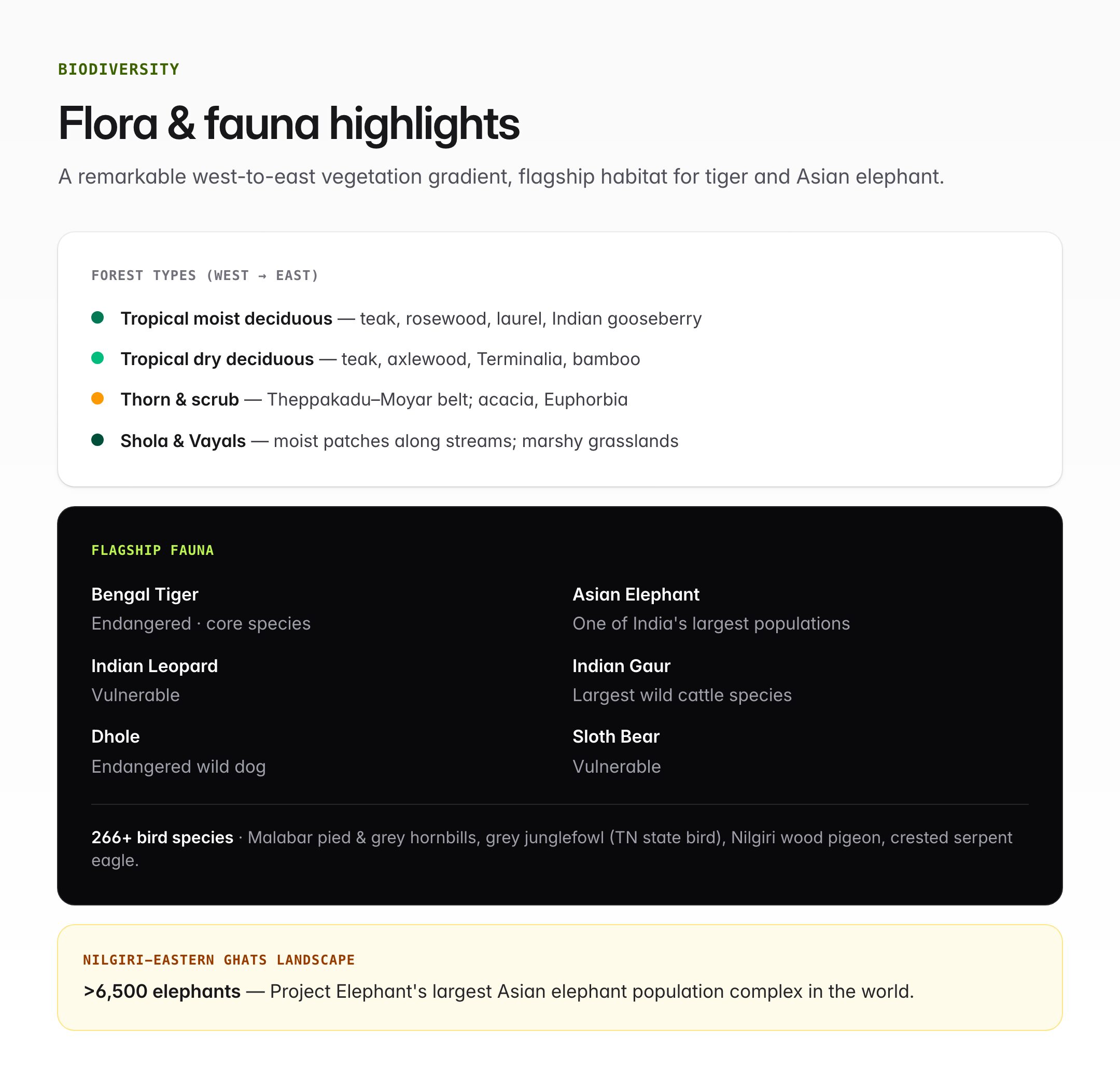
Mudumalai shows a remarkable vegetation gradient from west (wet) to east (dry) over a short distance.
| Forest Type | Location within MTR | Species |
|---|---|---|
| Tropical moist deciduous | Western and central | Teak, rosewood, laurel, Indian gooseberry |
| Tropical dry deciduous | Eastern | Teak, axlewood, Terminalia, bamboo |
| Thorn forest / scrub | Far eastern, Theppakadu-Moyar | Acacia, Euphorbia, Cassia |
| Moist semi-evergreen patches | Sholas along streams | Syzygium, Mesua, Ficus |
| Grasslands (Vayals) | Marshy depressions | Cymbopogon, Themeda, wild ragi |
The reserve has recorded around 500 plant species, including several medicinal plants used by local Irula, Kurumba and Paniya tribes.
Fauna
Mudumalai is a flagship habitat for the Bengal tiger and the Asian elephant.
Mammals
| Species | Status |
|---|---|
| Bengal Tiger (Panthera tigris) | Endangered; core species |
| Asian Elephant (Elephas maximus) | Endangered; one of India's largest populations |
| Indian Leopard (Panthera pardus fusca) | Vulnerable |
| Indian Gaur (Bos gaurus) | Vulnerable |
| Dhole (Cuon alpinus) | Endangered wild dog |
| Sloth Bear (Melursus ursinus) | Vulnerable |
| Indian Giant Squirrel (Ratufa indica) | State animal imagery |
| Sambar, Chital, Barking deer, Mouse deer | Prey base |
| Nilgiri Langur, Bonnet Macaque | Primates |
| Indian Pangolin | Near threatened |
Birds
Mudumalai has recorded over 266 bird species, many of them Western Ghats endemics: Malabar pied hornbill, Malabar grey hornbill, Indian paradise flycatcher, crested serpent eagle, grey junglefowl (state bird of Tamil Nadu), and Nilgiri wood pigeon.
Reptiles and Others
Mugger crocodile in the Moyar, king cobra, Indian rock python, monitor lizard, Indian star tortoise, and various geckos. Butterflies and dragonflies are exceptionally diverse, including Western Ghats endemics.
Elephant Corridor and Landscape Connectivity
Mudumalai forms part of the Sigur-Moyar-Mudumalai elephant corridor, one of the most critical in southern India.
| Corridor | Connects |
|---|---|
| Sigur Plateau corridor | Mudumalai to Sathyamangalam (east) |
| Moyar Gorge corridor | Mudumalai to BRT Tiger Reserve |
| Kekkatty-Benne corridor | Mudumalai to Bandipur (north) |
| Nilambur corridor | Mudumalai to Wayanad (west) |
The Nilgiri-Eastern Ghats landscape is recognised by Project Elephant as the “largest Asian elephant population complex in the world” – estimated at over 6,500 elephants.
Several corridors are threatened by highways (NH-181, NH-766), night traffic, railway lines, electric fences, resorts and coffee-tea plantations. The Supreme Court-ordered night ban on vehicular traffic through Bandipur-Mudumalai after 9 pm has been a key conservation win.
Moyar River and its Gorge
The Moyar River is Mudumalai's principal watercourse. Rising in the upper Nilgiris, it flows eastwards forming the deep Moyar Gorge, which separates Mudumalai from the Sigur Plateau and finally feeds the Bhavanisagar reservoir on the Bhavani river, a tributary of the Kaveri.
| Feature | Significance |
|---|---|
| Moyar Gorge | Cliffs up to 300 m deep; habitat for vultures and raptors |
| Moyar Waterfalls (Pykara, Moyar falls) | Natural tourist attractions |
| Bhavanisagar Dam | Irrigation for Coimbatore-Erode; Kaveri system |
The Moyar also hosts small populations of smooth-coated otters, mugger crocodile and marsh crocodile in its deeper pools.
Tribal Communities
Several indigenous groups live in and around Mudumalai. They have Particularly Vulnerable Tribal Group (PVTG) status or are Scheduled Tribes.
| Tribe | Traditional Livelihood |
|---|---|
| Irula | Hunter-gatherers, snake catchers, agriculture |
| Kurumba (Alu, Jenu, Betta) | Honey gathering, bamboo craft, shifting cultivation |
| Paniya | Agricultural labour, traditional medicine |
| Kattunayakan | Forest produce gathering |
| Toda and Kota | Higher Nilgiris (less prominent in MTR, more in Ooty region) |
Under the Forest Rights Act, 2006, several communities have received Community Forest Rights (CFR) and Habitat Rights. Eco-development committees are active in buffer zones.
Tourism and Facilities
Visitors usually enter through Theppakadu, where the Forest Department runs the Theppakadu Elephant Camp, one of the oldest in Asia (established 1917). The camp has housed working elephants used in forest patrols; Raghu and Bommi featured in the Oscar-winning "The Elephant Whisperers" (2023), filmed here.
| Tourist Activity | Detail |
|---|---|
| Safari | Canter and jeep safaris in core zones |
| Theppakadu Elephant Camp | Feeding and rehabilitation demonstration |
| Museum | Information centre on Nilgiris ecology |
| Trekking (limited) | Only in buffer zones with permits |
Conservation Challenges
| Threat | Description |
|---|---|
| Habitat fragmentation | Highways, railways, power lines, resorts |
| Human-wildlife conflict | Crop raids by elephants, livestock kills by leopards and tigers |
| Forest fires | Severe fires in 2019 (damaging over 13 sq km of buffer), recurring annually in dry season |
| Invasive species | Lantana camara, Chromolaena, Prosopis juliflora |
| Tourism pressure | Noise, plastic, disturbance to wildlife |
| Linear infrastructure | NH-766 corridor debate, Nilgiri Mountain Railway traffic |
| Climate change | Shifts in monsoon patterns, forest fires intensity |
Conservation Efforts
- Project Tiger funding; core-buffer zoning under Wildlife (Protection) Act, 1972
- Elephant death audit and electrocution prevention drive by TN Forest Department
- Night traffic ban on Bandipur-Mudumalai roads
- Anti-poaching camps and patrolling
- Resettlement schemes under Forest Rights Act for villages inside the core
- Restoration of vayals (marshy grasslands) as grazing meadows
- Removal of invasive Lantana and Prosopis
UPSC Relevance
Prelims: Mudumalai features in questions on Tiger Reserves of India (it is the first tiger reserve of Tamil Nadu, the state has five as of 2024 – Mudumalai, Anamalai, Kalakad-Mundanthurai, Sathyamangalam, Srivilliputhur-Megamalai). Candidates should remember it is part of the Nilgiri Biosphere Reserve (India's first), adjoins Bandipur (Karnataka), Wayanad (Kerala) and Mukurthi (TN), and lies on the Moyar River. Match-the-column and "which of the following is/are part of Nilgiri Biosphere Reserve" formats are very common.
Mains GS-3 (Environment): Use Mudumalai in answers on biosphere reserves, Western Ghats conservation (Gadgil and Kasturirangan reports), elephant corridors, Project Tiger and Project Elephant, human-elephant conflict, invasive species, and forest fires. It is also a useful example for eco-tourism, Community Forest Rights, and co-management of forests with tribal groups.
GS-1 (Society) and GS-2 (Governance): The reserve's Irula and Kurumba communities make it relevant for tribal rights, Particularly Vulnerable Tribal Groups (PVTG), and implementation of the Forest Rights Act. Governance debates around night traffic bans (Supreme Court orders) illustrate judicial activism in environmental matters.
Essay and Ethics: The Elephant Whisperers story offers a case study on the human-animal bond, compassion, and the ethics of keeping captive elephants – useful material when an essay asks about our responsibility to non-human life.
Candidates should tie Mudumalai into the broader Nilgiri-Sahyadri-Annamalai conservation corridor to answer high-value Mains questions on the Western Ghats.