The Nilgiri Biosphere Reserve (NBR) was the first biosphere reserve established in India in September 1986, under the UNESCO Man and the Biosphere (MAB) Programme. Spread across 5,520 sq km at the junction of the Western Ghats in the states of Tamil Nadu, Kerala, and Karnataka, it is one of the most biologically diverse regions in the country. The NBR was included in the UNESCO World Network of Biosphere Reserves in 2000. It is a frequently tested topic in UPSC Prelims and GS Paper III (Environment and Biodiversity).
Location and Extent
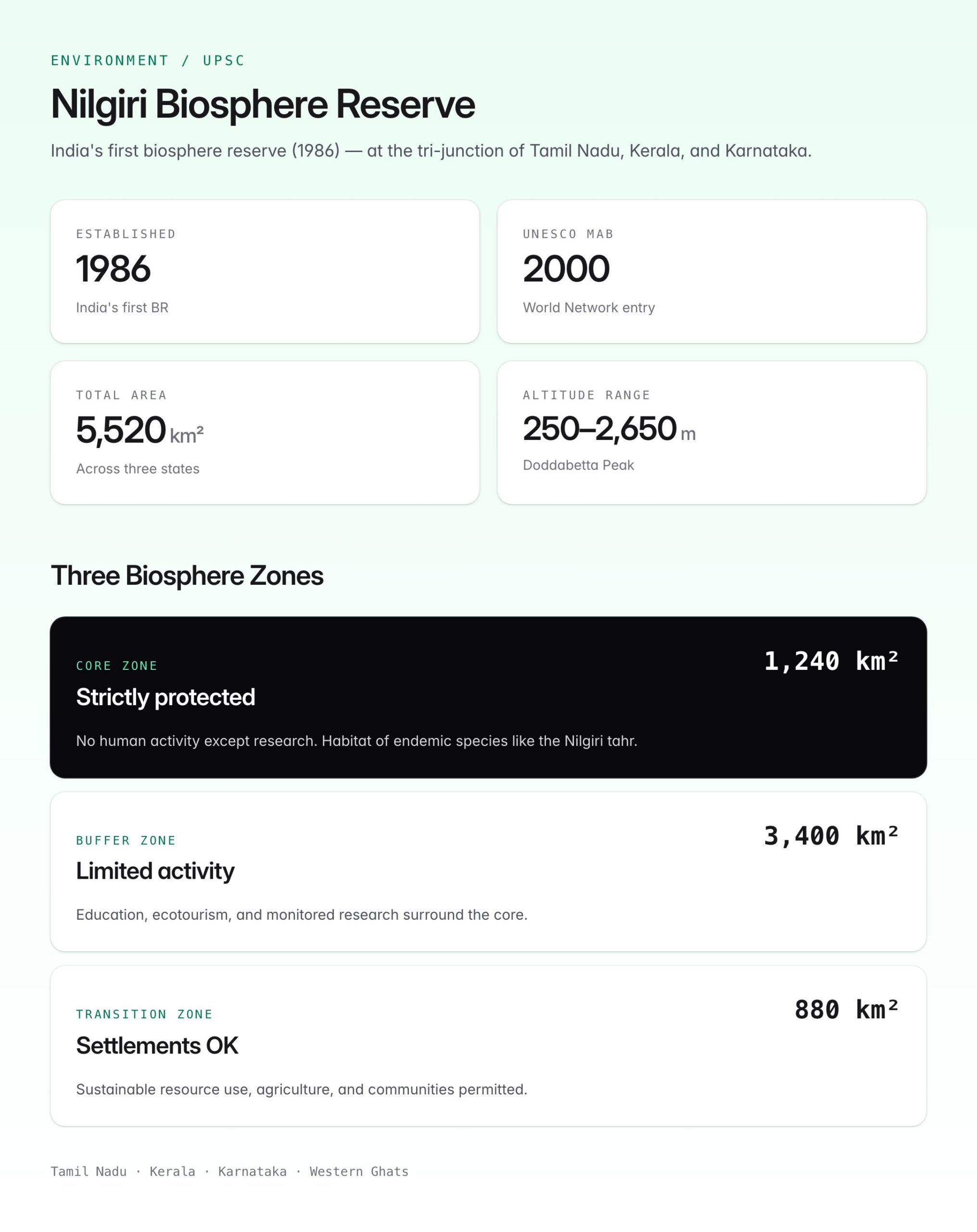
The Nilgiri Biosphere Reserve straddles the tri-junction of three southern Indian states:
| Parameter | Details |
|---|---|
| States | Tamil Nadu, Kerala, Karnataka |
| Total Area | 5,520 sq km |
| Core Zone | 1,240 sq km |
| Buffer Zone | 3,400 sq km |
| Transition Zone | 880 sq km |
| Altitude Range | 250 m to 2,650 m (Doddabetta Peak) |
| Established | September 1986 |
| UNESCO MAB Recognition | 2000 |
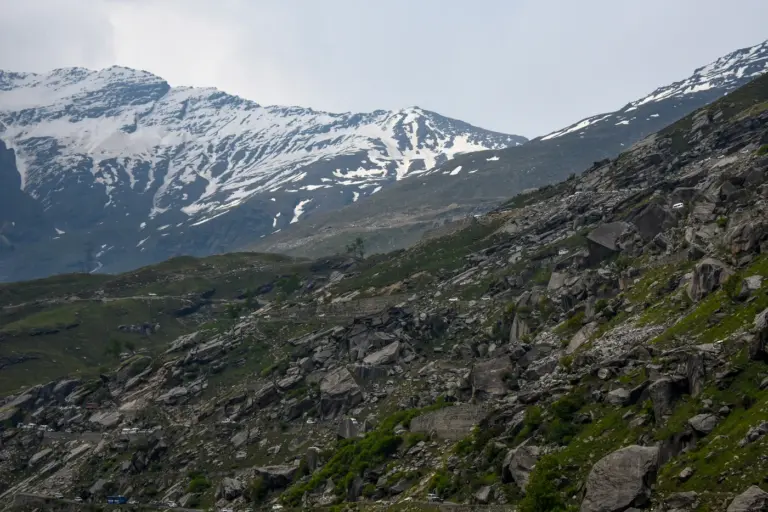
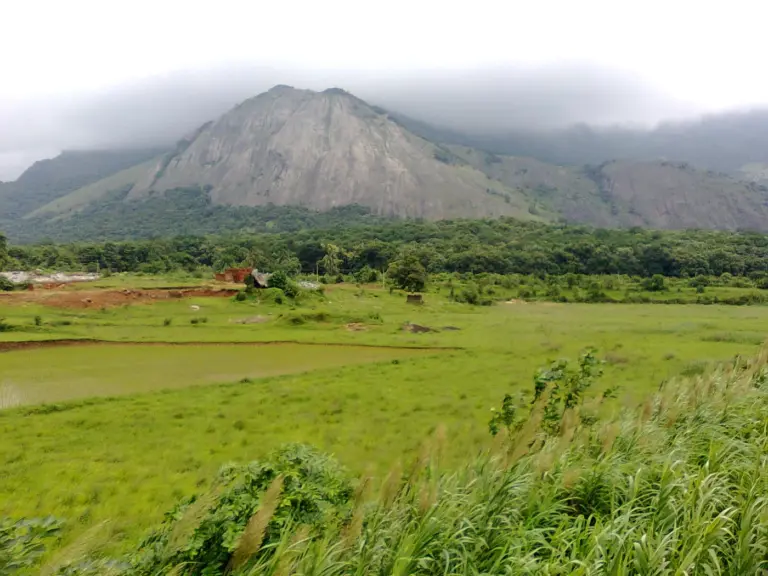
The reserve encompasses parts of the Nilgiri Hills, Wayanad Plateau, and the upper Mysore Plateau, creating a mosaic of habitats from tropical evergreen forests to montane grasslands.
Protected Areas Within the NBR
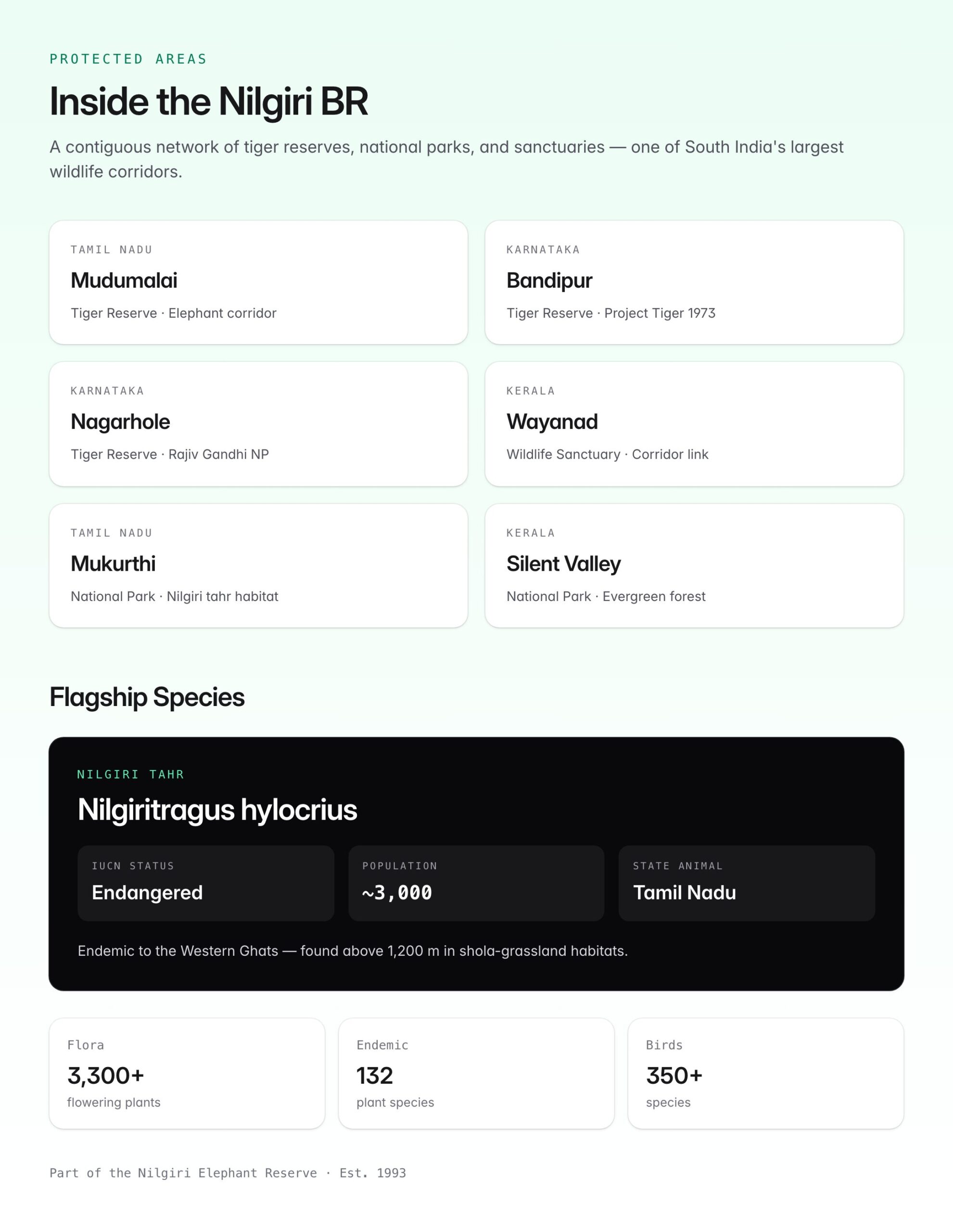
The Nilgiri Biosphere Reserve includes several nationally and internationally significant protected areas:
| Protected Area | State | Type | Key Feature |
|---|---|---|---|
| Mudumalai | Tamil Nadu | Tiger Reserve / National Park | Elephant corridor; part of Nilgiri Elephant Reserve |
| Bandipur | Karnataka | Tiger Reserve / National Park | One of India's first Project Tiger reserves (1973) |
| Nagarhole (Rajiv Gandhi NP) | Karnataka | Tiger Reserve / National Park | Rich tiger and elephant population |
| Wayanad | Kerala | Wildlife Sanctuary | Connects Bandipur-Nagarhole-Mudumalai |
| Mukurthi | Tamil Nadu | National Park | Key habitat of the Nilgiri tahr |
| Silent Valley | Kerala | National Park | One of the last undisturbed tracts of South Western Ghats evergreen forest |
| Aralam | Kerala | Wildlife Sanctuary | Northernmost wildlife sanctuary in Kerala |
This contiguous network forms one of the largest wildlife corridors in South India, critical for the movement of elephants, tigers, and other large mammals.
Biodiversity
Flora
The NBR hosts over 3,300 species of flowering plants, including approximately 132 endemic species. Vegetation types include:
- Tropical Wet Evergreen Forests (below 1,500 m on western slopes)
- Tropical Dry Deciduous Forests (eastern slopes)
- Tropical Moist Deciduous Forests (intermediate elevations)
- Montane Shola-Grassland Mosaic (above 1,800 m) — a unique ecosystem of stunted forests (sholas) interspersed with grasslands
- Teak and Bamboo Forests
Fauna
| Category | Key Species |
|---|---|
| Flagship Mammal | Nilgiri tahr (Nilgiritragus hylocrius) — IUCN Endangered; endemic to the Western Ghats; ~3,000 individuals estimated |
| Large Mammals | Asian elephant, Bengal tiger, Indian leopard, gaur, dhole, sloth bear |
| Primates | Nilgiri langur (IUCN Vulnerable), Lion-tailed macaque (IUCN Endangered) |
| Birds | Over 350 species; Nilgiri pipit, Nilgiri flycatcher (both endemic) |
| Amphibians | Over 60 species; high endemism |
The Nilgiri tahr is the state animal of Tamil Nadu and a frequent UPSC question. It is found only in the shola-grassland habitats of the Western Ghats, primarily above 1,200 m.
Tribal Communities
The NBR is home to several indigenous tribal communities with distinct cultural traditions:
| Tribe | Region | Key Features |
|---|---|---|
| Toda | Nilgiri Plateau | Pastoral community; buffalo-herding; unique barrel-vaulted huts (mund); population ~1,900 |
| Kota | Nilgiri Hills | Artisans and musicians; historically served Toda, Badaga, and Kurumba communities |
| Kurumba | Forests across NBR | Hunter-gatherers; deep knowledge of medicinal plants |
| Irula | Lower Nilgiris | Snake-catchers; knowledge of venom extraction |
| Paniya | Wayanad (Kerala) | One of the most marginalised scheduled tribes in Kerala |
| Kattunayakan | Wayanad / Nilgiris | Forest dwellers; Particularly Vulnerable Tribal Group (PVTG) |
The Toda people of the Nilgiris are among the most studied tribal communities in Indian anthropology, featured in ethnographic research since the colonial period.
UNESCO MAB Programme — Concept of Biosphere Reserves
Biosphere Reserves are designated under UNESCO's Man and the Biosphere (MAB) Programme, launched in 1971. They are not just conservation zones — they serve three interconnected functions:
- Conservation — protect biodiversity and ecosystems.
- Development — foster sustainable economic and human development.
- Logistic Support — provide facilities for research, monitoring, education, and training.
Zonation:
- Core Zone — strictly protected; no human activity except research.
- Buffer Zone — surrounds the core; limited human activity (education, ecotourism, research).
- Transition Zone — outermost; settlements and sustainable resource use permitted.
India currently has 18 biosphere reserves, of which 12 are part of the UNESCO World Network.
Conservation Challenges
- Human-wildlife conflict — elephants frequently raid crops in fringe villages; retaliatory killings occur.
- Invasive species — Lantana camara, Prosopis juliflora, and Senna spectabilis threaten native vegetation.
- Infrastructure pressure — highways (NH-766/Wayanad) bisect wildlife corridors; night traffic causes roadkills.
- Encroachment and fragmentation — tea, coffee, and spice plantations reduce contiguous forest cover.
- Climate change — upward shift of shola-grassland ecotone threatens Nilgiri tahr habitat.
Nilgiri Elephant Reserve
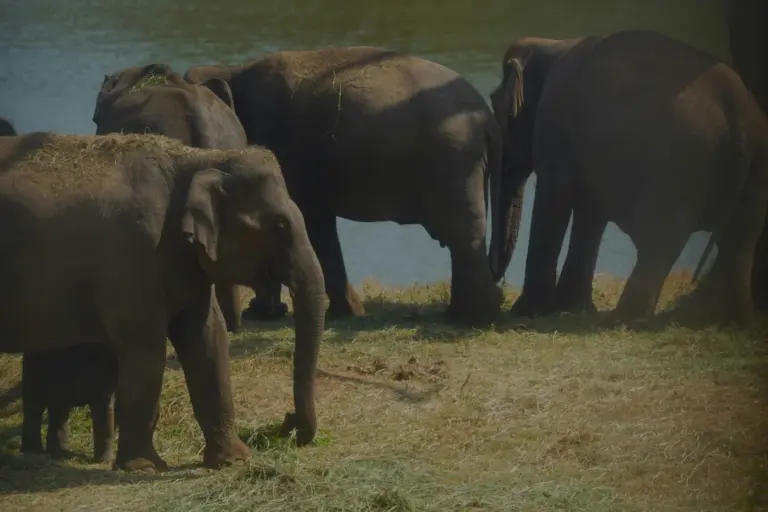
The Nilgiri Elephant Reserve, established in 1993 under Project Elephant, largely overlaps with the NBR. It is the first elephant reserve in India and harbours the single largest population of Asian elephants in the country (~6,000 individuals).
Key Government Initiatives
- Project Tiger — Bandipur (1973), Mudumalai, Nagarhole are Tiger Reserves under NTCA.
- Project Elephant — Nilgiri Elephant Reserve (1993).
- Eco-Sensitive Zone notifications for buffer areas around national parks and sanctuaries.
- Nilgiri Tahr Conservation Programme — species-specific conservation under the Tamil Nadu Forest Department.
UPSC Relevance
GS Paper III: Conservation, Environmental Pollution and Degradation; Biodiversity and its Conservation.
GS Paper I: Indian Geography — Physical Features (Western Ghats); Tribal Communities.
Prelims key points:
- Nilgiri Biosphere Reserve was India's first biosphere reserve (1986) and joined the UNESCO MAB World Network in 2000.
- Spread across Tamil Nadu, Kerala, and Karnataka — 5,520 sq km.
- Contains Mudumalai, Bandipur, Nagarhole, Silent Valley, Wayanad, and Mukurthi.
- Nilgiri tahr is IUCN Endangered and endemic to the Western Ghats.
- The Toda tribe of the Nilgiris is a pastoral community known for buffalo-herding.
- Nilgiri Elephant Reserve (1993) was India's first elephant reserve.
- Biosphere reserves have three zones: Core, Buffer, and Transition.
- India has 18 biosphere reserves, of which 12 are in the UNESCO World Network.
Tell Google you want more of this.
Add Anantam IAS as a preferred sourceOne tap, and this site shows up more often in your own Top Stories, AI Overviews and AI Mode. Remove it any time.