Muhammad Ghori and the Battles of Tarain: How Delhi Sultanate Was Founded by a Slave
Muhammad Ghori lost Tarain I in 1191 to Prithviraj Chauhan and won Tarain II in 1192. His slave Qutbuddin Aibak founded the Delhi Sultanate. UPSC notes.
Muhammad Ghori is one of those rulers whose individual life would be a footnote, except that the system he founded ended up running large parts of India for the next six centuries. He lost his first major battle in India at Tarain in 1191 to Prithviraj Chauhan, came back the next year and won at the same field, and then handed the new territories to his Turkic slave commanders. One of those slaves, Qutbuddin Aibak, would go on to declare himself sultan of Delhi after Ghori’s death in 1206. The Delhi Sultanate, the line of dynasties that followed, the whole long arc that includes the Khaljis, the Tughlaqs, the Sayyids, the Lodis, and indirectly the Mughals, all run back to this Ghurid commander from the highlands of central Afghanistan.
For UPSC aspirants, Muhammad Ghori sits at the most heavily tested transition point in medieval Indian history. The Battles of Tarain in 1191 and 1192, the figure of Prithviraj Chauhan, the origin of the Delhi Sultanate, and the Slave or Mamluk dynasty are standard fare for Prelims and Mains alike. The reason Muhammad Ghori matters is not the man, it is the systems his death created.
This piece walks through who he was, what he failed at first and then succeeded at, why Tarain went the way it did, and how an Afghan slave general became the founder of the Mamluk line at Delhi.
Quick Facts at a Glance
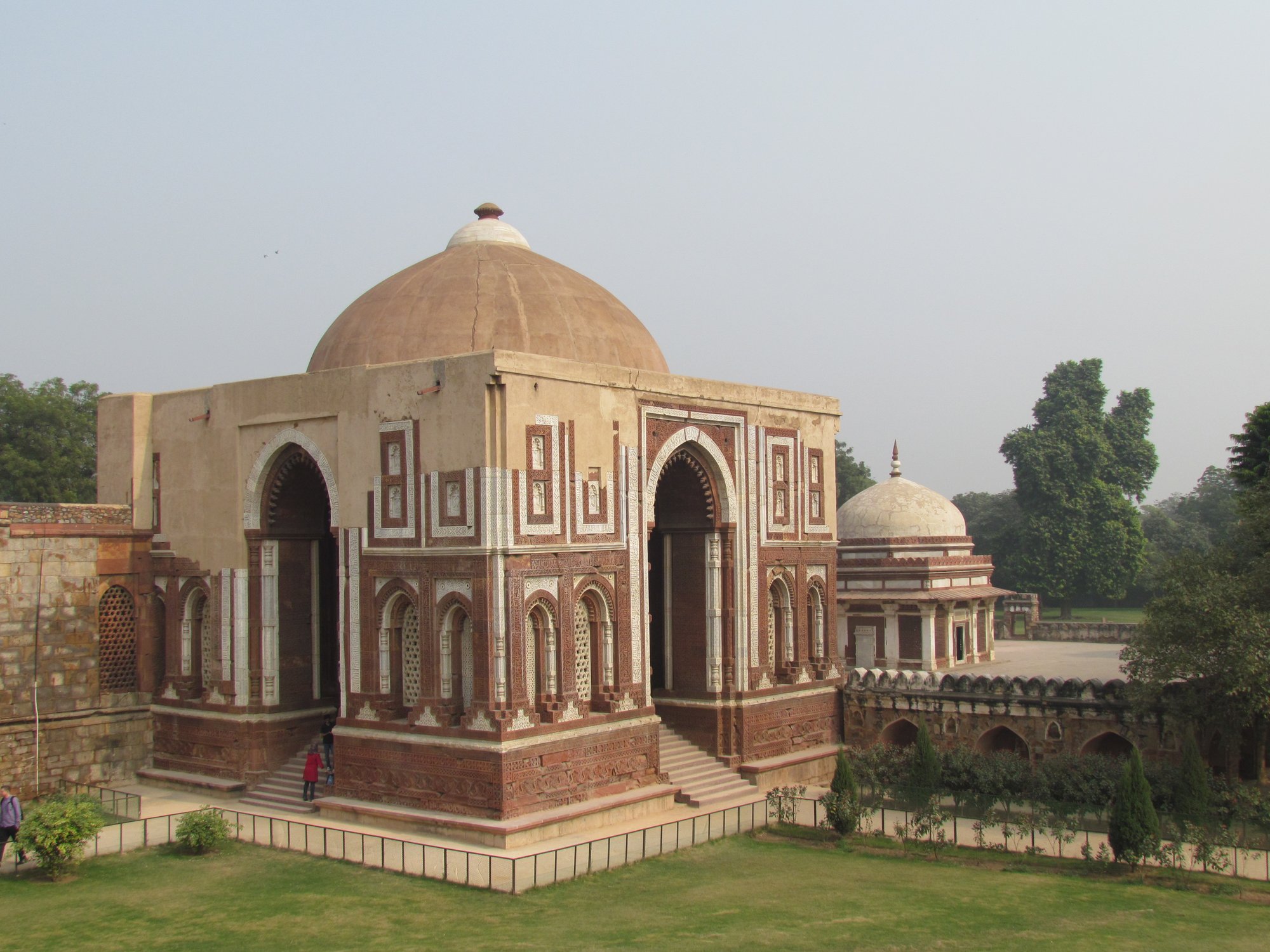
- Full name: Muizzuddin Muhammad ibn Sam, popularly Muhammad of Ghor or Muhammad Ghori
- Dynasty: Ghurid (Shansabani dynasty)
- Reign: Effective ruler from 1173 (as governor of Ghazni for his elder brother Ghiyasuddin Muhammad) and sole sultan from 1202 to 1206
- Origin: Ghor region, central Afghanistan
- Brother: Ghiyasuddin Muhammad (senior Ghurid sultan until 1202)
- First major Indian invasion: Multan, 1175
- First Tarain battle: 1191, defeated by Prithviraj Chauhan
- Second Tarain battle: 1192, defeated Prithviraj Chauhan
- Other major battle: Chandawar, 1194, defeated Jaichand of Kannauj
- Death: Assassinated near Damyak (modern Sohawa, Punjab, Pakistan) in March 1206
- Key successor in India: Qutbuddin Aibak, his Turkic slave, founder of the Mamluk or Slave dynasty
- Significance: Effective founder of Muslim political rule in northern India
Who Was Muhammad Ghori
Muhammad Ghori, properly Muizzuddin Muhammad, came from the Shansabani family, a Tajik or eastern-Iranian dynasty that ruled the mountainous Ghor region between Ghazni and Herat. The Ghurids were originally vassals of the Ghaznavids, but after the Seljuk decline and the sack of Ghazni in 1150 by Alauddin Husayn (called Jahansuz, the world-burner, for his destruction of Ghazni), they emerged as an independent power.
Muhammad and his elder brother Ghiyasuddin Muhammad ruled jointly. Ghiyasuddin was the senior, based at Firuzkuh, the Ghurid capital, and held the western half of the Ghurid lands including Khurasan. Muhammad held Ghazni from 1173 onward and was tasked with the eastern frontier, which meant the Punjab and the gateways to northern India.
His personal record is mixed. He was a competent commander but not in the Alexander or Babur class. What he did better than most contemporaries was learn from defeat, build a loyal slave-officer corps, and persist over a thirty-year time horizon.
Background and Historical Context
The Indian Theatre Before Ghori
When Muhammad Ghori began probing into northern India in 1175, the political map north of the Vindhyas was a mosaic of Rajput kingdoms. The Chauhans of Ajmer-Delhi under Someshvara and then his son Prithviraj III (Prithviraj Chauhan) were the dominant northern power. The Gahadavalas of Kannauj under Jaichand controlled the Ganga-Yamuna doab. The Chalukyas of Anhilwara (Gujarat) held the western coast. The Senas held Bengal, the Chandelas held Bundelkhand, the Solankis ruled Gujarat-Kathiawar. The Ghaznavid remnant at Lahore, weak and increasingly under pressure from the Ghurids in Khurasan, sat in the middle.
There was no unified northern Indian political order. The Rajput kingdoms feuded with each other (Prithviraj Chauhan and Jaichand of Kannauj being the most famous rivalry), and there was no real machinery for joint defence against a determined external power. Muhammad Ghori would exploit this through his career.
For broader context, see our background on the Delhi Sultanate that emerged from Ghori’s conquests, and the Mughal Empire that built on it three centuries later.
Muhammad Ghori’s Early Indian Campaigns
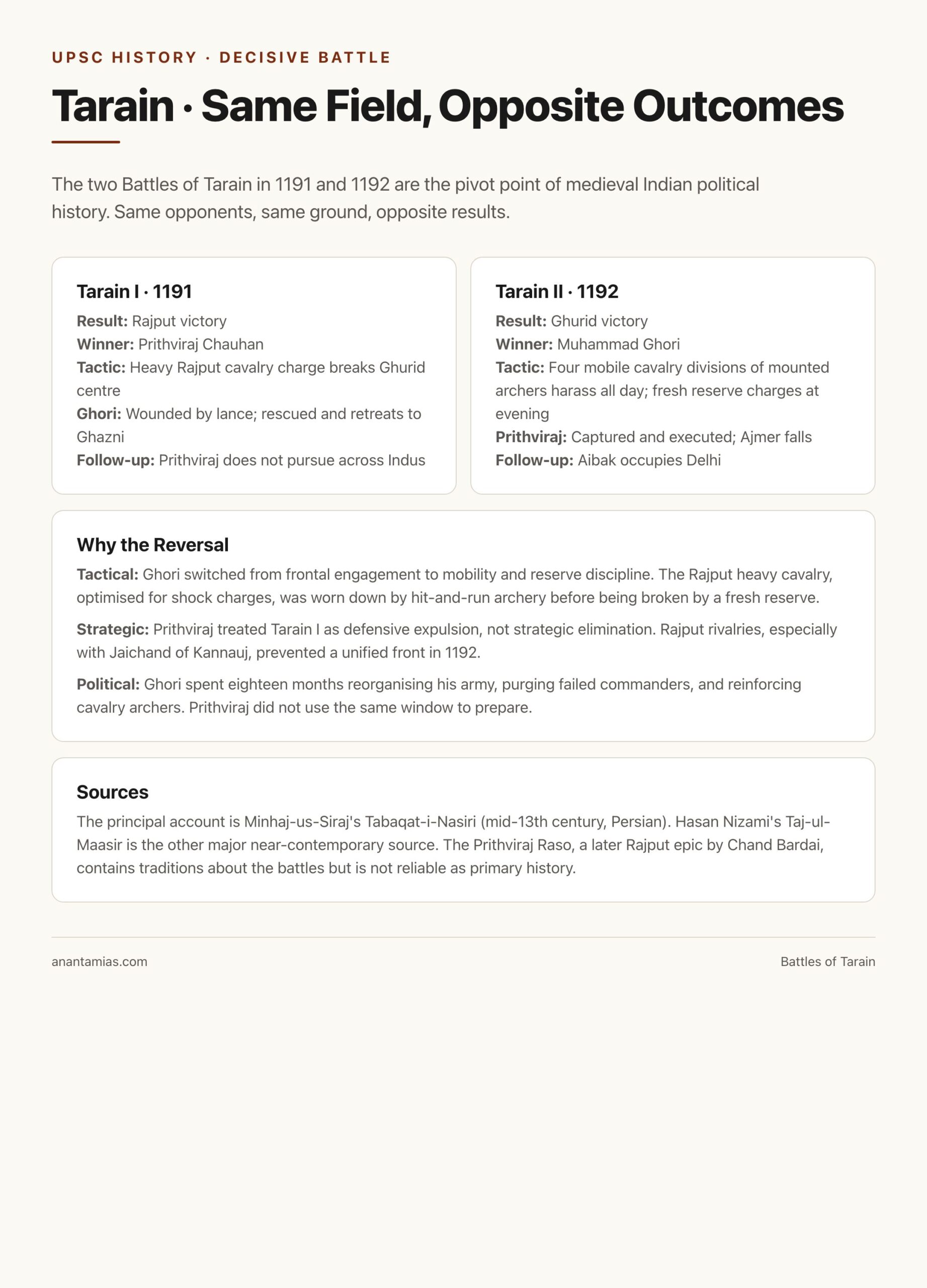
Muhammad Ghori’s expansion into India started in 1175 and proceeded in three broad phases.
- 1175 Multan campaign: Ghori captured Multan from the Ismaili Karmathian sect that controlled it. This gave him a permanent corridor through southern Punjab into northwest India.
- 1178 Gujarat invasion: Ghori attempted to push south through Rajasthan into Gujarat. He was decisively defeated by the Chalukya queen Naikidevi (regent for the young Bhima II) at Kayadara, near Mount Abu. This is sometimes called the Battle of Kayadara or Battle of Anhilwara. Ghori barely escaped with his life. It was a major check and forced him to change his strategy.
- 1186 capture of Lahore: Ghori finally extinguished the last Ghaznavid ruler Khusrau Malik at Lahore. This eliminated a major buffer and gave him a permanent forward base in the Punjab from which to launch deeper invasions.
By the late 1180s the stage was set for the climactic encounter with the Chauhans. The plain of Tarain near Karnal in modern Haryana would be the field.
Battles of Tarain in 1191 and 1192
The two Battles of Tarain are the single most important military events in medieval Indian history before the Mughal conquest. They are also one of the cleanest case studies in how a determined attacker learns from defeat.
First Battle of Tarain, 1191
Muhammad Ghori advanced from Lahore through the Punjab and besieged Tabarhinda (modern Bhatinda). Prithviraj Chauhan, the Chauhan ruler of Ajmer and Delhi, marched out with a large Rajput army drawn from his own forces and his allied feudatories. The two armies met at Tarain, about fourteen kilometres north of Thanesar.
The Chauhan cavalry charge broke the Ghurid centre. Muhammad Ghori himself was wounded in single combat (Persian sources say by a lance to the arm) and was rescued from the field by a young Khalji officer. The Ghurid army was routed and retreated to Ghazni. Prithviraj retook Tabarhinda after a thirteen-month siege.
This was a clear Indian victory. But two features of it would prove fatal in retrospect. First, Prithviraj did not pursue the broken Ghurid army across the Indus. Second, he treated the campaign as a defensive expulsion rather than a decisive elimination of a long-term strategic threat.
Second Battle of Tarain, 1192
Muhammad Ghori spent the next year and a half reorganising. He purged commanders who had failed, reinforced his cavalry with mounted archers, and assembled a fresh army of around one hundred and twenty thousand. Persian chronicler Minhaj-us-Siraj in the Tabaqat-i-Nasiri gives a vivid account.
In 1192 Ghori returned. The two armies again met at Tarain. This time Ghori avoided a head-on engagement. He divided his force into four mobile cavalry divisions of mounted archers and held a reserve. The four divisions harassed the Rajput line all day with hit-and-run archery, refusing battle, forcing the heavier Rajput cavalry to charge and exhaust their mounts. Late in the day, when the Rajput army was visibly fatigued, Ghori committed his fresh reserve in a single concentrated charge that shattered the Chauhan line.
Prithviraj fled the field but was captured shortly afterwards. Persian sources say he was executed; some Rajput traditions say he was taken to Ghazni and only later killed. The Chauhan capital at Ajmer fell. Delhi was occupied by Ghori’s slave commander Qutbuddin Aibak.
The contrast between the two battles is the standard UPSC comparison. Same field, same commanders, opposite outcomes. The difference was tactical learning, mobility, and disciplined reserve management on the Ghurid side, against an over-confident frontal charge on the Rajput side.
Battle of Chandawar 1194 and Further Campaigns
With the Chauhans broken, Ghori’s slave general Qutbuddin Aibak moved against Kannauj. In 1194 Muhammad Ghori himself defeated Jaichand of the Gahadavala dynasty at Chandawar, near modern Firozabad on the Yamuna. Jaichand was killed, his treasury at Asni was seized, and the Gahadavala domain collapsed. With Ajmer, Delhi and Kannauj all under Ghurid suzerainty within three years, the political map of north India was redrawn.
Subsequent campaigns under Aibak and Bakhtiyar Khalji extended Ghurid reach. Bakhtiyar Khalji’s raids took him into Bihar (destruction of Nalanda and Vikramashila monasteries around 1199 to 1203) and into Bengal (capture of Nadia, capital of the Sena ruler Lakshmana Sena, around 1204). Muhammad Ghori spent most of his later years dealing with reverses in Central Asia, especially the disastrous defeat by the Karakhitai and the Khwarezmians at Andkhud in 1204.
He was assassinated in March 1206 near Damyak on the banks of the Jhelum, while returning to Ghazni after suppressing a Khokhar revolt in the Punjab. The assassins are variously identified as Khokhars seeking revenge or Ismaili agents.
Legacy and the Slave or Mamluk Dynasty
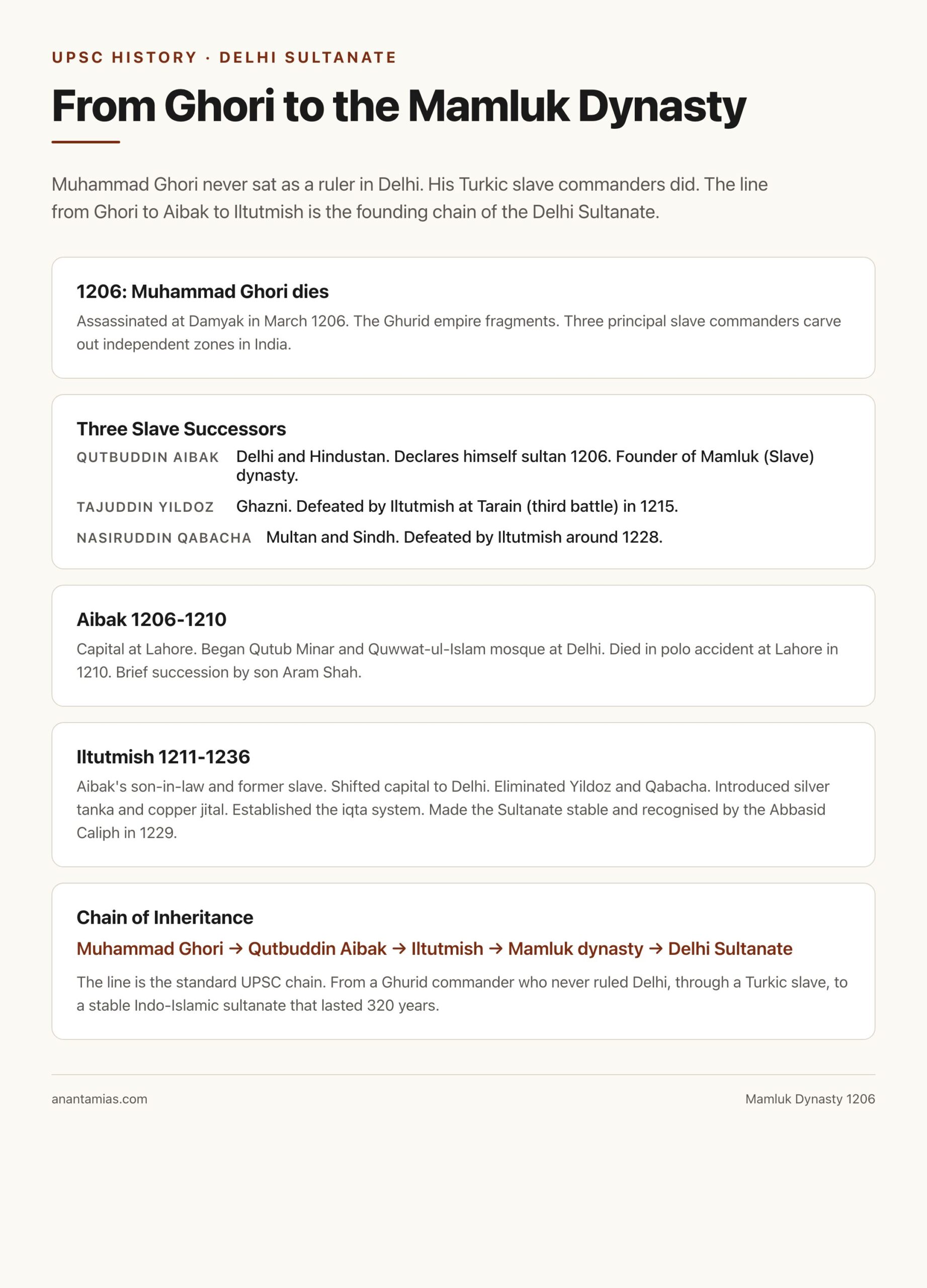
Muhammad Ghori did not formally establish the Delhi Sultanate. He never sat in Delhi as a ruler. He treated India as the eastern frontier of the Ghurid sultanate and ran it through three principal slave commanders. After his death the Ghurid empire broke up. The three commanders carved out independent zones.
- Qutbuddin Aibak: Ghori’s most trusted slave general, controlled Delhi and northern India. Took the title sultan after Ghori’s death in 1206 and is conventionally treated as the founder of the Mamluk or Slave dynasty, the first ruling house of the Delhi Sultanate. He began the Qutub Minar (completed by Iltutmish) and the Quwwat-ul-Islam mosque at Delhi.
- Tajuddin Yildoz: Held Ghazni. Brief rule, defeated by Iltutmish in 1215 at Tarain (third battle on the same plain).
- Nasiruddin Qabacha: Held Multan and Sindh. Defeated by Iltutmish around 1228.
Aibak died in 1210 in a polo accident at Lahore. He was succeeded briefly by his son Aram Shah and then by his son-in-law and former slave Iltutmish, who consolidated the Mamluk hold on Delhi, defeated Yildoz and Qabacha, secured the iqta system, and made the Delhi Sultanate a stable polity.
The line of inheritance, from Ghori to Aibak to Iltutmish, is the standard UPSC chain.
Muhammad Ghori Compared with Mahmud of Ghazni
Indian textbooks almost always pair Muhammad Ghori with Mahmud of Ghazni, the earlier Turkic conqueror who raided north India seventeen times between 1000 and 1027. The contrast is sharp and is a useful Mains framing.
| Dimension | Mahmud of Ghazni | Muhammad Ghori |
|---|---|---|
| Era | 998-1030 | 1173-1206 (effective Indian phase) |
| Goal | Plunder, iconoclasm, prestige in caliphal politics | Territorial conquest and administrative occupation |
| Result | Looted wealth taken back to Ghazni; no Indian state built | Permanent Muslim political occupation of north India |
| Sites attacked | Somnath, Mathura, Kanauj | Multan, Tabarhinda, Tarain, Ajmer, Delhi, Kannauj, Bihar, Bengal |
| Posterity | No dynasty in India | Delhi Sultanate via slave commanders |
The standard line is that Mahmud raided India, Ghori conquered it. Both formulations are simplifications, but the underlying contrast is real. Ghori is the founder of the political tradition that became the Delhi Sultanate; Mahmud is the precursor.
Prelims Pointers
- Muhammad Ghori belonged to the Ghurid (Shansabani) dynasty, originally from central Afghanistan.
- He was defeated by the Chalukya queen Naikidevi of Gujarat at Kayadara in 1178.
- He captured Multan in 1175 and Lahore in 1186 (ending Ghaznavid rule).
- First Battle of Tarain, 1191, Muhammad Ghori defeated by Prithviraj Chauhan.
- Second Battle of Tarain, 1192, Muhammad Ghori defeated Prithviraj Chauhan.
- Battle of Chandawar, 1194, defeated Jaichand of Kannauj.
- Bakhtiyar Khalji, a Ghurid commander, destroyed Nalanda around 1199-1203 and captured Bengal around 1204.
- Muhammad Ghori was assassinated in 1206 near Damyak (Punjab).
- Qutbuddin Aibak, his Turkic slave, founded the Mamluk or Slave dynasty at Delhi in 1206.
- The Persian chronicler Minhaj-us-Siraj (Tabaqat-i-Nasiri) is the main source for Ghori’s reign.
Mains Practice Questions
- “Muhammad Ghori, not Mahmud of Ghazni, was the true founder of Muslim political rule in India.” Critically examine. (15 marks)
- Analyse the tactical reasons for the reversal between the First and Second Battles of Tarain. What does this say about Rajput political organisation in the late twelfth century? (10 marks)
- Trace the line of succession from Muhammad Ghori to the consolidation of the Delhi Sultanate under Iltutmish. (15 marks)
- Examine the role of slave commanders in Ghori’s military system and explain why a slave general could legitimately succeed his master in medieval Islamicate polity. (10 marks)
Why Muhammad Ghori Still Matters
Muhammad Ghori is not remembered for personal brilliance. He is remembered because the political system that emerged from his eastern campaigns lasted longer than almost any other in Indian history. The Delhi Sultanate ran from 1206 to 1526. The Mughal succession that followed it ran (in some form) until 1857. That entire arc, six and a half centuries of Indo-Islamic rule in northern India, traces back to a Ghurid commander who lost his first major Indian battle in 1191 and his life in a punitive raid in 1206.
For UPSC, Muhammad Ghori is the single most economical entry point into the politics of the twelfth-to-thirteenth century transition. Master Tarain I and II, the Chandawar follow-up, and the chain to Aibak and Iltutmish, and you have a clean analytical frame for the founding of the Delhi Sultanate.
Frequently Asked Questions
Who was Muhammad Ghori?
Muhammad Ghori, properly Muizzuddin Muhammad ibn Sam, was the Ghurid sultan whose campaigns from 1175 to 1206 established Muslim political rule in northern India. His Turkic slave commanders, notably Qutbuddin Aibak, founded the Delhi Sultanate after his death.
What was the First Battle of Tarain?
The First Battle of Tarain was fought in 1191 between Muhammad Ghori and Prithviraj Chauhan on the plain near Tarain (modern Taraori in Haryana). Prithviraj defeated Ghori, who was wounded and fled back to Ghazni. The Rajput victory was decisive but not exploited.
What was the Second Battle of Tarain?
The Second Battle of Tarain in 1192, fought on the same field, ended in Ghori’s victory. Ghori used four mobile divisions of mounted archers to exhaust the Rajput cavalry and then committed a fresh reserve. Prithviraj was captured and the Chauhan power broken. Delhi fell soon after.
Why did Prithviraj Chauhan lose the Second Battle of Tarain?
Multiple factors. Tactically, the Rajput army relied on heavy cavalry charges that were exhausted by Ghori’s mobile archers. Strategically, after his 1191 victory Prithviraj did not eliminate the Ghurid threat or build a coalition. Politically, Rajput rivalries, particularly with Jaichand of Kannauj, meant no joint defensive front.
Did Muhammad Ghori found the Delhi Sultanate?
He did not formally found it. Ghori treated India as a Ghurid frontier and never ruled from Delhi himself. The Delhi Sultanate was founded by his slave Qutbuddin Aibak in 1206, the year of Ghori’s assassination. Aibak’s dynasty is called the Mamluk or Slave dynasty.
Who was Qutbuddin Aibak?
Qutbuddin Aibak was Muhammad Ghori’s most trusted Turkic slave general. He commanded the eastern Ghurid army, captured Delhi in 1192, and assumed sovereignty in 1206 after Ghori’s death. He began the construction of the Qutub Minar at Delhi.
How did Muhammad Ghori die?
Muhammad Ghori was assassinated in March 1206 at Damyak on the banks of the Jhelum, while returning to Ghazni after a Khokhar campaign in the Punjab. The killers are usually identified as Khokhars or as Ismaili agents.
What was the Battle of Chandawar?
The Battle of Chandawar, fought in 1194 near modern Firozabad in Uttar Pradesh, was Muhammad Ghori’s victory over Jaichand of the Gahadavala dynasty of Kannauj. Jaichand was killed and the Gahadavala kingdom collapsed, securing the Ganga-Yamuna doab for the Ghurids.
How is Muhammad Ghori different from Mahmud of Ghazni?
Mahmud of Ghazni raided India seventeen times between 1000 and 1027 for plunder and iconoclasm but founded no Indian state. Muhammad Ghori, more than a century later, fought campaigns of territorial conquest and his successors established the Delhi Sultanate. Ghori is the founder of Muslim political rule in India, Mahmud is the precursor.
Who was Bakhtiyar Khalji?
Bakhtiyar Khalji was a Ghurid commander under Qutbuddin Aibak. He led raids that destroyed the Buddhist monastic universities at Nalanda and Vikramashila around 1199 to 1203 and captured the Sena capital of Nadia in Bengal around 1204, extending Ghurid reach to the eastern Gangetic plain.
Why is Muhammad Ghori important for UPSC?
Muhammad Ghori is the single most important figure for the transition from early medieval to Sultanate-period north India. His battles of Tarain in 1191 and 1192, the founding of the Delhi Sultanate by his slave Aibak, and the chain of succession to Iltutmish are standard examination material in both Prelims and Mains.