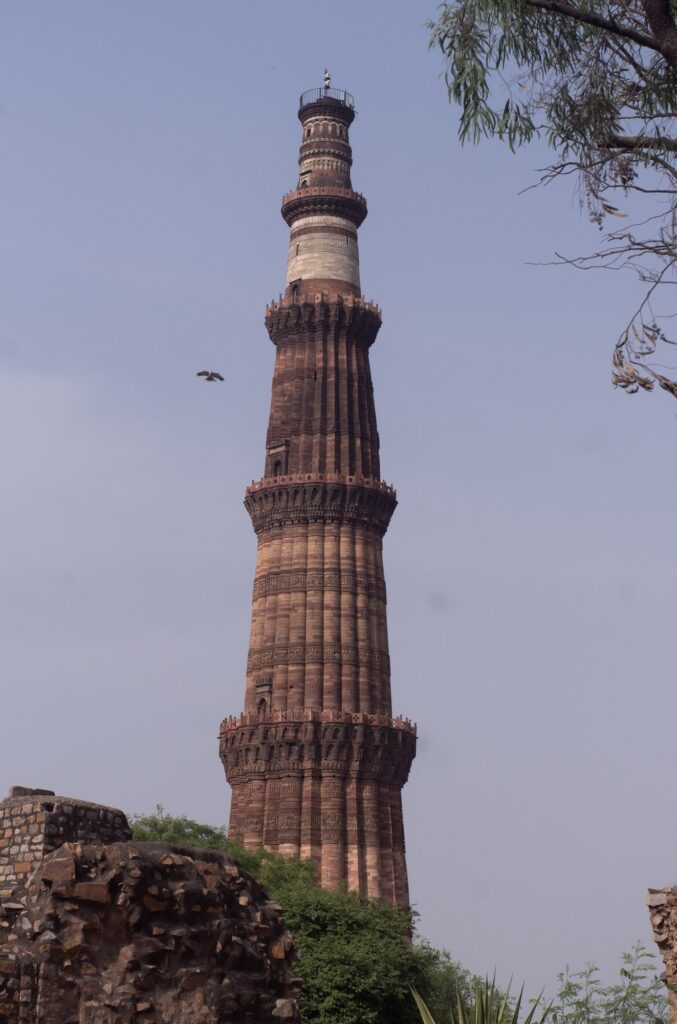
The Slave Dynasty, also called the Mamluk Dynasty, ruled the Delhi Sultanate from 1206 to 1290. It is the first of the five dynasties that together made up the Delhi Sultanate, the others being the Khilji, Tughlaq, Sayyid and Lodi. The Slave Dynasty is named for the fact that its three most important rulers — Qutb-ud-din Aibak, Iltutmish and Balban — were of slave origin, purchased and trained in the household of an earlier master. In the Turkish-Persian world of the thirteenth century, a mamluk was not a labourer but a military slave-officer, often more trusted than free-born nobility because his loyalty was personal and his future depended entirely on his patron.
The eighty-four years of Slave Dynasty rule are the foundational years of Muslim political power in northern India. Aibak began the construction of the Qutb Minar. Iltutmish gave the sultanate its first formal institutions — the Iqta system of revenue assignment, the silver tanka and copper jital currency, and the corps of forty senior nobles known as the Chahalgani or Turkan-i-Chahalgani. Razia Sultan, the only woman to sit on the throne of Delhi during this whole period, ruled briefly in the 1230s. Balban, who came to the throne in 1266, formalised the theory of sultan-as-shadow-of-god and the elaborate court etiquette of sijda and paibos.
This article walks through the rulers in sequence, sets out the major administrative innovations of the Slave Dynasty, and explains why the dynasty fell to the Khilji nobles in 1290.
Quick Facts
- Founder: Qutb-ud-din Aibak, 1206
- Last ruler: Shams-ud-din Kayumars, deposed 1290
- Capital: Delhi (with Lahore as an earlier seat under Aibak)
- Major rulers: Aibak, Iltutmish, Razia Sultan, Balban
- Key institutions: Iqta system, silver tanka, Chahalgani (Forty Nobles), sijda and paibos court etiquette
- External threat: Mongol invasions from Central Asia under Chinggis Khan and his successors
- Architectural legacy: Qutb Minar (begun under Aibak, completed under Iltutmish), Quwwat-ul-Islam mosque, Iltutmish’s tomb
- End date: 1290, when Jalal-ud-din Khilji deposed the last Slave ruler
Origin of the Slave Dynasty
The Slave Dynasty arose out of the eastern provinces of the Ghurid Empire. Muhammad Ghori, the Ghurid sultan, defeated Prithviraj Chauhan at the Second Battle of Tarain in 1192 — for the full sequence see our notes on the Muhammad Ghori Tarain battles. After his Indian conquests, Ghori left his most trusted slave-general, Qutb-ud-din Aibak, in charge of the Indian provinces while he returned to Ghazni.
When Muhammad Ghori was assassinated in 1206, Aibak was already governing northern India from Lahore. He declared himself sultan in the same year. The Ghurid Empire fragmented in Afghanistan, but the Indian portion survived as the Delhi Sultanate under the Slave Dynasty. The line of succession was not strictly hereditary. Power passed from master to slave or from father-in-law to son-in-law because the strongest claim was always the support of the Turkish slave nobility.
Qutb-ud-din Aibak (1206-1210)
Qutb-ud-din Aibak was a Turkish slave from Central Asia, sold first to a Qazi in Nishapur and later to Muhammad Ghori. He rose through military service. After Tarain in 1192, Ghori made him viceroy of his Indian conquests. Aibak operated from Lahore. He extended Ghurid power into the Ganga-Yamuna doab, into Gujarat under Bhima II, and into Bengal through his lieutenant Bakhtiyar Khilji.
Aibak began the construction of the Qutb Minar in Delhi in 1199, though only the first storey was finished in his lifetime. He also commissioned the Quwwat-ul-Islam mosque, which is the first Friday mosque built in India. Aibak was known by the epithet Lakh Baksh or “Giver of Lakhs” for his generosity. He died in 1210 from a fall while playing chaugan, an early form of polo, at Lahore. He was succeeded briefly by his son Aram Shah, who lacked support and was deposed within a year.
Iltutmish (1211-1236)
Shams-ud-din Iltutmish was Aibak’s son-in-law and the real consolidator of the Slave Dynasty. He was of Ilbari Turkish origin, sold into slavery as a boy and bought by Aibak. He deposed Aram Shah in 1211 with the support of the Turkish nobles and was crowned at Delhi.
Iqta system
Iltutmish formalised the Iqta system. An iqta was a temporary revenue assignment given to a noble or officer in lieu of cash salary. The holder, called an iqtadar or muqti, was responsible for collecting land revenue from the assigned area and maintaining troops for the sultan. The iqta was not hereditary and could be reassigned. The system spread administrative reach without requiring a large salaried bureaucracy in Delhi. Iltutmish granted iqtas to about 2,000 Turkish nobles, including the senior 40 known later as the Chahalgani.
Silver tanka and copper jital
Iltutmish introduced two new coins — the silver tanka of about 175 grains and the copper jital. The tanka became the standard silver coin of the sultanate for the next century and a half. Earlier coins had continued in the Hindu-style billon or copper denominations of the Tomara and Chauhan period. The new currency tied the sultanate to the Persianate trans-regional silver economy.
Chahalgani (Turkan-i-Chahalgani)
Iltutmish organised his most senior 40 Turkish nobles into a body called the Chahalgani or Group of Forty. They held the most important iqtas, commanded the army contingents and effectively functioned as a king-making council. The Chahalgani became both the strength and the weakness of the Slave Dynasty — strength while a strong sultan controlled them, weakness when succession was disputed.
Mongol diplomacy
Iltutmish’s reign coincided with the rise of Chinggis Khan in Central Asia. In 1221 the Mongol army under Chinggis Khan pursued Jalal-ud-din Mangbarni, the last Khwarazmshah ruler, to the Indus. Jalal-ud-din asked Iltutmish for asylum in Delhi. Iltutmish refused diplomatically, citing the unhealthy climate of Delhi, and so kept the Mongols at the Indus frontier rather than provoke an invasion. This is one of the earliest examples of Indian rulers managing the Mongol threat by avoiding it rather than confronting it.
Iltutmish died in 1236 at Delhi. His tomb in the Qutb complex is one of the earliest surviving examples of Indo-Islamic funerary architecture.
Razia Sultan (1236-1240)
Razia Sultan was Iltutmish’s daughter. Before his death, Iltutmish formally nominated her as his successor, passing over his surviving sons. This was unusual in the Turkish-Persian world but Iltutmish believed she was the most capable of his children. The Chahalgani initially placed her brother Rukn-ud-din Firoz on the throne. He proved incompetent. The Delhi public and a faction of the nobles deposed him and seated Razia in late 1236.
Razia Sultan ruled for about three and a half years. She is the only woman to sit on the throne of the Delhi Sultanate. She rode openly in male attire, sat in open court, and appointed an Abyssinian noble named Yakut as Amir-ul-Umara (chief of nobles), which offended the Turkish Chahalgani. The Turkish nobles, led by Malik Altunia, governor of Bhatinda, rebelled. Razia was captured. She married Altunia and they marched together on Delhi but were defeated by another faction of the Chahalgani. Razia and Altunia were killed near Kaithal in 1240. The dynasty passed back to Iltutmish’s sons, who proved weak.
Balban (1266-1287)
Ghiyas-ud-din Balban was originally an Ilbari Turkish slave bought by Iltutmish. He rose through the Chahalgani during the weak reigns of Iltutmish’s sons. He was the de facto regent under Sultan Nasir-ud-din Mahmud Shah from 1246 to 1266, holding the office of naib or deputy sultan. When Mahmud Shah died in 1266 without an heir, Balban took the throne in his own name.
Theory of kingship
Balban developed an elaborate theory of kingship modelled on the Sassanid Persian court. He proclaimed that the sultan was the zill-i-ilahi or shadow of god on earth, and the niyabat-i-khudai or vice-regent of god. Public laughter and casual conversation in his presence were forbidden. He insisted on the Persian ceremonies of sijda (prostration before the sultan) and paibos (kissing the sultan’s feet). These were drawn directly from Sassanid Iran and were resented by the orthodox ulema, but Balban enforced them.
Breaking the Chahalgani
Balban’s central political project was breaking the power of the Chahalgani. He executed senior Turkish nobles on charges of corruption or rebellion, confiscated their iqtas, and replaced them with new appointees who owed everything to him personally. By the end of his reign, the original Chahalgani had effectively been destroyed as a political bloc.
Iron and blood policy
Balban dealt harshly with revolts in the doab, Mewat and Bengal. He massacred the Mewatis around Delhi to make the capital safe. He suppressed the rebellion of Tughril Khan in Bengal in 1279 with personal command of the army. The Bengal rebels and their families were executed in public at Lakhnauti. The policy is sometimes called Balban’s iron and blood approach.
Mongol frontier
The Mongol pressure under successive Ilkhans of Persia intensified in Balban’s reign. Mongol raids reached the Beas. Balban fortified the north-western frontier with a chain of forts under his eldest son Muhammad, who was killed fighting the Mongols near Multan in 1285. The death of Muhammad broke Balban personally. He died in 1287.
Decline and Khilji Revolution
After Balban’s death, the throne passed to his grandson Kayqubad, who was incompetent and ill, then briefly to a child sultan Shams-ud-din Kayumars. The Turkish nobility was exhausted, the Chahalgani was a shadow, and the army was tired. The Khilji nobles, who were of mixed Turkish-Afghan origin and had been kept out of the inner circle of the Slave Dynasty, took advantage.
Jalal-ud-din Khilji, the senior Khilji noble, deposed Kayumars in 1290 and founded the Khilji Dynasty — the next chapter of the Delhi Sultanate, covered in our notes on the Khilji Dynasty. The Slave Dynasty ended after eighty-four years.
Administration of the Slave Dynasty
The Slave Dynasty inherited the Ghurid system and developed it. The central administration was based at Delhi. The four senior departments were the diwan-i-wazarat (finance), diwan-i-arz (military), diwan-i-insha (correspondence) and diwan-i-rasalat (foreign and religious affairs). The empire was divided into iqtas under the muqtis. Land revenue was the main income, supplemented by zakat, jizya on non-Muslims and customs duties.
The army was a mix of slave troops, iqtadar contingents and free Turkish cavalry. The standing army at Delhi was small but high quality. The total military strength of the sultanate at its peak under Balban is estimated at about 200,000 troops, but only a fraction were available for any single campaign.
Architecture and Culture
The Qutb complex at Delhi is the architectural signature of the Slave Dynasty. The Qutb Minar was begun by Aibak in 1199, taken up to four storeys by Iltutmish, and the fifth storey was added under Firoz Shah Tughlaq later. The Quwwat-ul-Islam mosque, begun under Aibak, was the first congregational mosque in north India. Iltutmish’s tomb, with its corbelled dome and Quranic calligraphy, is an early Indo-Islamic monument that mixes Hindu and Persian decorative motifs.
Persian became the court language. Sanskrit-trained Hindu officials were retained in revenue administration. Sufi orders, especially the Chishti silsila under Khwaja Moin-ud-din Chishti and later Hazrat Nizam-ud-din Auliya, became culturally influential during this period.
Prelims Pointers
- Slave Dynasty period: 1206-1290.
- Qutb-ud-din Aibak was the founder of the Slave Dynasty.
- Aibak was known as Lakh Baksh or “Giver of Lakhs”.
- The Qutb Minar was begun by Aibak in 1199 and completed by Iltutmish.
- Iltutmish introduced the silver tanka and copper jital.
- Iltutmish organised the Chahalgani or Turkan-i-Chahalgani — group of 40 Turkish nobles.
- Razia Sultan ruled from 1236 to 1240 and is the only woman to sit on the Delhi throne.
- Razia appointed Yakut, an Abyssinian, as Amir-ul-Umara.
- Balban ruled from 1266 to 1287 and propounded the theory of zill-i-ilahi.
- Sijda and paibos were court etiquettes enforced by Balban.
- Balban’s son Muhammad was killed fighting the Mongols in 1285.
- The Slave Dynasty was ended by Jalal-ud-din Khilji in 1290.
Mains Questions
- “The Slave Dynasty laid the institutional foundations of the Delhi Sultanate.” Discuss with reference to the Iqta system, the silver tanka and the Chahalgani. (GS Paper I, 15 marks)
- Examine the place of Razia Sultan in the history of medieval India. What does her reign reveal about the limits of female rule in the Delhi Sultanate? (GS Paper I, 10 marks)
- Critically evaluate Balban’s theory of kingship and his policy of breaking the Chahalgani. (GS Paper I, 15 marks)
Legacy and Way Forward
The Slave Dynasty established the political and administrative framework that all later Delhi Sultanate dynasties inherited. The iqta system, the silver tanka, the Persian court ritual and the Indo-Islamic architectural vocabulary all begin here. The dynasty also set the precedent that Turkish slave-officers could rise to the highest position in the realm, a precedent that shaped the recruitment of the Khilji, Tughlaq and later Mughal nobility.
Reading the Slave Dynasty alongside the Khilji Dynasty, the Tughlaq Dynasty and the Lodi Dynasty gives the full arc of the Delhi Sultanate from foundation to fall at the Battles of Panipat in 1526. For comparison with southern dynasties of the same period, see our notes on Krishnadevaraya of Vijayanagara and Rajaraja Chola I.
Frequently Asked Questions
Why is it called the Slave Dynasty?
It is called the Slave Dynasty because its three most important rulers — Qutb-ud-din Aibak, Iltutmish and Balban — began their lives as Turkish military slaves. In the Turkish-Persian system a mamluk was a slave-officer trained in the household of a master, often more trusted than free-born nobility. The dynasty is also called the Mamluk Dynasty for this reason.
Who founded the Slave Dynasty and when?
Qutb-ud-din Aibak founded the Slave Dynasty in 1206 after the assassination of his master Muhammad Ghori. Aibak declared himself sultan at Lahore in the same year. His successors moved the capital to Delhi.
What were the major reforms of Iltutmish?
Iltutmish formalised the Iqta system of revenue assignment, introduced the silver tanka and copper jital as standard coins, organised his 40 most senior Turkish nobles into the Chahalgani, and managed the Mongol threat by refusing to give asylum to the Khwarazmshah ruler Jalal-ud-din Mangbarni in 1221.
Who was Razia Sultan?
Razia Sultan was the daughter of Iltutmish and ruled the Delhi Sultanate from 1236 to 1240. She is the only woman to sit on the throne of the Delhi Sultanate. She was deposed and killed by a faction of the Turkish nobles in 1240, partly because of her appointment of the Abyssinian noble Yakut as Amir-ul-Umara.
What was Balban’s theory of kingship?
Balban propounded that the sultan was the zill-i-ilahi or shadow of god on earth and the niyabat-i-khudai or vice-regent of god. He enforced the Persian court ceremonies of sijda (prostration) and paibos (kissing the sultan’s feet). The theory was modelled on Sassanid Persian kingship.
What was the Chahalgani?
The Chahalgani or Turkan-i-Chahalgani was the body of 40 senior Turkish nobles organised by Iltutmish. They held the most important iqtas and functioned as a king-making council. Balban broke their power by executing senior members and confiscating their iqtas.
How did the Slave Dynasty end?
The Slave Dynasty ended in 1290 when Jalal-ud-din Khilji, a senior Khilji noble, deposed the child sultan Shams-ud-din Kayumars after the weak reigns of Balban’s grandson Kayqubad. The Khilji Dynasty followed.
Why is the Slave Dynasty important for UPSC?
The Slave Dynasty is the foundational dynasty of the Delhi Sultanate and is a regular topic in prelims and mains. Questions cover the iqta system, the Chahalgani, the silver tanka, the reigns of Iltutmish, Razia and Balban, and the architectural legacy of the Qutb complex.
Tell Google you want more of this.
Add Anantam IAS as a preferred sourceOne tap, and this site shows up more often in your own Top Stories, AI Overviews and AI Mode. Remove it any time.