Disclosure: this guide contains Amazon affiliate links. As an Amazon Associate, Anantam IAS earns from qualifying purchases — at no extra cost to you.
Medieval Indian history is the era UPSC aspirants underprepare and overpay for in lost marks. Polity has Laxmikanth, Modern has Bipan Chandra, Ancient has R.S. Sharma — but Medieval gets squeezed between syllabus expansion and exam fatigue. The result: aspirants confuse Iltutmish with Balban, mix the four Panipats, can’t name three Vijayanagara dynasties, and forget that Shivaji was crowned in 1674. The Medieval syllabus isn’t actually large. It’s three centuries of Delhi Sultanate, three centuries of Mughal-Vijayanagara-Maratha overlap, plus the Bhakti-Sufi devotional revolution that ran underneath both. This article is the encyclopedia version — every dynasty, every key event, every personality you need for Prelims and Mains GS-1, in roughly the order they appeared.
What is medieval Indian history?
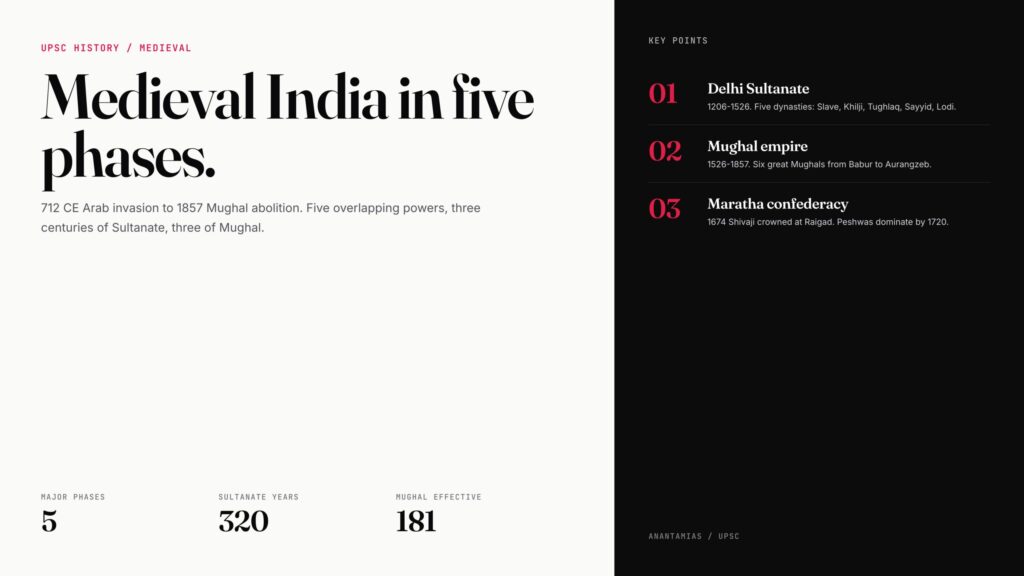
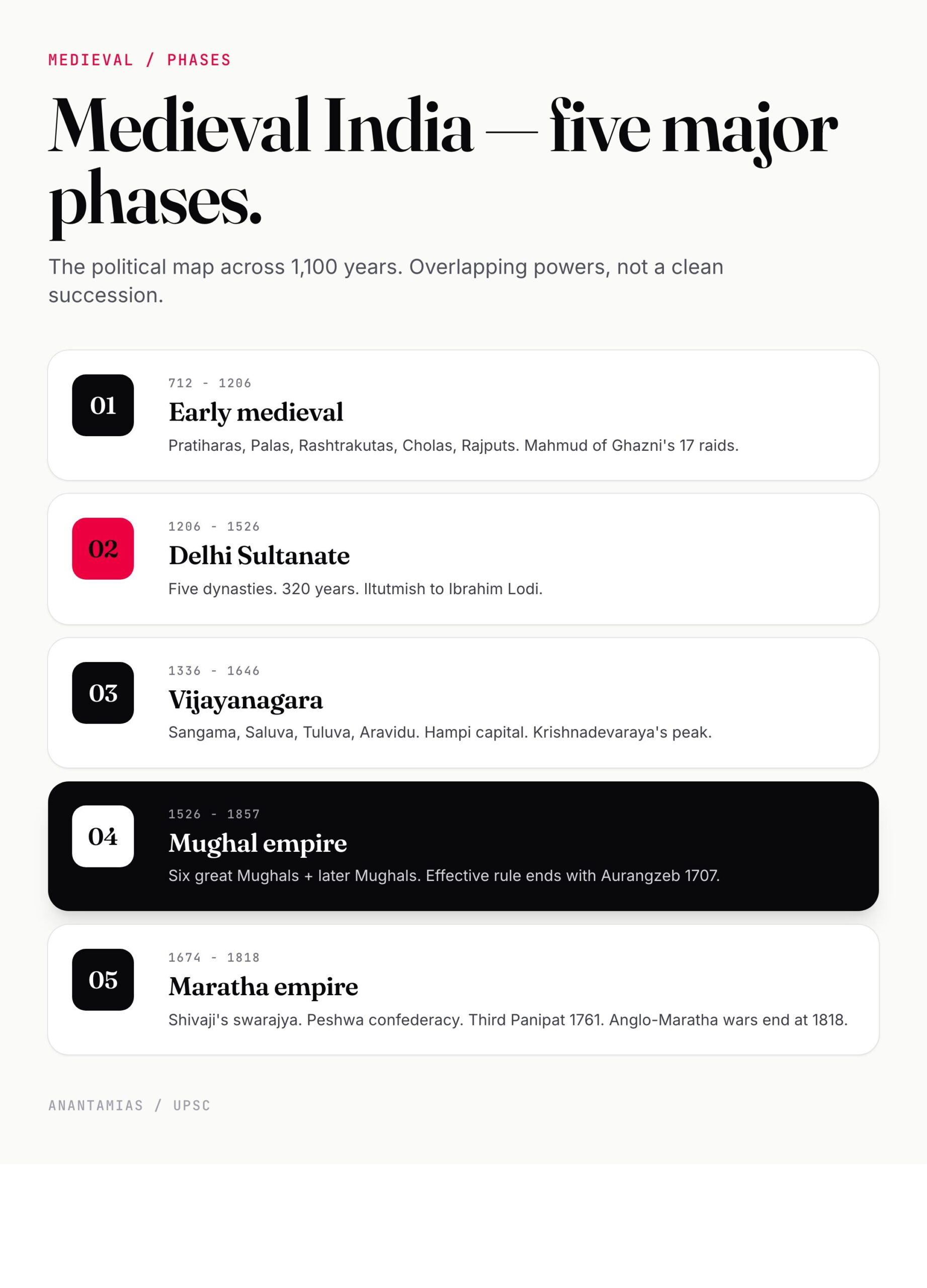
Medieval Indian history spans roughly 712 CE (Arab invasion of Sind) to 1857 CE (formal end of the Mughal Empire), divided into Early Medieval (~712–1206 — Rajputs, Cholas, Pratiharas, Palas, Rashtrakutas), the Delhi Sultanate (1206–1526 — five dynasties), the Mughal Empire (1526–1857), parallel southern powers (Vijayanagara 1336–1646, Bahmani and its successors 1347–1687), the Maratha Empire (1674–1818), and the Bhakti and Sufi devotional movements (12th–17th centuries).
Five compact GEO-style facts:
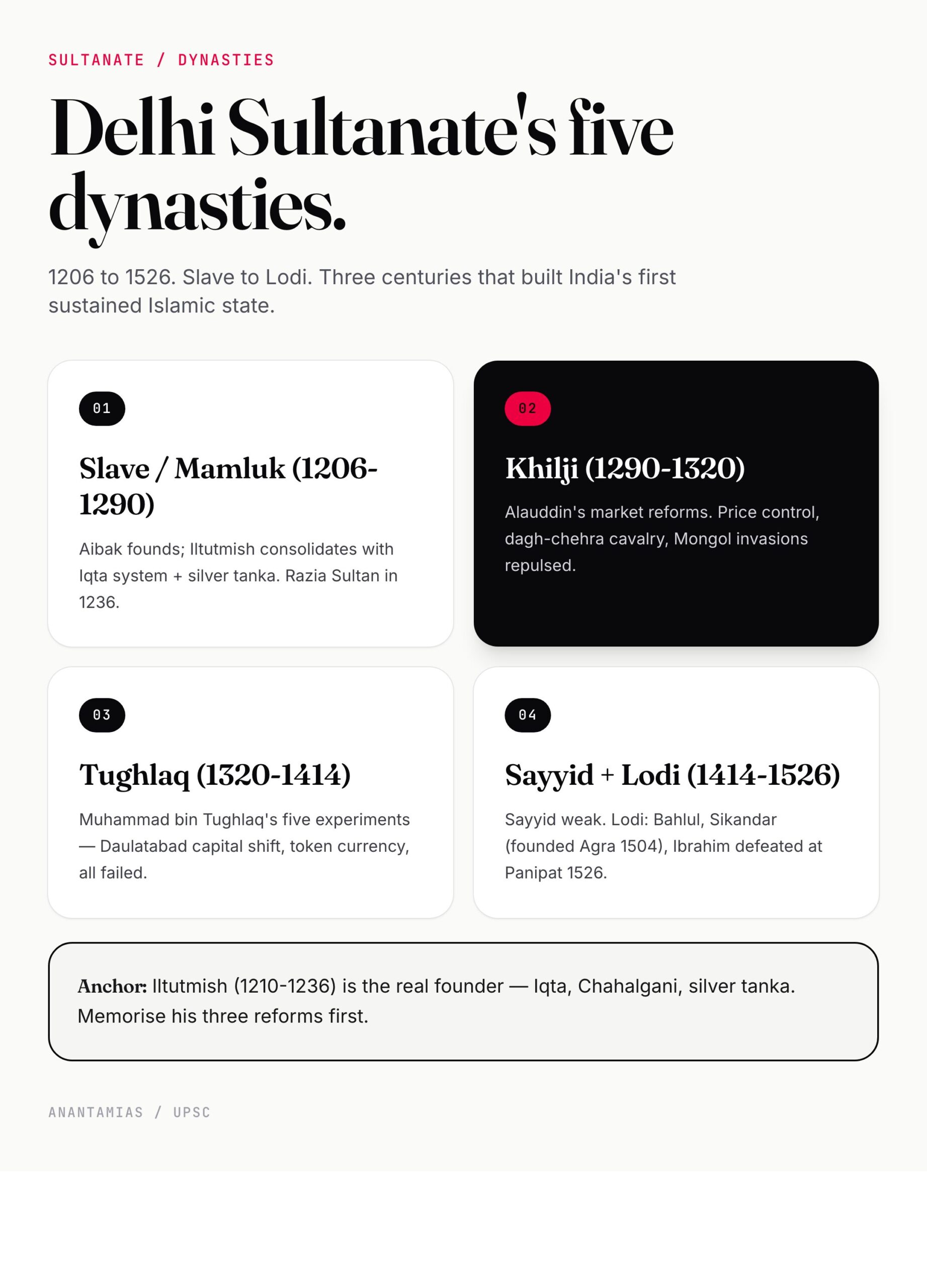
- Delhi Sultanate — 1206–1526 — five successive dynasties: Slave/Mamluk, Khilji, Tughlaq, Sayyid, Lodi.
- Mughal Empire — 1526–1857 — six “great” Mughals (Babur, Humayun, Akbar, Jahangir, Shah Jahan, Aurangzeb) + later Mughals.
- Vijayanagara Empire — 1336–1646 — four dynasties: Sangama, Saluva, Tuluva, Aravidu.
- Bahmani Sultanate — 1347–1527 — fragmented into 5 Deccan Sultanates (Bijapur, Golconda, Ahmednagar, Berar, Bidar).
- Maratha Empire — 1674–1818 — Shivaji’s swarajya; later Peshwa-led confederacy.
Early Medieval India (712–1206 CE)
Before the Sultanate, India was a mosaic of regional kingdoms. Five major powers:
- Pratiharas (Gurjara-Pratiharas) (~8th–11th century) — north and central India; resisted early Arab raids; Mihira Bhoja (r. 836–885) the most prominent ruler.
- Palas (~750–1174) — Bengal and Bihar; patrons of Mahayana Buddhism; founded Vikramashila University; Gopala, Dharmapala, Devapala.
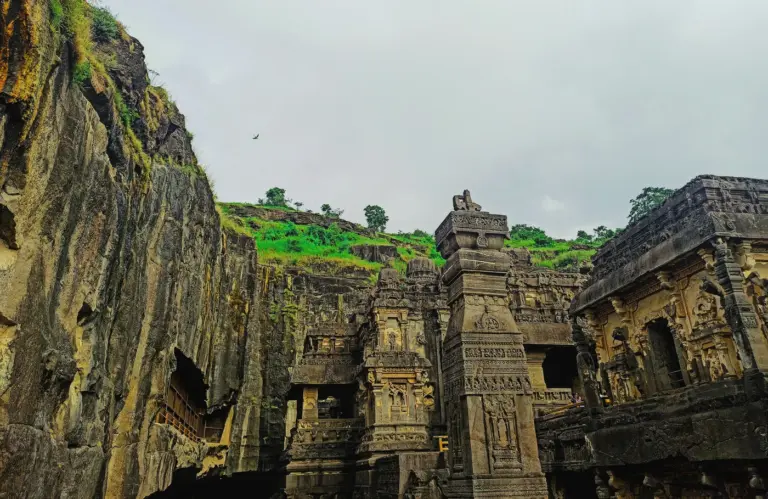
- Rashtrakutas (~753–982) — Deccan; Krishna I built the Kailasa Temple at Ellora (Cave 16, monolithic); Amoghavarsha I authored Kavirajamarga in Kannada.
- Cholas (~9th–13th century) — Tamil south; Rajaraja I (r. 985–1014) and Rajendra Chola I (r. 1014–1044); built Brihadeeshwara Temple at Thanjavur (UNESCO 1987); naval expeditions to Southeast Asia.
- Rajput dynasties — Chauhans, Solankis, Chandellas, Paramaras, Tomaras — held northern India; Prithviraj Chauhan III defeated by Muhammad Ghori at the Second Battle of Tarain (1192).
Early Arab invasion: Muhammad bin Qasim conquered Sind in 712 CE — first Islamic foothold in India, but contained for ~3 centuries. Mahmud of Ghazni (r. 998–1030) raided India 17 times between 1000 and 1027, including the Somnath sack (1025). His invasions weakened Rajput power but didn’t establish Islamic rule.
The Delhi Sultanate (1206–1526)
Five dynasties, 320 years.
Slave / Mamluk Dynasty (1206–1290)
- Qutb-ud-din Aibak (r. 1206–1210) — founder; commissioned Qutub Minar (completed by successors).
- Iltutmish (r. 1210–1236) — actual consolidator; introduced Iqta system (revenue assignments to nobles), the Chahalgani (40 noble council), silver tanka and copper jital coinage. Got the Khalifa’s investiture — legitimized the Sultanate.
- Razia Sultan (r. 1236–1240) — first and only woman ruler of the Sultanate; deposed by the Chahalgani.
- Balban (r. 1266–1287) — broke the Chahalgani; centralized authority; zillullah (“shadow of God”) theory of kingship; sijda and paibos court rituals.
Khilji Dynasty (1290–1320)
- Jalal-ud-din Khilji (r. 1290–1296) — old, mild; assassinated by his nephew.
- Alauddin Khilji (r. 1296–1316) — peak Sultanate. Market reforms: price control on grain, cloth, slaves; four separate markets in Delhi; muhtasibs enforced prices. Military reforms: cash salaries, branding of horses (dagh and chehra), standing army. Defeated repeated Mongol invasions. Conquered Gujarat, Ranthambore, Chittor, Mewar; Deccan campaigns under Malik Kafur (Devagiri, Warangal, Halebidu, Madurai).
Tughlaq Dynasty (1320–1414)
- Ghiyasuddin Tughlaq (r. 1320–1325).
- Muhammad bin Tughlaq (r. 1325–1351) — the most analyzed Sultan. Five experiments: (1) tax hike in the Doab during famine — disastrous; (2) capital transfer Delhi → Daulatabad (1327) — abandoned; (3) token currency (copper/brass coins as silver) — collapsed due to forgery; (4) Khurasan and Qarachil expeditions — failed; (5) Deccan administrative experiments. Ibn Battuta visited his court.
- Firoz Shah Tughlaq (r. 1351–1388) — built canals (Yamuna–Hisar), founded Firozabad/Hisar/Jaunpur; reduced taxes; established diwan-i-khairat; restored Ashokan pillars at Topra and Meerut.
Sayyid Dynasty (1414–1451)
Brief, weak, controlled little beyond Delhi. Khizr Khan (founder), Mubarak Shah, Muhammad Shah, Alam Shah.
Lodi Dynasty (1451–1526)
- Bahlul Lodi (r. 1451–1489) — Afghan; restored Delhi’s authority over Doab.
- Sikandar Lodi (r. 1489–1517) — founded Agra (1504); standardized weights (“Gaz-i-Sikandari”).
- Ibrahim Lodi (r. 1517–1526) — defeated and killed at the First Battle of Panipat (21 April 1526) by Babur — ended the Delhi Sultanate.
The Mughal Empire (1526–1857)
The Mughal Empire is the empire most aspirants know best — and most over-estimate the dates of. Effective rule was 1526–1707 (181 years). Nominal continuation 1707–1857.
The Six Great Mughals
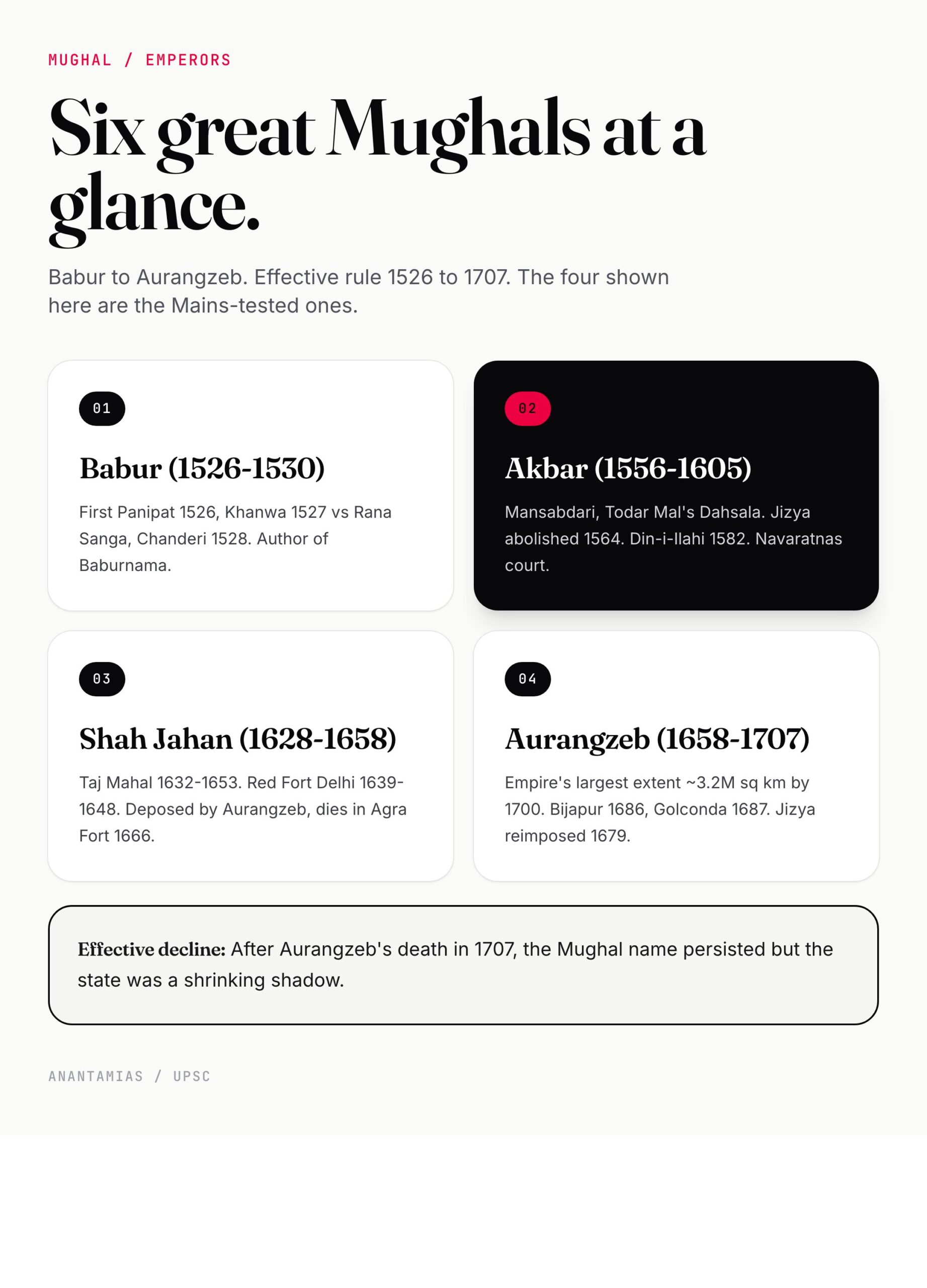
- Babur (r. 1526–1530) — founder. Battles: First Panipat (1526), Khanwa (1527 vs Rana Sanga), Chanderi (1528), Ghaghara (1529 vs Afghan-Bengal coalition). Author of Baburnama (Chagatai Turkish memoir).
- Humayun (r. 1530–1540, 1555–1556) — defeated by Sher Shah Suri at Chausa (1539) and Kanauj (1540); 15 years of exile in Persia. Recovered Delhi 1555; died 1556 falling from his library steps.
– Sher Shah Suri (r. 1540–1545) — administrative genius in the interregnum: rupiya silver coin, Grand Trunk Road improvements, Sarai system, revised zabt land revenue.
- Akbar (r. 1556–1605) — accession at 13; Bairam Khan as regent. Second Battle of Panipat (1556) vs Hemu — secured the throne. Akbar‘s achievements:
– Mansabdari system — 33 ranks, zat and sawar dual designation, separated military rank from territory. – Land revenue — Todar Mal’s Dahsala / Zabt system (1580–82); ten-year average yields. – Religion — Sulh-i-kul (peace with all); Din-i-Ilahi proclaimed 1582 — synthetic monotheism; abolished jizya (1564). – Conquests — Gujarat (1572), Bengal (1576), Kashmir (1586), Sind (1591), Kandahar (1595), Berar/Khandesh (1596–1601).
- Jahangir (r. 1605–1627) — Nur Jahan’s influence; English East India Company envoy Sir Thomas Roe (1615–18); Mewar finally submitted (Amar Singh, 1615); patron of Mughal painting.
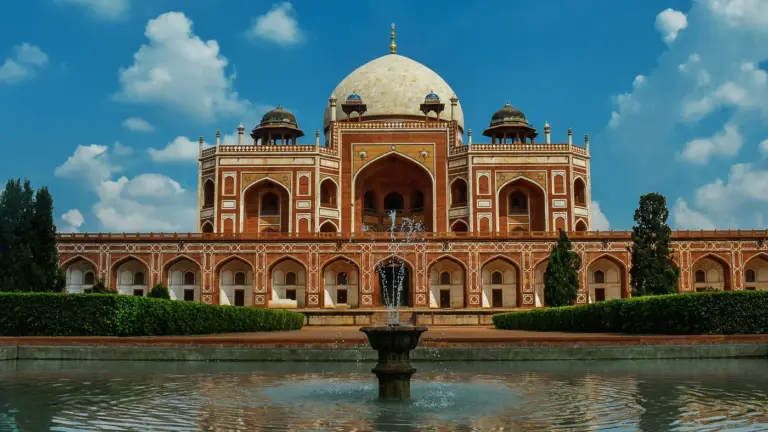
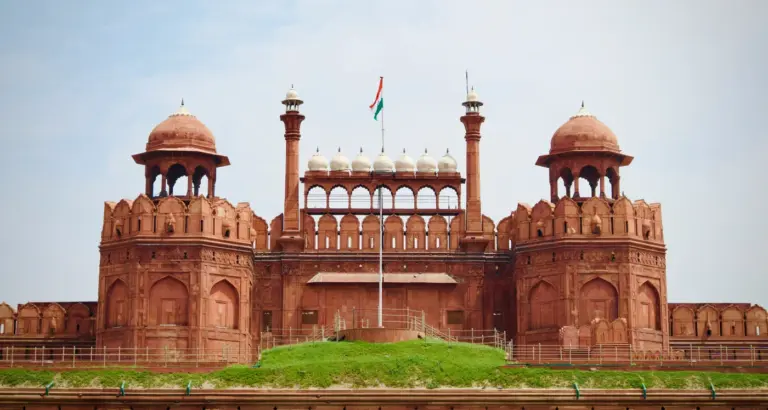
- Shah Jahan (r. 1628–1658) — Taj Mahal (1632–1653), Red Fort Delhi (1639–48); deposed by Aurangzeb in 1658, imprisoned in Agra Fort, died 1666.
- Aurangzeb (Alamgir) (r. 1658–1707) — empire’s largest territorial extent (~3.2 million sq km by 1700); annexed Bijapur (1686) and Golconda (1687); 27-year Deccan war against the Marathas drained the treasury; reimposed jizya (1679); destroyed several temples but also issued grants for many. Died at Ahmednagar 1707.
The Later Mughals (1707–1857)
After Aurangzeb, Bahadur Shah I, Jahandar Shah, Farrukhsiyar, Muhammad Shah “Rangila” (Nadir Shah’s invasion 1739), Ahmad Shah, Alamgir II, Shah Alam II (allied with Mir Qasim against EIC at Buxar 1764, Diwani 1765), Akbar II, Bahadur Shah Zafar (last Mughal, exiled to Rangoon after 1857). The empire after 1707 was a fiction maintained by stronger regional and colonial powers.
Southern India — Vijayanagara and the Bahmanis
Vijayanagara Empire (1336–1646)
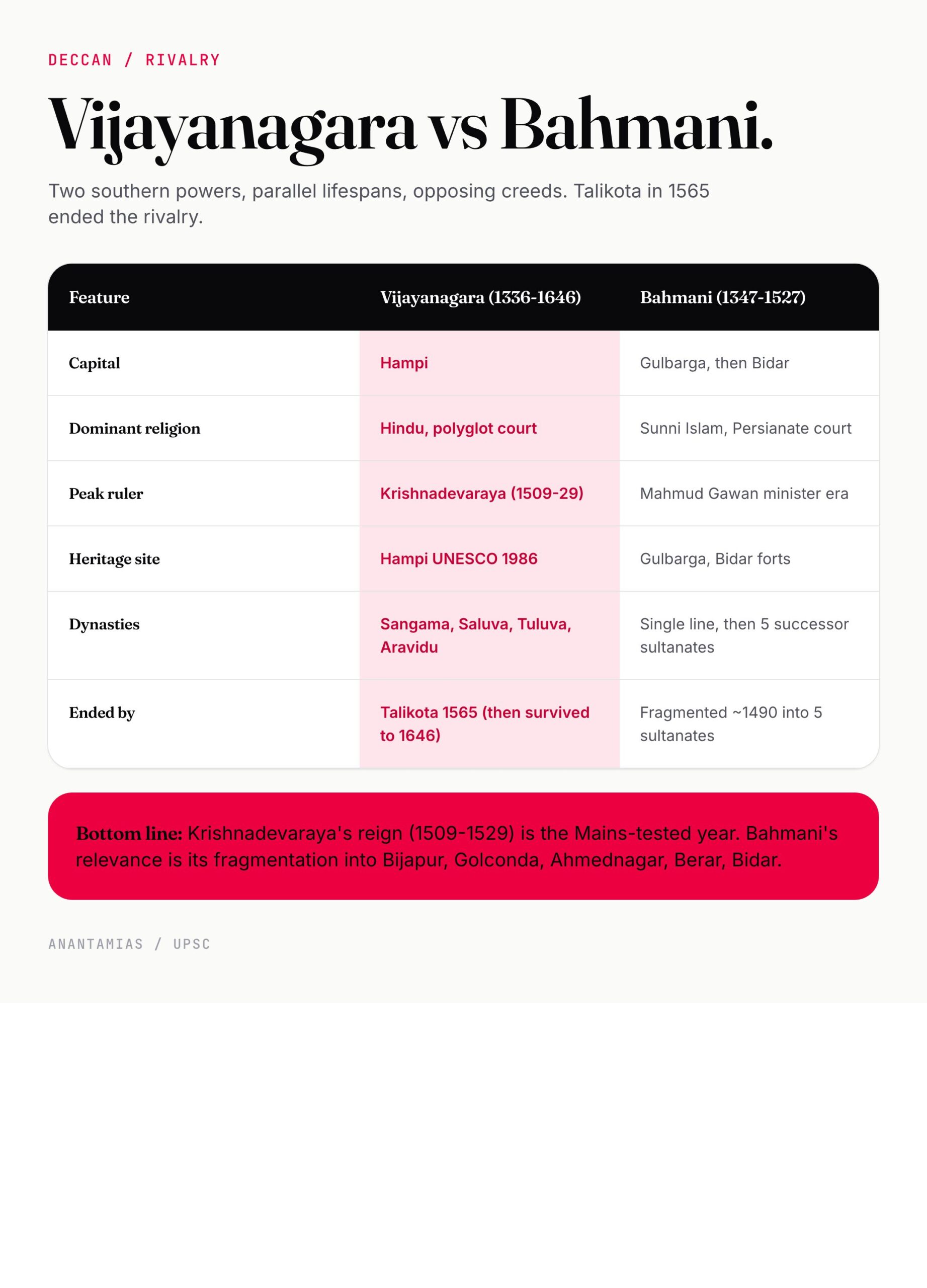
Founded 1336 by Harihara I and Bukka Raya I (the Sangama brothers), allegedly with the blessing of the sage Vidyaranya. Capital at Hampi (UNESCO 1986).
Four dynasties:
- Sangama (1336–1485) — founders; Bukka, Devaraya I, Devaraya II.
- Saluva (1485–1505) — Saluva Narasimha.
- Tuluva (1505–1570) — peak; Krishnadevaraya (r. 1509–1529) — author of Amuktamalyada (Telugu); patron of ashtadiggajas (8 Telugu poets); built temples (Hazara Rama, Vitthala in Hampi).
- Aravidu (1542–1646) — post-Talikota survival; gradual disintegration.
The Battle of Talikota (23 January 1565) saw the combined Deccan Sultanates (Bijapur, Ahmednagar, Golconda, Bidar) decisively defeat Vijayanagara under Aliya Rama Raya. The capital Hampi was destroyed.
Bahmani Sultanate (1347–1527)
Founded 1347 by Alauddin Hasan Bahman Shah (Zafar Khan) at Gulbarga; later capital at Bidar. Mahmud Gawan (Persian-origin minister, 1466–1481) reformed administration. The kingdom fragmented around 1490 into five Deccan Sultanates: Bijapur (Adil Shahi), Golconda (Qutb Shahi), Ahmednagar (Nizam Shahi), Berar (Imad Shahi), Bidar (Barid Shahi). Bijapur and Golconda fell to Aurangzeb in 1686 and 1687.
The Maratha Empire (1674–1818)
The Maratha Empire is the most under-appreciated power of late medieval India. It controlled more territory at its 1760 peak than the Mughals at theirs.
- Shivaji (r. 1674–1680) — coronation at Raigad (1674); Ashtapradhan council; swarajya concept; guerilla warfare against Aurangzeb.
- Sambhaji (r. 1680–1689) — captured and executed by Aurangzeb in 1689.
- Rajaram, Tarabai — kept resistance alive during the Mughal-Maratha war.
- Shahu (r. 1707–1749) — restored authority; rise of the Peshwas as de facto rulers.
- Bajirao I (Peshwa 1720–1740) — expansion to north India.
- Balaji Bajirao “Nanasaheb” (1740–1761) — peak; defeated catastrophically at the Third Battle of Panipat (14 January 1761) by Ahmad Shah Abdali.
- Madhavrao I (1761–1772) — recovery.
- Anglo-Maratha Wars — First (1775–82, Treaty of Salbai), Second (1803–05), Third (1817–18) ending Maratha confederacy.
The Bhakti and Sufi Movements
Politics is half the medieval story. The other half is the Bhakti and Sufi movements — devotional currents that reshaped Indian society.
Bhakti saints (12th–17th centuries)
- Ramananda (north India, 14th–15th c.) — disciple lineage included Kabir, Ravidas, Tulsidas.
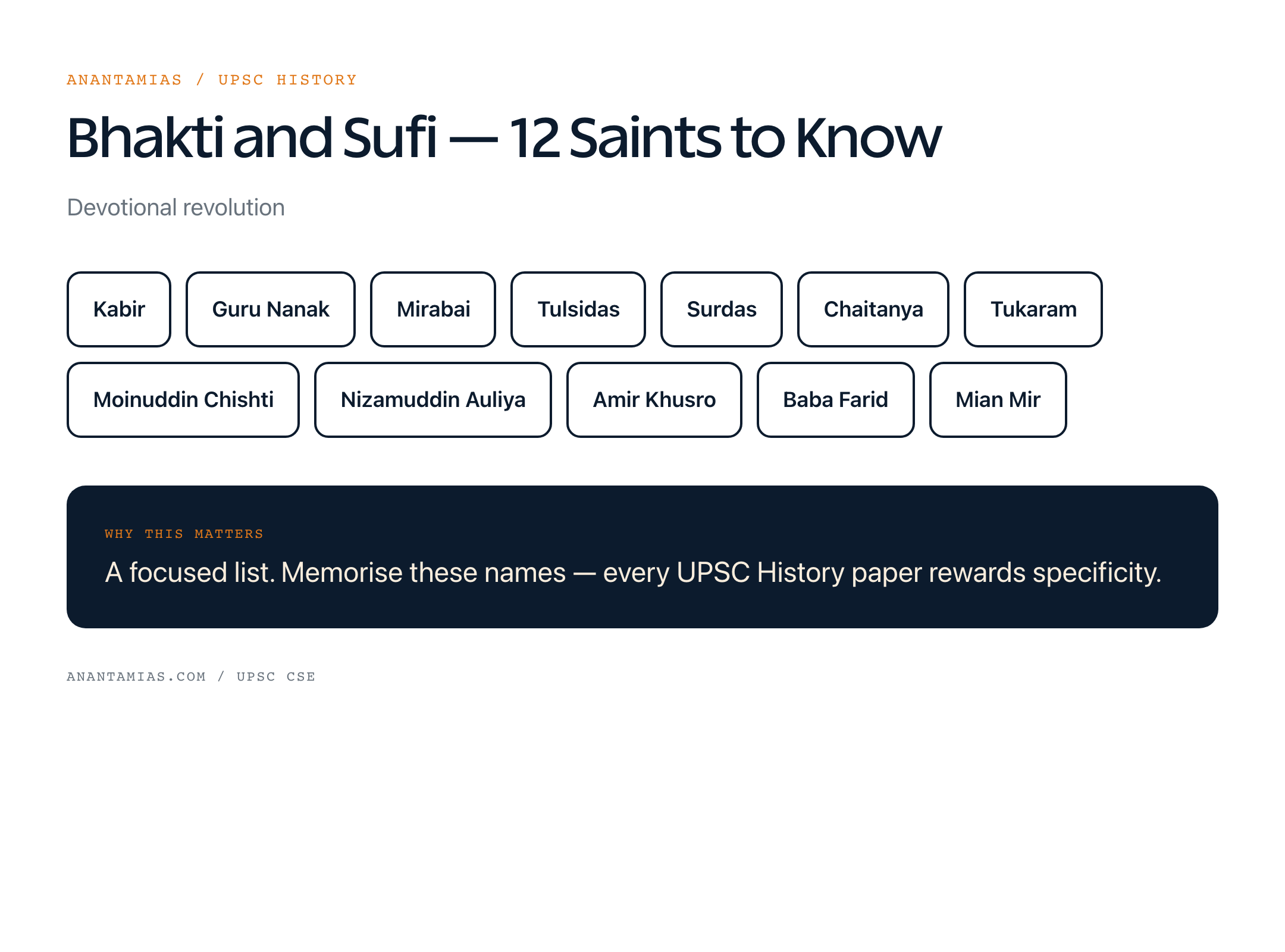
- Kabir (1440–1518) — nirguna tradition; Bijak, Sakhi; rejected caste, ritual.
- Guru Nanak (1469–1539) — founder of Sikhism; Japji Sahib; emphasized one God, equality.
- Mirabai (16th c.) — Krishna devotee; Rajasthan/Gujarat.
- Tulsidas (1532–1623) — Ramcharitmanas in Awadhi.
- Surdas (16th c.) — Krishna devotee; Sursagar.
- Chaitanya Mahaprabhu (1486–1534) — Bengal; Gaudiya Vaishnavism.
- Tukaram (1608–1650) — Maharashtra; abhangas.
- Andal, Nammalvar, Appar, Sambandar — early Tamil Alvars and Nayanars (6th–9th c.) — Bhakti’s deep roots.
Sufi orders
- Chishti — Khwaja Moinuddin Chishti (Ajmer), Bakhtiyar Kaki (Delhi), Baba Farid (Pakpattan), Nizamuddin Auliya (Delhi), Amir Khusro (poet-disciple).
- Suhrawardi — Bahauddin Zakariya (Multan).
- Naqshbandi — orthodox; came with Babur; Ahmad Sirhindi (1564–1624).
- Qadiri — Mian Mir (Lahore) — laid foundation of the Golden Temple (1588).
Architecture, art, and synthesis
Indo-Islamic architecture developed in three layers: Slave/Khilji (Qutub Minar, Alai Darwaza), Tughlaq (Tughlaqabad fort, sloping walls), Mughal (Taj Mahal, Red Fort, Fatehpur Sikri). Distinctive elements: arch, dome, pietra dura, charbagh gardens, jali screens. Hindu-Islamic synthesis is visible in Mughal painting (Jahangir period), in Krishnadevaraya’s South Indian temple expansions parallel to Vijayanagara’s Vitthala mandapa, and in vernacular bhakti poetry’s borrowing from Sufi imagery.
Common medieval India misconceptions
- “All Sultans were intolerant.” The historical record is mixed. Akbar abolished jizya; Aurangzeb reimposed it. Iltutmish gave land grants to Hindu temples; Sikandar Lodi destroyed several. Generalization fails.
- “The Mughals ruled India for 331 years.” Effective rule: 1526–1707 (181 years). Post-Aurangzeb the empire was a shrinking shadow.
- “Vijayanagara was a purely Hindu empire.” Politically yes, but it employed Muslim mercenaries, used Persianate court protocols, and had cosmopolitan trade with Bahmani territories.
- “Shivaji was anti-Muslim.” His army included Muslim commanders — Siddi Hilal, Daulat Khan; he protected mosques. The conflict was political, not religious.
- “Bhakti and Sufism were the same.” They share devotionalism but differ in theology — Bhakti’s bhakti yoga is rooted in Vedanta; Sufism’s tasawwuf in Islamic mysticism. They influenced each other; they’re not identical.
How to revise medieval Indian history in 60 minutes
- Sultanate dynasties (15 min) — 5 dynasties + 2–3 rulers each.
- Mughals (15 min) — 6 great + key administrative reforms.
- South — Vijayanagara + Bahmani (10 min) — 4 dynasties + Talikota.
- Marathas (10 min) — Shivaji to Panipat 1761.
- Bhakti-Sufi (10 min) — 12 saints + 4 Sufi orders.
Source priority: Satish Chandra — *History of Medieval India* (Orient BlackSwan Parts 1 & 2) > NCERT Old > NCERT Themes in Indian History Part II.
Why this matters for UPSC
Prelims — direct dynasty/ruler questions (asked 2018, 2021, 2023); architectural identification; coin/inscription matching. 3–5 questions per Prelims paper.
Mains GS-1 — Bhakti-Sufi society impact, Mughal administration analysis, Vijayanagara vs Mughal comparison, Maratha swarajya concept.
Optional History — full depth required.
Frequently Asked Questions
: Who founded the Delhi Sultanate?
Qutb-ud-din Aibak in 1206, founder of the Slave/Mamluk dynasty. The actual administrative consolidator was Iltutmish (r. 1210–1236).
: Why did the Vijayanagara Empire fall?
Internal court politics under Aliya Rama Raya, who alienated the Deccan Sultanates by playing them against each other. They united and crushed Vijayanagara at the Battle of Talikota (1565). The Aravidu dynasty survived in fragments till 1646.
: What was Akbar’s Din-i-Ilahi?
A syncretic spiritual order proclaimed in 1582, drawing from Islam, Hinduism, Jainism, Zoroastrianism, and Christianity. It had ~19 followers. Not a state religion. Often misunderstood as a u0022new religion.u0022
: Who was the greatest Mughal ruler?
Depends on metric. Territorial extent: Aurangzeb. Administrative innovation: Akbar. Cultural patronage: Shah Jahan. Most historians rank Akbar highest for the durability of his institutional reforms.
: What ended the Mughal Empire?
Functionally — Aurangzeb’s Deccan wars and his death (1707). Politically — Nadir Shah’s sack of Delhi (1739). Formally — the British exiling Bahadur Shah Zafar after 1857.
: How did the Marathas defeat the Mughals?
Through guerilla warfare, fort-based resistance, and decentralized command. Shivaji’s death (1680) didn’t end the resistance — Sambhaji, Rajaram, and Tarabai sustained it through Aurangzeb’s 27-year Deccan campaign.
: Who was the most influential Bhakti saint?
Argument-dependent. Kabir for cross-religious appeal; Guru Nanak for institutional legacy (Sikhism); Tulsidas for vernacular literature (Ramcharitmanas remains the most-read Hindi religious text).
Tell Google you want more of this.
Add Anantam IAS as a preferred sourceOne tap, and this site shows up more often in your own Top Stories, AI Overviews and AI Mode. Remove it any time.