NaBFID: Development Bank in India — Opportunities and Challenges (UPSC Economy)
India tried development finance institutions twice and watched them collapse. NaBFID is the third attempt to crack long-term infrastructure financing — here is how it is built, what it has done so far, and why it could still stumble.
India has tried to build a dedicated bank for infrastructure before, and it didn’t end well. The big development finance institutions of the old economy — IDBI, ICICI, IFCI — were meant to lend long and patient money to factories, power plants and roads. By the early 2000s most of them had either collapsed into commercial banks or been quietly wound down, buried under bad loans and a basic mismatch between the cheap short money they raised and the long projects they funded. For almost two decades after that, India had no specialist infrastructure lender at all.
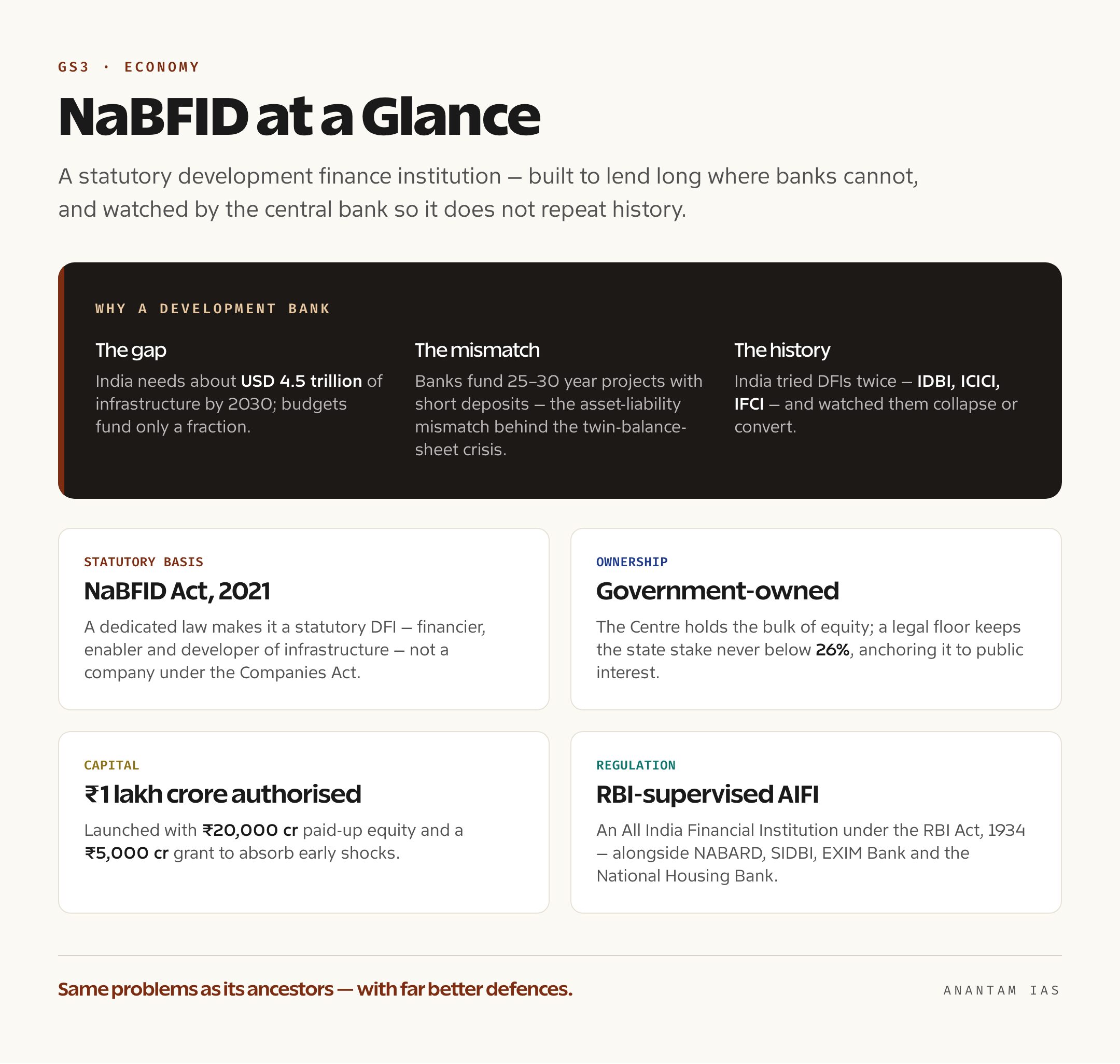
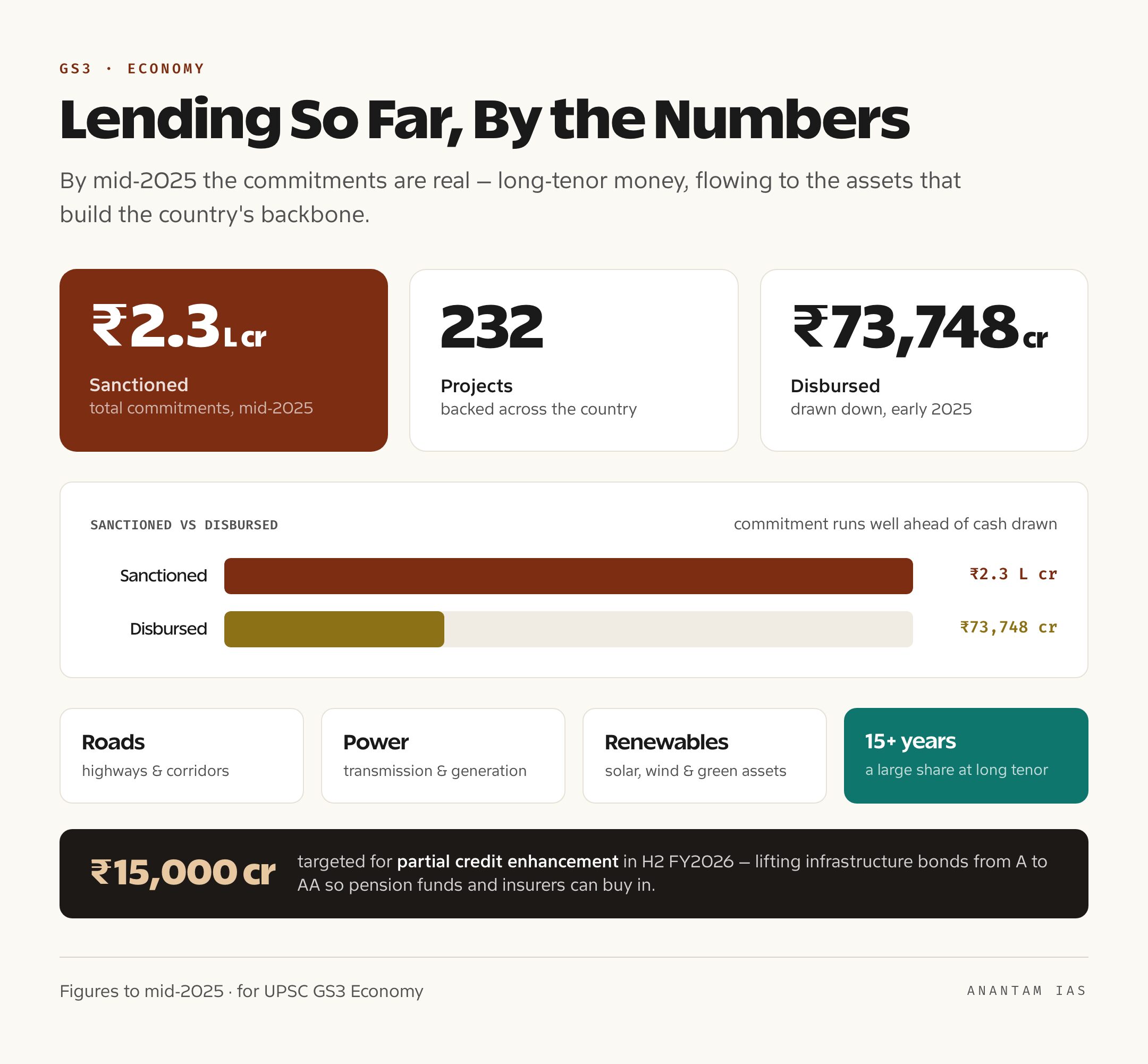
The National Bank for Financing Infrastructure and Development, or NaBFID, is the country’s third attempt to get this right. Set up under the NaBFID Act, 2021 as a statutory development finance institution, it exists to do the one thing commercial banks are structurally bad at — supplying 15-to-30-year money for roads, ports, transmission lines and renewable energy. And by mid-2025 it had already sanctioned more than Rs 2.3 lakh crore to over 200 projects. So the question for an aspirant isn’t whether NaBFID is ambitious. It’s whether it can avoid repeating the mistakes that killed its predecessors.
What NaBFID Actually Is
Start with the plain definition, because the exam rewards precision here. NaBFID is a development finance institution — a DFI — which is simply a specialist lender that provides long-tenor, often higher-risk finance to sectors the ordinary banking system underserves. Where a commercial bank chases short-term, low-risk lending it can match against household deposits, a DFI deliberately takes on the long, lumpy, slow-to-pay projects that build a country’s physical backbone.
It was created by a dedicated law, the NaBFID Act, 2021, which means it is a statutory body rather than a company floated under the Companies Act. That distinction matters. The Act gives NaBFID a clear mandate as financier, enabler and developer of infrastructure, lets it raise money in rupees and foreign currency, and surrounds its officers with legal protections so they can take genuine credit decisions without fearing every routine commercial risk will later be treated as a scam. The drafters had clearly read the obituaries of the earlier DFIs.
NaBFID is government-owned. The Centre holds the bulk of its equity, and the law caps the combined shareholding of the government and notified multilateral or sovereign institutions so that the state can never fall below 26% — a floor designed to keep it anchored to public-interest infrastructure rather than drifting into pure profit-seeking. Its first chairperson is K.V. Kamath, the former ICICI and New Development Bank chief, with Rajkiran Rai G as managing director — a deliberate pairing of a marquee name for credibility with a career banker for execution.
Its Mandate, Structure and Regulation
So how is it built, and who watches it? The architecture is meant to fix the two flaws that sank the old DFIs: thin capital and weak oversight.
On capital, NaBFID was launched with an authorised capital of Rs 1 lakh crore. The government injected Rs 20,000 crore as paid-up equity and added a Rs 5,000 crore grant to absorb early shocks, giving it a cushion most lenders would envy at birth. That equity base lets it borrow at scale — it has been raising tens of thousands of crores a year from the bond market — and on-lend for the long tenors that infrastructure demands. The twin development and financing objectives are written into the law: it is expected not just to lend, but to deepen the bond and derivatives markets that infrastructure finance needs to mature.
On oversight, the regulatory treatment has been clarified in NaBFID’s favour. The Reserve Bank of India regulates and supervises it as an All India Financial Institution, or AIFI, under the RBI Act, 1934 — the same prudential family as NABARD, SIDBI, EXIM Bank and the National Housing Bank. Through 2024 and 2025 the RBI went further, confirming through its master directions that NaBFID can participate in repo and credit-default-swap markets as an AIFI, and bringing it under the new prudential and outsourcing norms for these institutions. So it sits inside a proper regulatory perimeter, supervised by the central bank, with Basel-style capital discipline — not floating free as a politically directed lending arm. That is the structural answer to the governance failures of the past.
Why NaBFID Matters for the Indian Economy
Now the significance, which is really a story about a financing gap. India’s infrastructure ambition is enormous and well documented: the National Infrastructure Pipeline pencilled in over Rs 111 lakh crore of investment, and longer-range estimates put the country’s infrastructure spending need at around USD 4.5 trillion by 2030. The government’s own budgets can fund only a fraction of that directly; the bulk has to come from debt raised in bond markets, banks and non-bank lenders. That is the hole NaBFID exists to help fill.
It matters for four concrete reasons. First, it supplies genuinely long-tenor money — of its sanctions, a large share carries tenors above 15 years, which is exactly the maturity profile a 30-year toll road or transmission asset needs and a deposit-funded bank can rarely offer. Second, it eases the asset-liability mismatch that has repeatedly damaged bank balance sheets: when banks fund 25-year projects with one-year deposits, they invite the kind of stress that produced India’s twin-balance-sheet crisis. NaBFID, borrowing long itself, is built to absorb that maturity risk.
Third, it is meant to crowd in private capital, not crowd it out. This is where its newest tool comes in. In the Union Budget 2025-26 the government tasked NaBFID with running a partial credit enhancement facility, which it launched in September 2025 — the first major facility of its kind under the RBI’s August 2025 guidelines. The idea is elegant: NaBFID backstops part of an infrastructure company’s bond, lifting its rating from, say, single-A to double-A, which lets pension funds and insurers — who are barred from buying lower-rated paper — finally invest. NaBFID is targeting credit enhancement for roughly Rs 15,000 crore of bonds in the second half of 2025-26 alone, mostly in renewables and roads. Fourth, and relatedly, it plugs into the wider resource-mobilisation push, including the asset-monetisation drive: in 2025 the Finance Minister launched the National Monetisation Pipeline 2.0, targeting around Rs 16.72 lakh crore of asset-monetisation potential between FY2026 and FY2030, recycling capital that institutions like NaBFID can help redeploy.
The Challenges NaBFID Still Faces
But the case for NaBFID is not the same as a guarantee it will work, and the history here is sobering. The most honest framing is that the institution faces the exact problems that destroyed its ancestors, only with better defences.
The first and deepest challenge is the shallow corporate bond market. NaBFID can only become a true catalyst if it raises long-term funds cheaply and steadily — yet India’s bond market is thin below the top rating grades, dominated by a handful of AAA issuers, and short on the patient buyers (deep pension and insurance pools) that fund infrastructure in advanced economies. The whole partial-credit-enhancement experiment is an attempt to grow that market; if it doesn’t take off at scale, NaBFID’s reach stays limited. Second, credit enhancement itself concentrates risk: by guaranteeing slices of many bonds, NaBFID is warehousing infrastructure risk on its own balance sheet, and a cluster of stalled projects could turn that into the very bad-loan pile that buried IDBI and IFCI.
Third is project-appraisal capacity. Infrastructure lending fails not in spreadsheets but in execution — land acquisition delays, clearance bottlenecks, demand that never materialises. The old DFIs were accused of weak, sometimes politically nudged, appraisal; NaBFID needs world-class independent appraisal and the institutional spine to say no to a marginal project, even a politically favoured one. Fourth is the crowding-in question: if NaBFID lends on terms private financiers can’t match, it may simply substitute for private capital rather than mobilise it, leaving the market no deeper than before. And fifth, looming over all of it, is the governance test. Every Indian DFI began with good intentions; what corroded them was directed lending, ever-greening and the absence of an exit when projects soured. NaBFID’s legal protections and RBI supervision are designed to prevent that, but design is not destiny.
The Way Forward
So what would let NaBFID succeed where the others failed? The answer is less about NaBFID alone and more about the ecosystem around it.
It needs a deeper, broader debt market, which means steady reforms to let pension funds, insurers and provident funds hold longer-dated and credit-enhanced infrastructure paper, and a secondary market liquid enough that they can exit. The partial-credit-enhancement facility should be scaled deliberately, with strong underwriting standards, so it grows the bond market without quietly transferring project risk onto the public balance sheet. NaBFID should guard its independence fiercely — professional management, arm’s-length boards, transparent disclosure and genuine audit — because the moment lending becomes directed, the institution is on the road its predecessors travelled. It should co-finance rather than monopolise, partnering with the National Investment and Infrastructure Fund, multilateral lenders and private banks so that public capital de-risks projects and pulls private money in behind it. And it should build appraisal and risk-management capacity that matches the best in the world, with ring-fenced project structures and serious climate and ESG screening, so that the green and social infrastructure India needs gets funded on its merits. Get that ecosystem right and NaBFID becomes the patient-capital anchor a USD 5-trillion economy requires. Get it wrong, and it becomes the fourth name on a list India has already written three times.
For Your Mains Answer
NaBFID sits squarely in GS Paper III — under mobilisation of resources, infrastructure, investment models, banking-sector issues and inclusive growth. It is also strong interview and Essay material on themes of financing development, the role of the state in capital markets, and learning from institutional failure. Treat it as a case study in getting institutional design right, not as a list of features to memorise.
How to Build the Answer
Open with the problem, not the institution. State the infrastructure financing gap (the NIP’s Rs 111 lakh crore, the USD 4.5 trillion by 2030) and the structural reason banks can’t fill it — the asset-liability mismatch. Then introduce NaBFID as the designed solution: statutory DFI, RBI-regulated AIFI, well-capitalised. Move to what it has done (sanctions over Rs 2.3 lakh crore, the partial-credit-enhancement facility), then to the challenges, anchored explicitly in the failure of the old DFIs. Close on the ecosystem reforms. That arc — gap, design, performance, risk, way forward — fits almost any NaBFID question.
Common Mistakes to Avoid
Don’t confuse NaBFID with a commercial bank or with NABARD; name it precisely as a statutory DFI regulated as an AIFI. Don’t recite stale figures — the sanction number has moved fast, so use “over Rs 2.3 lakh crore by mid-2025” rather than the older Rs 1 lakh crore line. Don’t present it as a guaranteed success; the examiner is testing whether you can see the risks. And don’t skip the historical context — an answer that ignores IDBI and IFCI misses the whole point of why NaBFID is built the way it is.
A Compact Answer Spine
Infrastructure financing gap (NIP Rs 111 lakh crore; banks limited by asset-liability mismatch) → past DFIs (IDBI, ICICI, IFCI) failed on bad loans and mismatch → NaBFID Act 2021 creates a statutory, RBI-regulated DFI with Rs 1 lakh crore authorised capital → performance: over Rs 2.3 lakh crore sanctioned, partial credit enhancement launched 2025 → challenges: shallow bond market, risk concentration, appraisal capacity, crowding-in, governance → way forward: deepen debt markets, scale PCE prudently, protect autonomy, co-finance, world-class appraisal.
Diagram or Flowchart Idea
Draw a simple funnel: at the top, “Long-term savings” (pension funds, insurers, sovereign and multilateral capital, bonds); in the middle, “NaBFID” as the conduit, with a side-box labelled “Partial Credit Enhancement (A → AA)”; at the bottom, “Infrastructure” (roads, power, renewables, ports, metros). One clean intermediation diagram shows the catalytic role faster than a paragraph.
A Balanced-Conclusion Line
Something like: “NaBFID’s promise lies not in its capital but in its institutional design — whether India can finally pair patient public money with arm’s-length governance, the discipline its earlier development banks fatally lacked.”
How to Use Data Without Cramming
Carry three or four anchors, not a spreadsheet: over Rs 2.3 lakh crore sanctioned across 200-plus projects with disbursements near Rs 74,000 crore; Rs 1 lakh crore authorised capital; the NIP’s Rs 111 lakh crore and the USD 4.5 trillion-by-2030 gap; and one named reform — the 2025 partial credit enhancement facility. Deploy them as evidence inside your argument, not as a separate “facts” section.
FAQ
What is NaBFID and when was it set up? NaBFID — the National Bank for Financing Infrastructure and Development — is a statutory development finance institution created under the NaBFID Act, 2021 to provide long-term financing for India’s infrastructure. It is government-owned and acts as financier, enabler and developer of infrastructure projects.
How is NaBFID regulated? The Reserve Bank of India regulates and supervises NaBFID as an All India Financial Institution under the RBI Act, 1934 — the same regulatory category as NABARD, SIDBI, EXIM Bank and the National Housing Bank — applying Basel-style prudential and capital norms.
How much has NaBFID lent so far? By mid-2025 NaBFID had sanctioned over Rs 2.3 lakh crore across more than 230 infrastructure projects, with disbursements of roughly Rs 74,000 crore as of early 2025. Its lending has been concentrated in roads, power and renewable energy, much of it at tenors above 15 years.
Why did India need a new DFI when earlier ones failed? Earlier development banks like IDBI, ICICI and IFCI either collapsed under bad loans or converted into commercial banks, and ordinary banks can’t safely fund 25-to-30-year projects with short-term deposits — an asset-liability mismatch. NaBFID is designed to supply that patient, long-tenor capital with stronger capitalisation, RBI oversight and legal protections for its officers.
Practice Questions
Prelims MCQs
- With reference to the National Bank for Financing Infrastructure and Development (NaBFID), consider its legal status.
Which one of the following is correct?
(a) It is a non-statutory body set up under the Companies Act, 2013
(b) It is a statutory body established under the NaBFID Act, 2021
(c) It is a constitutional body under Article 280
(d) It is a wholly RBI-owned subsidiary.
Answer: (b) — NaBFID was created by a dedicated law, the NaBFID Act, 2021, making it a statutory development finance institution. - NaBFID is regulated and supervised by which authority, and in what category?
(a) SEBI, as a listed NBFC
(b) The Ministry of Finance, as a public-sector undertaking
(c) The Reserve Bank of India, as an All India Financial Institution
(d) IRDAI, as an insurer.
Answer: (c) — The RBI supervises NaBFID as an All India Financial Institution under the RBI Act, 1934, alongside NABARD, SIDBI, EXIM Bank and the National Housing Bank. - Consider the following institutions:
1. IFCI 2. ICICI 3. NABARD 4. NaBFID. Which of these are or were development finance institutions in India?
(a) 1 and 2 only
(b) 1, 3 and 4 only
(c) 2 and 4 only
(d) 1, 2, 3 and 4.
Answer: (d) — All four are or were DFIs: IFCI was India’s first (1948), ICICI was an early industrial DFI, NABARD serves rural and agricultural development, and NaBFID is the new infrastructure DFI. - The “partial credit enhancement” facility associated with NaBFID is primarily intended to:
(a) directly subsidise toll charges on highways
(b) raise the credit rating of infrastructure companies’ bonds so institutional investors can buy them
(c) provide foreign-currency hedging to exporters
(d) replace the government’s budgetary capital expenditure.
Answer: (b) — Partial credit enhancement lifts a bond’s rating (for example from A to AA), letting pension funds and insurers invest and deepening the corporate bond market. - The “asset-liability mismatch” cited as a reason for creating NaBFID refers to:
(a) banks lending long-tenor infrastructure loans while funding them with short-term deposits
(b) a mismatch between a bank’s foreign and domestic assets
(c) the gap between authorised and paid-up capital
(d) differences between book value and market value of shares.
Answer: (a) — Funding 25-to-30-year projects with short-term deposits creates a maturity mismatch that has repeatedly stressed bank balance sheets, which a long-borrowing DFI is meant to avoid.
Mains Practice Questions
- “India’s experiment with development finance institutions has failed twice.” Examine the reasons for the decline of earlier DFIs and discuss how NaBFID’s design seeks to avoid those pitfalls. (15 marks, 250 words)
- Bridging India’s infrastructure financing gap requires patient, long-tenor capital that the commercial banking system cannot easily supply. Critically evaluate the role NaBFID can play in mobilising such resources. (15 marks, 250 words)
- Discuss how partial credit enhancement and a deeper corporate bond market are central to NaBFID’s success, and analyse the risks this model concentrates on its balance sheet. (15 marks, 250 words)
- “Institutional design, not capital, will decide whether NaBFID succeeds.” Comment, with reference to governance, autonomy and project-appraisal capacity. (10 marks, 150 words)
- Examine the role of NaBFID within India’s broader resource-mobilisation strategy for infrastructure, including the National Infrastructure Pipeline and asset monetisation. (10 marks, 150 words)