Namdapha Flying Squirrel: India’s Rarest Mammal Hidden in Arunachal Pradesh
The Namdapha flying squirrel is endemic to a single valley in Arunachal Pradesh and listed Critically Endangered by IUCN. Habitat, traits, threats, and UPSC pointers.
In the dense canopy of Namdapha National Park, where the Eastern Himalayas meet the Patkai hills and rainfall crosses three thousand millimetres a year, lives one of the rarest mammals on Earth. The Namdapha flying squirrel, Biswamoyopterus biswasi, has been seen alive only a handful of times since it was first described in 1981. The species is endemic to a single valley inside the park, restricted to a specific stretch of tall jungle ironwood trees, and listed as Critically Endangered on the IUCN Red List. For decades, scientists have debated whether a viable population still exists or whether what we are watching is the slow, silent disappearance of a species that we barely had time to study.
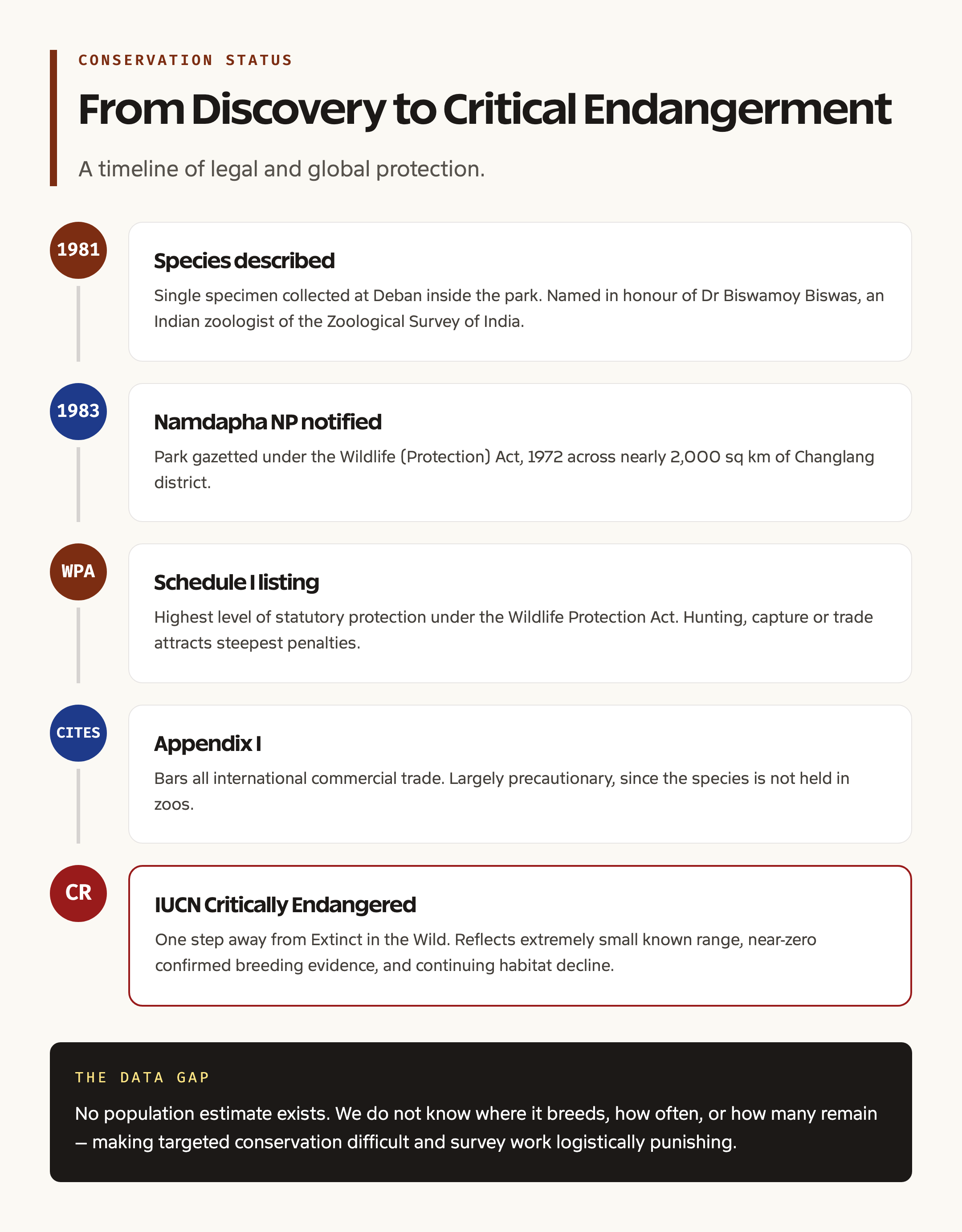
The squirrel was first described from a single specimen collected at Deban inside the park, named in honour of Dr. Biswamoy Biswas, a renowned Indian zoologist. No reliable population estimate exists. Estimates from camera-trap and field surveys suggest the global population may be in the low double digits or even fewer, all confined to a few square kilometres of unbroken canopy. The species has not been seen in any zoo, has never been bred in captivity, and is listed on Appendix I of CITES, which bars commercial trade entirely.
For UPSC, the Namdapha flying squirrel is a high-leverage species topic. It links a national park, a biodiversity hotspot, the Wildlife Protection Act, the IUCN classification system, CITES, and the larger story of how India catalogues and protects its small, charismatic but easily overlooked mammals. This guide expands every dimension of the species and its policy framework.
Quick Facts
- Scientific name: Biswamoyopterus biswasi
- Common name: Namdapha flying squirrel
- Family: Sciuridae (squirrel family); subfamily Pteromyinae (flying squirrels)
- First described: 1981, by S. Saha, based on a specimen from Deban
- Endemic to: A single valley inside Namdapha National Park, Arunachal Pradesh
- Habitat: Tall Mesua ferrea (jungle ironwood) trees in tropical rainforest
- Activity pattern: Strictly nocturnal
- Lifestyle: Arboreal; restricted to upper canopy
- Gliding aid: Patagium, a furry skin membrane between fore and hind limbs
- IUCN Red List: Critically Endangered (CR)
- Wildlife Protection Act, 1972: Schedule I (highest level of protection)
- CITES: Appendix I (no commercial trade)
- Global population: Estimated extremely low; no firm number available
- Diet: Likely leaves, fruits, and bark of canopy trees, similar to other flying squirrels
What Is the Namdapha Flying Squirrel
The Namdapha flying squirrel is a medium-large gliding rodent that occupies the highest layers of evergreen rainforest in the Eastern Himalayan biodiversity hotspot. It is one of three species in the genus Biswamoyopterus, the others being the Laotian giant flying squirrel and the Mount Gaoligong flying squirrel of southwestern China. All three are extremely rare and known from a tiny number of specimens.
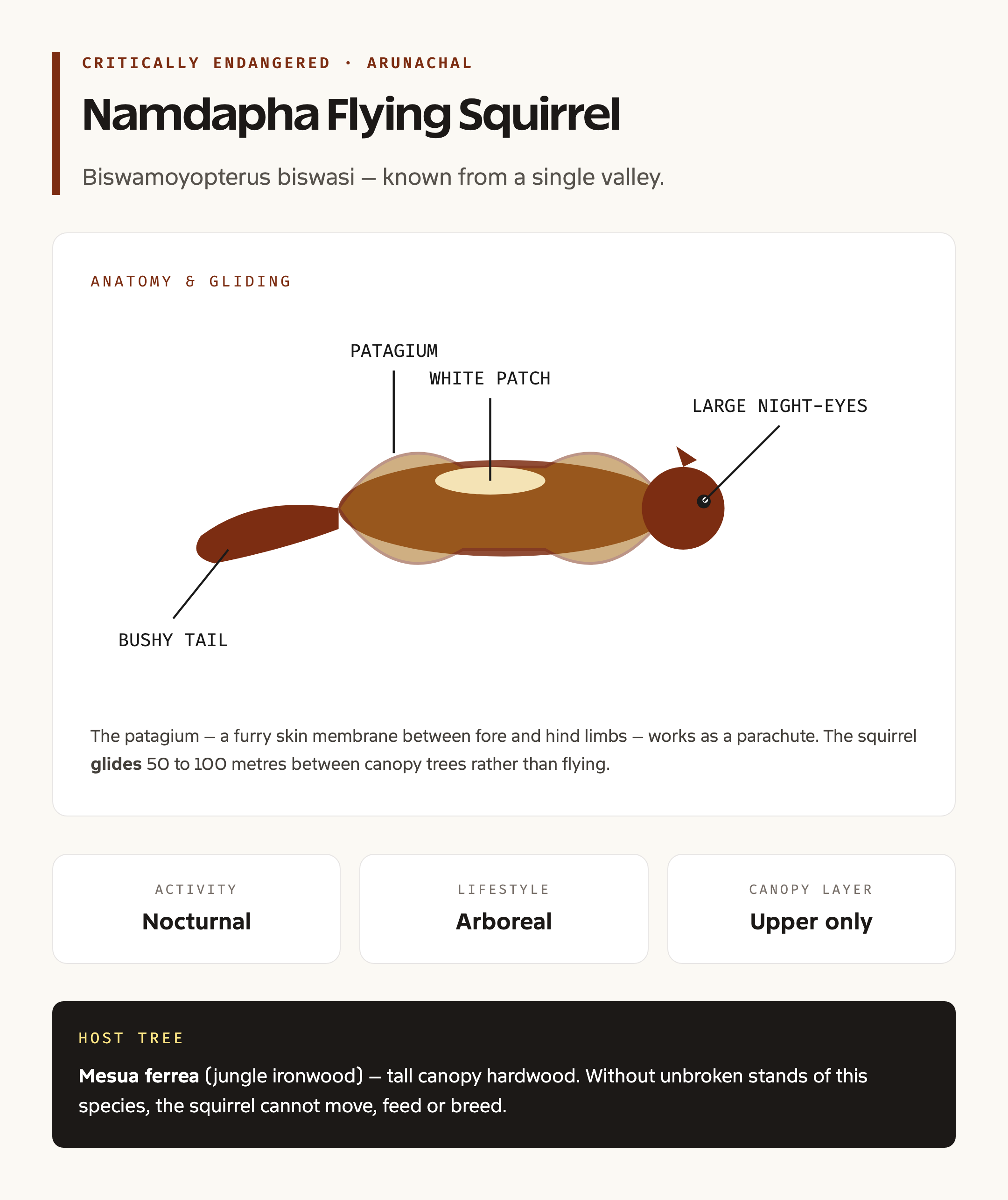
Adults carry a thick reddish-grizzled fur coat with a distinct white patch on the upper back, large dark eyes adapted to nocturnal vision, and a long bushy tail used as a rudder during glides. The defining feature is the patagium, a furred skin membrane stretched between wrist and ankle on each side of the body, which functions like a parachute when the squirrel launches from a high branch. A glide of 50 to 100 metres is well within range for related species in the genus, and the Namdapha flying squirrel is presumed to be capable of similar feats given its body proportions.
It does not actually fly in the bird sense; it glides. Wing-loading and tail steering allow it to move between widely spaced canopy trees without descending to the ground, where ground-based predators like clouded leopards, civets, and large snakes wait. Restriction to the upper canopy is not a quirk of behaviour, it is a survival strategy.
Background and Historical Context
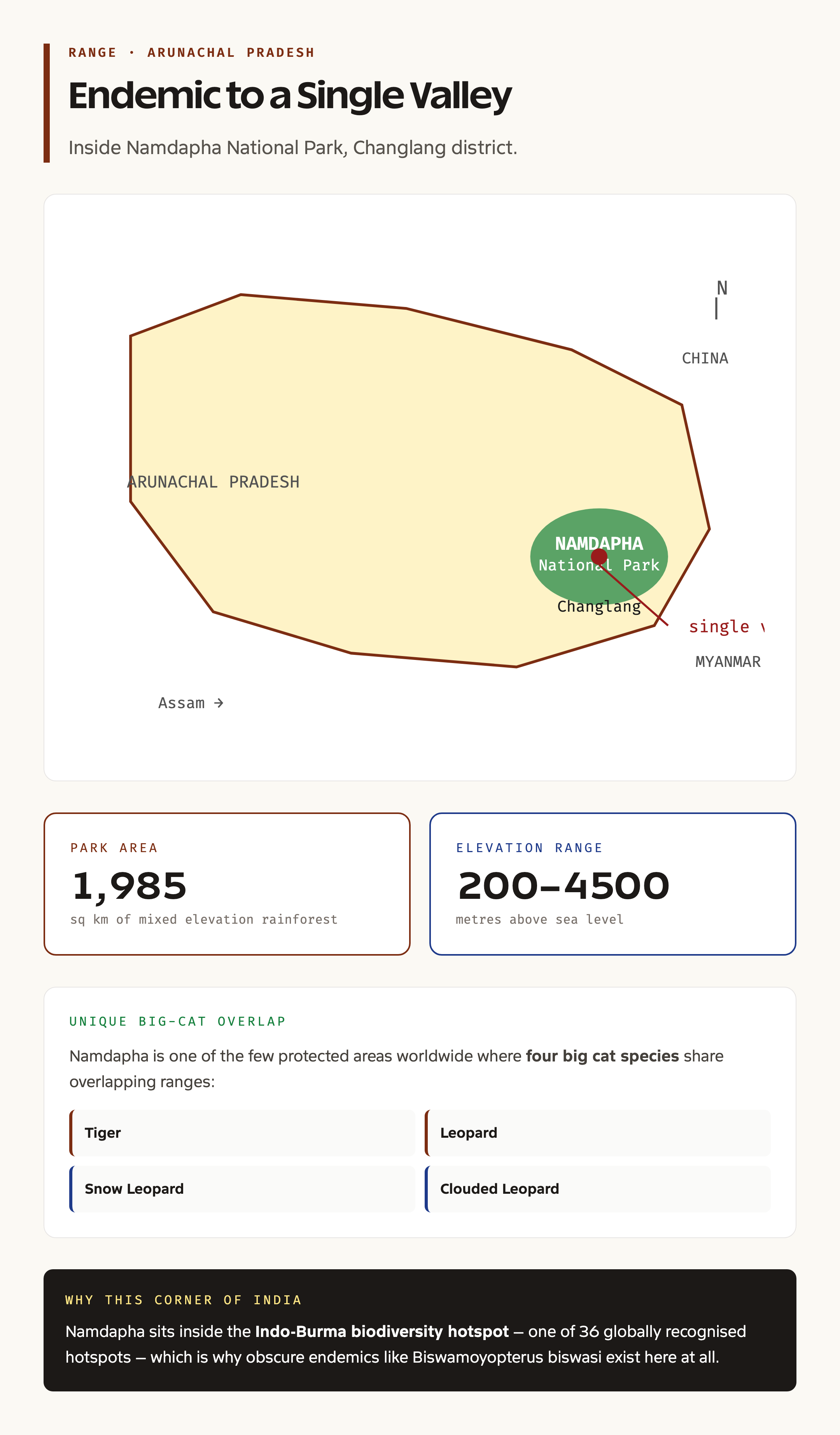
Namdapha National Park itself is a story of late twentieth-century conservation. Notified in 1983 and located in Changlang district of Arunachal Pradesh, it covers nearly two thousand square kilometres of mixed elevation rainforest from 200 metres up to over 4500 metres. It is one of the few protected areas in the world where four big cat species, the tiger, leopard, snow leopard, and clouded leopard, occur in overlapping ranges. The park sits inside the Indo-Burma biodiversity hotspot, which is why obscure endemic species like Biswamoyopterus biswasi exist here at all.
The flying squirrel’s discovery came two years before park notification. Surveyors collecting at Deban, on the Noa Dihing river inside the park area, recovered a single specimen that did not match any known species. Dr. Biswamoy Biswas, a zoologist of the Zoological Survey of India and lifelong student of Indian mammals, was honoured by having the genus and species named after him. The original holotype is preserved at the Zoological Survey of India in Kolkata.
Confirmed sightings since 1981 are rare. A few specimens have surfaced over the decades, with researchers reporting extreme difficulty in locating live animals despite repeated surveys. Camera traps placed in the canopy have occasionally returned blurred images that may or may not represent the species. The lack of confirmed encounters has driven the IUCN classification to Critically Endangered and triggered a steady stream of expert calls for intensive survey work.
Key Provisions: Legal and Conservation Architecture
Several layers of legal and institutional protection apply to the species.
The Wildlife (Protection) Act, 1972 places the Namdapha flying squirrel on Schedule I, which provides the highest level of statutory protection in India. Any hunting, capture, or trade attracts the steepest penalties under the Act. Habitat alteration inside the national park is similarly barred under the same legislation, and the broader environmental laws in India framework applies via the Forest Conservation Act, 1980 and the Environment Protection Act, 1986.
The IUCN Red List places the species in the Critically Endangered category, the last step before Extinct in the Wild. The classification reflects both the extremely small known range, restricted to a single valley, and the absence of evidence for a stable breeding population.
CITES Appendix I bars any international commercial trade in the species. Because the species is not held in zoos and cannot be legally traded, the Appendix I listing is largely a precautionary measure, but it matters for international monitoring.
Namdapha National Park itself, gazetted under the Wildlife Protection Act, provides the spatial protection. The Park is classified as a Tiger Reserve under Project Tiger, which adds an additional management layer through the National Tiger Conservation Authority. While that scheme is built around the tiger, its anti-poaching infrastructure benefits all species inside park boundaries, including the flying squirrel.
The species is a flagship case for Critically Endangered Species recovery programmes funded under the Centrally Sponsored Scheme on Integrated Development of Wildlife Habitats (IDWH).
Why It Matters
A species known from one valley with no confirmed live population looks marginal to a casual observer. Three reasons explain why it sits on every Indian conservation priority list.
It is a flagship for Eastern Himalayan biodiversity. The species’ continued existence is direct evidence that Namdapha’s canopy remains intact enough to host a near-mythical animal. Its disappearance would be a structural signal that something has cracked in the park’s evergreen forest layer.
It is an indicator of canopy connectivity. Flying squirrels need long stretches of unbroken upper canopy because their gliding range depends on the gaps between launch and landing trees. Logging or selective tree removal that fragments the canopy makes the habitat instantly unusable for the species, even if individual ironwood trees remain. The squirrel is therefore a sensitive sentinel of forest fragmentation in a way that ground-based species are not.
It is an irreplaceable evolutionary lineage. The genus Biswamoyopterus is small and morphologically distinct from other flying squirrels. Losing the Namdapha species would leave a permanent gap in the genus and the broader squirrel family tree. Linked topics include biodiversity in India, the Wildlife Protection Act, 1972, and the network of national parks of India.
Detailed Analysis: Threats Facing the Species
Several pressures combine to make the Namdapha flying squirrel one of India’s most fragile mammals.
Habitat loss is the headline threat. Even though Namdapha National Park is legally protected, its boundary has historically been subject to encroachment by Lisu and Chakma communities for shifting cultivation, settlement, and small-scale logging. Each loss of mature Mesua ferrea trees reduces the species’ usable habitat irreversibly because these trees take centuries to mature.
Hunting pressure is real, even though the species is rarely targeted by name. Local hunters opportunistically take any large mammal that appears in the canopy, and the squirrel’s slow reproduction makes any offtake unsustainable.
Climate change affects the entire Eastern Himalayan rainforest belt. Shifts in precipitation timing, temperature, and storm frequency alter flowering and fruiting cycles of canopy trees, which in turn change food availability for canopy mammals. The species’ tight habitat specialisation gives it almost no buffer against ecological change.
Ecological data gaps are themselves a threat. We do not know where the species breeds, how often, what size of home range each individual needs, or how many actually exist. Conservation actions in the absence of such data can only be precautionary, not targeted.
Forest road construction and tourism expansion in and around Namdapha need careful management. Even small-scale infrastructure can fragment the canopy, similar to the way tiger reserves in India have struggled with road and corridor pressures.
Comparative Snapshot: Indian Flying Squirrels
India hosts roughly a dozen flying squirrel species across diverse habitats. The Indian giant flying squirrel (Petaurista philippensis) is the most widespread and best known, found across peninsular forests. The red giant flying squirrel (Petaurista petaurista) inhabits the Himalayas. The Travancore flying squirrel is restricted to the Western Ghats. The hairy-footed flying squirrel and small Kashmir flying squirrel cover the high-altitude north.
Among all of these, the Namdapha flying squirrel is the rarest, the most range-restricted, and the only one in its specific genus. The closest taxonomic relatives, the Laotian and Gaoligong species, are found hundreds of kilometres away in Southeast Asia and southwestern China respectively. The Namdapha species’ isolation in a single Indian valley reflects an old biogeographic split that conservation cannot recreate if the species is lost.
Challenges in Conservation
The Namdapha flying squirrel exposes how hard it is to save a species we cannot easily find.
Survey logistics are punishing. Namdapha is a remote park with thick rainforest, leeches, monsoon mud, and limited road access. Reaching the core valley requires multi-day treks. Conducting nocturnal canopy surveys at the height the squirrel inhabits demands specialist climbing teams and infrared equipment.
Funding cycles do not match the work. Most research grants run for two to three years, while a project to confirm and study the species needs at least a decade of patient field effort across seasons.
Captive breeding is not an option for a species whose biology, diet, and reproductive cycle remain unknown. Even if individuals were captured, the risk of losing them in an unsuited captive environment is extreme.
Local engagement matters. The Lisu, Chakma, and Singpho communities living around Namdapha have to be partners, not adversaries, in any conservation effort. Models from FRA-aligned community-led management offer some templates, similar to forest community engagement under the broader environmental laws in India framework.
Prelims Pointers
- Scientific name: Biswamoyopterus biswasi
- Family: Sciuridae; subfamily Pteromyinae
- Endemic to a single valley inside Namdapha National Park, Arunachal Pradesh
- Inhabits Mesua ferrea (jungle ironwood) trees in upper canopy
- Strictly nocturnal and arboreal
- Has a furry membrane called Patagium for gliding
- IUCN Red List: Critically Endangered
- Wildlife Protection Act, 1972: Schedule I
- CITES: Appendix I
- Named in honour of Indian zoologist Dr. Biswamoy Biswas
- First described in 1981
- Namdapha National Park is in Changlang district of Arunachal Pradesh
- The Park hosts four big cats: tiger, leopard, snow leopard, clouded leopard
- Genus Biswamoyopterus contains three species, two of which are outside India
Mains Practice Questions
- The Namdapha flying squirrel is a Critically Endangered species known only from a single valley. Critically examine the institutional and ecological challenges of conserving range-restricted endemic mammals in India. (250 words)
- India’s protected area network is structured around flagship species but often misses small endemic mammals. Discuss with reference to the Namdapha flying squirrel and suggest a framework for non-flagship species protection. (250 words)
- Discuss how canopy connectivity in tropical rainforests affects the survival of arboreal mammals. Use the Namdapha flying squirrel as a case study. (150 words)
Way Forward
A targeted, multi-decade plan would change the species’ fate.
A dedicated species recovery project under the Critically Endangered Species framework would unlock funding certainty and bring the National Tiger Conservation Authority’s anti-poaching machinery into closer alignment with squirrel conservation.
Long-term canopy survey infrastructure including permanent canopy walkways, tree-mounted infrared camera arrays, and trained climbing teams would dramatically improve detection rates. The model is similar to canopy stations now operated in some Western Ghats forests.
Community partnership with Lisu, Chakma, and Singpho settlements is non-negotiable. Conservation agreements that compensate communities for protecting specific tree clusters and reporting sightings would convert local knowledge into a survey asset rather than treating local people as a threat.
Research collaboration with international flying-squirrel specialists working on the related Laotian and Gaoligong species would import expertise that India does not currently have on this genus.
Regular state-level monitoring as part of the All India Mammal Census, with explicit budget for endemic small mammals, would integrate the species into routine conservation reporting rather than leaving it to ad-hoc expedition reports.
A genetic preservation programme through the Wildlife Institute of India and partner labs would safeguard tissue samples even if the live population continues to dwindle, similar to genetic banking efforts for biodiversity in India at large.
The squirrel will not be saved by accident. It needs deliberate, patient, well-funded attention through one of the most logistically demanding terrains in the country. The good news is that everything required is already on the policy menu, just not yet activated for this specific species.
Frequently Asked Questions
What is the Namdapha flying squirrel?
It is a Critically Endangered nocturnal gliding mammal of the squirrel family, scientifically named Biswamoyopterus biswasi. It is endemic to a single valley inside Namdapha National Park in Arunachal Pradesh, India.
Where is the Namdapha flying squirrel found?
The species is restricted to a small area inside Namdapha National Park in Changlang district, Arunachal Pradesh. It inhabits tall Mesua ferrea or jungle ironwood trees in the upper canopy of tropical rainforest.
Can the Namdapha flying squirrel actually fly?
It glides rather than flies. A furry skin membrane called the patagium stretches between its forelimbs and hind limbs, allowing it to launch from a high branch and glide between widely spaced canopy trees, sometimes covering tens of metres in a single glide.
Why is the Namdapha flying squirrel Critically Endangered?
The species has an extremely small known range, very few confirmed sightings since 1981, and faces threats from habitat loss, fragmentation of canopy, opportunistic hunting, and climate change. With no confirmed breeding population, IUCN places it just one step away from Extinct in the Wild.
Who is the squirrel named after?
The genus and species honour Dr. Biswamoy Biswas, an Indian zoologist of the Zoological Survey of India who made significant contributions to the study of Indian mammals.
What is Schedule I of the Wildlife Protection Act?
Schedule I lists species that receive the highest level of protection under the Wildlife (Protection) Act, 1972. Hunting, capture, or trade attracts the steepest legal penalties. The Namdapha flying squirrel is on Schedule I.
Is the Namdapha flying squirrel found anywhere else?
No. It is endemic to one specific valley inside Namdapha National Park. Two related species in the same genus, the Laotian and Mount Gaoligong flying squirrels, occur in Laos and southwestern China respectively, but they are separate species.
What threats face the species today?
Loss of mature jungle ironwood trees, fragmentation of unbroken canopy from logging or shifting cultivation, opportunistic hunting, climate-driven shifts in food availability, and a near-total lack of basic ecological data on the species are the main threats.
Why is canopy connectivity so important for flying squirrels?
Flying squirrels glide between trees and rarely descend to the ground. They need continuous stretches of upper canopy with sufficient launch and landing trees within glide range. If logging or roads break up the canopy, the species cannot effectively move, feed, or breed.
How does the Namdapha flying squirrel relate to UPSC syllabus?
It connects to environment and ecology, biodiversity hotspots, the Wildlife Protection Act, the IUCN Red List, CITES, national parks, and species recovery policy. It pairs well with topics like Namdapha National Park, biodiversity in India, and Critically Endangered species frameworks.