Biodiversity in India: Hotspots, Species & Conservation
India occupies just 2.4% of the world’s land area but holds over 8% of all recorded species on Earth. That disproportionate richness isn’t luck — it’s geography. India sits at the convergence of three major biogeographic realms, spans 30 degrees of latitude, and has everything from the world’s highest mountains to tropical rainforests to hot deserts to mangrove coasts. Biodiversity in India is not just an ecological story; it’s a governance and legal story that UPSC tests consistently.
India as a Mega-Diversity Country
The concept of mega-diversity countries was developed by Conservation International biologist Russell Mittermeier. These are nations that harbour the majority of Earth’s species despite covering a minority of its area.
India is one of 17 mega-diversity countries, alongside Brazil, Colombia, China, Mexico, Australia, and others.
India’s biodiversity statistics:
- Flora: ~49,000 plant species (about 12% of global flora); 7,099 endemic plants
- Fauna: ~1,02,718 known animal species
- Mammals: 426 species (including the Royal Bengal Tiger, Asian elephant, snow leopard)
- Birds: 1,353 species (~13% of global birds)
- Reptiles: 521 species
- Amphibians: 339 species
- Fish: ~2,546 species (freshwater + marine)
- Flowering plants: ~18,000 species (about 6% of global)
- Endemics: ~62% of amphibians and ~45% of reptiles are endemic to India
Why Is India So Biodiverse?
Five geographic and ecological factors explain India’s extraordinary species richness:
- Varied climate zones — from arctic alpine (Himalayas) to tropical (Kerala, Andaman)
- Diverse geological history — Indian peninsula was originally part of Gondwana; its northward drift and collision with Asia created new habitats and allowed mixing of species from multiple evolutionary lineages
- Three major biogeographic realms — Indomalayan, Palearctic, and Afrotropical realms converge in or near India
- Extensive river systems — 14 major rivers supporting vast freshwater biodiversity
- Varied soil and terrain — deserts, plains, plateaus, mountains, coast, and islands each supporting distinct ecosystems
India’s Four Biodiversity Hotspots
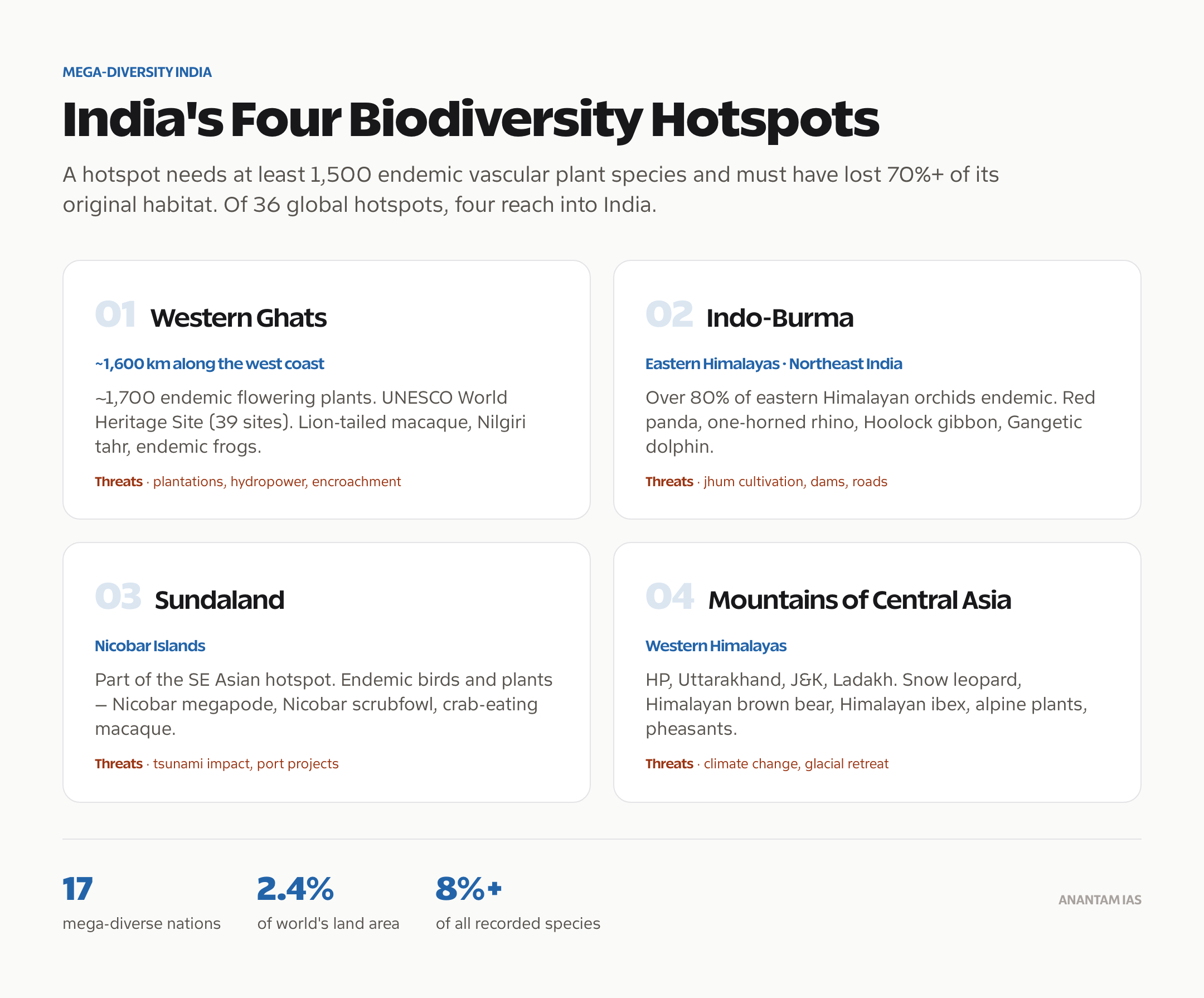
A biodiversity hotspot is defined by Conservation International as a region with at least 1,500 endemic vascular plant species that has lost at least 70% of its original habitat. Both criteria must be met.
There are 36 global biodiversity hotspots. India contains four (partially or fully).
1. Western Ghats
- Geography: A mountain chain running ~1,600 km along India’s west coast, from Gujarat/Maharashtra border to Kerala’s southern tip
- States: Gujarat, Maharashtra, Goa, Karnataka, Tamil Nadu, Kerala
- Endemics: ~5,000 species of flowering plants (1,700 endemic); 508 endemic bird species in the region; 179 amphibian species (~80% endemic); 157 reptile species
- Iconic species: Lion-tailed macaque, Nilgiri tahr, Malabar giant squirrel, Indian giant flying squirrel, numerous endemic frogs
- UNESCO recognition: Western Ghats is a UNESCO World Heritage Site (39 component sites across 6 states)
- Threats: Plantation agriculture (tea, coffee, rubber), hydroelectric projects, road building, mining, encroachment
2. Eastern Himalayas (Indo-Burma Hotspot extends into NE India)
The biodiversity hotspot in India’s northeast is part of the Indo-Burma Biodiversity Hotspot and the Himalayan region.
- Geography: Arunachal Pradesh, Sikkim, parts of West Bengal, Assam, Manipur, Mizoram, Nagaland, Meghalaya
- Characteristics: One of the world’s richest temperate broadleaf forests; dense tropical forests in the foothills
- Endemics: Extraordinary plant diversity — over 80% of the eastern Himalayan orchid species are endemic; 26 endemic mammal species in the broader region
- Iconic species: Red panda, snow leopard, one-horned rhinoceros (Assam), Hoolock gibbon, Gangetic river dolphin
- Threats: Shifting cultivation (jhum), large hydroelectric dams (Arunachal Pradesh has the highest hydropower potential in India), insurgency-related enforcement challenges, road development
3. Sundaland (Nicobar Islands)
- Geography: The Nicobar Islands (part of Andaman and Nicobar archipelago) fall within the Sundaland biodiversity hotspot — which primarily covers Southeast Asia (Sumatra, Borneo, Java, Philippines)
- Endemics: Several bird species and plants endemic to the Nicobars
- Iconic species: Nicobar megapode, Nicobar scrubfowl, Nicobar crab-eating macaque
- Threats: The 2004 Indian Ocean Tsunami caused massive habitat disruption; infrastructure development plans for Great Nicobar Island (a proposed transshipment port and holistic township project) raise serious conservation concerns — the project’s environmental clearance was challenged by ecologists
4. Himalayan Region (Mountains of Central Asia Hotspot)
The broader Mountains of Central Asia hotspot includes parts of the western Himalayas — northwestern India (Himachal Pradesh, Uttarakhand, Jammu & Kashmir, Ladakh).
- Endemics: Alpine plants, snow leopard, Himalayan brown bear, Himalayan ibex, various pheasant species
- Challenges: Climate change is disproportionately affecting high-altitude ecosystems — glacial retreat, shifting snowlines, and altitudinal migration of species
Summary Table
| Hotspot | Region in India | Key Endemics | Primary Threats |
|---|---|---|---|
| Western Ghats | West coast mountain chain | Lion-tailed macaque, Nilgiri tahr, endemic frogs | Plantations, hydropower, encroachment |
| Indo-Burma / Eastern Himalayas | Northeast India | Red panda, Hoolock gibbon, orchid species | Jhum cultivation, dams, roads |
| Sundaland | Nicobar Islands | Nicobar megapode, endemic plants | Tsunami impacts, infrastructure projects |
| Mountains of Central Asia | Western Himalayas | Snow leopard, Himalayan brown bear | Climate change, glacial retreat |
Convention on Biological Diversity (CBD)
The Convention on Biological Diversity (CBD) was opened for signature at the Earth Summit (Rio de Janeiro, 1992) and entered into force in December 1993. India ratified the CBD in February 1994.
The CBD has three objectives:
- Conservation of biological diversity
- Sustainable use of biodiversity components
- Fair and equitable sharing of benefits arising from the utilisation of genetic resources
COP of CBD
The Conference of Parties (COP) of CBD meets every two years. Key milestones:
- CBD COP 10 (Nagoya, 2010): Adopted the Nagoya Protocol on access and benefit sharing; adopted the Aichi Biodiversity Targets (20 targets for 2011–2020)
- CBD COP 15 (Montreal, 2022): Adopted the Kunming-Montreal Global Biodiversity Framework (GBF) — the most significant global biodiversity agreement in a decade
Kunming-Montreal Global Biodiversity Framework (2022)
The GBF sets 23 targets for 2030. The most important for UPSC:
- 30×30 target (Target 3): Protect at least 30% of the world’s lands and oceans by 2030 (India’s current protected area coverage is ~5% of land)
- Target 2: Restore at least 30% of degraded terrestrial, inland water, and marine and coastal ecosystems
- Target 19: Mobilise at least $200 billion per year globally for biodiversity from all sources; eliminate harmful subsidies worth $500 billion per year
Nagoya Protocol
The Nagoya Protocol on Access to Genetic Resources and the Fair and Equitable Sharing of Benefits Arising from their Utilisation (ABS) was adopted at CBD COP 10 in Nagoya, Japan, in October 2010. It entered into force in October 2014.
What It Does
The Nagoya Protocol operationalises the CBD’s third objective — benefit sharing. Its key requirements:
- Countries must ensure that access to genetic resources (plants, animals, microbes) is based on prior informed consent (PIC) from the country of origin and from local/indigenous communities who hold traditional knowledge
- Benefits (monetary and non-monetary) arising from research or commercial use must be shared through mutually agreed terms (MAT)
- A compliance mechanism and an Access and Benefit Sharing Clearing-House (ABSCH) tracks genetic resource access
India’s Implementation
India implemented the Nagoya Protocol through the Biological Diversity Act 2002 (and its 2021 amendment). The NBA (National Biodiversity Authority) administers ABS agreements.
A historical example: turmeric, neem, and basmati rice patents by foreign companies were contested by India as “biopiracy” — using Indian genetic resources and traditional knowledge without consent or benefit sharing. These cases predated the Nagoya Protocol but motivated India’s strong support for ABS mechanisms.
Biological Diversity Act 2002
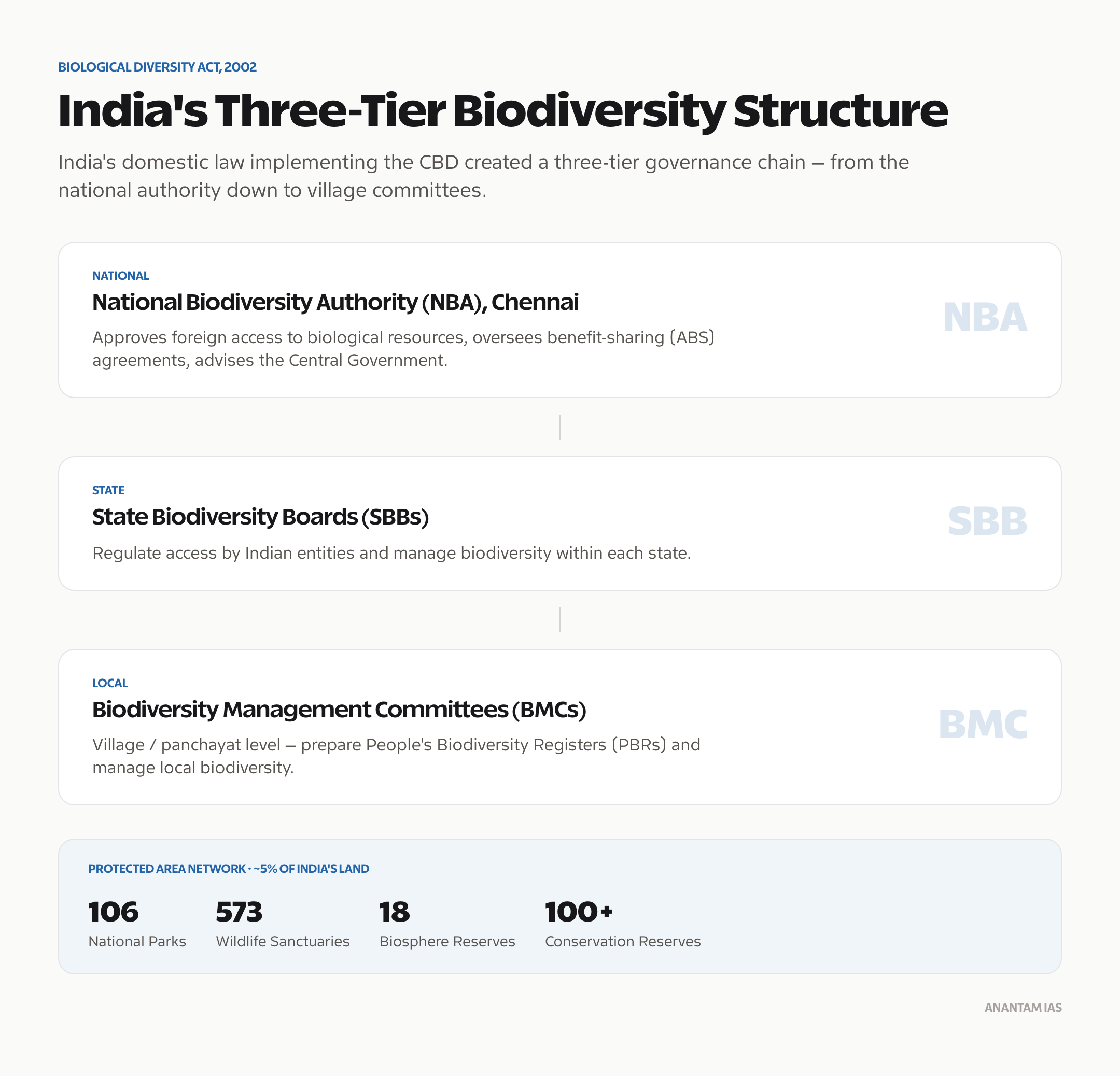
The Biological Diversity Act, 2002 is India’s domestic legislation implementing the CBD. It created a three-tier regulatory structure.
Three-Tier Structure
| Level | Body | Function |
|---|---|---|
| National | National Biodiversity Authority (NBA), Chennai | Approves foreign entities’ access to biological resources; oversees ABS agreements; advises Central Government |
| State | State Biodiversity Boards (SBBs) | Regulate access by Indian entities; manage biodiversity in states |
| Local | Biodiversity Management Committees (BMCs) | Village/panchayat level; prepare People’s Biodiversity Registers (PBR); manage local biodiversity |
Key Provisions
- Section 3: Foreign nationals/companies must take prior approval from NBA to obtain biological resources or knowledge
- Section 7: Indians must inform their state SBB before accessing biodiversity for commercial purposes
- Section 41: BMCs in every local body to conserve local biodiversity and document it in PBRs
- Section 18: NBA can restrict certain biological resources from export
- Section 36: Central Government must develop National Biodiversity Strategy and Action Plan (NBSAP)
2021 Amendment Controversy
The Biological Diversity (Amendment) Act, 2023 (passed after wide consultation from 2021) made significant changes:
- AYUSH sector exempted from some compliance requirements — allowing companies using codified traditional knowledge (like Ayurvedic texts) to access biological resources with lighter compliance
- Domestic companies and researchers face reduced regulatory burden
- BMC role strengthened — BMCs must approve ABS agreements affecting their locality
Critics argued the amendment weakened benefit-sharing protections; supporters said it reduced regulatory overload that was stifling domestic research.
National Biodiversity Strategy and Action Plan (NBSAP)
India’s NBSAP (2014–2020) was submitted to the CBD Secretariat. It identified priorities for biodiversity conservation, including:
- Expanding protected area network
- Integrating biodiversity into sectoral plans (agriculture, forestry, urban planning)
- Reducing invasive species threats
- Strengthening BMCs and PBRs
India submitted its updated NBSAP targets aligned with the Kunming-Montreal GBF in 2023.
People’s Biodiversity Registers (PBRs)
PBRs are community-level documentation of local biodiversity — species present in the area, their traditional uses, local names, and status. They serve as evidence in biopiracy disputes and inform local resource management decisions. India has prepared PBRs in thousands of panchayats.
Endemic Species in India
Endemism means a species is found nowhere else in the world. India’s high endemism reflects its isolation (oceanic separation from other landmasses) and microhabitat diversity.
| Taxonomic Group | Total Species in India | Endemic Species | % Endemic |
|---|---|---|---|
| Flowering Plants | ~18,000 | ~7,099 | ~39% |
| Mammals | 426 | ~44 | ~10% |
| Birds | 1,353 | ~78 | ~6% |
| Reptiles | 521 | ~187 | ~36% |
| Amphibians | 339 | ~209 | ~62% |
Key endemic species:
- Lion-tailed macaque (Western Ghats) — critically endangered; ~3,500 individuals
- Nilgiri tahr (Western Ghats) — endangered; found only in the shola grassland-forest mosaic
- Andaman white-toothed shrew (Andaman Islands) — endemic island species
- Gangetic river dolphin (river systems) — India’s national aquatic animal; technically not fully endemic (also in Bangladesh, Nepal)
- Malabar trogon, Malabar grey hornbill (Western Ghats birds)
- Namdapha flying squirrel (Arunachal Pradesh) — known from a single specimen
- Purple frog (Nasikabatrachus sahyadrensis) (Western Ghats) — a “living fossil” discovered in 2003; belongs to a family that diverged from other frogs ~130 million years ago
Conservation Frameworks in India
Protected Area Network
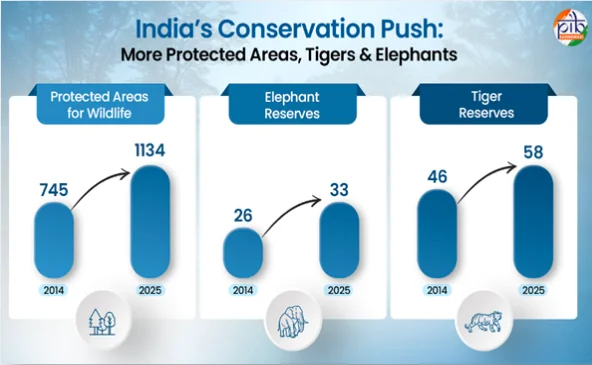
India’s Protected Area (PA) network covers approximately 5.03% of India’s land area (about 171,921 km²):
- National Parks: 106 (higher protection — no human activity)
- Wildlife Sanctuaries: 573 (some human activity permitted)
- Conservation Reserves: 100+ (community-managed)
- Community Reserves: 200+
- Biosphere Reserves: 18 (11 designated as UNESCO Biosphere Reserves)
Project Tiger and Project Elephant
- Project Tiger (1973): World’s most successful large carnivore conservation programme. India’s tiger population grew from ~1,827 (2010) to 3,682 (2022 census) — roughly 75% of the global tiger population. Managed by NTCA (National Tiger Conservation Authority).
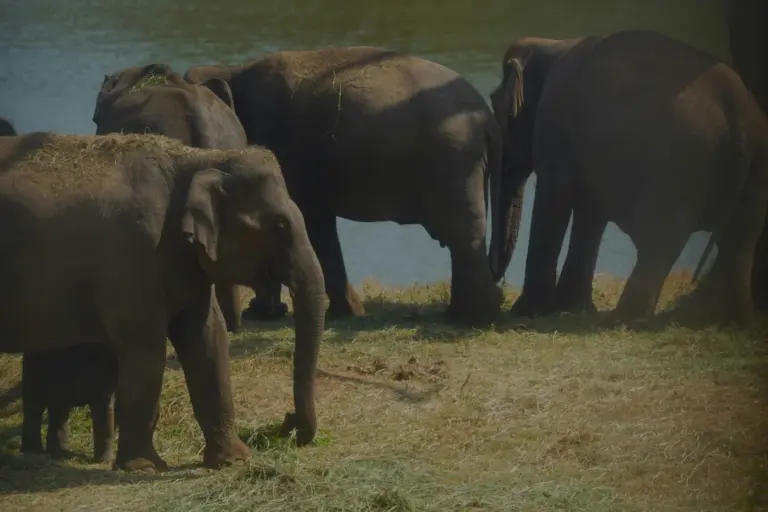
- Project Elephant (1992): India has ~27,000–28,000 Asian elephants — the largest wild population globally. Managed by MOEFCC’s Project Elephant division; 33 elephant reserves.
Frequently Asked Questions
Q1. Which are India’s four biodiversity hotspots?
India has four biodiversity hotspots: (1) Western Ghats — the richest in endemics, running along India’s west coast, with species like the lion-tailed macaque and hundreds of endemic amphibians; (2) Eastern Himalayas / Indo-Burma region — covering India’s northeastern states with extraordinary forest biodiversity; (3) Sundaland — the Nicobar Islands fall within this Southeast Asian hotspot; (4) Mountains of Central Asia / Himalayan region — covering the western Himalayas with snow leopards, alpine endemics, and glacial ecosystems. A hotspot must have at least 1,500 endemic plant species and have lost at least 70% of original habitat.
Q2. What is the Nagoya Protocol and how does India implement it?
The Nagoya Protocol (adopted 2010, in force 2014) is a supplementary agreement to the CBD that operationalises u0022access and benefit sharingu0022 — ensuring that countries (and local communities) whose biological resources or traditional knowledge is used for research or commercial purposes receive fair benefits. India implements it through the Biological Diversity Act 2002, which requires foreign entities to obtain National Biodiversity Authority (NBA) approval before accessing India’s biological resources. India has used this framework to contest biopiracy of resources like turmeric, neem, and basmati rice.
Q3. What is the Biological Diversity Act 2002 and its three-tier structure?
The Biological Diversity Act 2002 implements the CBD in India and creates three levels of governance: National Biodiversity Authority (NBA) at the national level (regulates foreign access, administers ABS), State Biodiversity Boards (SBBs) at state level (regulate Indian entities’ commercial access), and Biodiversity Management Committees (BMCs) at the local/panchayat level (document local biodiversity in People’s Biodiversity Registers, manage local resources). The 2023 amendment exempted AYUSH companies using codified traditional knowledge from some requirements and strengthened BMC roles.
Q4. What is India’s status as a mega-diversity country?
India is one of 17 u0022mega-diversity countriesu0022 identified by Conservation International — nations that harbour a disproportionately large share of global biodiversity relative to their land area. India covers 2.4% of global land but holds over 8% of known species. It has ~49,000 plant species, ~1,02,718 animal species, ~7,099 endemic plants, and extraordinarily high endemism in amphibians (~62%) and reptiles (~36%). Three major biogeographic realms converge in or near India, contributing to its exceptional species richness.
Q5. What is the Kunming-Montreal Global Biodiversity Framework?
Adopted at CBD COP 15 in Montreal in December 2022, the Kunming-Montreal Global Biodiversity Framework (GBF) is the main global agreement to halt and reverse biodiversity loss by 2030. It includes 23 targets, most notably the u002230x30u0022 target — protecting at least 30% of the world’s land and oceans by 2030 (compared to about 17% of land currently protected globally). It also targets restoring 30% of degraded ecosystems and mobilising $200 billion per year in biodiversity finance. India’s current PA network covers about 5% of land area, far below the 30×30 ambition.
Tell Google you want more of this.
Add Anantam IAS as a preferred sourceOne tap, and this site shows up more often in your own Top Stories, AI Overviews and AI Mode. Remove it any time.