National IPR Policy (UPSC Science & Tech)
UPSC guide to India's National IPR Policy 2016: objectives, institutional architecture, IP laws, performance, TRIPS, recent reforms and 2024-26 updates.
The National Intellectual Property Rights (IPR) Policy, 2016 is India's first comprehensive blueprint for intellectual property — patents, trademarks, copyrights, designs, geographical indications, plant varieties, semiconductor topographies and trade secrets. Released on 12 May 2016 by the Department for Promotion of Industry and Internal Trade (DPIIT) under the Ministry of Commerce and Industry, it set the slogan "Creative India; Innovative India" and brought all IP-related ministries onto a single page.
A modern IPR regime matters because innovation is what separates middle-income economies from advanced ones. India's Global Innovation Index rank rose from 81 in 2015 to 39 in 2024 — partly on the back of streamlined IP processes, faster patent grants, surging start-up filings and strong GI tagging.
For UPSC, the National IPR Policy is a flagship GS III — Science & Technology and Economy topic, with strong overflow into GS II — International Relations (TRIPS, FTAs) and GS I — Indian Society (traditional knowledge).
What is intellectual property — the foundations
Intellectual Property (IP) refers to creations of the mind — inventions, literary and artistic works, designs, symbols, names, images — for which the law grants exclusive rights for a limited period. Major IP categories:
| IP type | Protects | Governing Indian law | Term |
|---|---|---|---|
| Patent | New, non-obvious, industrially applicable inventions | Patents Act, 1970 (amended 2005) | 20 years from filing |
| Trademark | Brand names, logos, sounds, shapes | Trade Marks Act, 1999 | 10 years renewable |
| Copyright | Literary, artistic, musical, cinematographic works | Copyright Act, 1957 | Life + 60 years |
| Industrial design | Aesthetic of an article | Designs Act, 2000 | 10 + 5 years |
| Geographical indication | Region-specific products (Darjeeling tea, Banarasi saree) | GI Act, 1999 | 10 years renewable |
| Plant variety | New plant varieties; farmers' rights protected | PPVFR Act, 2001 | 15-18 years |
| Semiconductor topography | IC layout designs | SICLD Act, 2000 | 10 years |
| Trade secrets | Confidential business information | Common law / contract | Indefinite |
India is a signatory to WTO TRIPS, the Paris Convention, Berne Convention, Madrid Protocol (trademarks), the Marrakesh Treaty (visually impaired) and many others under the umbrella of WIPO.
Objectives of the National IPR Policy 2016
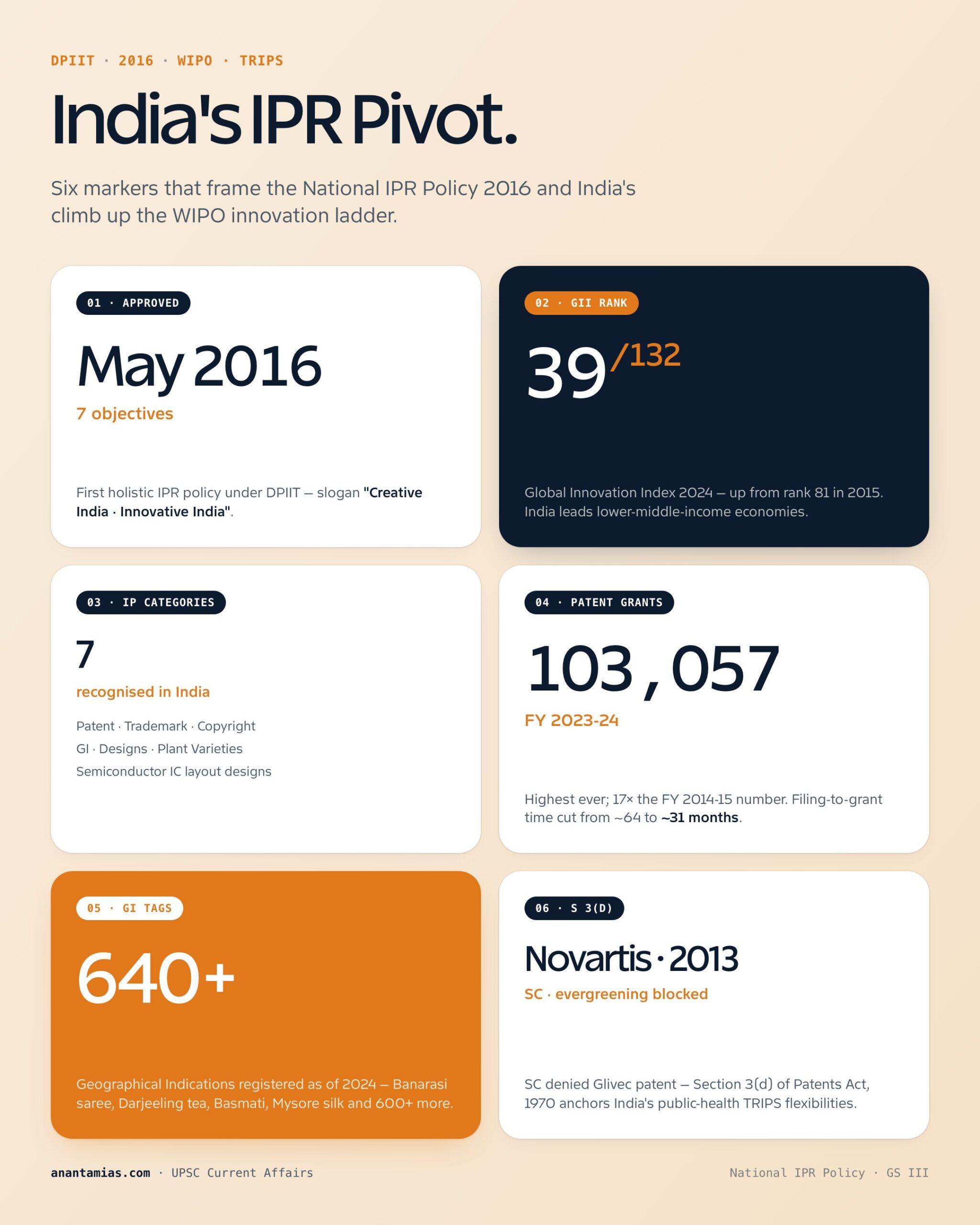
The policy lays out seven objectives:
- IPR awareness, outreach and promotion — public awareness of the economic, social and cultural benefits of IP among students, MSMEs, scientists and creators.
- Generation of IPRs — stimulate creation of IPRs across sectors with a focus on academia, R&D institutions and start-ups.
- Legal and legislative framework — strong, effective, balanced laws; protect public interest including health, environment and traditional knowledge.
- Administration and management — modernise and strengthen IP administration with service-oriented systems.
- Commercialisation of IPRs — get value from IPRs through licensing, technology transfer and finance.
- Enforcement and adjudication — strengthen enforcement and adjudicatory mechanisms to combat IPR infringements.
- Human capital development — strengthen and expand human resources, institutions and capacities for teaching, training, research and skill-building in IPRs.
Institutional architecture
| Body | Role |
|---|---|
| DPIIT, Ministry of Commerce and Industry | Nodal department for IPR; policy implementation |
| Office of the Controller General of Patents, Designs and Trade Marks (CGPDTM) | Apex IP office; supervises patent and trademark offices in Delhi, Mumbai, Chennai, Kolkata |
| Cell for IPR Promotion and Management (CIPAM) | Set up 2016 to coordinate and implement the IPR Policy; merged into DPIIT |
| Indian Patent Office (IPO) | Examines and grants patents |
| Trade Marks Registry | Trademarks |
| Geographical Indications Registry, Chennai | GIs |
| Copyright Office | Now under DPIIT (shifted from MHRD in 2016) |
| Intellectual Property Appellate Board (IPAB) | Abolished in 2021 — disputes now go to High Courts |
| Protection of Plant Varieties and Farmers' Rights Authority (PPVFRA) | Plant varieties under Ministry of Agriculture |
| Semiconductor Integrated Circuits Layout-Design Registry | SICLD topographies |
A specialised Intellectual Property Division (IPD) was set up at the Delhi High Court in 2021, followed by Madras, Bombay, Calcutta and Karnataka High Courts to handle IP disputes after IPAB's abolition.
How India performs on IP
| Indicator | Trend |
|---|---|
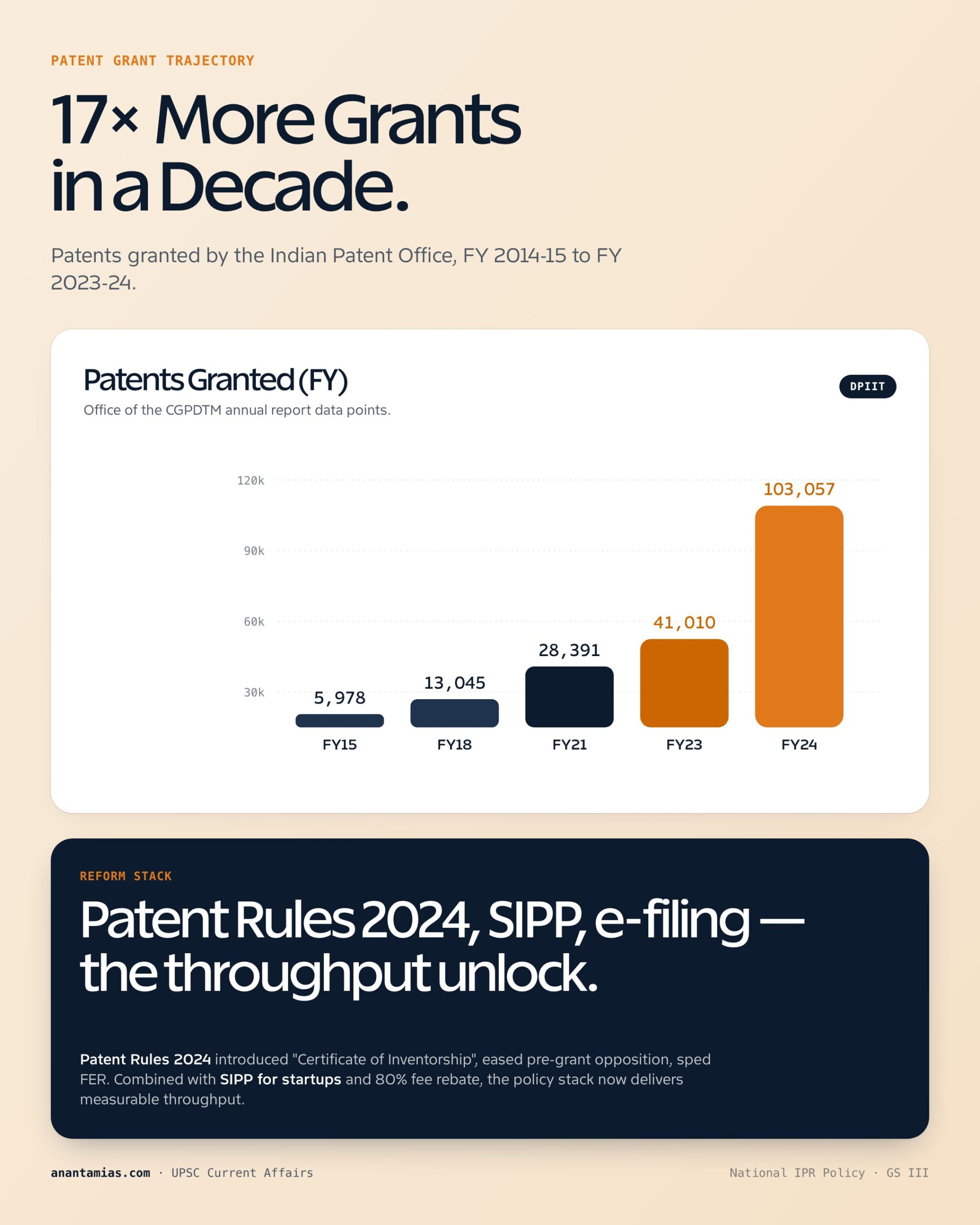
| Patent filings | Crossed 90,000+ per year by 2024 (vs 42,763 in 2014-15) |
| Patent grants | Over 100,000 grants in FY 2023-24 — record high |
| Patent pendency | Down from 64 months in 2014 to ~31 months in 2024 |
| Trademark filings | India among top 5 globally |
| GI tags | 600+ GIs registered as of 2024 |
| Global Innovation Index | India 39th in 2024 (was 81st in 2015) |
| Domestic share of patent filings | Crossed 50% for the first time in FY 2022-23 |
| WIPO patent applications (PCT) | India in top 10 origin countries by 2024 |
Key reforms since the IPR Policy
- Patent Rules amendments (2016, 2017, 2019, 2024) — fee discounts for start-ups and MSMEs, expedited examination, electronic filing, AI-driven examination tools.
- Patents (Amendment) Rules, 2024 — sharply reduced timelines, removed annual working statement burden, strengthened pre/post-grant opposition rules.
- Trade Marks Rules 2017 — simplified to 8 forms from 74; e-filing.
- Copyright (Amendment) Rules 2021 — alignment with TRIPS, broadcasting and statutory licensing reforms.
- GI booster — over 200 new GIs registered post-2016 including Banglar Rasogolla, Madurai Malli, Tirur Betel, Manipur Black Rice, Kashmir Saffron.
- Madrid Protocol membership (2013) — Indian businesses can file trademarks internationally.
- National Innovation Foundation (NIF) — supports grassroots inventors and traditional knowledge documentation.
- Traditional Knowledge Digital Library (TKDL) — first global IP database for traditional knowledge; access opened to public 2022 to support generic challenges.
- IPAB abolished (2021) — High Courts have IP divisions; faster disposal at IPDs.
TRIPS, public health and India
India's Patents Act, 1970 was originally tailored to support generic pharmaceutical manufacturing. The 2005 amendment — to comply with TRIPS post-WTO accession — restored product patents but kept three crucial flexibilities:
- Section 3(d) — bars patents for "new forms of known substances" without enhanced efficacy. Used in the famous Novartis v. Union of India (2013) case to deny a patent for Glivec.
- Compulsory licensing (Section 84) — granted famously to Natco for Bayer's cancer drug Nexavar in 2012.
- Pre-grant and post-grant opposition — allows civil society to challenge patents.
These flexibilities have helped India remain the "pharmacy of the world", supplying over 20% of global generic drugs by volume and 60% of vaccines by volume.
Bio-piracy and traditional knowledge
India fought and won several landmark cases against bio-piracy — patenting of indigenous genetic resources or traditional knowledge:
| Case | Outcome |
|---|---|
| Turmeric (US, 1995-97) | USPTO patent revoked after CSIR submitted prior-art evidence |
| Neem (EPO, 1995-2005) | EU patent on neem fungicide revoked on prior-art grounds |
| Basmati (US, 1997-2002) | Several claims of RiceTec narrowed |
The Traditional Knowledge Digital Library (TKDL) was created in response, digitising centuries-old Ayurvedic, Siddha, Unani and Yoga literature in five international languages and shared with major patent offices.
The Biological Diversity Act, 2002 (and 2023 amendment) governs access to genetic resources and benefit-sharing under the Nagoya Protocol.
Challenges
| Challenge | Detail |
|---|---|
| Examiner shortage | Despite hiring drives, India still has fewer patent examiners per capita than US, EU, China |
| Quality concerns | Faster grants raise quality control questions |
| MSME and start-up reach | Awareness still uneven; rural creators under-represented |
| University patenting | Indian universities lag in commercialisation despite Bayh-Dole-style ambitions |
| Trade pressures | US Special 301 Report still classifies India as a "Priority Watch List" country |
| Standard-essential patents | FRAND disputes (Ericsson, Nokia, Xiaomi) running for years |
| Cross-border IP enforcement | Digital piracy, counterfeit goods, dark-web platforms |
| GI commercialisation | Many GI holders earn little despite registration |
| Technology transfer | Public-funded research lab IP rarely flows to industry at scale |
Recent developments (2024-26)
- Patents (Amendment) Rules, 2024 — reduced timelines, simplified working statements, opposition reforms.
- Draft Patents (Amendment) Rules 2025 — under consultation, proposes further start-up incentives.
- Jan Vishwas (Amendment of Provisions) Act, 2023 — decriminalised minor IP offences.
- AI-aided patent examination at IPO from 2024 to clear backlog.
- GI booster scheme — push from MoCommerce for 1,000 GIs by 2027.
- Anusandhan National Research Foundation (ANRF) operational from 2024 with patent-commercialisation focus.
- National Geospatial Policy (2022) and DPDP Act 2023 — adjacent IP-related governance changes.
- Indo-Pacific Economic Framework (IPEF) IP and trade-secrets discussions.
- WIPO Treaty on Genetic Resources and Associated Traditional Knowledge (2024) — adopted at Geneva diplomatic conference; major win for India's long-standing demand.
- WIPO Design Law Treaty (2024) — concluded after 25 years; simpler design protection.
- Gen-AI and copyright — Indian courts hearing first cases on training-data infringement (2024-25).
- Madras IP Division and Bombay IPD added to the Delhi IPD (2023-24) post-IPAB abolition.
Way forward
- Examiner cadre — quadruple patent examiner strength; specialise in biotech, AI, pharma, telecom.
- Quality + speed — automated tools for prior-art search, AI-aided examination.
- University commercialisation — model on Bayh-Dole; technology transfer offices at every IIT, IISc, NIT, central university.
- MSME and start-up outreach — fee waivers, IP cells in incubators.
- GI value chain — branding, packaging, e-commerce, GI logo enforcement.
- Traditional knowledge protection — operationalise WIPO Genetic Resources Treaty 2024; strengthen TKDL access.
- AI and IP — clear rules on AI-generated content authorship, training-data fair use, deepfakes.
- Standard-essential patent reforms — predictable FRAND framework.
- Digital enforcement — anti-piracy, counterfeit detection through AI, blockchain, digital watermarking.
- International leadership — push for South-led WIPO reforms and balanced FTAs.
- Public R&D-private commercialisation bridges — translational research grants tied to IP outputs.
Mains hook
"India's National IPR Policy 2016 has moved patents from a bureaucratic backwater to a strategic asset, but the next leap requires university research, MSMEs and traditional-knowledge holders to share equally in the gains." Critically examine. (GS III, 250 words, 15 marks)
Prelims pointers
- National IPR Policy — adopted 12 May 2016; nodal: DPIIT under Ministry of Commerce and Industry.
- Slogan — "Creative India; Innovative India".
- CIPAM — Cell for IPR Promotion and Management.
- Patents Act, 1970 — amended 2005 (TRIPS); Section 3(d) prevents evergreening; Section 84 enables compulsory licensing.
- Novartis v. Union of India (2013) — Glivec case; SC upheld Section 3(d).
- Natco v. Bayer (2012) — first compulsory licence for Nexavar.
- TRIPS — 1995; under WTO; minimum IP standards globally.
- WIPO — World Intellectual Property Organization, Geneva; specialised UN agency.
- GI Act, 1999 — over 600 GIs registered in India.
- TKDL — Traditional Knowledge Digital Library; digitised Ayush traditional knowledge.
- IPAB abolished (2021); specialised IP Divisions at High Courts.
- PPVFR Act, 2001 — protects plant varieties and farmers' rights.
- WIPO Treaty on Genetic Resources (2024) — landmark; supports India's demand for disclosure of origin.
- Global Innovation Index — India 39th (2024), up from 81st in 2015.
For UPSC, intellectual property is the connective tissue between science, industry, agriculture, culture, public health and trade diplomacy. The aspirant who can connect Section 3(d) to vaccine equity, GI Banglar Rasogolla to rural value chains, and the Genetic Resources Treaty 2024 to bio-piracy concerns will speak the language of IP fluently.