A patent is a contract between an inventor and the state. The state grants the inventor a temporary monopoly. In return, the inventor describes the invention publicly so that, when the monopoly expires, anyone can use it. The system rests on the premise that what is being patented is genuinely new. If the same idea was already known and used, the patent should not have been granted, because it adds nothing to the public stock of knowledge. This pre-existing knowledge is called prior art, and demonstrating it can defeat a patent application or revoke a patent already granted.
For India, prior art is a problem of language. Centuries of medicinal, agricultural and ritual knowledge sit in Sanskrit, Tamil, Arabic, Urdu and dozens of regional languages and scripts. Patent examiners in Washington, Munich or Tokyo cannot read these texts. In the 1990s, this gap allowed several foreign companies to obtain patents on traditional Indian remedies, including turmeric for wound healing, neem oil as a fungicide, and basmati rice lines. Each was prior art in India for centuries. None was prior art that a USPTO examiner could find. The Traditional Knowledge Digital Library is the structural fix to this problem.
For UPSC, the TKDL is a flagship example of how India can use intellectual-property institutions to defend its heritage and recently to encourage research and innovation. It connects to GS-II governance, GS-III science and technology and IPR, and to the broader policy debate about the global IP system.
Quick Facts: TKDL at a Glance
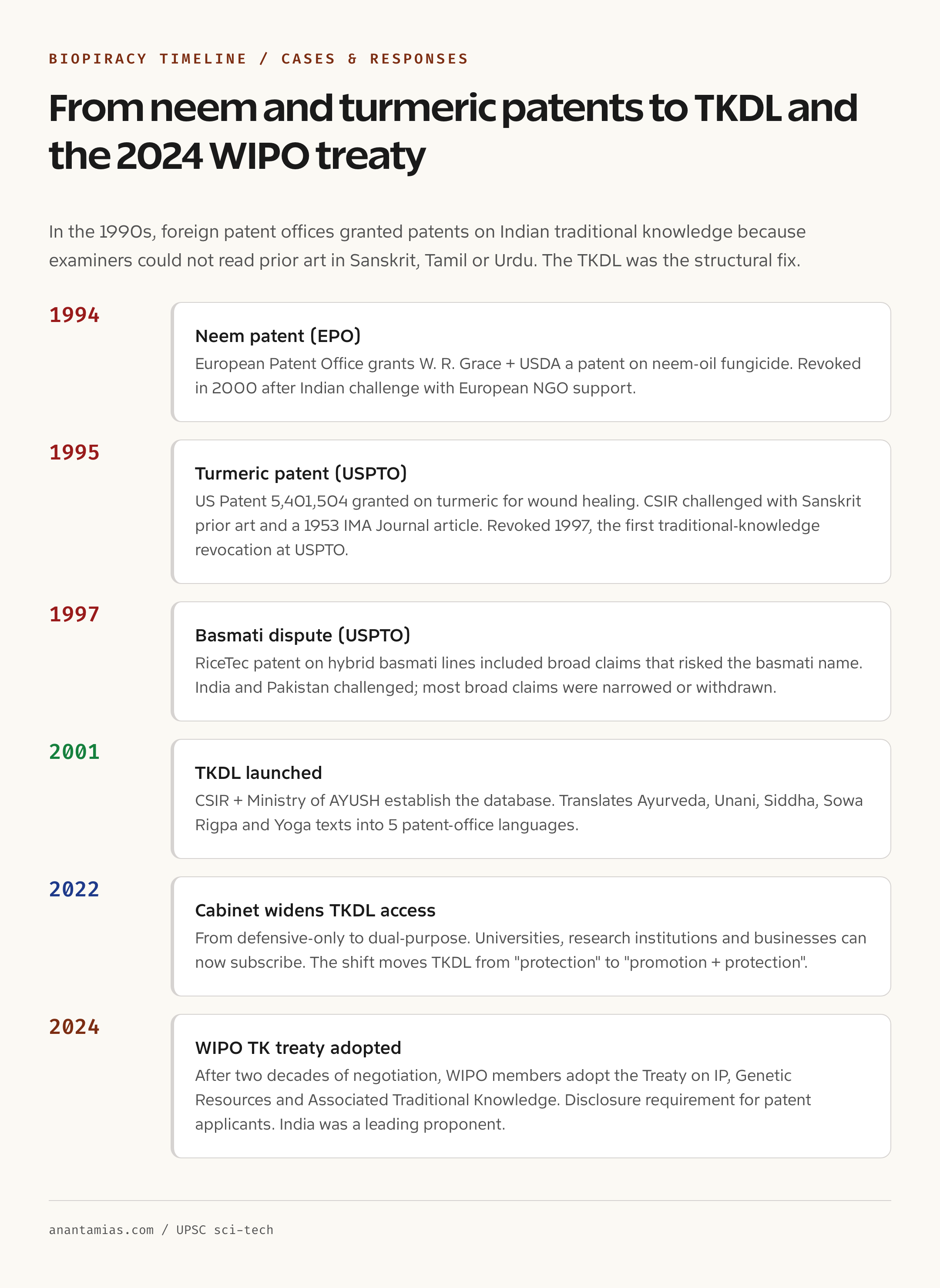
- Definition: A digital database of Indian traditional knowledge, structured to serve as searchable prior art for patent examination
- Joint owners: Council of Scientific and Industrial Research (CSIR) and Ministry of AYUSH
- Established: 2001
- Coverage: Ayurveda, Unani, Siddha, Sowa Rigpa, Yoga
- Source texts: Around 50,000 to 100,000 formulations from classical and regional texts
- Translation languages: English, French, German, Japanese, Spanish (the five major patent-office working languages)
- Classification system: Traditional Knowledge Resource Classification (TKRC), bridging traditional concepts to the International Patent Classification (IPC)
- Trigger cases: Turmeric (US 1995), Neem (EPO 1994-95), Basmati (US 1997)
- Patent offices originally with access: 14 international patent offices under non-disclosure agreements
- 2022 reform: Cabinet approved widening of access to research institutions, universities and businesses through paid subscription
What Is the TKDL?
The Traditional Knowledge Digital Library is a database that translates and structures India’s documented traditional knowledge in a form that patent examiners and researchers can search. Its purpose is twofold. First, it serves as documented prior art: when a patent application based on traditional knowledge is filed at a foreign patent office, the examiner can search the TKDL and find that the underlying idea is already part of the public record. The patent should then be refused, or, if granted, can be revoked. Second, in its newly opened form, it serves as a research resource for legitimate innovation that builds on traditional knowledge with proper attribution and benefit-sharing.
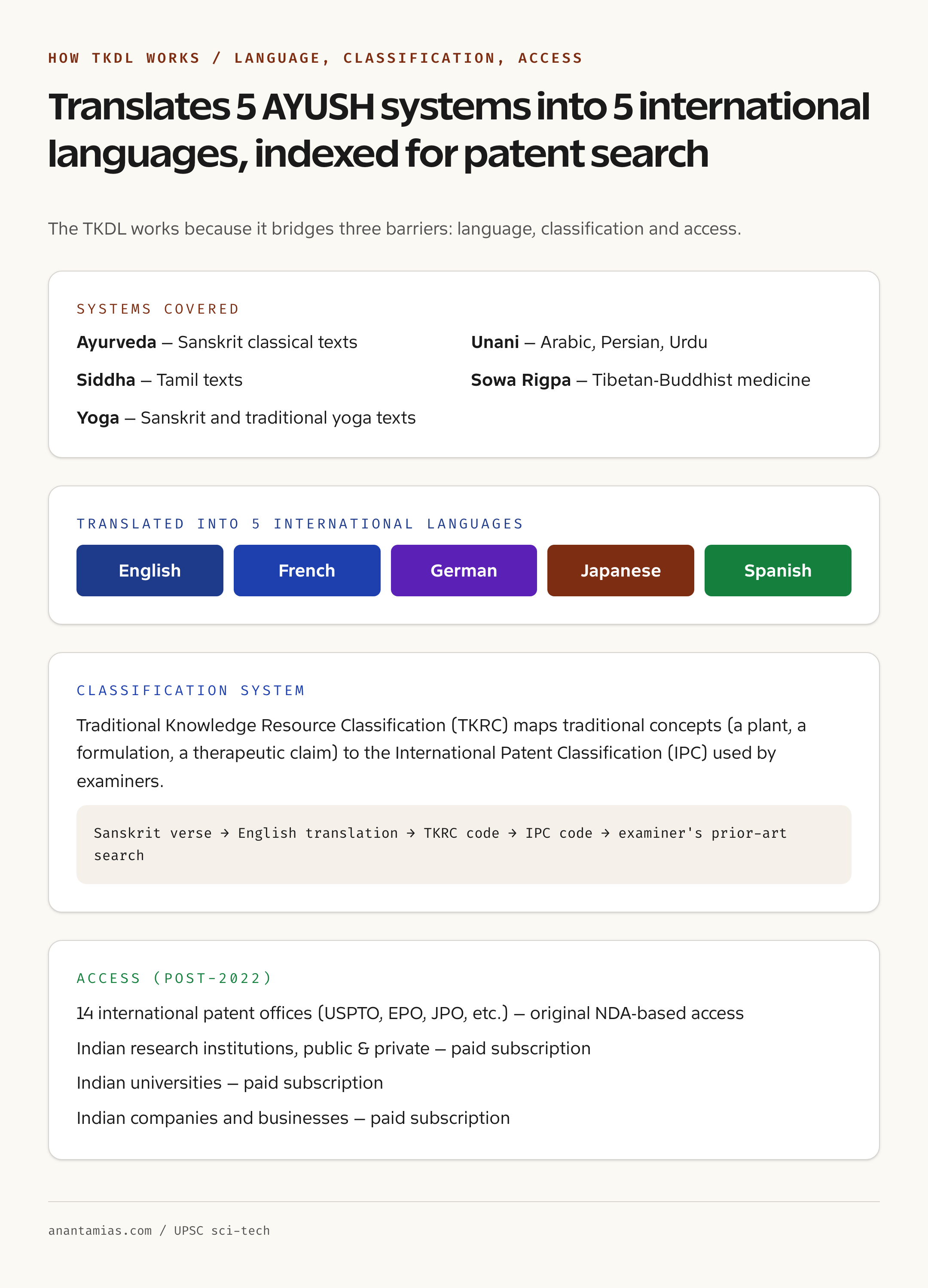
The structure of the TKDL is the engineering achievement that makes the system work. Ancient texts in Sanskrit, Tamil, Arabic, Persian, Urdu and other languages are translated into English, French, German, Japanese and Spanish, the working languages of the major patent offices. The information is encoded in a Traditional Knowledge Resource Classification, which maps traditional concepts (a particular plant, formulation or therapeutic claim) to the International Patent Classification used by examiners. The result is that an examiner searching for “anti-fungal compositions including azadirachta indica” can find the Sanskrit verse describing the same property in a structured English translation, with full citation to the source text.
The TKDL is jointly developed by the Council of Scientific and Industrial Research (CSIR), particularly through its National Institute of Science Communication and Information Resources, and the Ministry of AYUSH, which brings the systems-of-medicine expertise. The library was established in 2001 in response to a series of biopiracy cases that had embarrassed Indian policymakers in the previous decade.
Background and Historical Context
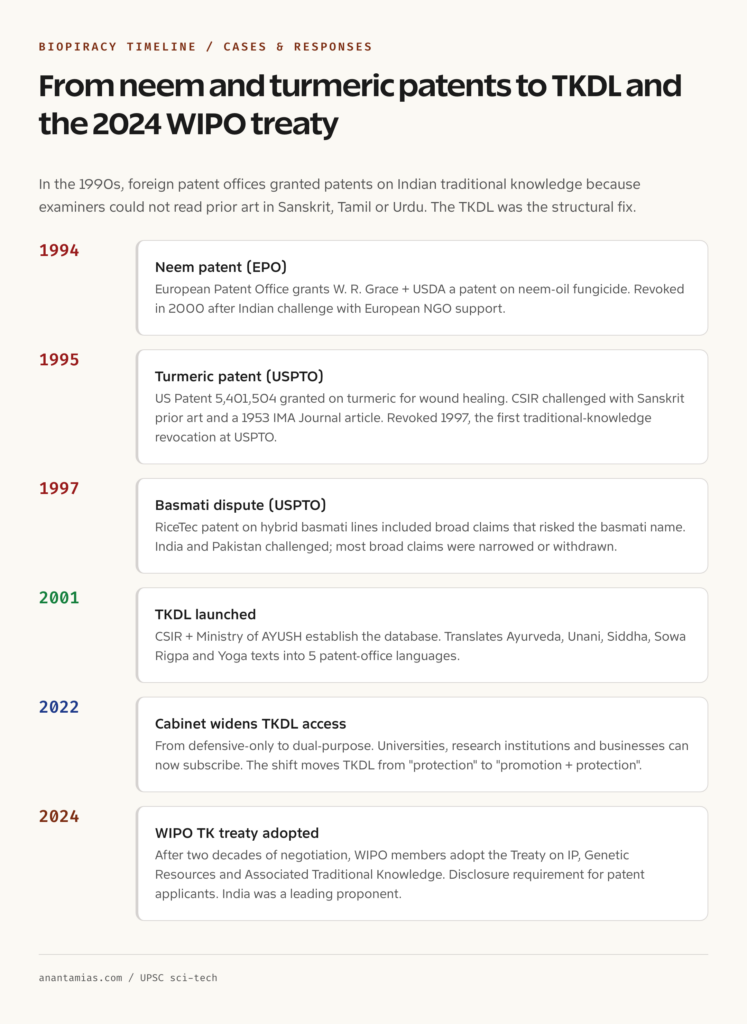
The TKDL was the institutional answer to a series of high-profile cases in the 1990s in which foreign companies obtained patents on traditional Indian knowledge. The pattern was the same in each case: the company filed for a patent in a foreign jurisdiction, the patent examiner could not find written prior art in English or other major patent-office languages, and the patent was granted. Indian protests followed, but the cost and complexity of overturning a granted patent fell on India.
The turmeric case of 1995 is the canonical example. Two researchers based in the United States, working at the University of Mississippi Medical Center, obtained US patent number 5,401,504 for the use of turmeric in wound healing. CSIR challenged the patent at the United States Patent and Trademark Office, presenting prior art in Sanskrit texts and an article published in 1953 in the Journal of the Indian Medical Association. The USPTO revoked the patent in 1997, the first case in which traditional knowledge was used to overturn a US patent.
The neem case of 1994-95 involved a US company, W. R. Grace, and the United States Department of Agriculture, who obtained a European Patent Office patent on a fungicide made from neem oil. The patent was challenged by the Indian government with the support of European environmental groups. The European Patent Office revoked the patent in 2000 on the ground that neem’s fungicidal properties were prior art in India. The case continued through appeals and was finally settled in 2005 with the patent revocation upheld.
The basmati case of 1997 was different. A US company, RiceTec, was granted a US patent on certain hybrid basmati lines, and the patent included claims that, if interpreted broadly, could have restricted the use of the basmati name. India and Pakistan together challenged the broader claims, and most were withdrawn or narrowed. The dispute was about both prior art and geographical indication.
These three cases together created political pressure for a systemic solution rather than case-by-case litigation, which was expensive and reactive. The TKDL was launched in 2001 to provide that systemic solution. By 2024, the TKDL had been credited with the defeat or withdrawal of more than 250 patent applications globally that improperly claimed traditional Indian knowledge. For broader context on India’s intellectual property landscape, see our pieces on intellectual property rights in India, biopiracy and the National IPR Policy.
How TKDL Works in Practice
When a patent application is filed at a participating patent office, the examiner searches the relevant prior art. Ordinary prior art search covers patent databases and major scientific literature, but it does not cover non-English ancient texts or oral knowledge. Without TKDL, an examiner has no realistic way to discover that a claim about, say, the wound-healing properties of a particular plant is documented in a Vedic-era text. With TKDL, the examiner can run a structured search using terms in the IPC classification, find the relevant traditional knowledge entry, and see the underlying source citation in translation.
If the examiner concludes that the application is not novel because it is anticipated by traditional knowledge, the patent is refused. If a patent has already been granted, an interested party can use TKDL evidence as prior art in opposition proceedings or in court. The TKDL is not itself a court, and it does not prevent patenting directly; it provides the evidence that makes refusal or revocation possible.
The 14 patent offices originally given TKDL access under non-disclosure agreements include the USPTO, the European Patent Office, the Japan Patent Office, and many others, covering the jurisdictions where biopiracy was most likely. Access was tightly controlled because the database itself contains commercially valuable translated knowledge, and uncontrolled distribution risked enabling new forms of appropriation rather than preventing them.
The 2022 Reform: From Protection to Promotion
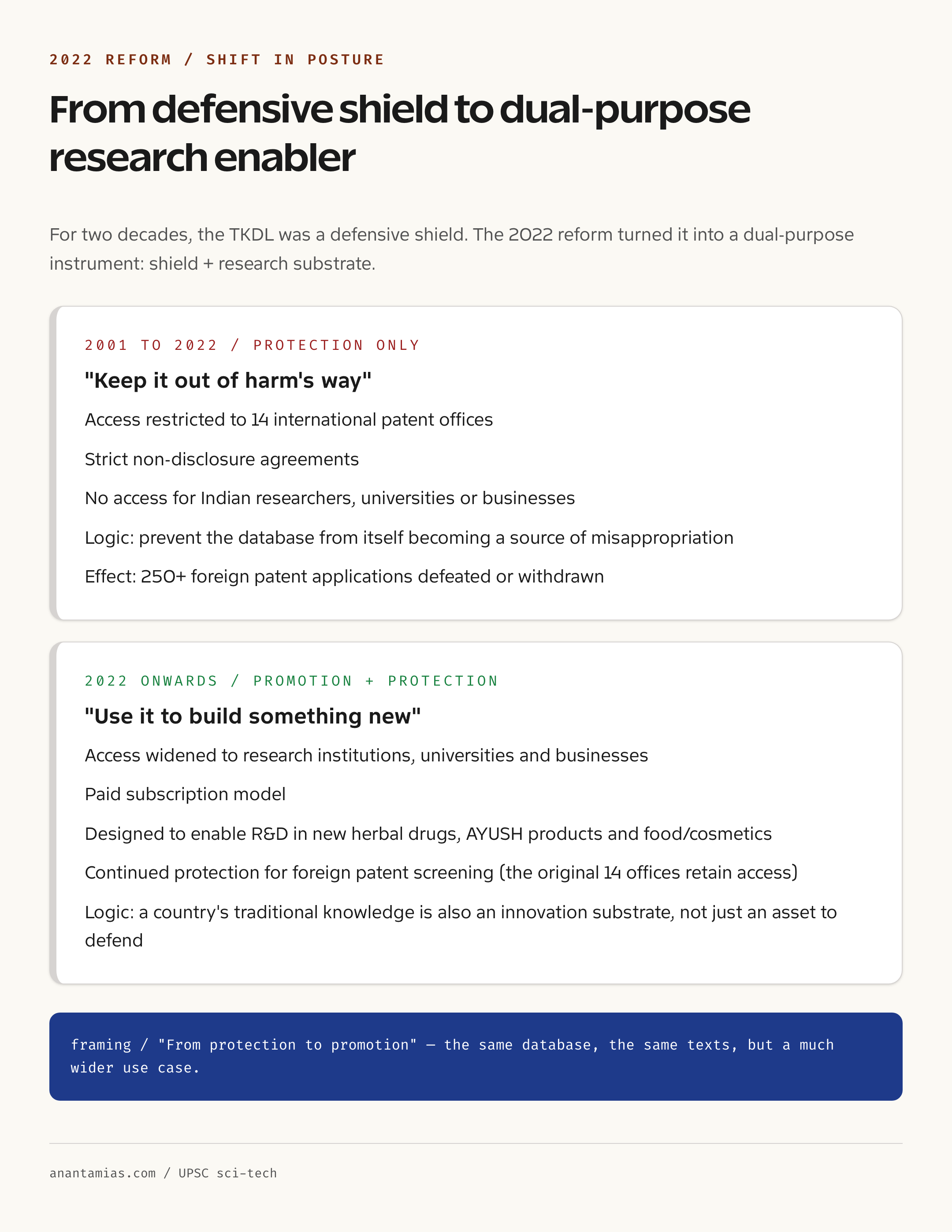
For two decades, the TKDL was a defensive instrument. Access was restricted to patent examiners, and the underlying philosophy was to keep the database out of broader circulation in case it itself became a source of misappropriation. By the 2020s, this defensive posture was increasingly seen as too narrow. India had a wealth of traditional knowledge that could underpin legitimate innovation, including new herbal drugs, cosmetics and food products, but Indian researchers and businesses could not access the TKDL any more easily than foreigners.
In 2022, the Union Cabinet approved a widening of access. Under the new policy, the TKDL is available not only to the original 14 patent offices but also to research institutions (public and private), universities, and companies and businesses. Access is provided through a paid subscription model, with terms that include attribution and, where appropriate, benefit-sharing for any commercialised innovation derived from the traditional knowledge.
The shift is significant. It moves the TKDL from a purely protective tool to a dual-purpose instrument: protection against biopiracy continues, but the database also becomes a substrate for R&D. The objective is to encourage the development of new herbal drugs, AYUSH-aligned products and other innovations rooted in India’s documented traditional knowledge, with appropriate IP protection.
Why It Matters
The TKDL matters for three reasons. The first is intellectual property. In a global IP system that has historically favoured Western corporate research over indigenous and traditional knowledge, the TKDL is one of the few institutional mechanisms that pushes back successfully. It has set a precedent followed by other countries with rich traditional knowledge bases, including Peru, Ecuador and South Africa, which are developing their own TK databases.
The second is economic. India’s traditional knowledge is the basis for an AYUSH sector that includes Ayurvedic and Unani drugs, cosmetics and dietary supplements, and that has substantial export potential. Without protection against biopiracy, much of the commercial value of this knowledge would be captured by foreign patent holders. With TKDL backing, Indian companies and researchers can develop and protect innovations that build on the traditional base.
The third is cultural. Traditional knowledge is intertwined with community identity and intergenerational transmission. Documenting and protecting it formally, while also making it accessible for legitimate research, helps preserve the broader practice of these traditions rather than letting them erode.
Comparative Perspective
Other countries have developed their own TK protection mechanisms. Peru established its Indigenous Knowledge Protection Law and a national registry of collective indigenous knowledge in 2002. China has digitised its traditional medicine literature in the China Traditional Chinese Medicine Patent Database. Ecuador has a TK registry. South Africa has registries for indigenous bioresources. None of these is as well known internationally as the TKDL, in part because India’s earlier biopiracy battles drew global attention.
The World Intellectual Property Organization (WIPO) has been working for years on an international instrument for the protection of traditional knowledge, traditional cultural expressions and genetic resources. In 2024, after more than two decades of negotiation, WIPO adopted the Treaty on Intellectual Property, Genetic Resources and Associated Traditional Knowledge. This treaty introduces a disclosure requirement for patent applicants to declare the origin of any genetic resources or associated traditional knowledge used in the invention. India was an active proponent. The TKDL infrastructure complements such international instruments by providing concrete prior art evidence.
Challenges
The TKDL faces real challenges. The database is large but not exhaustive. Many traditional practices are oral and not yet documented in structured form. Knowledge held by tribal and indigenous communities, particularly those whose languages have less written tradition, is underrepresented. There is also the question of consent and benefit-sharing within India: the TKDL contains knowledge that often originates from specific communities, and the 2022 widening of access raises questions about how benefits from commercialisation flow back to those communities.
Maintenance and updating require continuous funding. The classification system needs to be kept current as the IPC evolves. Translations need quality control. Patent landscape monitoring requires legal capacity that government institutions have built over time but that must continue to be resourced.
International acceptance is also incomplete. While the 14 original TKDL-access offices accept it as authoritative prior art, other jurisdictions and patent systems are slower to adopt. The 2024 WIPO treaty’s disclosure requirement, when fully implemented, should improve this picture, but its effectiveness will depend on national-level implementation.
UPSC Prelims Pointers
- TKDL = Traditional Knowledge Digital Library, established in 2001
- Joint venture between CSIR and the Ministry of AYUSH
- Covers Ayurveda, Unani, Siddha, Sowa Rigpa and Yoga
- Texts translated into 5 international languages: English, French, German, Japanese, Spanish
- Uses Traditional Knowledge Resource Classification (TKRC), mapped to International Patent Classification (IPC)
- Trigger cases: turmeric (US 1995), neem (EPO 1994-95), basmati (US 1997)
- Originally accessible to 14 international patent offices under NDAs
- 2022 Cabinet decision widened access to research institutions, universities and businesses
- Access now offered through a paid subscription model
- Has helped defeat or withdraw over 250 patent applications globally
- Complements WIPO’s 2024 Treaty on IP, Genetic Resources and Associated TK
- Indian patents law requires disclosure of biological source under Section 10(4) of the Patents Act, 1970
UPSC Mains Practice Questions
- Discuss the rationale, structure and impact of the Traditional Knowledge Digital Library (TKDL). How has it changed the global discourse on biopiracy?
- Examine the 2022 reform that widened access to TKDL. What are its implications for research, innovation and benefit-sharing for traditional knowledge holders?
- The turmeric, neem and basmati cases of the 1990s exposed weaknesses in the international patent system’s treatment of traditional knowledge. Discuss how India responded institutionally.
- “Traditional knowledge protection requires both defensive instruments like TKDL and positive instruments like the 2024 WIPO treaty.” Examine.
Way Forward
The TKDL is one of India’s most successful institutional innovations in IPR. The next decade should consolidate and extend its impact. Coverage should be deepened, particularly to include knowledge held by tribal and indigenous communities, with appropriate consent and benefit-sharing protocols. The widened-access regime introduced in 2022 should be implemented with clear rules on benefit-sharing where commercial products result. International expansion of recognition, supported by the 2024 WIPO treaty, should continue, with India remaining a leading voice for traditional knowledge holders globally.
For students, the TKDL is a compact case study that illustrates how a country can use legal and institutional infrastructure to protect non-tangible heritage. It also illustrates the shift many such instruments need to make over time, from purely defensive (keep others out) to also generative (build something new). The same shift is visible in other Indian IP institutions, from the Patents Office to the Geographical Indications Registry. The TKDL is a model worth studying.
Frequently Asked Questions
What is the Traditional Knowledge Digital Library?
The Traditional Knowledge Digital Library, or TKDL, is a digital database that translates and structures India’s documented traditional knowledge in a form that international patent examiners and researchers can search. It was established in 2001 as a joint venture between the Council of Scientific and Industrial Research (CSIR) and the Ministry of AYUSH, in response to a series of biopiracy cases in the 1990s.
Why was the TKDL created?
The TKDL was created in response to high-profile cases where foreign companies were granted patents on knowledge already documented in ancient Indian texts. The turmeric patent in the United States (1995), the neem patent at the European Patent Office (1994-95), and the basmati dispute in the United States (1997) all happened because foreign patent examiners could not read prior-art texts in Sanskrit, Tamil, Arabic, Urdu or other Indian languages. The TKDL solves this by translating the texts into English, French, German, Japanese and Spanish.
Which traditional systems does the TKDL cover?
The TKDL covers Ayurveda, Unani, Siddha, Sowa Rigpa and Yoga. It includes formulations, practices and concepts from classical texts and regional traditions. The database does not currently cover all Indian traditional knowledge. Knowledge held by tribal and indigenous communities, particularly oral knowledge, is partly outside the current scope.
Who runs the TKDL?
The TKDL is jointly run by the Council of Scientific and Industrial Research (CSIR), particularly through the National Institute of Science Communication and Information Resources (NISCAIR), and the Ministry of AYUSH. CSIR provides the IP and technical infrastructure; AYUSH provides the systems-of-medicine expertise.
What was the turmeric patent case?
In 1995, two researchers at the University of Mississippi Medical Center received US patent number 5,401,504 for the use of turmeric in wound healing. CSIR challenged the patent in 1996, presenting evidence of prior art in Sanskrit texts and an article published in 1953 in the Journal of the Indian Medical Association. The USPTO revoked the patent in 1997, the first time traditional knowledge was used to overturn a US patent.
What was the neem patent case?
In 1994-95, a US company W. R. Grace and the United States Department of Agriculture were granted a European Patent Office patent on a fungicide derived from neem oil. The Indian government challenged the patent with the support of European environmental groups. The European Patent Office revoked the patent in 2000 on the ground that neem’s fungicidal properties were prior art in India, a decision upheld through subsequent appeals.
What changed with the 2022 reform?
Until 2022, TKDL access was restricted to 14 international patent offices under non-disclosure agreements, to prevent the database itself from becoming a source of misappropriation. In 2022, the Union Cabinet approved widening of access to research institutions, universities, and companies and businesses through a paid subscription model. The shift moved the TKDL from a purely defensive tool to a dual-purpose instrument that also enables R&D and innovation rooted in traditional knowledge.
How does the TKDL relate to the 2024 WIPO treaty?
In 2024, the World Intellectual Property Organization adopted the Treaty on Intellectual Property, Genetic Resources and Associated Traditional Knowledge, which introduces a disclosure requirement for patent applicants to declare the origin of any genetic resources or associated traditional knowledge used in their invention. The TKDL provides concrete prior art evidence that complements this international framework. India was an active proponent of the treaty.
Has the TKDL been successful?
Yes, by most measures. Since its launch, the TKDL has been credited with the defeat or withdrawal of more than 250 patent applications globally that improperly claimed traditional Indian knowledge. The cost of fighting individual cases through litigation, as in the original turmeric and neem cases, was very high; TKDL prevents many cases from being granted in the first place by providing accessible prior art. Internationally, the TKDL has become a model that other traditional-knowledge-rich countries are adapting.
Tell Google you want more of this.
Add Anantam IAS as a preferred sourceOne tap, and this site shows up more often in your own Top Stories, AI Overviews and AI Mode. Remove it any time.