National Tiger Conservation Authority (NTCA): Mandate, Powers, M-STrIPES
NTCA is India's statutory authority for tiger conservation under the Wildlife Protection Act, 1972. Composition, functions, M-STrIPES, All India Tiger Estimation, and UPSC pointers explained.
The Indian tiger story has two halves. The first half, from 1973 to 2005, is the Project Tiger story, an executive programme launched by Indira Gandhi after a census revealed only about 1,800 wild tigers left in the country. The second half, from 2006 onward, is the National Tiger Conservation Authority story. After the Sariska disaster of 2004, when the entire tiger population of a flagship reserve was found to have been wiped out by poachers, Parliament concluded that an executive programme without statutory backing was not enough. The 2006 amendment to the Wildlife Protection Act created NTCA, gave it legal powers, and made tiger conservation a matter of statutory obligation rather than ministerial discretion.
NTCA is therefore not a programme but an authority. It approves tiger reserve boundaries, sets buffer-zone rules, deploys the M-STrIPES electronic monitoring system, runs the All India Tiger Estimation every four years, and can suspend tourism in a reserve if it judges visitor pressure to be undermining conservation. Its decisions carry the force of law, and its directions to state forest departments are legally binding under the Act.
For UPSC, NTCA is one of the most heavily examined statutory bodies in environment and ecology. Prelims has tested its constituting Act, its composition, and its tools repeatedly. Mains has asked about Project Tiger’s evolution and the human-wildlife conflict that surrounds tiger reserves. This guide walks through NTCA’s mandate, structure, instruments, and the policy debates around it.
Quick Facts
- Nature: Statutory body
- Constituting Act: Wildlife Protection Act, 1972 (amended 2006)
- Year established: 2006
- Parent ministry: Ministry of Environment, Forest and Climate Change (MoEFCC)
- Headquarters: New Delhi
- Chairperson: Union Minister, Environment, Forest and Climate Change (ex-officio)
- Vice-Chairperson: Minister of State, Environment (ex-officio)
- Member Secretary: Director General, Project Tiger
- Members: Eight from amongst experts in wildlife, MPs, NGOs
- Tiger reserves notified: 58 (as of 2026)
- Tiger population (2022 census): 3,682 (estimated mid-point)
- Flagship survey: All India Tiger Estimation (AITE), every 4 years
- Monitoring tool: M-STrIPES (Monitoring System for Tigers, Intensive Protection and Ecological Status)
- Successor of: Project Tiger Steering Committee (1973)
What Is the NTCA
The National Tiger Conservation Authority is the statutory body charged with the conservation, protection, and recovery of tigers in India. It was created by the 2006 amendment to the Wildlife Protection Act, 1972, which inserted Chapter IV-B specifically to govern tiger reserves. The authority is vested with the power to lay down policy for tiger conservation, approve the constitution of tiger reserves, evaluate the state-level tiger conservation plans, and oversee the operation of Project Tiger as a centrally sponsored scheme.
What distinguishes NTCA from a routine government committee is its statutory grounding. Its directions to state forest departments are not advisory. They are binding. A state government cannot dilute the boundary of a tiger reserve, run tourism inside its core, or relocate villages from buffer zones without NTCA approval. The authority can also direct the suspension of tourism if it judges visitor pressure to be undermining conservation, a power it has used in cases such as Bandipur and Tadoba.
NTCA also functions as an interface between scientific monitoring and policy. The M-STrIPES platform feeds field data on tiger sightings, patrolling, and threats directly to authority headquarters, where it is integrated with the four-yearly All India Tiger Estimation. The combination of a binding mandate and a real-time data system gives NTCA a level of policy traction that few other Indian conservation institutions enjoy.
Background and Historical Context
The institutional ancestry of NTCA goes back to Project Tiger. Launched in 1973 with an initial cluster of nine reserves, including Corbett, Kanha, Bandipur, Manas, and Sundarbans, Project Tiger became the iconic conservation programme of the Indira Gandhi era. The early decades produced significant population recoveries. From an estimated 1,800 wild tigers at launch, the count had climbed past 3,500 by the early 1990s.
The 2004 Sariska shock changed everything. A field investigation by an NGO revealed that the entire tiger population of Sariska Tiger Reserve in Rajasthan had been eliminated by organised poaching, and that the state forest department had failed to detect or report the loss. The Tiger Task Force constituted by the Prime Minister, headed by Sunita Narain, concluded that Project Tiger needed statutory backing. Without it, central directives were too easily ignored, monitoring data was weak, and accountability was diffuse.
The Wildlife Protection (Amendment) Act, 2006, was the legislative response. It inserted Chapter IV-B, which created NTCA and gave it specific powers over tiger reserves. The Tiger and Other Endangered Species Crime Control Bureau, also called the Wildlife Crime Control Bureau, was simultaneously strengthened to handle the criminal-enforcement side. The architecture that emerged in 2006 is the architecture that governs Indian tiger conservation today.
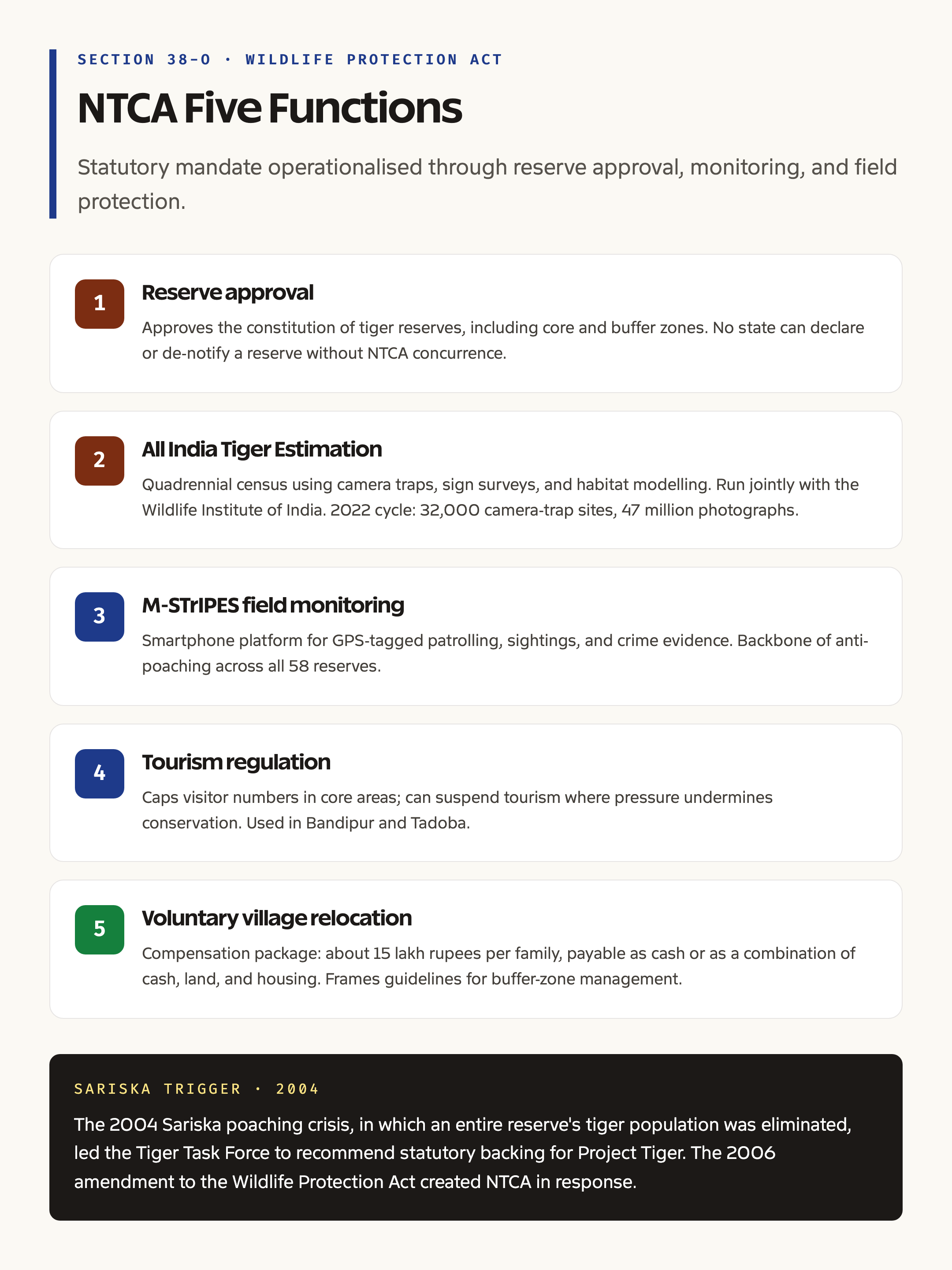
In the years since, NTCA’s mandate has been consolidated through periodic notifications, court orders, and tiger-reserve declarations. The list of tiger reserves has grown from 28 in 2006 to 58 in 2026. The All India Tiger Estimation has been conducted in 2006, 2010, 2014, 2018, and 2022, each cycle showing population growth. The 2022 estimate placed the tiger population at 3,682, more than double the 2006 figure of 1,411.
Composition of NTCA
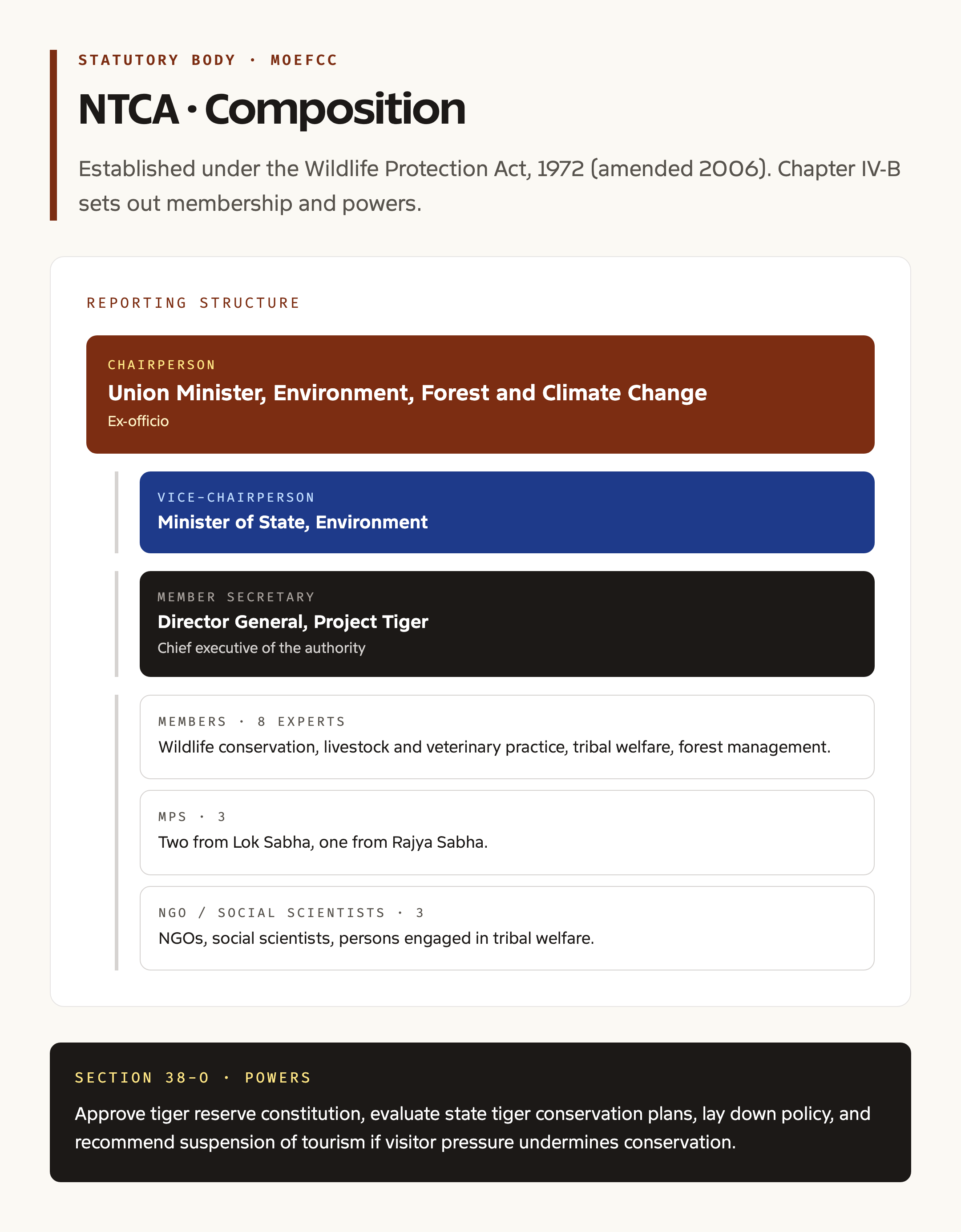
NTCA is a multi-member body chaired by political leadership and run on the operational side by the Director General of Project Tiger. The composition is designed to balance ministerial authority with technical expertise.
The Chairperson is the Union Minister for Environment, Forest and Climate Change, who serves ex-officio. The Vice-Chairperson is the Minister of State for Environment. Three Parliamentarians are nominated to the body, two from the Lok Sabha and one from the Rajya Sabha, ensuring legislative oversight. Three appointees represent NGOs, social scientists, and persons engaged in tribal welfare, recognising that tiger conservation cannot be detached from the rights of forest-dwelling communities.
The Member Secretary is the Director General of Project Tiger, who serves as the chief executive of the authority and head of its secretariat. Eight expert members are appointed from amongst persons with experience in wildlife conservation, livestock or veterinary practice, tribal welfare, and forest management. The Inspector-General of Forests, in charge of Project Tiger, serves as another ex-officio member. The structure consciously brings together political accountability, scientific input, and field experience under one roof.
Key Functions and Provisions
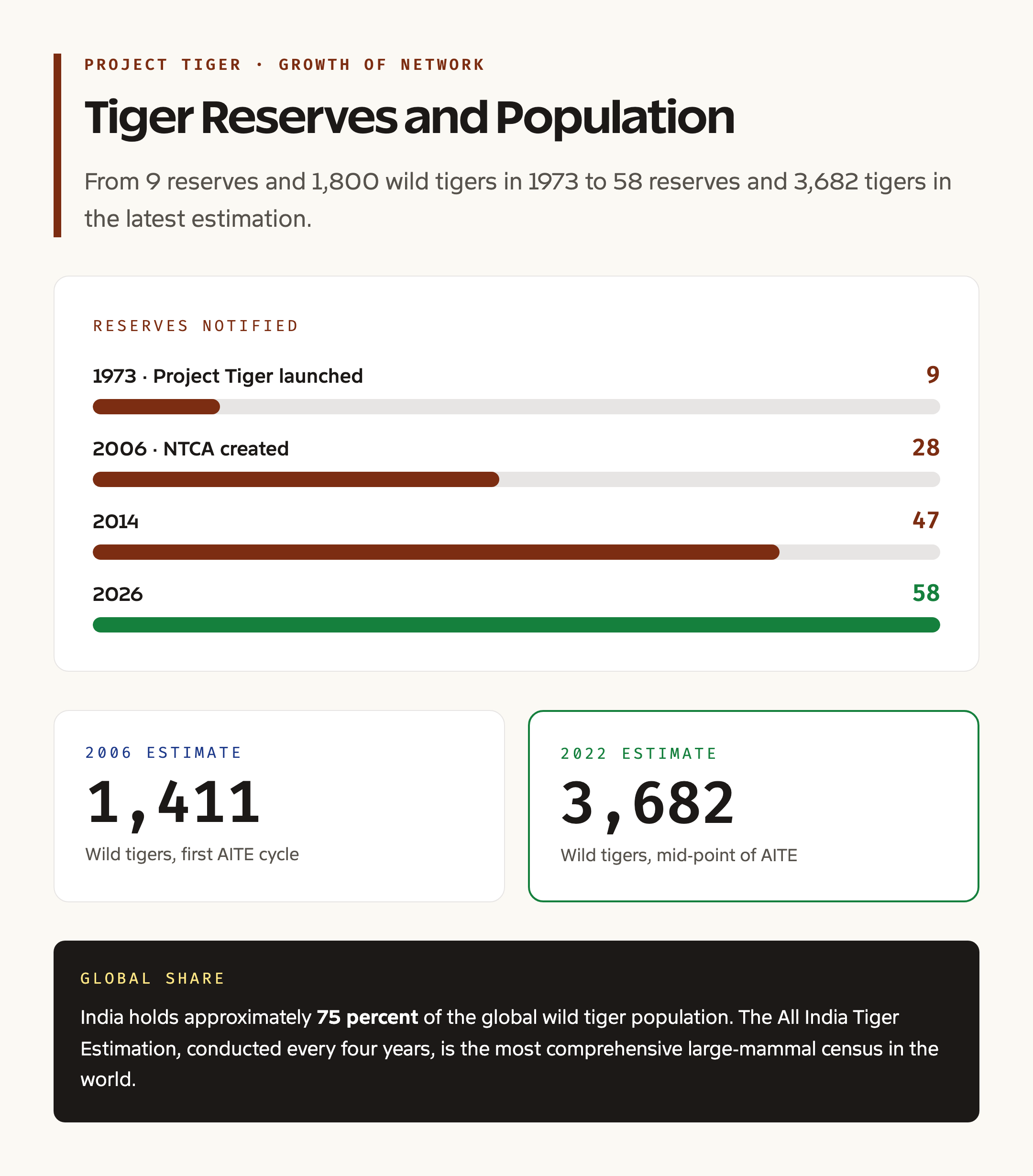
NTCA’s powers and duties are laid out in Section 38-O of the Wildlife Protection Act and operationalised through subordinate notifications. The principal functions group into five categories.
Reserve approval: The authority approves the proposal of a state government to declare a new tiger reserve, including the demarcation of core and buffer zones. No state can declare or de-notify a tiger reserve without NTCA concurrence, and the boundaries it approves are binding.
Population monitoring: The All India Tiger Estimation is conducted under NTCA’s supervision every four years using camera traps, sign surveys, and habitat modelling. The estimation is run jointly with the Wildlife Institute of India and produces a state-by-state population report that has become the most authoritative dataset on tiger numbers globally.
Field protection: NTCA deploys the M-STrIPES platform, an Android-based application that records GPS-tagged sightings, patrolling routes, and crime evidence in real time. Data flows from field staff to range, division, and NTCA headquarters, allowing rapid identification of patrolling gaps and emerging threats.
Tourism regulation: Section 38-O empowers NTCA to recommend the suspension of tiger tourism if visitor pressure is found to be detrimental. The authority has used this power, including in Bandipur and Tadoba, and has issued tourism guidelines that limit visitor numbers in core areas to a small fraction of the reserve.
Village relocation: Where villages exist inside core zones, NTCA frames the guidelines for voluntary relocation, including the compensation package. The current package offers about ₹15 lakh per family, with the option of cash or land-and-house combination. The relocation programme has been controversial but has also been a major contributor to the recovery of contiguous tiger habitat.
Why NTCA Matters
The case for NTCA rests on three propositions. First, the tiger is the apex predator of the Indian forest and an indicator species. Where tigers thrive, the ecosystem is functional. Where they vanish, the wider biodiversity is usually in trouble. Protecting tigers therefore protects whole landscapes, including the biodiversity India reservoirs of the Western Ghats, central India, and the north-east.
Second, India holds about 75 percent of the global wild tiger population. The country’s success or failure on this front sets the global benchmark. The 2022 census figure of 3,682 puts India well ahead of every other tiger range state. NTCA’s instruments, particularly M-STrIPES and AITE, are studied and adapted by countries from Russia to Indonesia.
Third, tiger reserves anchor a vast hydrological and ecosystem-services infrastructure. Catchments of major rivers including the Ganga, Narmada, Godavari, and Cauvery overlap with the tiger reserves in India network. Forests in these catchments regulate sediment, water flow, and carbon storage. Losing them would have economic consequences far beyond conservation.
Detailed Analysis: M-STrIPES and AITE
M-STrIPES deserves a closer look because it has reshaped how field protection is run in India. The platform replaced paper-based patrolling logs with a smartphone application that captures GPS coordinates, photographs, and event categorisation in real time. Each beat-level patrol is logged. Each sign of a tiger or evidence of poaching is geotagged. The data uploads when network connectivity is available and accumulates into a national database.
The implications are operational. Senior officers can see patrolling intensity by reserve, identify under-patrolled areas, and direct staff resources accordingly. Wildlife crime patterns become visible. Habitat-use changes by tigers and their prey can be tracked over time. The platform has become the backbone of the tiger-recovery story since 2010.
The All India Tiger Estimation pairs M-STrIPES with a structured quadrennial census. The 2022 cycle covered 20 tiger states, deployed about 32,000 camera-trap locations, and processed over 47 million camera-trap photographs using individual-tiger identification algorithms. The result was a population estimate of 3,682 tigers, with a confidence interval that places the true figure between 3,167 and 3,925. The same survey produces estimates for co-predators including leopards, dholes, and prey species, making it the most comprehensive large-mammal census in the world.
Comparative Perspective
India’s tiger-conservation framework is exceptional in several ways. The combination of a statutory authority, a binding power over state action, a real-time field-monitoring platform, and a quadrennial census operates at a scale and rigour that no other megafauna conservation programme matches. Russia, China, Bhutan, and Nepal have tiger-monitoring frameworks, but none has the institutional weight of NTCA.
The closest international analogue is the African elephant Great Elephant Census run by NGOs across the Savanna ranges. That census, however, lacks a statutory authority that can suspend tourism, approve reserve boundaries, or compel state-government action. NTCA’s blend of legal authority and scientific instrumentation is, in this sense, a model worth studying for any country grappling with the conservation of a high-conflict apex species.
Challenges and Issues
The NTCA framework, for all its strengths, faces real difficulties. Human-wildlife conflict is the most visible. Tiger populations have rebounded faster than usable habitat, and dispersing tigers now appear regularly in agricultural fringes around reserves. Reports of livestock predation and occasional human casualties feed political pressure for retaliatory action.
Village relocation is contested on rights grounds. Forest-dwelling communities, protected under the Forest Rights Act, 2006, have frequently challenged the way relocations are conducted, and the courts have intervened in several cases. NTCA’s relocation guidelines are formally voluntary, but field reports suggest that the voluntariness is uneven in practice.
Funding shortfalls are persistent. The Project Tiger budget under NTCA has not kept pace with the expanding reserve network, and several state forest departments report inadequate frontline staffing. Climate change is emerging as a slow-moving threat, with shifts in prey availability and vegetation in reserves like Sundarbans. The tiger-corridor question, that is, the connectivity between reserves, is unresolved, since corridors lie outside the formal reserve boundary and are subject to development pressure.
Prelims Pointers
- Statutory backing: Wildlife Protection Act, 1972, as amended in 2006 (Chapter IV-B).
- Year of NTCA establishment: 2006.
- Parent ministry: MoEFCC.
- Chairperson: Union Minister, Environment.
- Member Secretary: Director General, Project Tiger.
- Total tiger reserves (2026): 58.
- 2022 tiger estimate: 3,682 (mid-point).
- Census frequency: Every 4 years (AITE).
- Field-monitoring tool: M-STrIPES (Monitoring System for Tigers, Intensive Protection and Ecological Status).
- Original Project Tiger launch: 1973, with 9 reserves.
- Trigger for NTCA creation: Sariska poaching crisis, 2004; Tiger Task Force report, 2005.
- Power to suspend tourism: Section 38-O, Wildlife Protection Act.
Probable Mains Questions
- The 2006 amendment to the Wildlife Protection Act, 1972, gave statutory teeth to Project Tiger. Critically examine the role of NTCA in tiger conservation, with reference to the All India Tiger Estimation. (250 words)
- Discuss the tension between the Forest Rights Act, 2006, and tiger-reserve relocation policy. How has NTCA navigated this tension? (250 words)
- India holds 75 percent of the world’s wild tigers. Examine the technological, legal, and institutional reasons for India’s success in tiger recovery since 2006. (150 words)
Way Forward
NTCA’s next decade should focus on four shifts. First, landscape-scale planning. Reserves alone cannot hold a growing tiger population. Tiger corridors, often outside formal reserve boundaries, need legal status and active management, perhaps through a dedicated chapter in the Wildlife Protection Act.
Second, adaptive management for human-wildlife conflict. Compensation for livestock loss, rapid response teams, and community-based early warning need scaling, particularly in central Indian and Western Ghats reserves where conflict has risen.
Third, co-predator and prey monitoring. AITE has been progressively broadened to cover leopards and other species, but a fully ecosystem-level census would integrate tigers with their prey base, water availability, and climate indicators.
Fourth, forest-rights reconciliation. Working with the Tribal Affairs Ministry and gram sabhas to ensure that any relocation is genuinely voluntary, and that buffer-zone management gives forest dwellers a real stake in conservation, would consolidate NTCA’s social legitimacy. Combined with the broader reform agenda under Project Tiger Conservation and the environmental laws in India, this can keep India’s flagship conservation success story going.
Frequently Asked Questions
What is the National Tiger Conservation Authority?
NTCA is the statutory body created in 2006 under the Wildlife Protection Act, 1972, to oversee tiger conservation in India. It approves tiger reserves, deploys field-monitoring systems, conducts the four-yearly All India Tiger Estimation, and issues binding directions to state forest departments on tiger-reserve management.
Under which Act was NTCA established?
NTCA was established under the Wildlife Protection Act, 1972, as amended in 2006. The amendment inserted Chapter IV-B into the Act, which sets out the authority’s composition, powers, and procedures.
Who chairs the NTCA?
The Chairperson is the Union Minister for Environment, Forest and Climate Change, serving ex-officio. The Vice-Chairperson is the Minister of State for Environment. The Member Secretary, who is the chief executive, is the Director General of Project Tiger.
What is M-STrIPES?
M-STrIPES stands for Monitoring System for Tigers, Intensive Protection and Ecological Status. It is a smartphone-based platform used by NTCA and state forest departments to record GPS-tagged patrolling, sightings, and crime evidence in real time. It has become the operational backbone of tiger reserves in India.
How often is the tiger census conducted?
The All India Tiger Estimation is conducted every four years. Cycles have run in 2006, 2010, 2014, 2018, and 2022. The 2022 cycle estimated about 3,682 tigers, more than double the 2006 figure of 1,411.
Can NTCA suspend tiger tourism?
Yes. Section 38-O of the Wildlife Protection Act empowers NTCA to recommend or direct the suspension of tourism in a tiger reserve if visitor pressure is found to be detrimental to conservation. The authority has used this power in the past, including in Bandipur and Tadoba.
What is the difference between core and buffer zones?
The core zone is the inviolate area of a tiger reserve, kept free of human habitation and economic activity. The buffer zone surrounds the core and allows regulated forestry, tourism, and forest-rights-based livelihood activity. Both are notified with NTCA approval.
How many tiger reserves does India have?
As of 2026, India has 58 notified tiger reserves spread across 20 states, covering approximately 78,000 square kilometres. The list has expanded steadily from the original 9 reserves notified in 1973 under Project Tiger.
What is village relocation in tiger reserves?
Village relocation is the voluntary movement of forest-dwelling communities out of the core zone of a tiger reserve, in exchange for a compensation package. NTCA’s current package is roughly ₹15 lakh per family, payable as cash or as a combination of cash, land, and housing.
Why was NTCA created in 2006?
NTCA was created in response to the 2004 Sariska poaching crisis, where the tiger population of an entire reserve was wiped out without timely detection. The Tiger Task Force concluded that Project Tiger lacked statutory authority and that a new body with binding legal powers was needed.