Need for UEGS (Urban Employment Guarantee Scheme): Drivers and Design (UPSC)
Why India needs a UEGS — urban poverty, PLFS data, urban inflation, NULM gaps and 2024-26 Budget signals. Full UPSC GS-III coverage with state pilots and design template.
A Urban Employment Guarantee Scheme (UEGS) would extend to towns and cities the demand-driven, statutory, public-works architecture that the Mahatma Gandhi National Rural Employment Guarantee Act, 2005 built for rural India. The case for a UEGS rests on five pillars: persistently high urban unemployment, distress-driving urban inflation, weak existing urban anti-poverty schemes, accelerating urbanisation, and the fiscal-political feasibility demonstrated by state pilots. The Covid-19 shock sharpened the case; the post-pandemic period has only confirmed it. This guide lays out the data, design principles, fiscal envelope, criticisms, and 2024-26 Budget signals that UPSC aspirants must master under GS-III (Inclusive growth, employment) and GS-II (welfare schemes).
Why a UEGS — The Five Drivers
1. High and Sticky Urban Inflation
The Crisil Inflation Insight (multiple editions, 2023-25) and RBI bulletins repeatedly show that the urban poor are worst affected by India's persistently high inflation. Food (especially vegetables and pulses) and rent push urban CPI above rural CPI in most months. The urban informal worker, with no land, no own-grown food, and no MGNREGA cushion, has nothing to absorb price spikes.
2. Persistently Higher Urban Unemployment
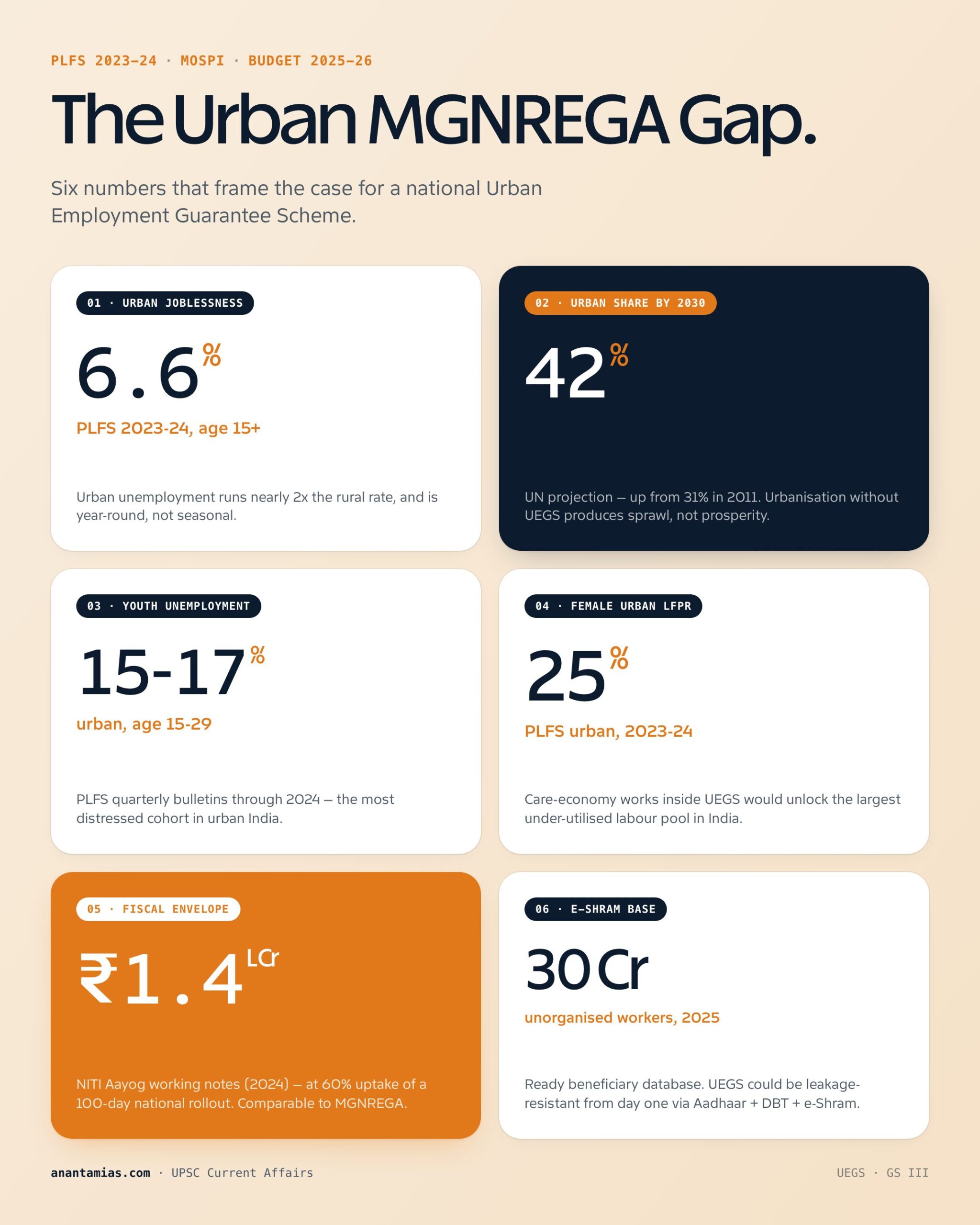
- The Periodic Labour Force Survey (PLFS) released by MoSPI in 2024 for the year 2023-24 showed an urban unemployment rate of 6.6 percent (15+) versus much lower rural rates.
- Urban youth unemployment (15-29) exceeded 15-17 percent in PLFS quarterly bulletins through 2024.
- The Centre for Monitoring Indian Economy (CMIE) has consistently shown urban unemployment running 1-2 percentage points above rural.
- Crucially, rural unemployment is largely seasonal, while urban unemployment is year-round — migrant workers face hunger, debt, and homelessness whenever they cannot find work.
3. Low Wages and Rising Inequalities in Urban Work
- PLFS 2023-24 shows that just over 50 percent of the urban workforce remains in self-employment or casual wage labour.
- Real wage growth in urban informal sectors has been weak — monthly per-capita consumption of bottom-decile urban households rose less than 2 percent annually in real terms over 2017-23.
- Urban India houses the steepest wealth concentration — the top 1 percent in metro cities owns a disproportionate share of housing and financial assets.
4. Skewed Welfare Architecture
| Programme | Rural Reach | Urban Reach |
|---|---|---|
| MGNREGA | Universal (rural households) | Not applicable |
| PM Garib Kalyan Rojgar Abhiyaan (Covid-era) | Rural-only | Not applicable |
| PM Awas Yojana — Gramin | Rural | Urban variant smaller in scale |
| NRLM (Aajeevika) | Rural SHG focus | NULM is smaller, focuses on entrepreneurship |
| Mid-Day Meal | Rural and urban | Same |
| NSAP (pension/widow benefit) | Both | Both |
The National Urban Livelihoods Mission (NULM/DAY-NULM) was launched in 2013, replacing the Swarna Jayanti Shahari Rozgar Yojana (SJSRY) of 1997. NULM emphasises self-employment, skill development, SHGs, shelters for the urban homeless, and street vendor support — but does not provide a wage employment guarantee. It is voluntary, supply-driven, and small.
5. Accelerating Urbanisation
By 2030, the United Nations projects 42 percent of India's population will be urban (from around 31 percent in 2011). Without a UEGS, this transition risks producing informal sprawl, slums, and underemployment. With a UEGS, urbanisation can be channelled into productive public infrastructure, environmental restoration, and care services.
Comparing MGNREGA and a Proposed UEGS
| Feature | MGNREGA (2005) | Proposed UEGS |
|---|---|---|
| Statutory backing | NREGA, 2005 | National Urban Employment Guarantee Act |
| Coverage | Rural households | Urban informal workers + educated youth |
| Days guaranteed | 100 days/household/year | 100-150 days proposed |
| Wage | State-notified, indexed to CPI-AL | State-notified, indexed to CPI-IW |
| Implementing unit | Gram Panchayat | Urban Local Body (ULB) — Municipalities, Corporations |
| Planning forum | Gram Sabha | Ward Sabha |
| Wage payment | DBT to Aadhaar-linked accounts | DBT to Aadhaar-linked accounts |
| Funding | 75 percent Centre, 25 percent state (general); 90:10 NE | Similar 75:25 / 90:10 share recommended |
| Social audit | Mandatory | Mandatory recommended |
| Type of works | Earthworks, water conservation, housing assets | Public infrastructure, urban commons restoration, care services, apprenticeships |
Design Principles for an Effective UEGS
Two-Track Coverage
A well-designed UEGS must cater simultaneously to:
- Urban informal workers (construction labourers, head loaders, domestic workers, street vendors) — guaranteed wage employment in public works.
- Educated unemployed youth — paid apprenticeships in municipal offices, schools, hospitals, e-governance centres — building skills while earning.
Permissible Works
- Building and maintenance of roads, footpaths, bus shelters, public toilets.
- Urban commons restoration — lakes, ponds, wetlands, biodiversity parks.
- Solid waste management, anti-littering drives, sewage maintenance.
- Care economy — crèche workers, elderly-care assistants, NGO-run shelter helpers (women-friendly).
- Public service apprenticeships — schools, hospitals, e-governance front desks.
Implementation Spine
- Urban Local Bodies under the 74th Constitutional Amendment (1992) as primary implementing agencies.
- Ward Sabha consultations for works planning.
- Mandatory social audit by ward-level committees.
- Time-bound grievance redressal — written response within 15 days.
- Aadhaar-linked job cards and DBT wages.
- e-Shram integration for portable benefits.
State Pilots: The Real Evidence
- Kerala — Ayyankali Urban Employment Guarantee Scheme (AUEGS, 2010): 100 days/household, women's participation >80 percent, present across all 93 municipalities.
- Himachal Pradesh — Mukhya Mantri Shahari Ajeevika Guarantee Yojana (2020): 120 days, all ULBs.
- Odisha — Mukhyamantri Karma Tatpara Abhiyan (MUKTA, April 2020): convergence of urban poverty schemes for community-led works.
- Tamil Nadu, Madhya Pradesh, Jharkhand: smaller pilots focused on youth and BPL-card holders.
These pilots prove the model works at scale, with women's participation high and works delivering visible urban infrastructure.
Recent Developments (2024-26)
Budget 2024-25
- Rs 2 lakh crore package for employment-linked incentives (ELI) — first-time employee, manufacturing employer subsidies, and EPFO-linked support.
- Internship Scheme to provide 1 crore internships in 500 top companies over five years — central government bears training cost (Rs 4,500/month allowance).
- The Budget did not legislate a national UEGS but acknowledged urban employment distress.
Budget 2025-26
- ELI schemes continued; manufacturing employer subsidy scaled.
- Rs 2 lakh crore kept for ELI envelope; expansion of National Apprenticeship Promotion Scheme (NAPS).
- Focus on Saksham Anganwadi 2.0, urban skilling, and PMKVY 4.0.
- Renewed political debate on urban wage guarantee, with several opposition states tabling state-level Bills.
NITI Aayog and Standing Committees
- The Standing Committee on Labour (2023-24) recommended a national urban wage employment scheme.
- NITI Aayog working notes (2024) model fiscal cost at Rs 1-1.5 lakh crore/year for a 100-day-per-worker national rollout.
- Pre-Budget Economic Memoranda (2024-25) repeatedly flagged urban unemployment as the biggest macro risk.
PLFS 2024 (Q3 FY25)
- Urban unemployment edged up to 6.7-6.8 percent, especially among 18-29 year-olds.
- Female labour-force participation in urban areas remained low at around 25 percent, despite a national surge in rural FLFPR.
e-Shram and Beneficiary Readiness
- e-Shram portal crossed 30 crore registrations of unorganised workers by 2025, providing the de facto database that any UEGS would draw on.
Concerns and Counter-Arguments
- Fiscal sustainability: A national UEGS at Rs 1-1.5 lakh crore would need recurrent fiscal space; centre-state burden sharing critical.
- Capacity gap: Most ULBs are under-staffed; rolling out a demand-driven programme requires dedicated cadre, audit infrastructure, and digital backbone.
- Productivity concerns: Risk of low-quality "make-work" without strong asset standards.
- Wage distortion: Notified wages may push up local informal wages, raising inflation concerns in tight labour markets.
- Targeting: Urban informality is harder to target than rural — migrants lack residential proof, women face safety issues at worksites.
Way Forward
- National framework, state-led implementation — Centre legislates, states opt in with state-specific wage rates.
- Convergence with Smart Cities Mission, AMRUT 2.0, Swachh Bharat Mission Urban 2.0, PMAY-U 2.0 to source labour-intensive sub-projects.
- Care-economy works for women-friendly employment.
- Sunset clauses to keep the programme genuinely demand-driven.
- ULB capacity-building through dedicated urban management cadres.
- Integration with e-Shram, Aadhaar, Jan Dhan for seamless wage transfers and grievance redressal.
International Comparisons
- South Africa's Expanded Public Works Programme (EPWP, 2004) — multi-sector public works, gender-sensitive design, skill component.
- Argentina's Plan Jefes y Jefas (2002) — counter-cyclical urban employment, phased out post-recovery.
- USA's WPA (New Deal, 1935) — historical precedent for large-scale public works.
- Ethiopia's PSNP — combines transfers with public works, robust targeting.
UPSC Relevance
GS-III Mapping
- Inclusive growth and issues arising from it.
- Issues related to direct and indirect farm subsidies and minimum support prices (analogous welfare-spending debate).
- Effects of liberalisation on the economy, changes in industrial policy.
GS-II Mapping
- Welfare schemes for vulnerable sections of the population by the Centre and States.
- Issues relating to development and management of social sector / services.
Prelims Pointers
- MGNREGA — 2005, statutory, 100 days, demand-driven.
- NULM (DAY-NULM) — 2013; replaced SJSRY — 1997.
- 74th Constitutional Amendment, 1992 — Urban Local Bodies, 12th Schedule.
- PLFS — annual (July-June reference) by MoSPI since 2017-18.
- e-Shram — Ministry of Labour & Employment, launched August 2021.
- Ayyankali Urban Employment Guarantee Scheme — Kerala (2010).
Mains Hooks
- "Examine the rationale, design, and feasibility of an Urban Employment Guarantee Scheme." (GS-III)
- "How has the absence of an urban MGNREGA equivalent shaped India's response to economic shocks like the Covid-19 pandemic? Suggest reforms." (GS-III)
- "Compare and contrast NULM with a proposed UEGS in addressing urban poverty." (GS-II)
A UEGS addresses the most visible asymmetry in India's social protection architecture. The drivers — high urban inflation, persistent urban unemployment, weak NULM coverage, accelerating urbanisation — are now data-confirmed. The design template — MGNREGA-plus-ULB-plus-care-economy is feasible. The fiscal envelope is well within the realm of comparative welfare expenditure. For UPSC, anchor your answer on PLFS data, NULM-SJSRY history, state pilots, and 74th CAA to write convincing GS-III responses.
Lessons from MGNREGA That a UEGS Must Apply
MGNREGA's two-decade journey holds crucial lessons:
- Demand-driven funding is the only model that respects rural realities; UEGS must replicate this rather than fix annual allocations.
- Time-bound wage payments within 15 days of work are essential to credibility; failures here erode trust quickly.
- Social audits are the single most powerful accountability tool; UEGS should write them into law.
- Asset durability matters — works that last 5+ years justify the spend.
- Women's participation rises sharply when worksites are close, safe, and gender-sensitive.
- Geo-tagging and PFMS integration prevent ghost works and double-counting.
The Fiscal Mathematics of UEGS
Assume a national UEGS with the following parameters:
| Parameter | Value |
|---|---|
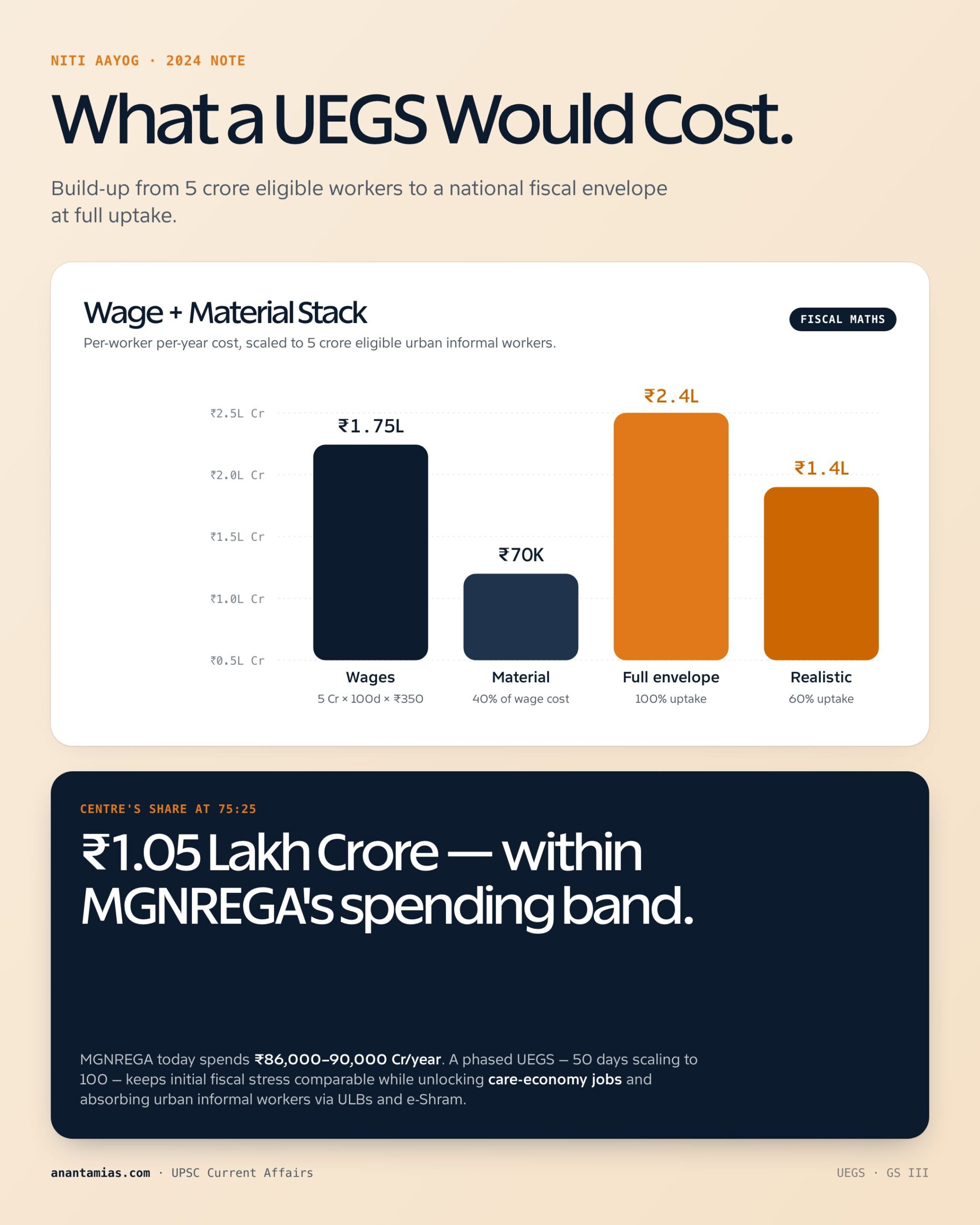
| Eligible urban informal workers | 5 crore |
| Days guaranteed per year | 100 |
| Notified daily wage (avg) | Rs 350 |
| Wage cost per worker per year | Rs 35,000 |
| Total wage cost (full uptake) | Rs 1.75 lakh crore |
| Material/asset cost (40% addition) | Rs 70,000 crore |
| Total fiscal envelope | ~Rs 2.4 lakh crore |
| Realistic uptake (60%) | ~Rs 1.4 lakh crore |
| Centre share at 75% | ~Rs 1.05 lakh crore |
This is comparable to MGNREGA's Rs 86,000-90,000 crore annual outlay. A phased rollout (start with 50 days, scale to 100) would lower initial fiscal stress.
A Care-Economy-Forward Design
A modern UEGS should reserve at least 30-40 percent of works for the care economy — anganwadi support, elderly care, palliative care, mental health outreach, school nutrition follow-up, ASHA-style community health. These works:
- Improve female labour participation.
- Generate human capital rather than just physical assets.
- Align with NEP 2020, Ayushman Bharat, Saksham Anganwadi 2.0.
- Ease constraints on women's safety at construction worksites.
A Roadmap to National Rollout
- Phase I (Year 1): Five state pilots converged into a national framework; UEGS Bill drafted.
- Phase II (Year 2): NUEGA enacted; 100 cities (capitals, Smart Cities) onboarded with 50-day guarantee.
- Phase III (Year 3-4): Expansion to all class-I cities (≥1 lakh population); 100-day guarantee phased in.
- Phase IV (Year 5+): Full national rollout with care-economy and apprenticeship tracks.
A measured rollout matches fiscal capacity, ULB capacity, and political consensus without overpromising.