New Parliament House — Central Vista, Features, Significance (UPSC Polity)
UPSC guide to the New Parliament House: Central Vista redevelopment, features, Sengol installation, controversies, capacity for delimitation, and 2024-26 functioning.
The New Parliament House of India was inaugurated on 28 May 2023 by Prime Minister Narendra Modi, marking a generational shift in the institutional architecture of Indian democracy. Built as part of the Central Vista Redevelopment Project, the new building replaces the iconic circular Sansad Bhavan designed by Sir Edwin Lutyens and Sir Herbert Baker between 1921 and 1927. The old building, which had served as the seat of the Imperial Legislative Council and post-independence Parliament for over 96 years, was constrained by structural age, fire safety norms, seismic standards, and — most critically — insufficient seating capacity for the post-2026 delimitation Lok Sabha.
For UPSC, the New Parliament House is more than an architectural fact. It connects to the delimitation debate, women's reservation rollout, simultaneous-elections committee, federalism (north-south seat realignment), heritage conservation, and the political symbolism of the Sengol installation. The 2024-26 functioning of the new building — its first full Budget Session in 2024, the 18th Lok Sabha taking oath in June 2024, the JPC sittings on Waqf and One Nation One Election bills — has tested its design and raised governance questions.
This guide covers the historical context, design rationale, key features, controversies, and the institutional significance of the New Parliament House for the next generation of Indian democracy.
Why a new Parliament House was needed
Structural and safety concerns
- Fire safety — the old Sansad Bhavan was not compliant with modern fire codes; multiple short-circuit incidents reported in 2010s.
- Seismic safety — the old building was designed for Seismic Zone II; Delhi was reclassified as Seismic Zone IV (high seismic risk). The original structure could not be retrofitted.
- Distressed infrastructure — water seepages, masonry damage, degraded aesthetics.
- Obsolete communication infrastructure — poor acoustics, outdated AV systems.
Capacity constraints
- The current Lok Sabha is capped at 552; actual strength 543.
- After delimitation post-2026 census, Lok Sabha strength is expected to rise to 800-848 members.
- The old chamber could seat only 552; could not accommodate post-delimitation expansion.
- Joint sittings of both Houses required temporary makeshift arrangements.
Workspace inadequacy
- Sub-partitions in the old building led to cramped MP offices.
- No central library complex.
- Inadequate space for committee meetings, secretarial staff, media.
The old Parliament House — historical context
Design and architecture
- Architects: Sir Edwin Lutyens and Sir Herbert Baker.
- Built 1921-1927.
- Inaugurated 18 January 1927 by then Viceroy Lord Irwin.
- Circular shape inspired by the Chausath Yogini Temple at Mitaoli, Morena (Madhya Pradesh) — though some historians dispute this attribution.
- Diameter: 170.69 m (560 ft).
- Originally housed the Imperial Legislative Council.
Post-independence
- First general election Lok Sabha elected in April 1952; first sitting on 13 May 1952.
- Two floors added in 1956 to expand workspace.
- Witnessed every constitutional amendment, every budget, and every key debate of Indian democracy for over 96 years.
Heritage status
- Designated as Grade-I heritage building by Heritage Conservation Committee, Delhi.
- The old building has been preserved and converted into a Constitution Museum ("Samvidhan Sadan").
Central Vista Redevelopment — the larger project
The new Parliament House is one piece of a much larger redevelopment of Lutyens' Delhi.
Scope of Central Vista
- New Parliament House (inaugurated 2023).
- Common Central Secretariat — 10 office buildings replacing scattered ministries.
- Executive Enclave — new PMO, Cabinet Secretariat, India House.
- National Museum — moving to North and South Blocks.
- Vice-President's Enclave and PM's residence — relocated.
- Refurbished Rajpath / Kartavya Path.
Project details
- Master plan architect: HCP Design, Planning and Management led by Bimal Patel.
- Project tender: 2019.
- Foundation laid: 10 December 2020 by PM Modi.
- Inaugurated: 28 May 2023.
- Cost: Initial estimate Rs. 971 crore; final cost ~Rs. 1,200+ crore.
- Constructed by: Tata Projects Ltd.
Features of the New Parliament House
Architectural design
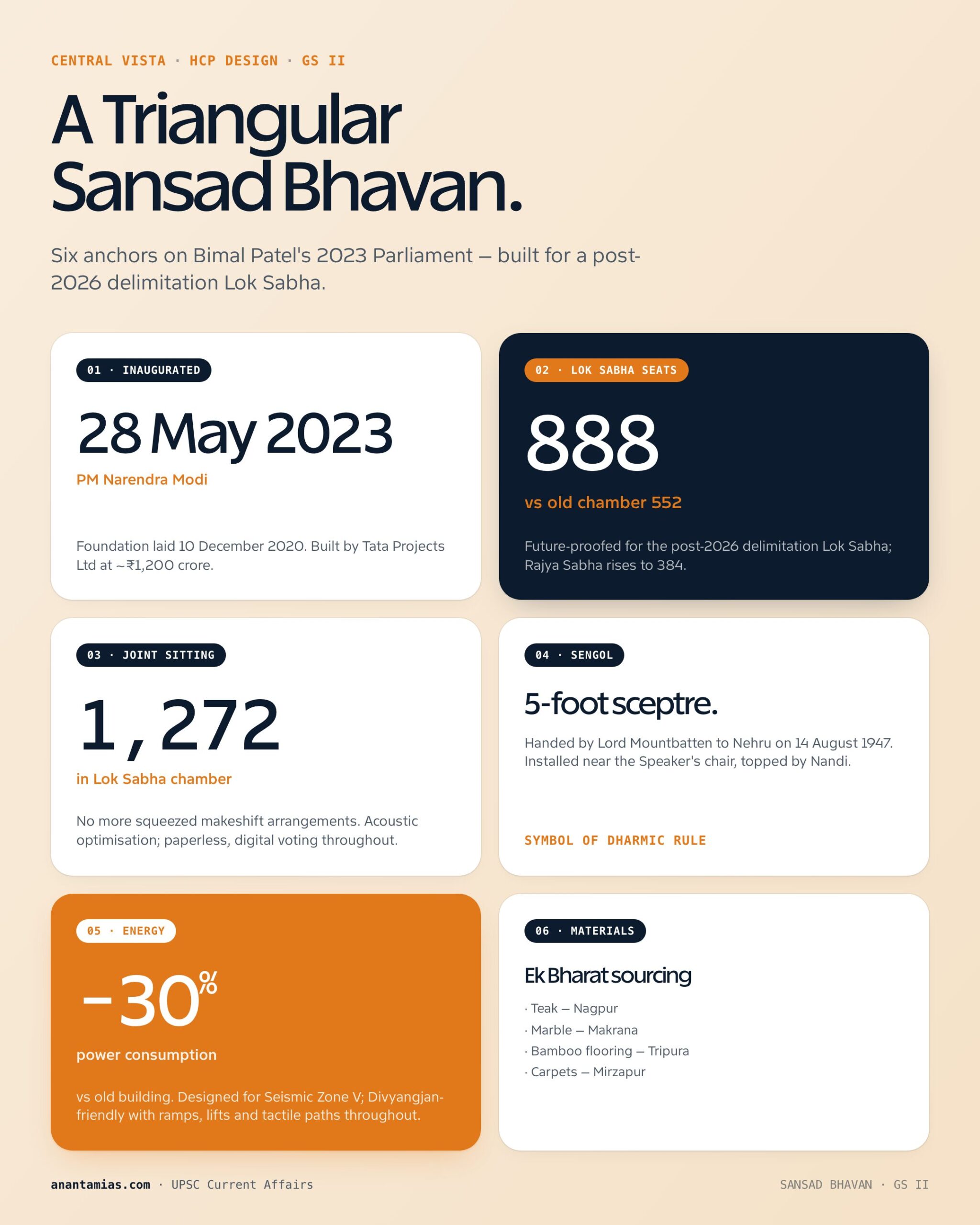
- Triangular shape — symbolising the diversity and dynamism of Indian society; also efficient for spatial use.
- Total area: ~64,500 sq metres.
- Four storeys including basement.
- Three main entrances: Gyan Dwar, Shakti Dwar, Karma Dwar.
- Six ceremonial gates: themed on water (Makara Dwar), land (Gaja Dwar), sky (Garuda Dwar), and others.
- Ek Bharat Shreshtha Bharat spirit — materials sourced from across India.
Materials sourced from India
| Material | Source |
|---|---|
| Wood (teak) | Nagpur, Maharashtra |
| Marble | Makrana (Rajasthan), Gujarat |
| Stone (red and white sandstone) | Sarmathura (Rajasthan) |
| Bamboo flooring | Tripura |
| Sandstone for carvings | Dholpur (Rajasthan) |
| Granite | Lakha (Rajasthan) |
| Carpets (hand-woven) | Mirzapur (Uttar Pradesh) |
| Brass works | Ahmedabad |
Capacity
| Chamber | New Parliament | Old Parliament |
|---|---|---|
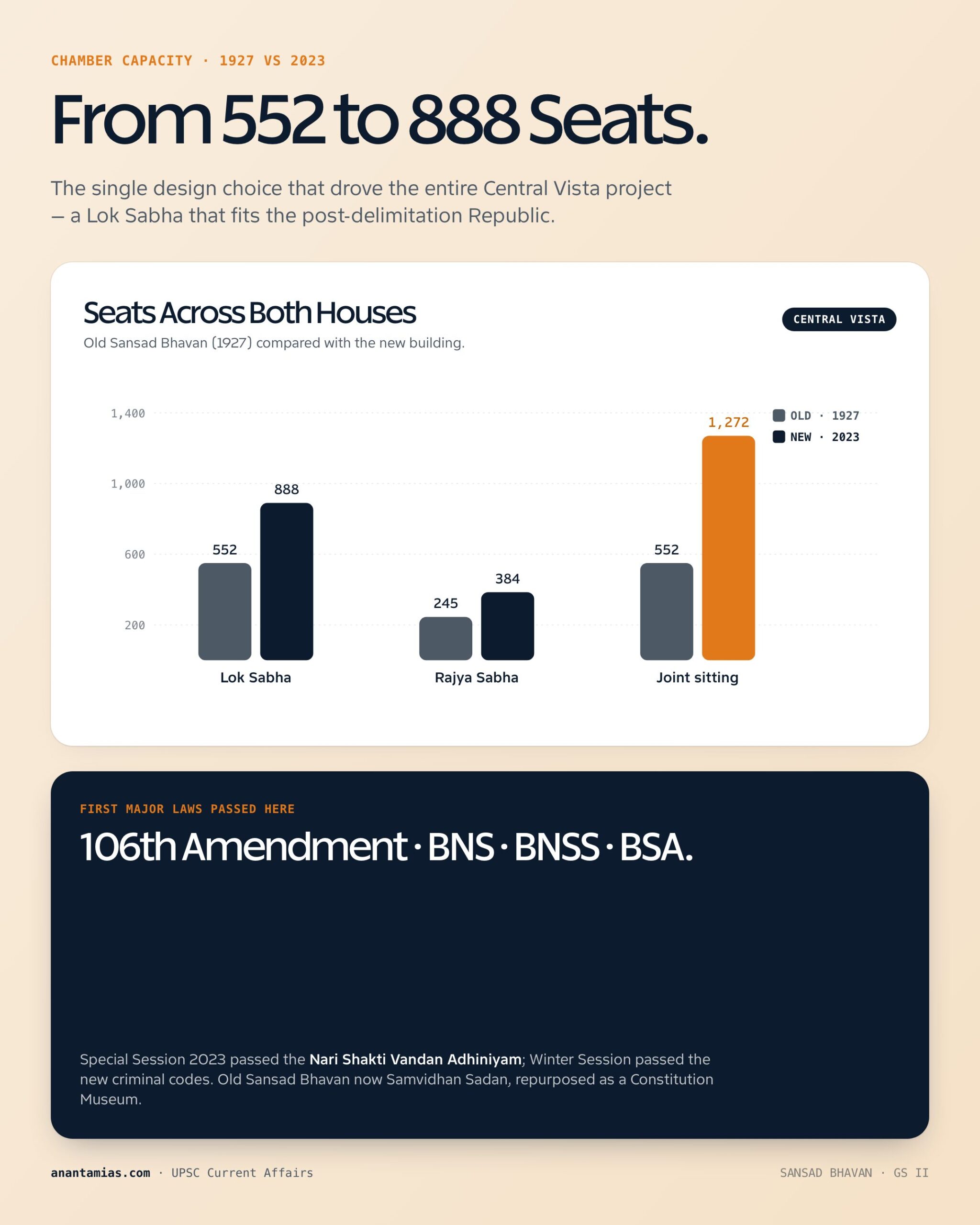
| Lok Sabha seats | 888 | 543 |
| Rajya Sabha seats | 384 | 245 |
| Joint sittings | 1,272 in Lok Sabha chamber | 552 (squeezed) |
The 888 seats are designed to accommodate post-delimitation Lok Sabha which could rise to ~800.
Symbolic elements
- National Bird Peacock — theme of Lok Sabha chamber.
- National Flower Lotus — theme of Rajya Sabha chamber.
- National Tree Banyan — Constitutional Court area.
- Sengol — installed near the Speaker's chair in Lok Sabha.
- Historic sceptre handed over by Lord Mountbatten to PM Nehru on 14 August 1947.
- Symbol of "transfer of power" and just rule (dharmic governance).
- Crafted by Vummidi Bangaru Chetty jewellers, Madras.
- 5 feet long, made of silver coated in gold, topped by Nandi (signifying justice).
- Ashok Stambh sculpture — at the entrance.
- Foucault Pendulum — symbolising India's place in the cosmos.
- Constitutional Gallery — with original copies of the Constitution.
Modern infrastructure
- Earthquake-resistant — designed for Zone V seismic standards.
- Eco-friendly — 30% reduction in power consumption vs old building.
- Completely paperless — digital voting, e-filing, video conferencing.
- Acoustic optimisation — clear sound capture for every member.
- Universal accessibility — Divyangjan-friendly with ramps, lifts, tactile paths.
- Constitution Hall — central feature with original copy of Constitution.
- Dedicated lounges for MPs, dining halls, library.
The new Parliament in operation (2024-26)
First Sessions
- Special Session, September 2023 — inaugural session in new building. Women's Reservation (106th Amendment) passed here.
- Winter Session 2023 — full functioning began; BNS, BNSS, BSA passed.
- Budget Session 2024 — first full Budget Session.
- 18th Lok Sabha (June 2024-) — newly elected MPs took oath; Speaker Om Birla re-elected.
- Special Sittings 2024 — JPC on Waqf, One Nation One Election deliberations.
Key events
- Sengol installation — 28 May 2023.
- PM's address to joint sitting — multiple occasions.
- President's address to Parliament — June 2024 inaugural session.
- G20 sidelines — visiting parliamentarians.
Controversies and concerns
Cost and timing
- Project went ahead during COVID-19 pandemic — criticised for spending priorities.
- Cost overruns — initial Rs. 971 crore became Rs. 1,200+ crore.
- Questions about transparency in tendering.
Heritage debate
- Critics argued the old building should have been retrofitted, not retired.
- Heritage conservationists raised objections.
- Supreme Court in Rajeev Suri v. DDA (2021) upheld the project, holding that environmental and heritage clearances were properly obtained.
Sengol political controversy
- Opposition questioned the religious-spiritual symbolism.
- Government emphasised the historical "transfer of power" significance.
- Cultural debate over inclusion of religious objects in secular institutions.
Functioning concerns
- Acoustic problems reported in initial sittings.
- Connectivity issues with paperless voting in early sessions.
- Some MPs raised concerns about seating sightlines.
- Suspension of MPs — December 2023, 146 MPs suspended; raised questions about disciplinary use of new chamber.
Symbolic debate
- "Naming" question — should old Parliament be renamed Samvidhan Sadan? (formally renamed Samvidhan Sadan in 2023)
- Some opposition members boycotted the inauguration ceremony.
Significance for Indian democracy
| Dimension | Significance |
|---|---|
| Capacity | Future-proofs Parliament for post-2026 delimitation |
| Symbolism | Departs from colonial design; anchors Indian motifs |
| Federalism | Materials and motifs from every state — Ek Bharat Shreshtha Bharat |
| Functionality | Modern committee rooms, library, accessibility |
| Sustainability | 30% energy reduction; paperless |
| Heritage | Old building converted to Samvidhan Sadan / Constitution Museum |
Linked institutional reforms
The new building coincides with multiple reform debates:
- Delimitation — capacity for post-2026 seat allocation; raises North-South balance question.
- Nari Shakti Vandan Adhiniyam (106th Amendment, 2023) — reservation of 33% Lok Sabha seats for women, dependent on delimitation.
- One Nation One Election — Kovind Committee report (March 2024); JPC examining bills.
- Productivity reforms — does new architecture enable better debate?
- Bharatiya Nyaya Sanhita series — first major laws passed in new building.
- Women's representation — 18th LS has 14% women MPs; up modestly from 17th LS.
Mains-style answer hook
"The New Parliament House is the most consequential institutional architecture of independent India since the Constitution itself. Inaugurated in May 2023, designed by Bimal Patel, equipped to seat 888 in the Lok Sabha and 384 in the Rajya Sabha, it future-proofs Indian Parliament for the post-2026 delimitation. The Sengol installation, the Ek Bharat Shreshtha Bharat material sourcing, and the Samvidhan Sadan repurposing of the old building together signal a generational transition. Whether the building elevates the quality of debate, dialogue, and dissent — Parliament's three Ds — depends not on architecture but on procedural reform, committee strengthening, and an independent Speaker. The new chamber is the canvas; what India paints on it is yet to unfold."
Prelims pointers
- Inaugurated: 28 May 2023 by PM Narendra Modi.
- Foundation laid: 10 December 2020.
- Architect: Bimal Patel, HCP Design, Planning and Management.
- Built by: Tata Projects Ltd.
- Cost: ~Rs. 1,200+ crore.
- Shape: triangular.
- Capacity: Lok Sabha 888, Rajya Sabha 384, joint sitting 1,272.
- Sengol: handed by Lord Mountbatten to Nehru on 14 August 1947; installed in new Lok Sabha.
- Old Sansad Bhavan: designed by Lutyens and Baker, 1921-1927; renamed Samvidhan Sadan.
- Themes: peacock (LS), lotus (RS), banyan (Constitutional Court area).
- Materials: teak (Nagpur), marble (Makrana), bamboo flooring (Tripura).
FAQ
Why was a new Parliament House needed?
Capacity (post-2026 delimitation), structural and seismic safety, fire safety norms, modern infrastructure requirements.
What is the Sengol?
The historic sceptre handed over by Lord Mountbatten to PM Nehru on 14 August 1947 as a symbol of transfer of power. It was installed near the Speaker's chair in the new Lok Sabha on 28 May 2023.
Who designed the new Parliament?
Architect Bimal Patel of HCP Design, Planning and Management — the same firm that did the Sabarmati Riverfront and Kashi Vishwanath Corridor.
What happens to the old Parliament?
The old Sansad Bhavan has been renamed Samvidhan Sadan and is being converted into a Constitution Museum.
Related: Parliament, Women's Reservation Act, Delimitation, Standing Committee Report Summary.