OBC Non-Creamy Layer: Meaning, Income Limit & UPSC Notes
Complete guide to OBC Non-Creamy Layer — definition, income limit, Mandal Commission, Indra Sawhney case, and UPSC Prelims and Mains relevance.
Introduction
The OBC Non-Creamy Layer (OBC-NCL) is a sub-category within India's Other Backward Classes (OBC) framework. Only candidates from the non-creamy layer are eligible for the 27% reservation in central government jobs, higher education institutions like IITs, IIMs, AIIMS, and central universities. The concept separates the socially and economically advanced sections of OBCs from those still requiring affirmative action.
This guide explains the meaning, historical origin, current income limit, identification criteria, key court cases, and UPSC relevance.
What Is the Creamy Layer
The creamy layer refers to the relatively forward members among OBCs who are excluded from reservation benefits so that affirmative action reaches those who truly need it. The non-creamy layer is the remainder — genuine OBC candidates eligible for reservation.
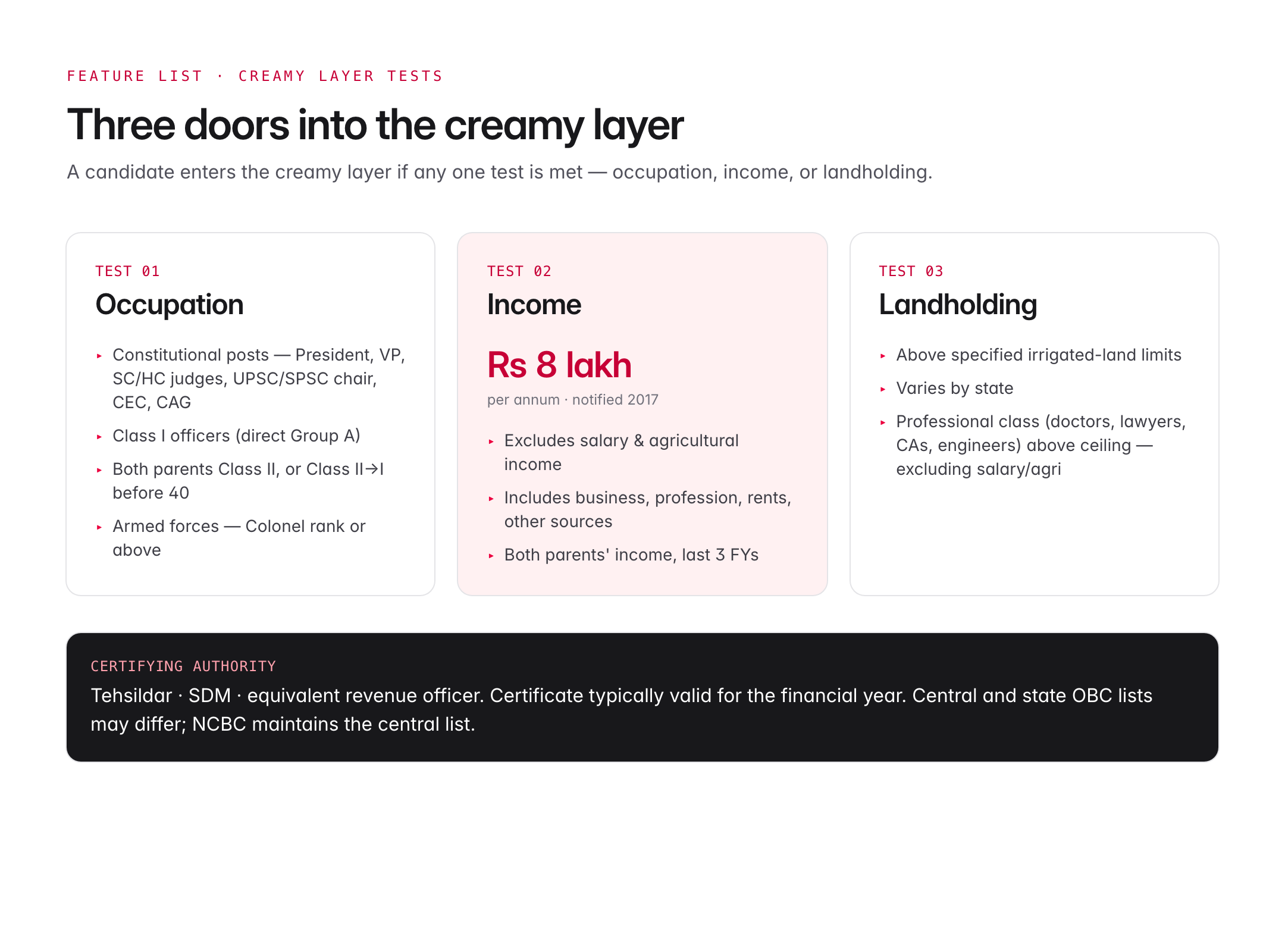
The test is based on three parameters:
- Occupation / Designation of parents (in government or armed forces).
- Family income from sources other than salary and agriculture.
- Landholdings above specified urban/rural limits.
Origin: Mandal Commission and After
- Mandal Commission (1979) under B.P. Mandal submitted its report in 1980, recommending 27% reservation for Socially and Educationally Backward Classes (SEBCs) in central government jobs.
- V.P. Singh government (1990) implemented the recommendations through an office memorandum.
- The decision sparked nationwide protests and was challenged in the Indra Sawhney v. Union of India case (1992).
Indra Sawhney v. Union of India (1992) — The Mandal Judgment
A 9-judge Supreme Court bench upheld the 27% OBC reservation but introduced critical safeguards:
- Total reservations must not exceed 50% (except in extraordinary circumstances).
- Reservations do not apply to promotions for OBCs.
- A creamy layer must be excluded from OBC reservation.
- Economic criteria alone cannot be the basis of reservation.
Following this ruling, the central government constituted the Justice R.N. Prasad Committee, which in 1993 issued the first set of creamy layer criteria.
Current Income Limit
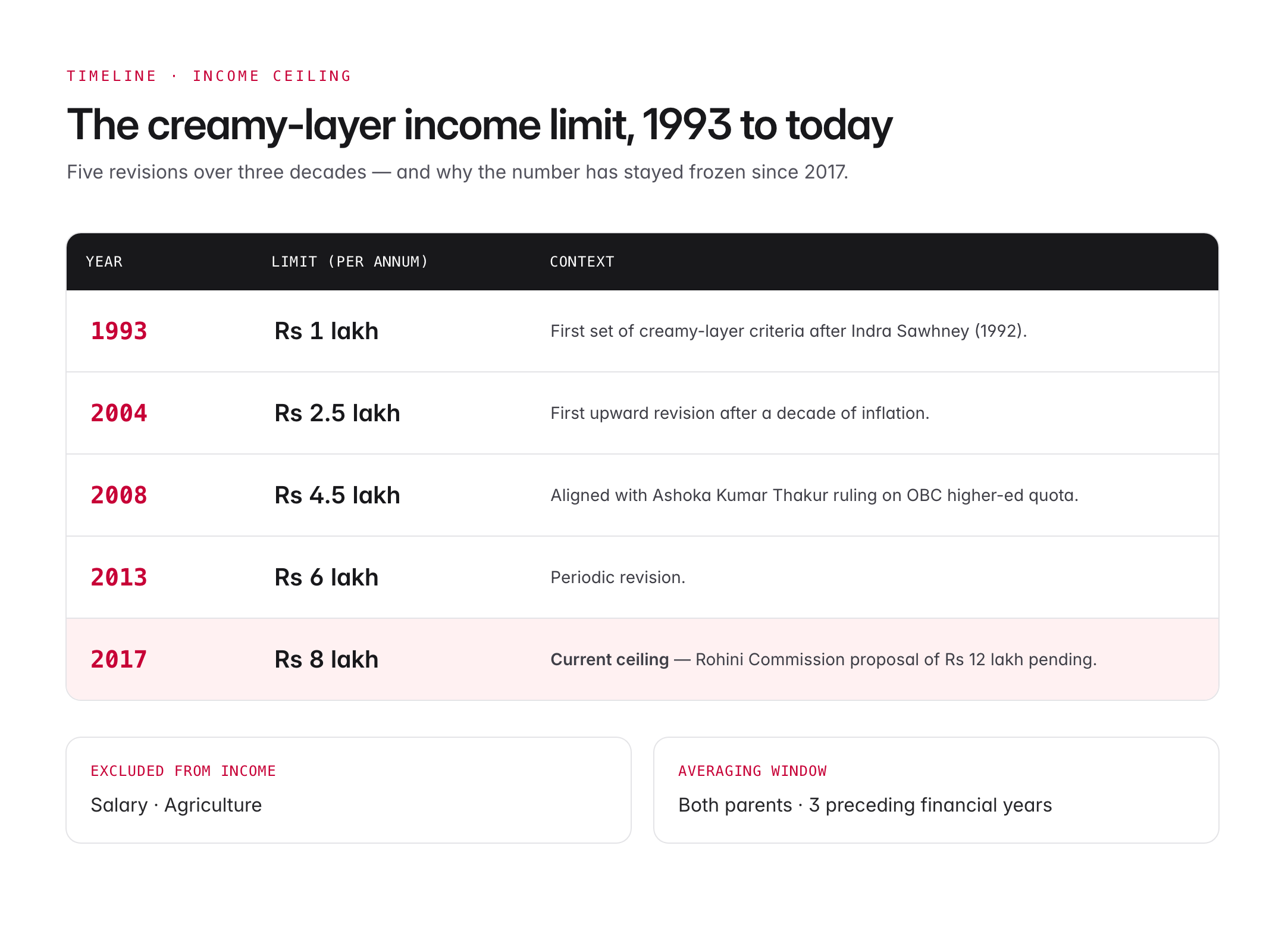
The creamy layer income ceiling has been revised periodically:
| Year | Income Limit (per annum) |
|---|---|
| 1993 | Rs 1 lakh |
| 2004 | Rs 2.5 lakh |
| 2008 | Rs 4.5 lakh |
| 2013 | Rs 6 lakh |
| 2017 | Rs 8 lakh |
The current ceiling is Rs 8 lakh per annum (as notified in 2017). A proposal to raise it to Rs 12 lakh, examined by the Justice G. Rohini Commission, has not yet been formally implemented.
What Counts Toward the Rs 8 Lakh
- Income from salary and agriculture is excluded when computing the limit.
- Income from business, profession, rents, and other sources is included.
- Income of both parents is added together over the three preceding financial years.
Creamy Layer Criteria Beyond Income
Apart from the income test, candidates may be classified in the creamy layer based on parental occupation:
- Constitutional posts: Children of President, Vice-President, Supreme Court/High Court judges, UPSC/SPSC chairpersons, CEC, CAG.
- Class I officers: Children of directly recruited Group A officers of central/state government.
- Class II officers: Where both parents are Class II officers, or one parent is promoted to Class I before age 40.
- Armed forces: Children of officers at Colonel rank or equivalent and above.
- Private sector: Income and social status evaluated equivalently.
- Professional class: Doctors, lawyers, engineers, CAs earning above the income ceiling (excluding salary/agriculture).
- Landholdings: Above specified irrigated land limits (varies by state).
Certification Process
- OBC-NCL status is certified by a Tehsildar, SDM, or equivalent competent revenue authority.
- Certificates are typically valid for one financial year for recruitment and admissions.
- Candidates applying to central jobs or central educational institutions must provide a recent certificate (usually within the same financial year).
- State-level OBC lists may differ from the central OBC list maintained by the National Commission for Backward Classes (NCBC).
National Commission for Backward Classes (NCBC)
- Initially established in 1993 as a statutory body under the NCBC Act.
- Granted constitutional status through the 102nd Constitutional Amendment Act, 2018, inserting Article 338B.
- 105th Constitutional Amendment (2021) restored state governments' power to identify SEBCs after the Maratha Reservation judgment.
Key Supreme Court Cases
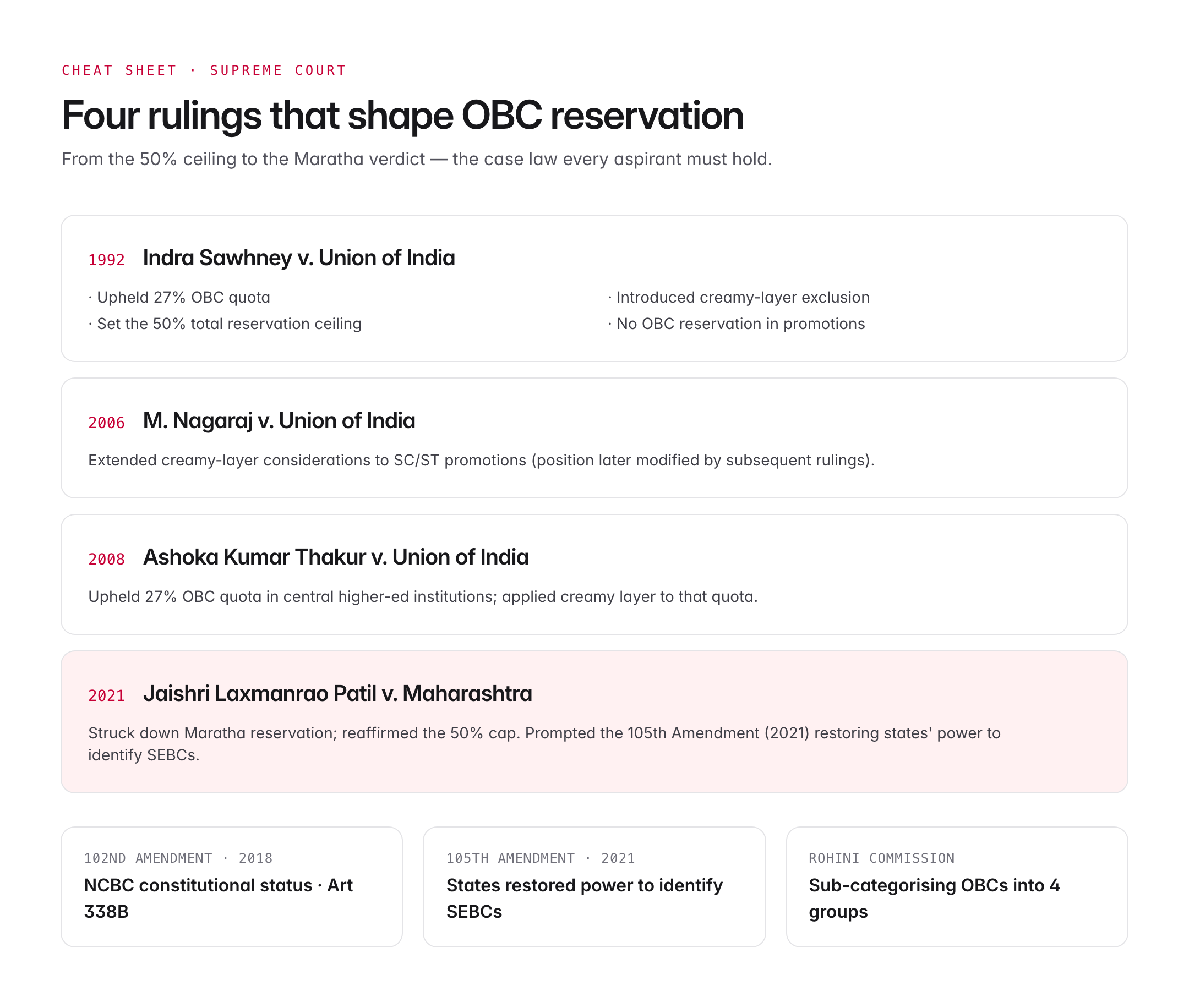
| Case | Significance |
|---|---|
| Indra Sawhney v. UoI (1992) | Upheld 27% OBC quota; introduced creamy layer and 50% ceiling |
| Ashoka Kumar Thakur v. UoI (2008) | Upheld 27% OBC quota in central educational institutions; applied creamy layer to OBC reservation in higher education |
| M. Nagaraj v. UoI (2006) | Extended creamy layer principle considerations to SC/ST promotions (modified later) |
| Jaishri Laxmanrao Patil v. Maharashtra (2021) | Struck down Maratha reservation; reaffirmed 50% cap |
Debates and Criticisms
- Income ceiling indexation: Rs 8 lakh has been unchanged since 2017; inflation has eroded its real value.
- Justice Rohini Commission: Examining sub-categorisation of OBCs into four groups for more equitable distribution of the 27%.
- Inclusion of salary/agriculture: Excluding these makes actual income estimates much higher than Rs 8 lakh.
- State vs central lists: Differing criteria cause confusion for students appearing in national exams.
- EWS overlap: The Rs 8 lakh figure is identical to the EWS ceiling, creating confusion — but EWS excludes SC/ST/OBC, whereas OBC-NCL applies within OBC.
UPSC Relevance
Prelims angle: Memorise the Rs 8 lakh income limit (2017 onward), the 27% quota, the 50% ceiling from Indra Sawhney, NCBC constitutional status via 102nd Amendment (Article 338B), and the exclusions (salary and agriculture). Common MCQs test creamy layer exclusions and NCBC powers.
Mains GS I and GS II angle: Use OBC-NCL in answers on social justice, affirmative action, Mandal politics, inclusive growth, and constitutional reservations. Compare with EWS quota (103rd Amendment) and SC/ST reservation in promotions.
PYQ angle:
- "Whether the Supreme Court Judgement (July 2018) can settle the political tussle between the Lt. Governor and elected government of Delhi?" — Use reservation jurisprudence framing.
- "What are the two major legal initiatives by the State since Independence, addressing discrimination against Scheduled Tribes (STs)?" (Mains 2017)
- Prelims 2021: MCQ on creamy layer concept.
OBC-NCL is a high-yield topic connecting polity, society, and current affairs.