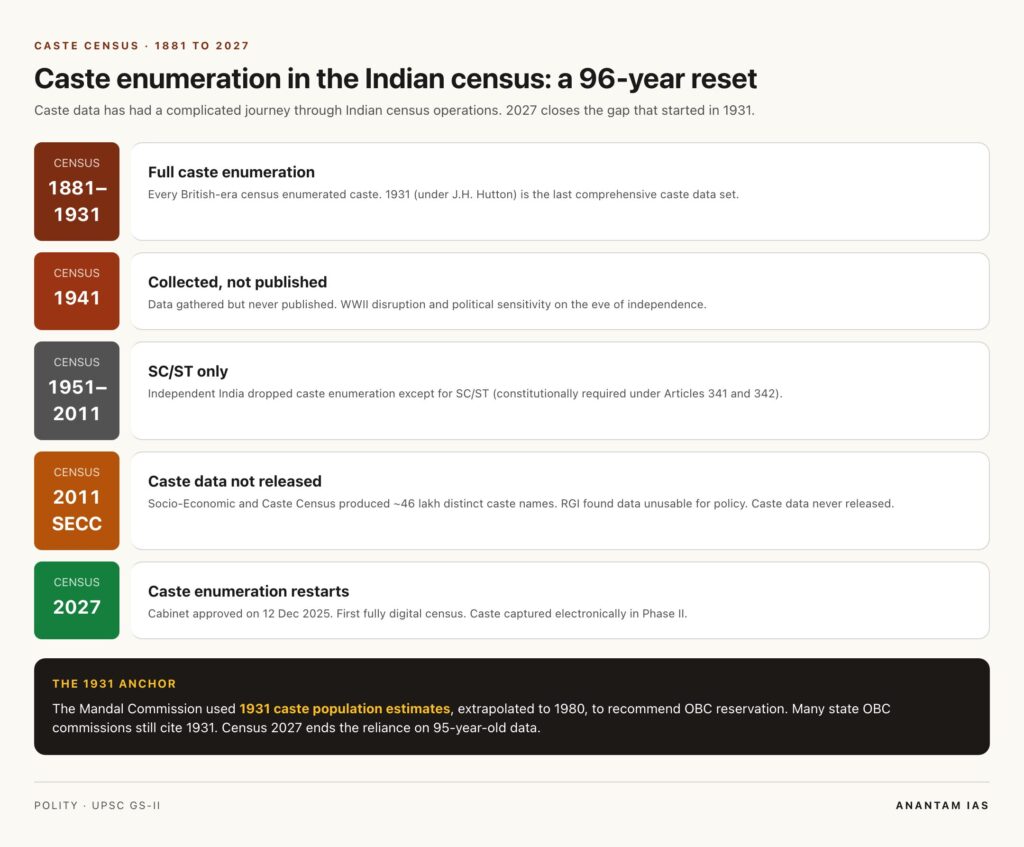
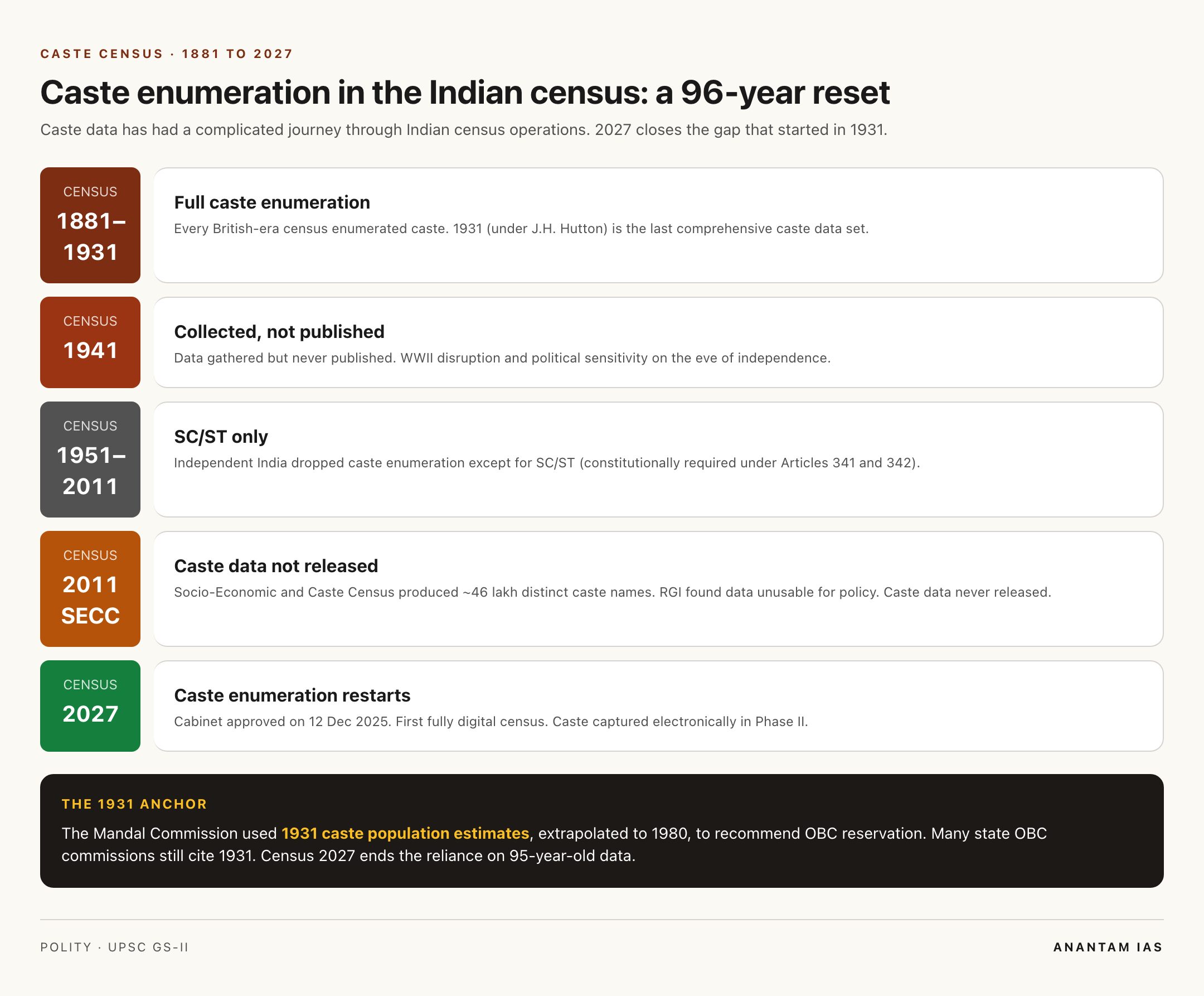
The Union Cabinet, chaired by the Prime Minister, approved the proposal for the Census of India 2027 on 12 December 2025, making 2027 the year India returns to the decennial census after the 2021 round was deferred owing to the COVID-19 pandemic. More consequentially, the Cabinet Committee on Political Affairs simultaneously decided to include caste enumeration in Census 2027. This is the first time since 1931 that comprehensive caste data, beyond the Scheduled Castes and Scheduled Tribes, will be collected as part of a decadal census operation.
The decision settles a debate that has run for almost a decade. The 2011 Socio-Economic and Caste Census, SECC, was conducted as a separate exercise alongside the 2011 census, but its caste data was never released because the data set returned an estimated 46 lakh distinct caste names, and the Registrar General of India found the data unusable for policy. State governments such as Bihar and Karnataka subsequently conducted their own caste surveys, anchored on Entry 45 of the Concurrent List, while pressing the Centre to take up a national caste census. The 12 December 2025 approval ends that wait.
This guide unpacks the constitutional and legal framework of the caste census, the difference between the decennial census and the SECC, the historical context dating back to 1881, the technological innovations of the 2027 round, and the prelims and mains-relevant pointers.
Quick Facts on the Caste Census
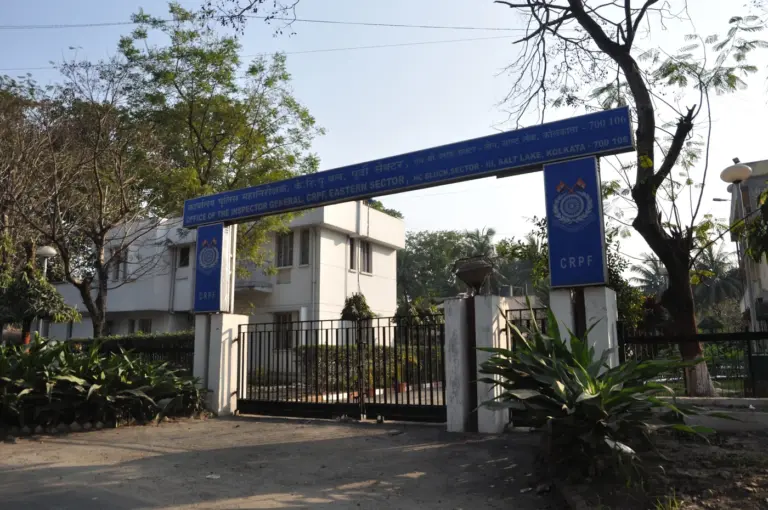
The Cabinet approved Census 2027 on 12 December 2025. It will be the 16th Census of India and the 8th since independence. Caste enumeration will be part of the Population Enumeration phase. The last comprehensive caste enumeration in a decadal census was in 1931. Caste data was collected in 1941 but not published. The 2011 SECC was a separate exercise; its caste data was never released. Census is an exclusive Union subject under Entry 69 of the Union List in the Seventh Schedule. Census 2027 will be conducted under the Census Act, 1948 and the Census Rules, 1990. The nodal authority is the Office of the Registrar General and Census Commissioner of India under the Ministry of Home Affairs. Census 2027 will be India’s first fully digital census, with mobile-based enumeration and an option for self-enumeration online.
What a Caste Census Is
A caste census is the enumeration of caste identity as part of a national census operation, alongside age, sex, religion, education, occupation and other demographic variables. In the Indian context, a caste census typically refers to the enumeration of all castes, including Scheduled Castes, Scheduled Tribes, Other Backward Classes, and other castes, as part of the decennial census conducted under the Census Act, 1948.
Background and Historical Context
Caste data has had a complicated journey through Indian census operations. From 1881 to 1931, every British-era census in India enumerated caste. The 1931 census, conducted under the supervision of J.H. Hutton, remains the last comprehensive caste-wise data set in Indian census history. The 1941 census did collect caste information, but the data was never published, partly because of the disruption caused by the Second World War and partly because of the political sensitivity of caste data on the eve of independence.
After independence, the Government of India took a deliberate decision in the 1951 census not to enumerate caste, except for Scheduled Castes and Scheduled Tribes whose enumeration was constitutionally required for affirmative action under Articles 341 and 342. The reasoning, articulated by Sardar Patel and others at the time, was that enumerating caste would entrench rather than dissolve caste identities and that an independent India should not normalise caste counting. This position held through every census from 1951 to 2011.
The 2011 SECC was an attempt to bridge the gap. It was conducted as a separate exercise alongside the 2011 decennial census, with the rural component handled by the Ministry of Rural Development, the urban component by the Ministry of Housing and Urban Affairs, and the caste enumeration by the Registrar General of India. The SECC produced socioeconomic data that has been used for benefits targeting under PM Awas Yojana, MGNREGS, Ayushman Bharat and other schemes. But the caste data, returning approximately 46 lakh distinct caste names because of variations in spelling and self-reporting, was never released for use.
State surveys filled the policy vacuum partially. The Bihar caste survey of 2022 to 2023 produced state-level caste data that was used to design state-specific reservation policies. The Karnataka caste survey conducted earlier under the Kantharaj Commission also produced data, though it has been subject to political contestation. The 12 December 2025 Cabinet decision to include caste enumeration in Census 2027 closes the debate at the central level.
Census vs SECC: The Critical Distinction
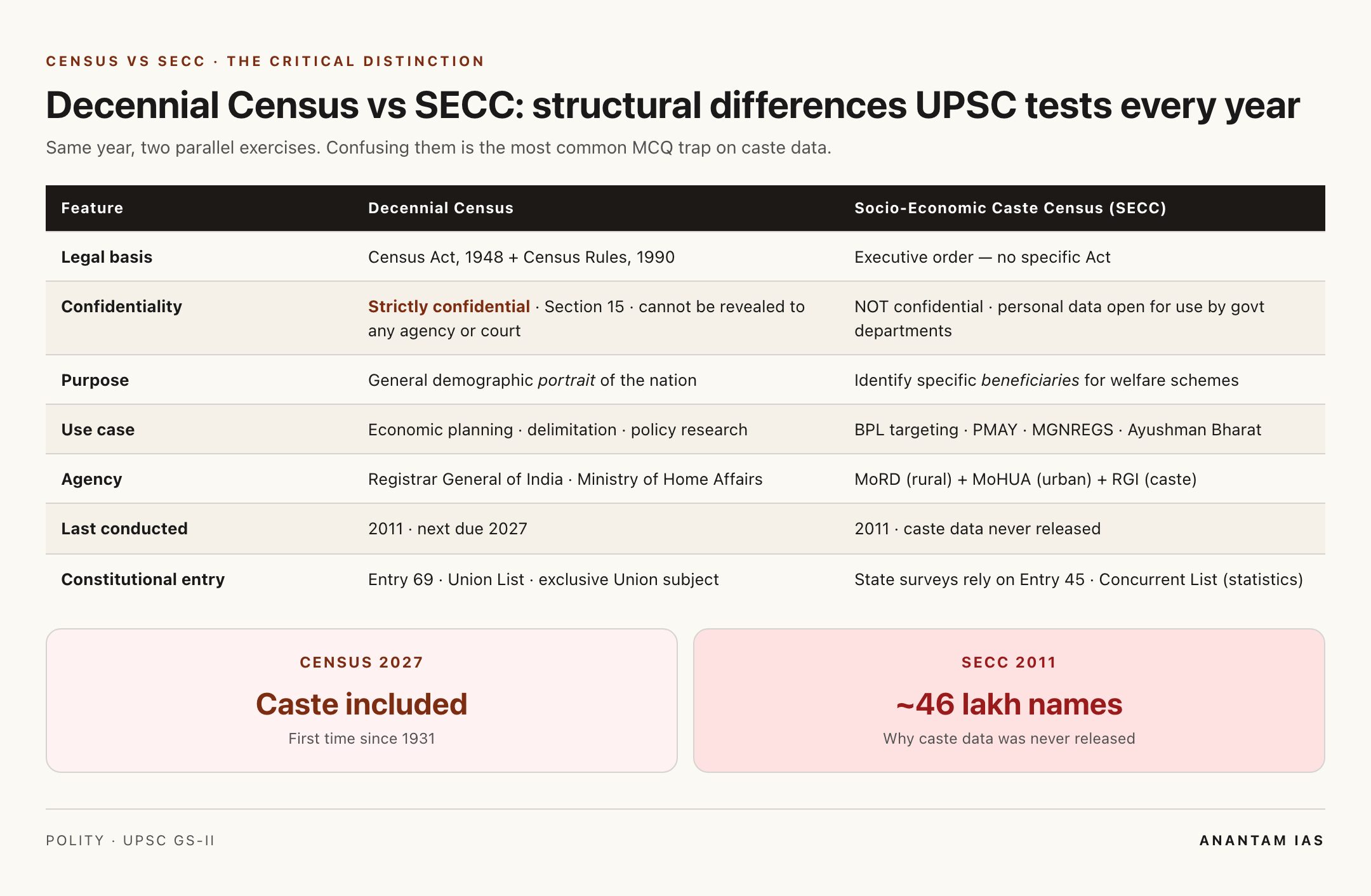
The decennial census and the SECC are structurally different exercises, and conflating them is one of the most common errors in MCQs. The decennial census is conducted under the Census Act, 1948. SECC was conducted under an executive order in 2011, with no specific statutory basis.
The decennial census carries strict confidentiality protections. Under Section 15 of the Census Act, 1948, individual data collected during the census is confidential, cannot be revealed to any agency, and cannot be summoned by any court of law. SECC data, by contrast, is not confidential in the same statutory sense. Personal data from SECC is open for use by government departments to grant or restrict benefits, and many welfare schemes use SECC data as the eligibility filter.
The purpose differs. The decennial census provides a general demographic portrait of the nation, used by economists, planners and researchers across sectors. SECC was designed to identify specific beneficiaries for welfare schemes, particularly to replace the older below-poverty-line, BPL, methodology with an automatically computed deprivation index. The agency differs too. The decennial census is conducted entirely by the Registrar General of India under the Ministry of Home Affairs. SECC was conducted jointly by the Ministry of Rural Development for rural areas, the Ministry of Housing and Urban Affairs for urban areas, and the RGI for the caste component.
Constitutional and Legal Framework
Three constitutional provisions structure the caste census debate, mapped within the broader Indian Polity notes and the Seventh Schedule of the Indian Constitution. Entry 69 of the Union List in the Seventh Schedule places “Census” exclusively under Union competence. This is why state-level caste surveys, such as those conducted by Bihar and Karnataka, are technically described as “surveys” rather than censuses, and rely instead on Entry 45 of the Concurrent List, which deals with collection of statistics. Article 340 empowers the President to appoint a Commission to investigate the conditions of socially and educationally backward classes within the territory of India, and to make recommendations on steps to remove their difficulties. Caste data is essential for fulfilling Article 340. Articles 341 and 342 deal with the Presidential notification of Scheduled Castes and Scheduled Tribes lists.
The reservation framework that flows from these provisions also intersects with the basic structure doctrine jurisprudence on equality and affirmative action. A subtle but important distinction within these provisions is that Scheduled Caste status is religion-specific, available only to persons professing Hinduism, Sikhism or Buddhism, while Scheduled Tribe and Other Backward Class status are religion-neutral and available across faiths. This difference, encoded in successive constitution orders and the SC/ST and OBC lists, has implications for how caste data is interpreted in policy.
Why a Caste Census Is Needed Now
Three policy imperatives drive the renewed demand for caste data. The first is the work of the Rohini Commission, set up in 2017 under Article 340 to look into the sub-categorisation of OBCs, recognising that benefits within the OBC reservation pool have been concentrated in a few dominant communities. The Commission has repeatedly noted the difficulty of doing rigorous sub-categorisation without population data on individual OBC castes.
The second is the 50 percent ceiling on reservations laid down by the Supreme Court in Indra Sawhney v. Union of India in 1992. Several states have argued that they need to exceed this ceiling to provide adequate reservation for SCs, STs and OBCs whose population share, in those states, exceeds the 50 percent cap. The M. Nagaraj judgment in 2006 and the Jarnail Singh judgment in 2018 have made it clear that any deviation from the cap or any reservation in promotions requires “quantifiable data” of backwardness, inadequate representation, and overall administrative efficiency. Without a caste census, generating that quantifiable data is difficult.
The third is the Supreme Court’s 2024 ruling in State of Punjab v. Davinder Singh, which held that states can sub-classify SCs and STs to give preferential treatment within reserved categories to those who are more backward. This judgment requires fresh empirical data on which sub-castes within the SC and ST lists are more deprived. A caste census is the most reliable way to generate that data.
Detailed Analysis of Census 2027
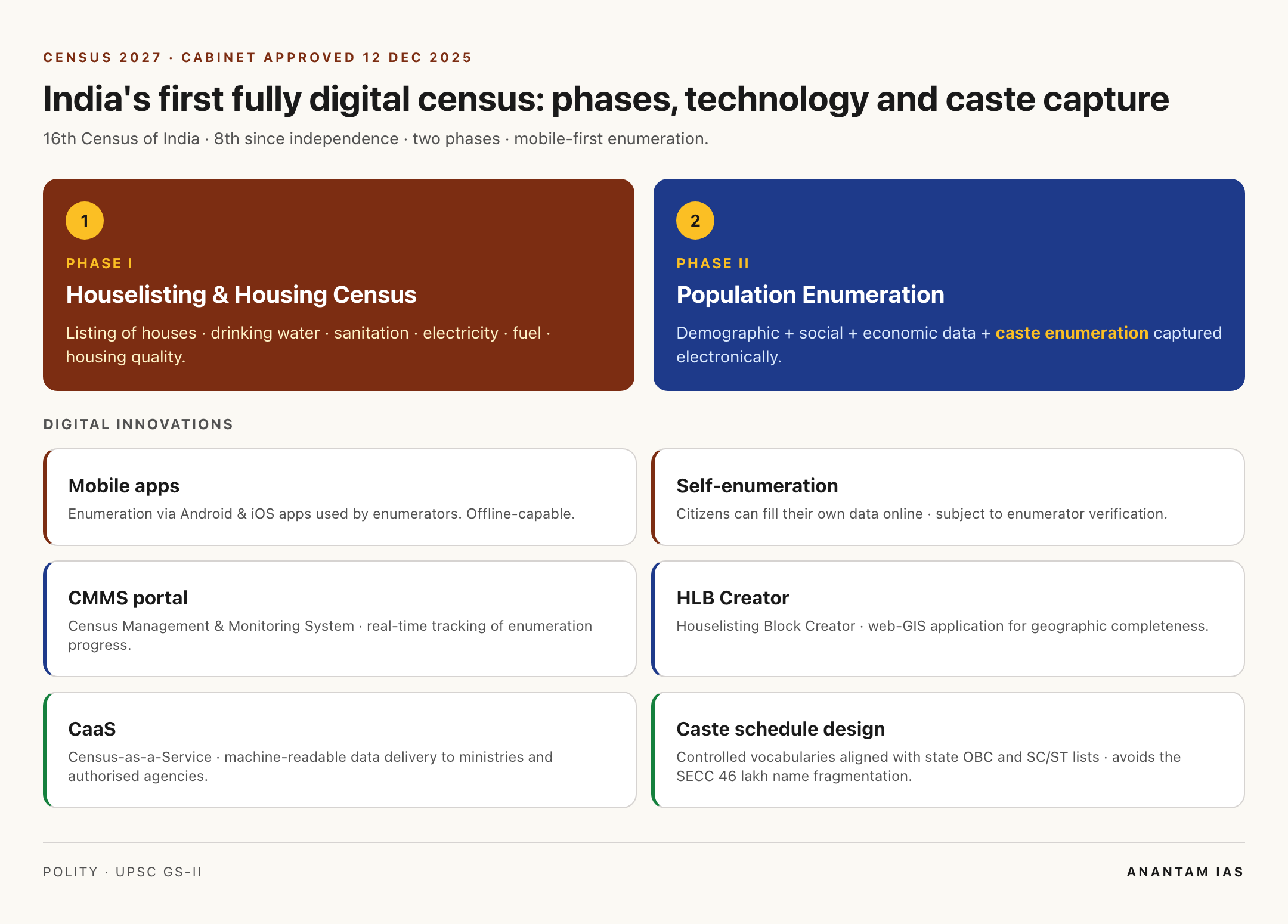
Census 2027 will be conducted in two phases under the Census Act, 1948 and the Census Rules, 1990. Phase I is the Houselisting and Housing Census, which lists all houses in the country and assesses amenities such as drinking water, sanitation, electricity, fuel and housing quality. Phase II is the Population Enumeration, which collects demographic, social and economic data on every individual, including caste.
The 2027 round will be the first fully digital census in Indian history. Data collection will be primarily through mobile applications on Android and iOS devices used by enumerators. A new self-enumeration option will allow citizens to fill in their own data online, subject to verification by enumerators. The technology stack includes the Census Management and Monitoring System portal, the CMMS, for real-time tracking of enumeration progress. The Houselisting Block Creator, HLB Creator, is a web-based GIS application that maps enumeration blocks and ensures geographic completeness. The Census-as-a-Service module, CaaS, is designed to deliver data in clean, machine-readable formats to ministries and authorised agencies.
Caste enumeration will be conducted electronically during Phase II. The methodology, including the question wording and the design of the caste schedule, has been debated extensively. The challenge that derailed SECC 2011, the proliferation of distinct caste names because of self-reporting, will need to be managed through careful schedule design, controlled vocabularies and post-enumeration data cleaning aligned with state-level OBC and SC/ST lists.
Why the 1931 Reset Matters
The 1931 figures continue to anchor much of India’s caste-based affirmative action policy, simply because there is no more recent comprehensive caste data set. The Mandal Commission, which recommended OBC reservation in 1980, used 1931 caste population estimates extrapolated to its time. Many state-level OBC commissions still cite 1931 figures. The use of 95-year-old data to design contemporary reservation policy is hard to defend on any rigorous methodological standard. Census 2027 ends that anachronism.
The 1931 reset also recalibrates the political conversation. Several political parties have argued that the share of OBCs in the population has historically been understated, and that quantifying their share through a contemporary census will make the case for a higher reservation share more rigorous. Others have argued the opposite, that quantification will reveal that some OBC sub-castes are heavily over-represented in benefits while others are under-represented, justifying the kind of sub-categorisation that the Rohini Commission has been working on.
Comparative Approach: Caste Surveys in States
Bihar conducted a caste-based survey in 2022 and released the results in October 2023, finding that OBCs and EBCs together comprised 63 percent of the state’s population. The survey was not technically a census but a survey under Entry 45 of the Concurrent List. The Patna High Court and the Supreme Court declined to halt the survey. Karnataka conducted a Socio-Economic and Educational Survey under the Kantharaj Commission in 2014 to 2015, but the report has been politically contested. Telangana and Andhra Pradesh have also conducted surveys at various scales. These state surveys provide useful templates for design but cannot substitute for a national census, which alone provides comparable, standardised, all-India data under a common statutory framework.
Challenges in the 2027 Round
Five challenges define the 2027 round. The first is the design of the caste schedule. The 2011 SECC produced 46 lakh distinct caste names because of free-text self-reporting, and the 2027 round will need to use controlled vocabularies and dropdown menus aligned with state-level OBC and SC/ST lists to avoid that fragmentation. The second is data integrity. Caste self-identification in a politically charged environment can be subject to strategic misreporting, particularly where benefits are at stake. The third is digital infrastructure. A fully digital census in a country with significant connectivity gaps requires offline-capable applications and robust synchronisation logic. The fourth is timeline. The full operational plan for Phase I and Phase II will likely run through 2027 and into 2028, with data publication in stages thereafter. The fifth is political management. Releasing caste data has political consequences for reservation policy, sub-categorisation debates and state-level political alignments.
Prelims Pointers
Census 2027 was approved by the Union Cabinet on 12 December 2025. It will be the 16th Census of India and the 8th since independence. Caste enumeration will be part of Phase II, the Population Enumeration. The last comprehensive caste enumeration was in 1931. Census is an exclusive Union subject under Entry 69 of the Union List. State-level caste surveys are conducted under Entry 45 of the Concurrent List. Census 2027 will be conducted under the Census Act, 1948 and the Census Rules, 1990. The nodal authority is the Registrar General and Census Commissioner of India under the Ministry of Home Affairs. The 2011 SECC caste data was never released. Article 340 empowers the President to appoint a backward classes commission. Articles 341 and 342 deal with the SC and ST lists. The Indra Sawhney judgment of 1992 set the 50 percent reservation cap. The 2024 ruling in Davinder Singh allowed states to sub-classify SCs and STs.
Mains Practice Questions
- “The decision to include caste enumeration in Census 2027 closes a 96-year gap in Indian demographic data.” Discuss the policy implications of this decision for reservation, welfare and political representation. (GS Paper 2, 250 words)
- Distinguish between the decennial census and the Socio-Economic and Caste Census in terms of legal basis, confidentiality and policy use. Why was the SECC 2011 caste data not released? (GS Paper 2, 250 words)
- Examine the constitutional framework for the enumeration of socially and educationally backward classes in India, with reference to Articles 340, 341 and 342. (GS Paper 2, 150 words)
- Census 2027 will be India’s first fully digital census. Discuss the technological innovations and the implementation challenges of moving census operations to a digital platform. (GS Paper 2, 150 words)
Way Forward
A successful caste census needs four enabling conditions. First, a careful design of the caste schedule using controlled vocabularies aligned with state-level OBC and SC/ST lists, drawing on lessons from SECC 2011 and from state surveys conducted in Bihar and Karnataka. Second, a robust digital backbone that works offline, synchronises reliably and maintains the strict confidentiality protections required by the Census Act, 1948. Third, a clear data publication plan that distinguishes between aggregate caste data, which can be released for policy use, and individual records, which remain confidential. Fourth, a credible institutional framework for using caste data, including the Rohini Commission’s sub-categorisation work, state-level commissions for OBC and SC/ST reservation, and the National Commission for Backward Classes.
The deeper challenge is to use the data well. Caste counting is a means to better-targeted welfare, more empirical reservation policy and a sharper conversation about social justice. It is not an end in itself. The 2027 round closes the 1931 gap. The decade after 2027 will determine whether the data is used to design more rigorous and equitable policy or simply to recalibrate political alignments around new numbers.
Frequently Asked Questions
Watch on YouTube
Related video from the Anantam IAS YouTube channel.
Will Census 2027 include caste enumeration?
Yes. The Cabinet Committee on Political Affairs decided in December 2025 to include caste enumeration in Census 2027 as part of the Population Enumeration phase. This is the first time since 1931 that comprehensive caste data, beyond Scheduled Castes and Scheduled Tribes, will be collected in a decadal census.
What is the difference between the decennial census and the SECC 2011?
The decennial census is conducted under the Census Act, 1948, with strict confidentiality of individual data under Section 15. SECC 2011 was conducted under an executive order, with no specific statute, and personal data is open for use by government departments to determine welfare scheme eligibility. The decennial census provides a general demographic portrait; SECC was designed to identify beneficiaries for welfare schemes.
Why was the SECC 2011 caste data not released?
The SECC 2011 returned approximately 46 lakh distinct caste names because of variations in spelling and self-reporting. The Registrar General of India found the data unusable for policy because the same caste was reported under multiple variant names, and aligning the data with state-level OBC and SC/ST lists proved unworkable. The caste data was therefore never officially released.
Is Census a state subject or a Union subject?
Census is an exclusive Union subject under Entry 69 of the Union List in the Seventh Schedule. This is why state-level caste exercises by Bihar, Karnataka and others are technically described as u0022surveysu0022 rather than u0022censusesu0022 and are conducted under Entry 45 of the Concurrent List, which deals with the collection of statistics.
When was the last comprehensive caste enumeration in India?
The last comprehensive caste enumeration in a decadal census was in 1931. Caste data was collected in 1941 but never published. From 1951 to 2011, only Scheduled Caste and Scheduled Tribe data was enumerated as part of the decennial census.
Why is a caste census needed now?
A caste census provides the empirical basis for sub-categorisation of OBCs under the Rohini Commission, for justifying any reservation that exceeds the 50 percent cap set by Indra Sawhney in 1992, and for sub-classification of SCs and STs as permitted by the Supreme Court in Davinder Singh, 2024. M. Nagaraj and Jarnail Singh judgments require quantifiable data for reservation in promotions.
Are SC, ST and OBC categories religion-neutral?
ST and OBC categories are religion-neutral and available across faiths. SC status is religion-specific and is available only to persons professing Hinduism, Sikhism or Buddhism, under successive Constitution Orders issued under Article 341. This distinction is encoded in case law and is sometimes contested.
What is the legal basis of Census 2027?
Census 2027 will be conducted under the Census Act, 1948, and governed by the Census Rules, 1990. The nodal authority is the Office of the Registrar General and Census Commissioner of India, under the Ministry of Home Affairs.
What is the 50 percent reservation cap?
The Supreme Court in Indra Sawhney v. Union of India, 1992, popularly called the Mandal case, held that reservations should not ordinarily exceed 50 percent. Any deviation requires extraordinary circumstances supported by quantifiable data. The cap continues to govern reservation jurisprudence, though several state laws and the EWS reservation have raised questions about its rigidity.
What technology will Census 2027 use?
Census 2027 will be India’s first fully digital census. Data will be collected through Android and iOS mobile applications used by enumerators, with an option for citizens to self-enumerate online. The technology stack includes the Census Management and Monitoring System (CMMS) portal for real-time tracking, the Houselisting Block Creator (HLB Creator) GIS application, and the Census-as-a-Service module for delivering machine-readable data to authorised users.
Tell Google you want more of this.
Add Anantam IAS as a preferred sourceOne tap, and this site shows up more often in your own Top Stories, AI Overviews and AI Mode. Remove it any time.