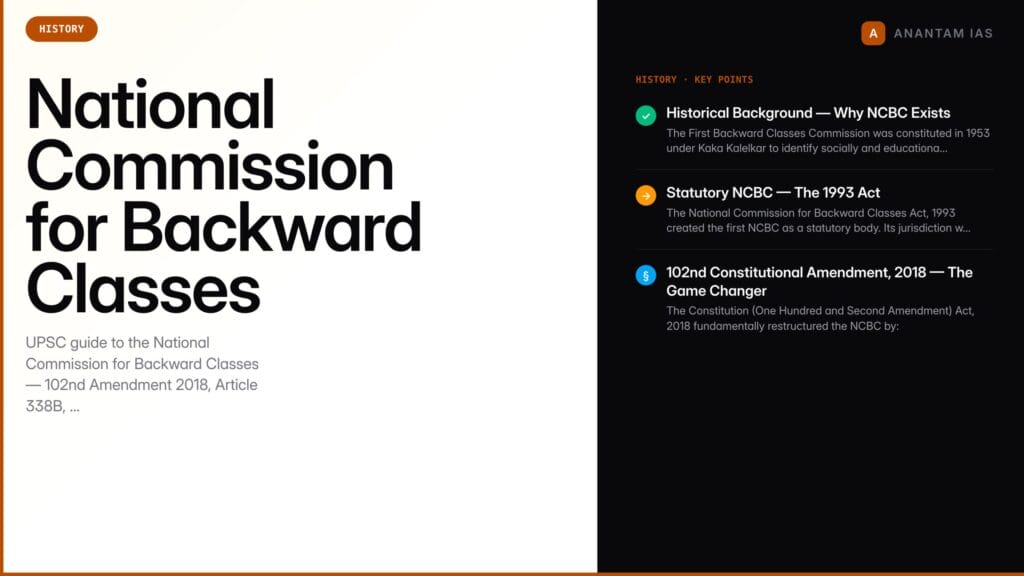
The National Commission for Backward Classes (NCBC) is a constitutional body that safeguards the interests of the Socially and Educationally Backward Classes (SEBCs) in India. Originally set up as a statutory body under the NCBC Act, 1993, following the Supreme Court’s directive in the Indra Sawhney judgment (1992), it was elevated to a constitutional body by the 102nd Constitutional Amendment Act, 2018, which inserted Article 338B. This transformation gave NCBC the same status as the National Commission for Scheduled Castes (NCSC) and National Commission for Scheduled Tribes (NCST). The body is pivotal to India’s reservation framework and is a frequent subject in UPSC Prelims and GS Paper II (Indian Polity and Social Justice).
Historical Background — Why NCBC Exists
Kaka Kalelkar Commission (1953)
The First Backward Classes Commission was constituted in 1953 under Kaka Kalelkar to identify socially and educationally backward classes. Its recommendations were not accepted by the government due to alleged lack of objectivity.
Mandal Commission (1979–1980)
The Second Backward Classes Commission under B.P. Mandal identified 3,743 castes as Other Backward Classes (OBCs) and recommended 27% reservation in central government jobs and educational institutions. The report, submitted in 1980, was implemented only in 1990 by the V.P. Singh government.
Indra Sawhney Case (1992)
The Supreme Court's 9-judge bench in Indra Sawhney v. Union of India upheld the 27% OBC reservation but directed the government to create a permanent body to examine inclusion and exclusion requests in the OBC list.
Statutory NCBC — The 1993 Act
The National Commission for Backward Classes Act, 1993 created the first NCBC as a statutory body. Its jurisdiction was limited to:
- Examining requests for inclusion of castes in the Central List of OBCs
- Examining requests for exclusion from the list
- Tendering advice to the Central Government
This statutory NCBC had no constitutional status and no powers to address grievances of backward classes.
102nd Constitutional Amendment, 2018 — The Game Changer
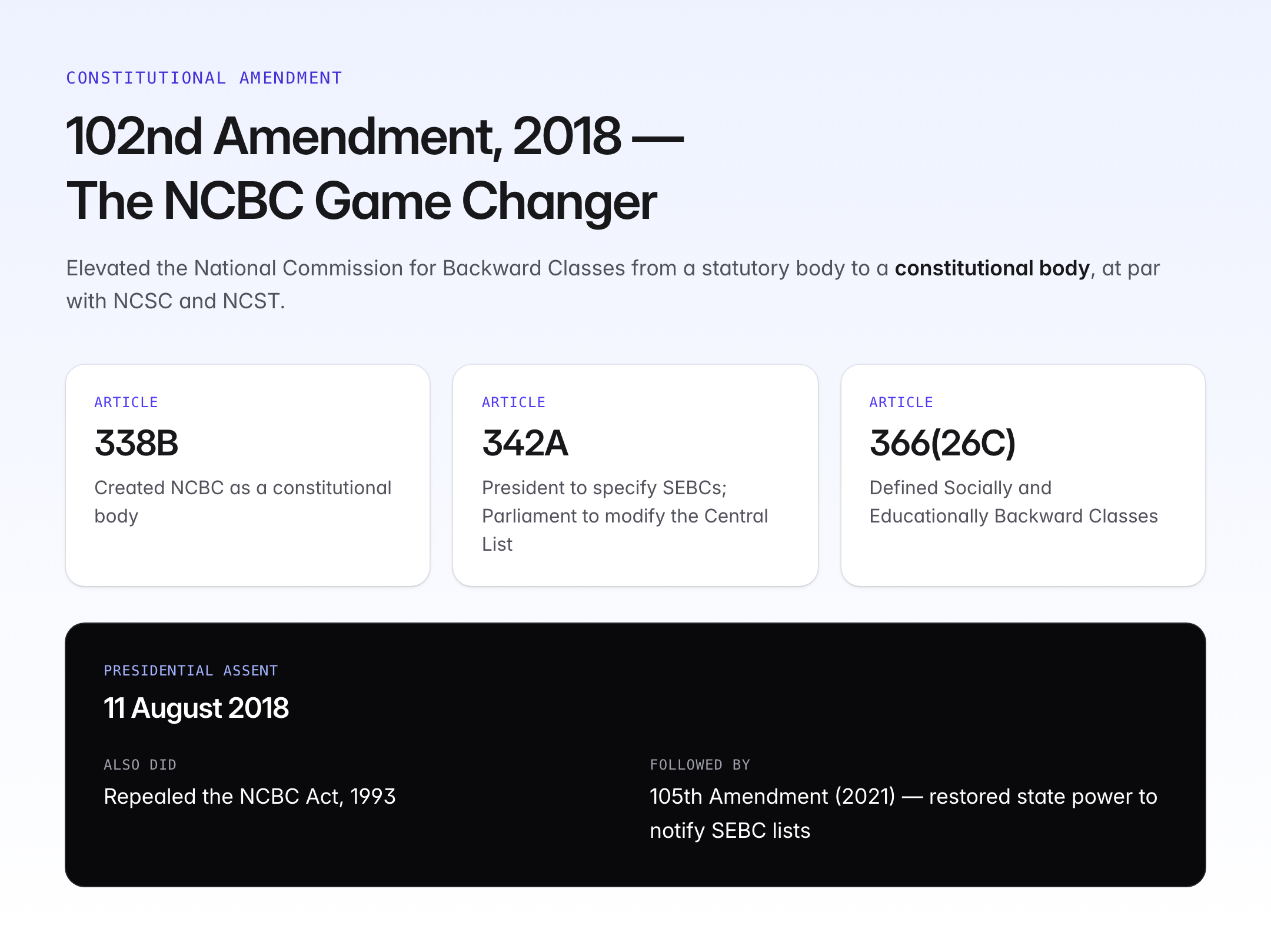
The Constitution (One Hundred and Second Amendment) Act, 2018 fundamentally restructured the NCBC by:
- Inserting Article 338B — creating NCBC as a constitutional body
- Inserting Article 342A — empowering the President to specify SEBCs, with Parliament's power to modify the Central List
- Inserting Article 366(26C) — defining Socially and Educationally Backward Classes
- Repealing the NCBC Act, 1993
The amendment received Presidential assent on 11 August 2018.
105th Amendment, 2021 — Restoring State Power
Following the Maratha reservation case (Jaishri Laxmanrao Patil, 2021), where the Supreme Court held that states could not identify SEBCs after the 102nd Amendment, the 105th Constitutional Amendment, 2021 amended Article 342A to restore the power of State Governments to prepare and maintain their own state list of SEBCs.
Composition of NCBC
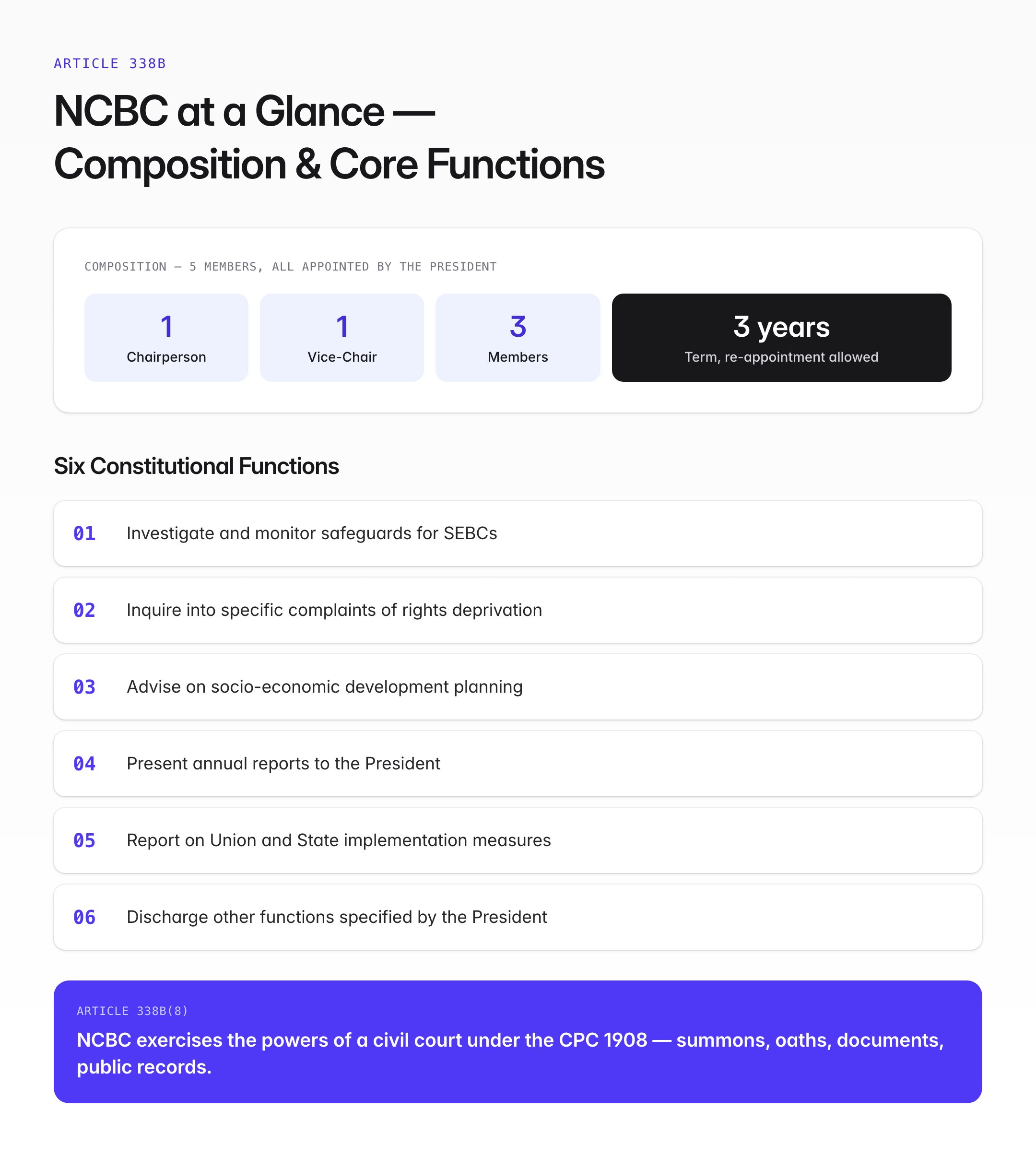
Under Article 338B(2), the Commission consists of:
| Post | Number | Appointment |
|---|---|---|
| Chairperson | 1 | President of India (by warrant under hand and seal) |
| Vice-Chairperson | 1 | President of India |
| Other Members | 3 | President of India |
| Total | 5 | — |
Tenure and Service Conditions
- Term: 3 years (as prescribed by the President)
- Re-appointment: Permitted
- Salary and allowances: Determined by the President
- Removal: Only by the President on grounds of proved misbehaviour or incapacity (similar to Supreme Court judges)
Functions and Duties — Article 338B(5)
NCBC performs the following constitutional functions:
- Investigate and monitor all matters relating to safeguards for socially and educationally backward classes
- Inquire into specific complaints regarding deprivation of rights
- Participate and advise on the planning process of socio-economic development of SEBCs
- Present annual reports to the President on the working of safeguards
- Report on implementation of measures taken by the Union and States
- Discharge other functions in relation to protection, welfare and development of backward classes as specified by the President
Powers of a Civil Court — Article 338B(8)
While investigating any matter or inquiring into any complaint, NCBC has all powers of a civil court trying a suit under the Code of Civil Procedure, 1908:
| Power | Scope |
|---|---|
| Summoning and enforcing attendance | Any person from any part of India |
| Examination on oath | Witnesses and deponents |
| Production of documents | Requisitioning records from any office |
| Receiving evidence on affidavits | Accepting sworn statements |
| Requisitioning public records | From any court or office |
| Issuing commissions | For examination of witnesses and documents |
Consultation with NCBC — Article 338B(9)
The Union and State Governments are constitutionally required to consult the NCBC on all major policy matters affecting the socially and educationally backward classes. This mirrors the consultation requirement for NCSC and NCST.
Difference Between Pre-2018 and Post-2018 NCBC
| Feature | Pre-2018 (Statutory NCBC) | Post-2018 (Constitutional NCBC) |
|---|---|---|
| Legal status | Statutory — NCBC Act, 1993 | Constitutional — Article 338B |
| Composition | Chairperson + 4 members | Chairperson + Vice-Chairperson + 3 members |
| Jurisdiction | Only inclusion/exclusion in Central OBC list | Full grievance redressal, monitoring, advisory |
| Civil court powers | Limited | Full powers under CPC |
| Reports | To Union government | To President, laid before Parliament |
| Removal | As per statute | Only on grounds akin to SC judge |
| Consultation | Not mandated | Mandatory on major policy affecting SEBCs |
Supreme Court Jurisdiction and Key Judgments
Indra Sawhney v. Union of India (1992)
The 9-judge Supreme Court bench:
- Upheld 27% OBC reservation
- Capped total reservation at 50% (except in extraordinary circumstances)
- Introduced the "creamy layer" concept for OBCs
- Directed creation of a permanent body — leading to the NCBC Act, 1993
M. Nagaraj v. Union of India (2006)
Extended the creamy layer principle to promotions in SC/ST reservations; reaffirmed reservation must meet tests of backwardness, inadequate representation, and administrative efficiency.
Jaishri Laxmanrao Patil (Maratha Reservation) Case, 2021
The 5-judge bench held:
- The 50% reservation cap under Indra Sawhney stands
- Only Parliament, not states, could identify SEBCs post-102nd Amendment (this was overturned by the 105th Amendment)
- Maratha reservation by Maharashtra struck down as unconstitutional
Relationship with Other Commissions
| Commission | Constitutional Article | Focus |
|---|---|---|
| National Commission for SCs (NCSC) | Article 338 | Scheduled Castes, Anglo-Indians |
| National Commission for STs (NCST) | Article 338A | Scheduled Tribes |
| National Commission for Backward Classes (NCBC) | Article 338B | Socially and Educationally Backward Classes (SEBCs) |
All three are constitutional bodies with identical powers and report directly to the President.
Challenges and Criticism
- Creamy layer controversy — repeated debates on income thresholds and inclusion criteria
- Delay in updating OBC list — insertion/deletion takes years
- Sub-categorisation pending — the Justice Rohini Commission (2017) was set up to sub-categorise OBCs for equitable distribution of reservation benefits; report yet to be fully acted upon
- Overlap with State Commissions — coordination issues post 105th Amendment
- Data deficit — no caste census since 1931; Socio-Economic Caste Census (SECC 2011) data on caste not fully released
Recent Developments
- The Justice Rohini Commission, set up in 2017 to sub-categorise OBCs, submitted its report to the President in July 2023, after 14 extensions
- The 105th Amendment (2021) restored state powers to notify their SEBC lists
- Debate on caste census in 2021 and 2024 renewed focus on NCBC's role in updating OBC data
UPSC Relevance
GS Paper Mapping
- GS Paper II — Indian Polity (Constitutional Bodies), Social Justice (Welfare schemes, mechanisms, laws, institutions for vulnerable sections)
- GS Paper I — Social empowerment (caste system, affirmative action)
- Essay — Social justice, reservations, equality of opportunity
Prelims Pointers
- 102nd Amendment, 2018 — inserted Articles 338B, 342A, 366(26C)
- 105th Amendment, 2021 — restored state powers to identify SEBCs
- Composition: 1 Chairperson + 1 Vice-Chairperson + 3 Members (total 5)
- Appointment: By President
- Tenure: 3 years
- Article 338B — NCBC; Article 338 — NCSC; Article 338A — NCST
- Indra Sawhney (1992) — directed creation of permanent body; 50% cap; creamy layer
- Mandal Commission — 27% OBC reservation
- Kaka Kalelkar Commission — First Backward Classes Commission, 1953
- Justice Rohini Commission (2017) — OBC sub-categorisation
- NCBC has powers of a civil court under CPC
- Reports submitted to President, laid before Parliament
The National Commission for Backward Classes stands as a cornerstone of India's social justice architecture, ensuring that the constitutional promise of equality of opportunity reaches the country's most populous and diverse backward class communities.
Tell Google you want more of this.
Add Anantam IAS as a preferred sourceOne tap, and this site shows up more often in your own Top Stories, AI Overviews and AI Mode. Remove it any time.