Padma Awards — Padma Vibhushan, Padma Bhushan, and Padma Shri Explained
Complete guide to India's Padma Awards covering the three-tier hierarchy, selection committee, nomination process, criteria, notable recipients, and UPSC relevance.
The Padma Awards are among India’s highest civilian honours, recognising achievements in all fields of activity where an element of public service is involved. Announced annually on the eve of Republic Day (25 January), the awards are conferred by the President of India in a ceremony held at Rashtrapati Bhavan. For UPSC aspirants, the Padma Awards are important for both static polity and current affairs questions.
The Three-Tier Hierarchy
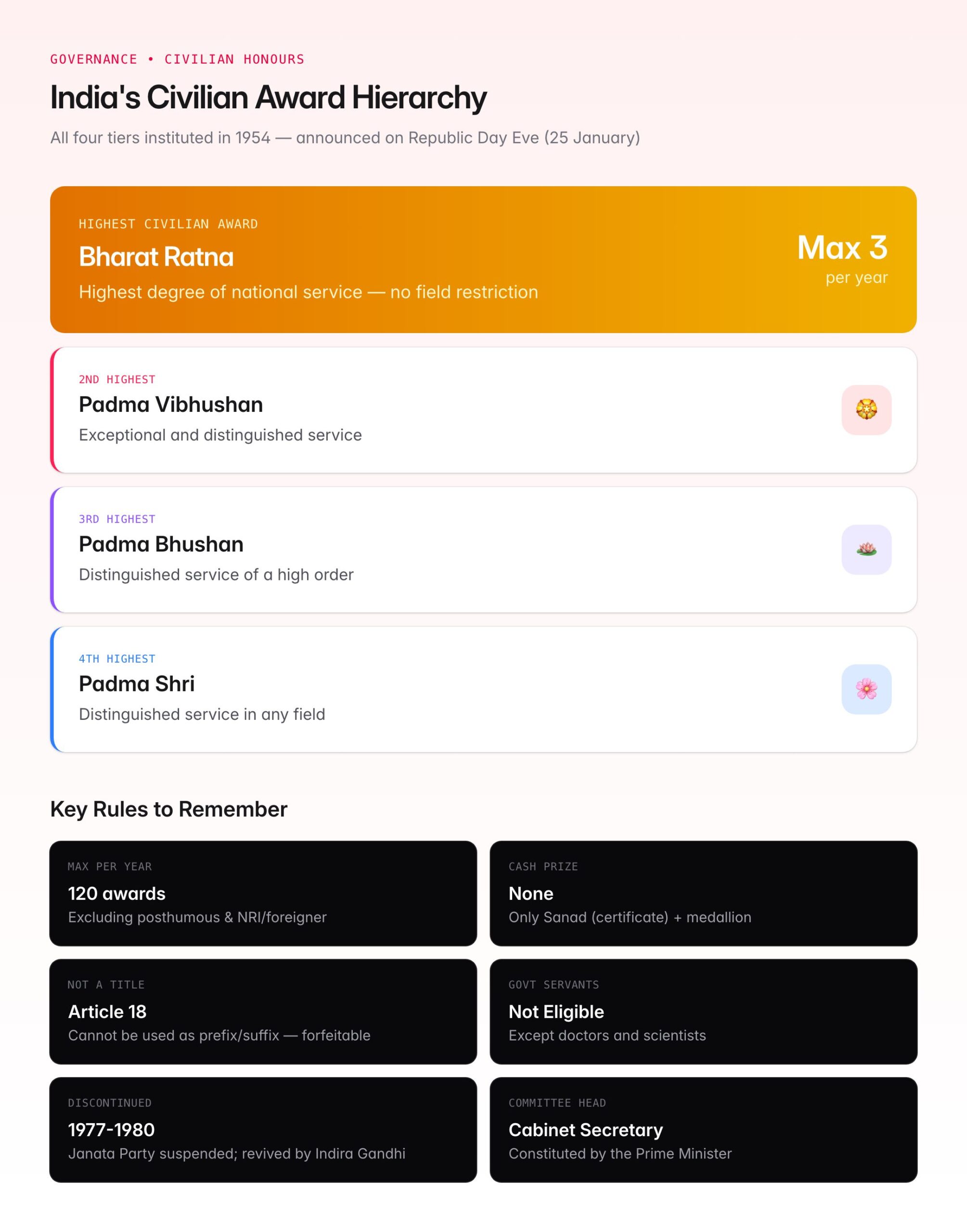
The Padma Awards comprise three categories, in descending order of distinction:
| Award | Level | Recognition |
|---|---|---|
| Padma Vibhushan | Highest | Exceptional and distinguished service |
| Padma Bhushan | Second highest | Distinguished service of a high order |
| Padma Shri | Third highest | Distinguished service in any field |
All three awards were instituted in 1954 through a Presidential notification. They were briefly interrupted in 1977 by the Janata Party government (which also discontinued the Bharat Ratna) and were revived in 1980 by the Indira Gandhi government.
Key distinction from Bharat Ratna: The Bharat Ratna is India's highest civilian award and stands above the Padma Awards. While the Bharat Ratna recognises the highest degree of national service (with no more than three awards in a given year), the Padma Awards are broader in scope and number.
Eligibility and Criteria
The Padma Awards are given in the following categories of activity:
- Art (music, painting, sculpture, cinema, theatre, literature)
- Social work
- Public affairs
- Science and engineering
- Trade and industry
- Medicine
- Literature and education
- Civil service
- Sports
- Any other field
Key Rules
- The awards are open to all Indian citizens. In exceptional cases, they may be conferred on NRIs, PIOs, and foreigners.
- Government servants, including those in PSUs, are not eligible (except doctors and scientists).
- The awards are not a title and cannot be used as a prefix or suffix to the recipient's name. Using them as such can lead to forfeiture under Article 18 of the Constitution.
- Awards can be conferred posthumously in rare cases.
- The total number of awards in a year (excluding posthumous awards and those to NRIs/foreigners/PIOs) should not exceed 120.
- The awards can be withdrawn by the President if the awardee's conduct subsequently brings disrepute.
Nomination and Selection Process
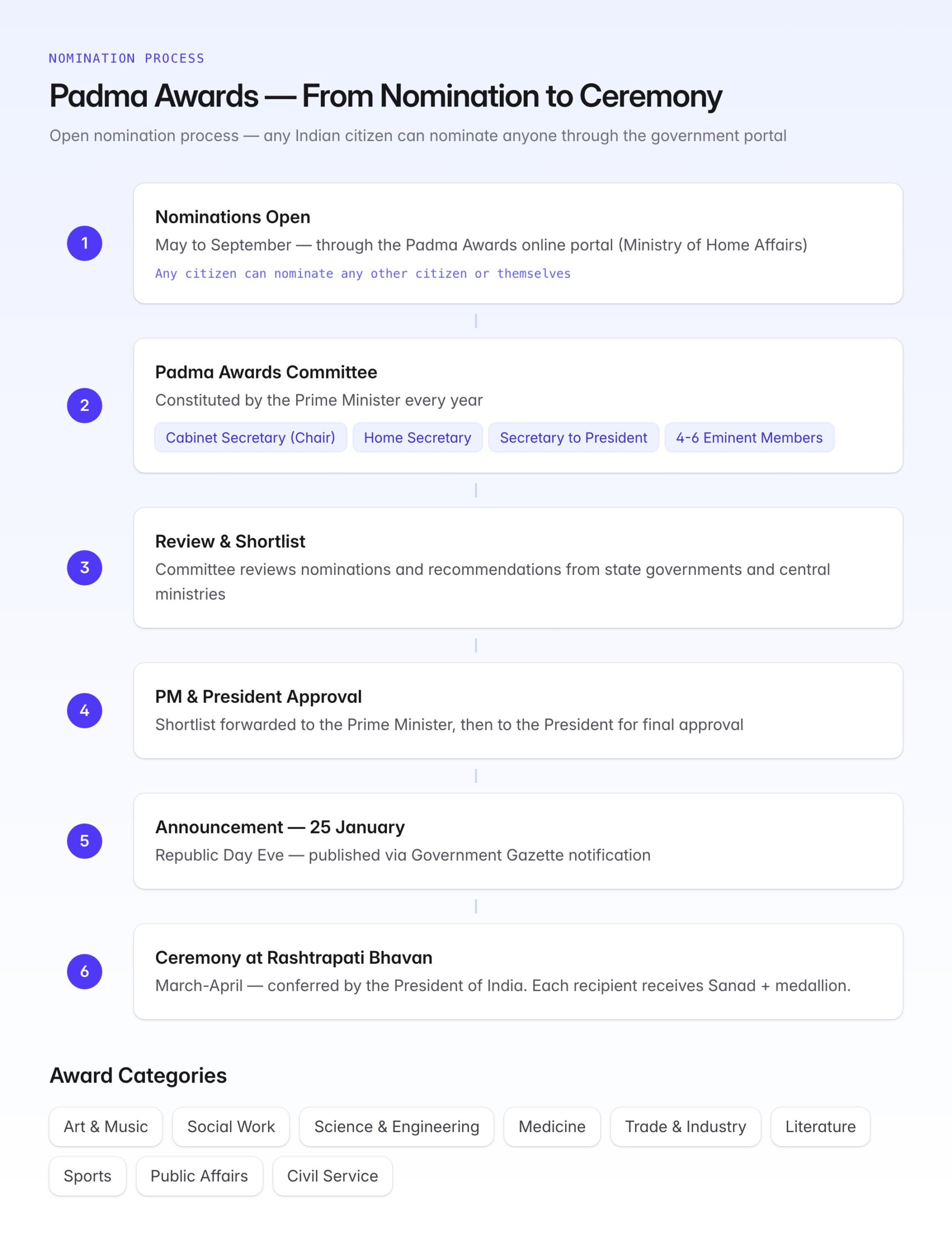
The Padma Awards have an open nomination process — any Indian citizen can nominate any other citizen (or themselves) through the government's online portal.
Step-by-Step Process
- Nominations open annually (usually May to September) through the Padma Awards portal managed by the Ministry of Home Affairs.
- All nominations are placed before the Padma Awards Committee, which is constituted by the Prime Minister every year.
- The committee is headed by the Cabinet Secretary and includes the Home Secretary, Secretary to the President, and four to six eminent persons as members.
- The committee reviews nominations, considers recommendations from state governments and central ministries, and prepares a shortlist.
- The shortlist is forwarded to the Prime Minister and then to the President for approval.
- The list is announced on 25 January (Republic Day Eve) through a government gazette notification.
- Awards are presented at a ceremony at Rashtrapati Bhavan, usually between March and April.
What the Award Comprises
Each recipient receives:
- A Sanad (certificate) signed by the President
- A medallion (medal) — the design differs for each tier
- No cash prize is attached to the Padma Awards
The medallion designs feature a lotus (padma) motif in different metallic finishes corresponding to the three tiers.
Notable Recipients Across Fields
Science and Medicine
| Recipient | Award | Field |
|---|---|---|
| Dr. APJ Abdul Kalam | Padma Vibhushan (1990) | Aerospace science (before becoming President) |
| C.N.R. Rao | Padma Vibhushan (1985) | Chemistry |
| Dr. Devi Shetty | Padma Bhushan (2012) | Affordable cardiac surgery |
Arts and Literature
| Recipient | Award | Field |
|---|---|---|
| Lata Mangeshkar | Padma Vibhushan (1999) | Music |
| Pandit Ravi Shankar | Padma Vibhushan (1981) | Sitar, Indian classical music |
| R.K. Narayan | Padma Vibhushan (2000) | Literature |
Social Work and Public Service
| Recipient | Award | Field |
|---|---|---|
| Baba Amte | Padma Vibhushan (1986) | Social work with leprosy patients |
| Ela Bhatt | Padma Bhushan (1986) | Founded SEWA for women workers |
| Sindhutai Sapkal | Padma Shri (2021) | Orphan welfare, "Mother of Orphans" |
Sports
| Recipient | Award | Field |
|---|---|---|
| Sachin Tendulkar | Padma Vibhushan (2008) | Cricket |
| Mary Kom | Padma Vibhushan (2020) | Boxing |
| Dhyan Chand | Padma Bhushan (1956) | Hockey |
Unsung Heroes
In recent years, the government has made a conscious effort to honour unsung heroes — individuals working at grassroots levels in remote areas. Recipients have included tribal healers, folk artists, handloom weavers, and rural innovators who may not have national fame but have made exceptional contributions to their communities.
Constitutional and Legal Basis
- The Padma Awards derive their authority from Article 18 of the Constitution, which addresses titles. While Article 18(1) prohibits the State from conferring titles, the awards are technically honours, not titles.
- The Supreme Court in Balaji Raghavan v. Union of India (1996) ruled that Padma Awards are constitutional as long as they are not used as titles or prefixes/suffixes.
- If a recipient uses the award as a title, it is liable to be forfeited.
Comparison with Other Civilian Awards
| Award | Level | Instituted | Key Feature |
|---|---|---|---|
| Bharat Ratna | Highest civilian | 1954 | Maximum 3 per year; no field restriction |
| Padma Vibhushan | 2nd highest | 1954 | Exceptional service |
| Padma Bhushan | 3rd highest | 1954 | Distinguished service of high order |
| Padma Shri | 4th highest | 1954 | Distinguished service |
UPSC Relevance
GS Paper II: Governance, constitutional provisions (Article 18), role of institutions. Prelims: Frequently tested — hierarchy, selection process, key facts.
Key Prelims facts:
- The three Padma Awards are Padma Vibhushan > Padma Bhushan > Padma Shri, all instituted in 1954.
- They were discontinued in 1977 and revived in 1980.
- The Padma Awards Committee is headed by the Cabinet Secretary.
- Awards are announced on 25 January (Republic Day Eve) and conferred by the President.
- They are not titles and cannot be used as prefix/suffix (Article 18).
- The total number should not exceed 120 per year (excluding posthumous and NRI/foreigner awards).
- Government servants are generally not eligible (except doctors and scientists).
- Any citizen can nominate any other citizen through the online portal.
- The awards carry no cash prize — only a Sanad and medallion.