Parambikulam Tiger Reserve — Location, Biodiversity & Conservation
Complete UPSC guide to Parambikulam Tiger Reserve covering location in Kerala, Kannimara teak, flora and fauna, tribal communities, and ecotourism.
The Parambikulam Tiger Reserve is one of India's most biodiverse and well-managed protected areas, located in the Palakkad district of Kerala within the southern Western Ghats. Home to the legendary Kannimara teak — believed to be the oldest and largest living teak tree in the world — and a thriving tiger population, Parambikulam is a model of community-based conservation. It is a significant topic for UPSC, particularly in the context of tiger conservation, Western Ghats ecology, and tribal livelihood integration.
Location and Geography
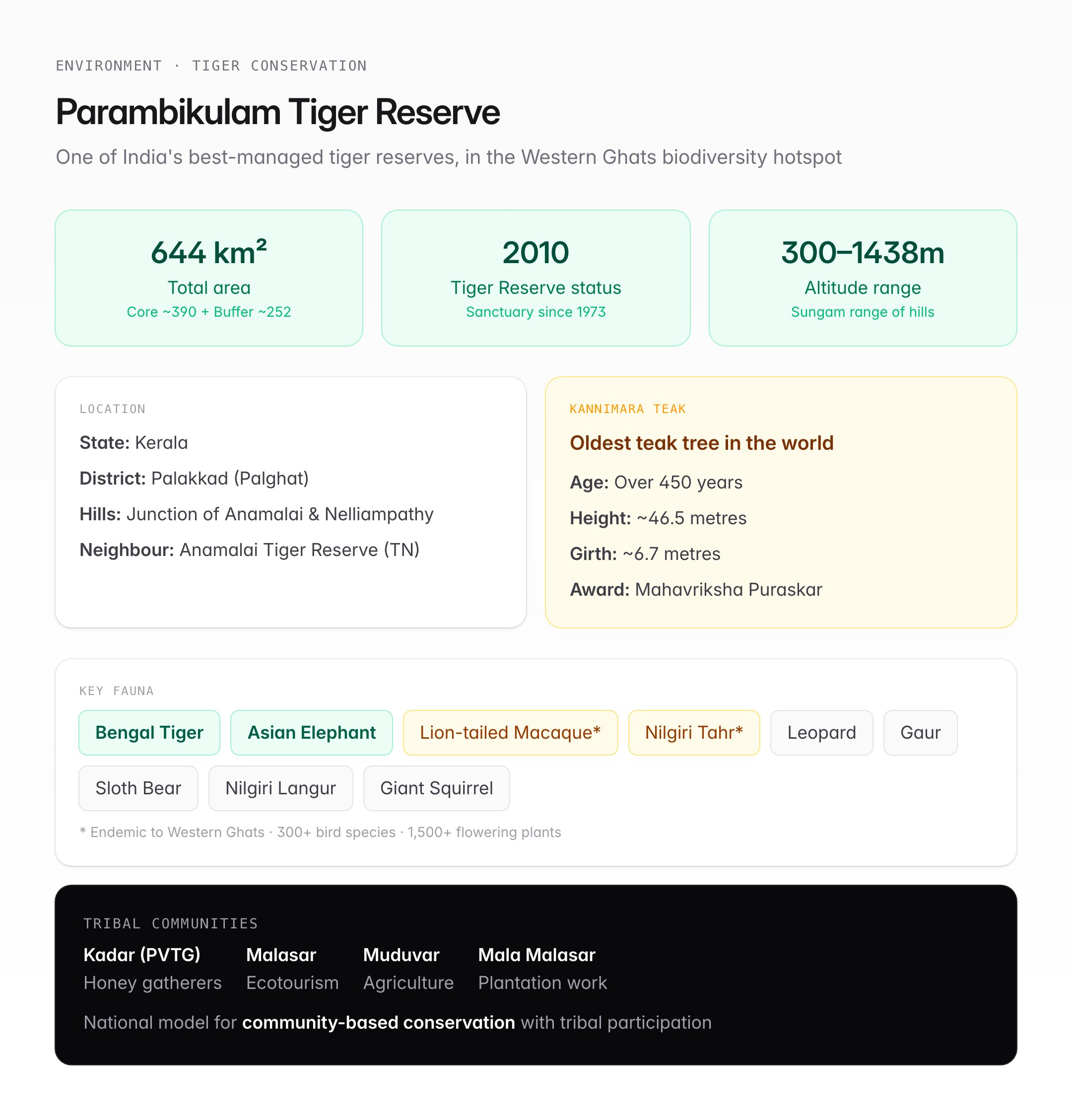
- State: Kerala
- District: Palakkad (Palghat)
- Area: Approximately 644 sq km (core area ~390 sq km; buffer zone ~252 sq km).
- Declared Tiger Reserve: 2010 (under Project Tiger)
- Earlier status: Parambikulam Wildlife Sanctuary (declared 1973).
- Altitude: Ranges from 300 m to 1,438 m above sea level.
- Coordinates: Lies in the Sungam range of hills, at the junction of the Anamalai Hills and the Nelliampathy Hills.
- Neighbouring protected areas: Shares boundaries with the Anamalai Tiger Reserve (Tamil Nadu) to the east and the Nemmara Forest Division to the west. Part of the larger Anamalai-Parambikulam landscape, one of the most significant elephant habitats in southern India.
River Systems and Dams
The reserve is drained by several rivers, and notably contains three major dams:
| Dam | River | Purpose |
|---|---|---|
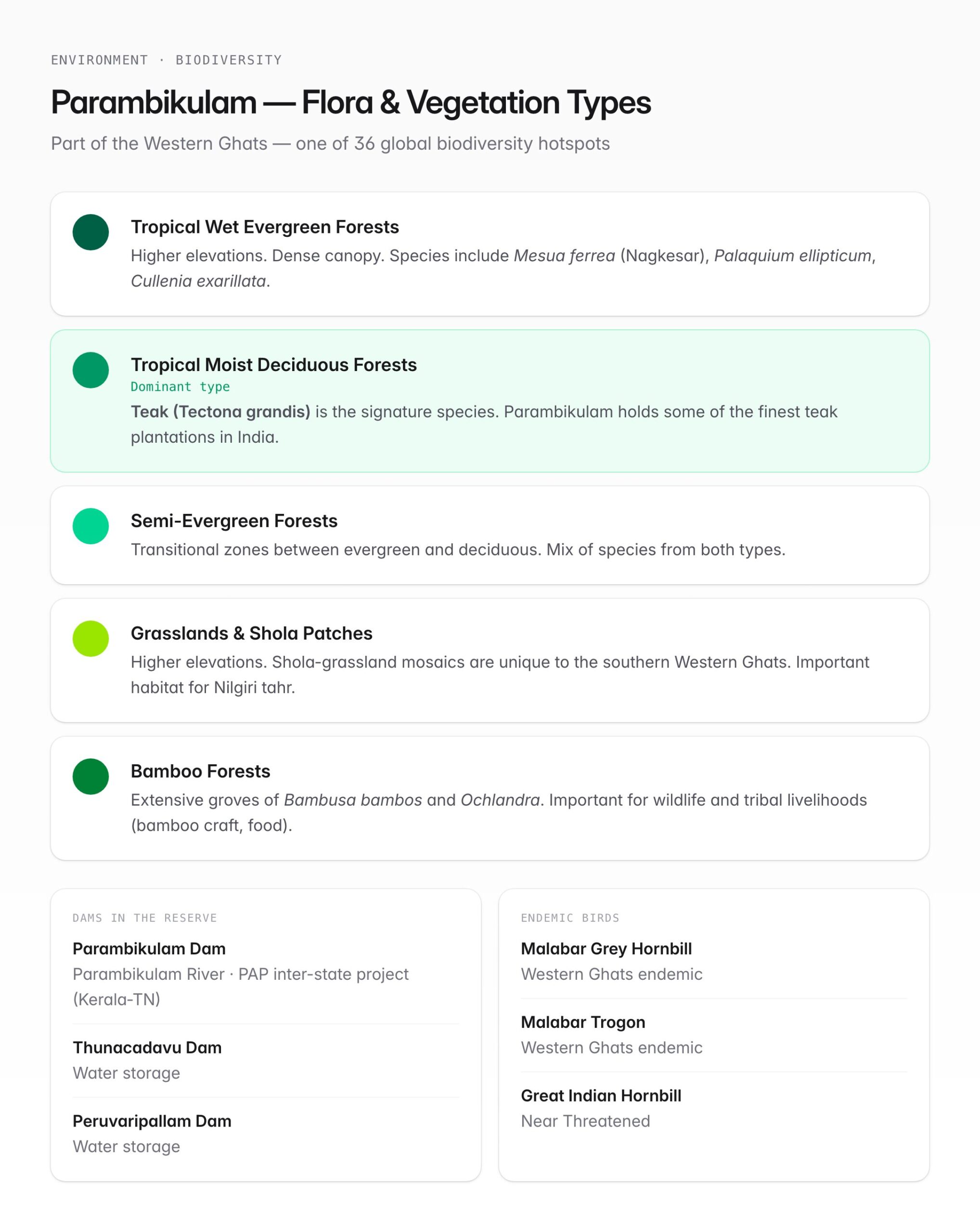
| Parambikulam Dam | Parambikulam River | Irrigation and hydroelectric power; part of the Parambikulam-Aliyar Project (PAP) |
| Thunacadavu Dam | Thunacadavu stream | Water storage |
| Peruvaripallam Dam | Peruvaripallam stream | Water storage |
The Parambikulam-Aliyar Project (PAP) is a major inter-state (Kerala-Tamil Nadu) water-sharing project that utilises the waters of the Parambikulam, Aliyar, and other rivers for irrigation in Coimbatore and Palakkad districts.
The Kannimara Teak
The Kannimara teak (Tectona grandis) is the most iconic natural feature of Parambikulam:
- Believed to be the oldest teak tree in the world, with an estimated age of over 450 years.
- Height: approximately 46.5 metres; girth: approximately 6.7 metres.
- Won the "Mahavriksha Puraskar" (Great Tree Award) from the Government of India.
- Located near the Kannimara camping area inside the reserve.
- The tree is revered by local tribal communities and is a major attraction for visitors.
- It stands as testimony to the old-growth teak forests that once dominated the Western Ghats before colonial-era logging.
Flora
Parambikulam's vegetation reflects its position in the Western Ghats biodiversity hotspot:
- Tropical wet evergreen forests — Found at higher elevations; dense canopy with species like Mesua ferrea (Nagkesar), Palaquium ellipticum, and Cullenia exarillata.
- Tropical moist deciduous forests — Dominant vegetation type; teak (Tectona grandis) is the signature species. Parambikulam holds some of the finest teak plantations in India.
- Semi-evergreen forests — Transitional zones between evergreen and deciduous.
- Grasslands and shola patches — At higher elevations; shola-grassland mosaics are unique to the southern Western Ghats.
- Bamboo forests — Extensive bamboo groves, particularly Bambusa bambos and Ochlandra, important for wildlife and tribal livelihoods.
The reserve has recorded over 1,500 species of flowering plants, including several endemic and rare species.
Fauna
Mammals
- Bengal tiger (Panthera tigris tigris) — The flagship species; Parambikulam has a healthy and growing tiger population.
- Asian elephant — The reserve is part of a major elephant corridor connecting Anamalai and Parambikulam.
- Leopard, gaur (Indian bison), sambar deer, spotted deer (chital), wild boar, Nilgiri tahr (in higher reaches), lion-tailed macaque (endemic to Western Ghats), Nilgiri langur, sloth bear, Indian giant squirrel.
- Smooth-coated otter in the reservoir areas.
Birds
- Over 300 bird species recorded, including:
- Malabar grey hornbill (endemic)
- Malabar trogon (endemic)
- Great Indian hornbill
- Ceylon frogmouth
- Black eagle
- Various species of flycatchers, woodpeckers, and barbets.
Reptiles and Amphibians
- King cobra, Indian rock python, forest cane turtle, and several endemic frog species.
- The Western Ghats is a global amphibian hotspot, and Parambikulam contributes significantly to this diversity.
Tiger Population and Conservation Success
Parambikulam is recognised as one of India's best-managed tiger reserves:
- Tiger population has shown a steady increase since the area was declared a Tiger Reserve in 2010.
- The reserve benefits from its location within a larger landscape of connected forests (Anamalai-Parambikulam-Indira Gandhi corridor), ensuring genetic connectivity for tiger populations.
- Camera trap surveys and the All India Tiger Estimation exercises have confirmed a healthy breeding population.
- The reserve was among the first in India to receive the TX2 Award (from the Global Tiger Initiative) for excellence in tiger conservation management.
- Anti-poaching measures include regular patrols, electronic surveillance, and community participation in protection.
Tribal Communities
Parambikulam is home to several indigenous tribal communities who have lived in these forests for centuries:
| Tribe | Key Features |
|---|---|
| Kadar | One of the oldest tribal groups in southern India; classified as a Particularly Vulnerable Tribal Group (PVTG); traditional honey gatherers and forest produce collectors |
| Malasar | Dependent on forest produce and shifting cultivation; now involved in ecotourism |
| Muduvar | Agriculture-based; cultivate small patches within the forest |
| Mala Malasar | Closely related to Malasar; involved in plantation work |
Community-Based Conservation
Parambikulam is a national model for integrating tribal communities into conservation:
- Tribal youth are employed as forest watchers, guides, and ecotourism facilitators.
- The Parambikulam Foundation supports livelihood programmes including honey processing, bamboo craft, and organic farming.
- The Forest Rights Act (2006) has been implemented to recognise community forest rights.
- Revenue from ecotourism is shared with local communities, creating economic incentives for conservation.
Ecotourism
Parambikulam has developed a regulated ecotourism model that balances visitor access with conservation:
- Trekking routes — Guided treks to Kannimara teak, Karimala Gopuram viewpoint, and bamboo forests.
- Tree-top huts and log houses — Eco-friendly accommodation inside the reserve.
- Night safaris and nature walks — Conducted with trained tribal guides.
- Bamboo rafting on the Parambikulam reservoir.
- Visitor carrying capacity is strictly regulated to minimise disturbance.
- The reserve is closed during the monsoon season (typically June to September) for wildlife breeding and forest regeneration.
UPSC Relevance
GS Paper III — Environment: Conservation of biodiversity; tiger reserves; environmental impact assessment.
GS Paper I — Geography: Western Ghats; biodiversity hotspots.
GS Paper II — Governance: Tribal welfare; Forest Rights Act.
Prelims key facts:
- Parambikulam Tiger Reserve is in Palakkad district, Kerala.
- Declared a Tiger Reserve in 2010; earlier a Wildlife Sanctuary (1973).
- Part of the Anamalai-Parambikulam landscape in the Western Ghats biodiversity hotspot.
- Home to the Kannimara teak — the oldest and largest living teak tree (over 450 years old).
- The Parambikulam-Aliyar Project (PAP) is an inter-state water-sharing project between Kerala and Tamil Nadu.
- Kadar tribe (PVTG) is among the indigenous communities residing in the reserve.
- Key fauna: Bengal tiger, Asian elephant, lion-tailed macaque (endemic), Nilgiri tahr, gaur.
- The reserve is a model for community-based conservation with tribal participation in ecotourism and protection.
- The Western Ghats is one of the 36 global biodiversity hotspots (UPSC frequently tests this count).