PM SHRI Scheme: Pradhan Mantri Schools for Rising India
PM SHRI scheme upgrades 14,500+ schools into model institutions aligned with NEP 2020. Explore features, funding, components, and UPSC governance relevance.
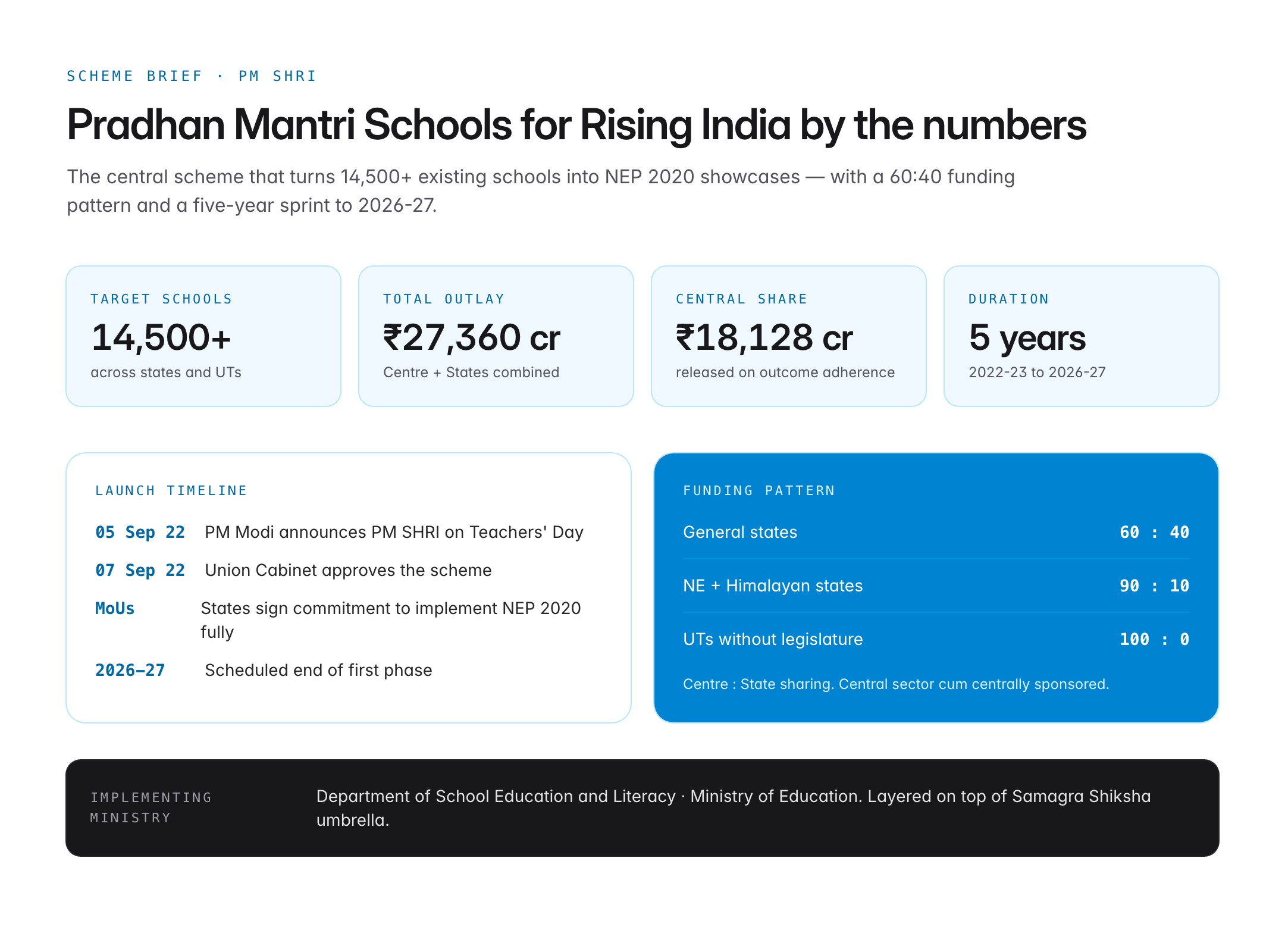
The PM SHRI scheme, or Pradhan Mantri Schools for Rising India, is a centrally sponsored scheme launched by the Ministry of Education in 2022 to upgrade over 14,500 existing schools across the country into exemplar institutions aligned with the National Education Policy (NEP) 2020. Announced by Prime Minister Narendra Modi on Teachers' Day, 5 September 2022, and approved by the Union Cabinet on 7 September 2022, PM SHRI aims to make each selected school a model of quality, equity, inclusion and holistic development that can in turn mentor other schools in its region. For UPSC aspirants, it is a high-yield topic on education policy, cooperative federalism and NEP implementation.
Background and Launch
The scheme grew directly out of NEP 2020, which envisaged a thorough reimagining of school education along four axes: access, equity, quality and accountability, plus affordability. PM SHRI operationalises NEP in a concrete, institution-level way. Salient launch details:
- Announcement – 5 September 2022, Teachers' Day.
- Cabinet approval – 7 September 2022.
- Implementing ministry – Department of School Education and Literacy, Ministry of Education.
- Coverage – schools run by Central Government, State/UT Governments, and local bodies.
Initial MoUs were signed with participating states, with funding contingent on their commitment to implement NEP 2020 fully.
Key Features of PM SHRI
PM SHRI schools are expected to be green, smart and future-ready. Core features include:
- NEP 2020 alignment – including the 5+3+3+4 structure (Foundational, Preparatory, Middle, Secondary stages).
- Emphasis on Foundational Literacy and Numeracy (FLN) in line with the NIPUN Bharat mission.
- Experiential, inquiry-driven and competency-based learning rather than rote learning.
- Multilingualism with mother-tongue instruction in early grades.
- Integration of arts, sports, vocational education and the Bagless Days concept.
- Digital infrastructure – smart classrooms, ICT labs, and digital pedagogy.
- Green school elements – solar panels, water conservation, waste management, kitchen gardens.
- Inclusion – barrier-free access for children with special needs, gender sensitivity, tribal and minority inclusion.
- Assessment reform – holistic progress cards, regular formative assessment.
- Mentorship role – each PM SHRI school is expected to function as a model and mentor for surrounding schools.
Scale, Funding and Duration
| Parameter | Detail |
|---|---|
| Target coverage | Around 14,500+ schools across states and UTs |
| Scheme duration | 2022-23 to 2026-27 (five years initially) |
| Total outlay (indicative) | Rs 27,360 crore (Centre + States) |
| Central share | ~Rs 18,128 crore |
| Sharing pattern | 60:40 between Centre and States (90:10 for NE and Himalayan states; 100% for UTs without legislature) |
PM SHRI is a central sector cum centrally sponsored scheme, layered on top of existing programmes such as Samagra Shiksha. Funds are released based on progress, adherence to NEP and outcomes.
Selection Process
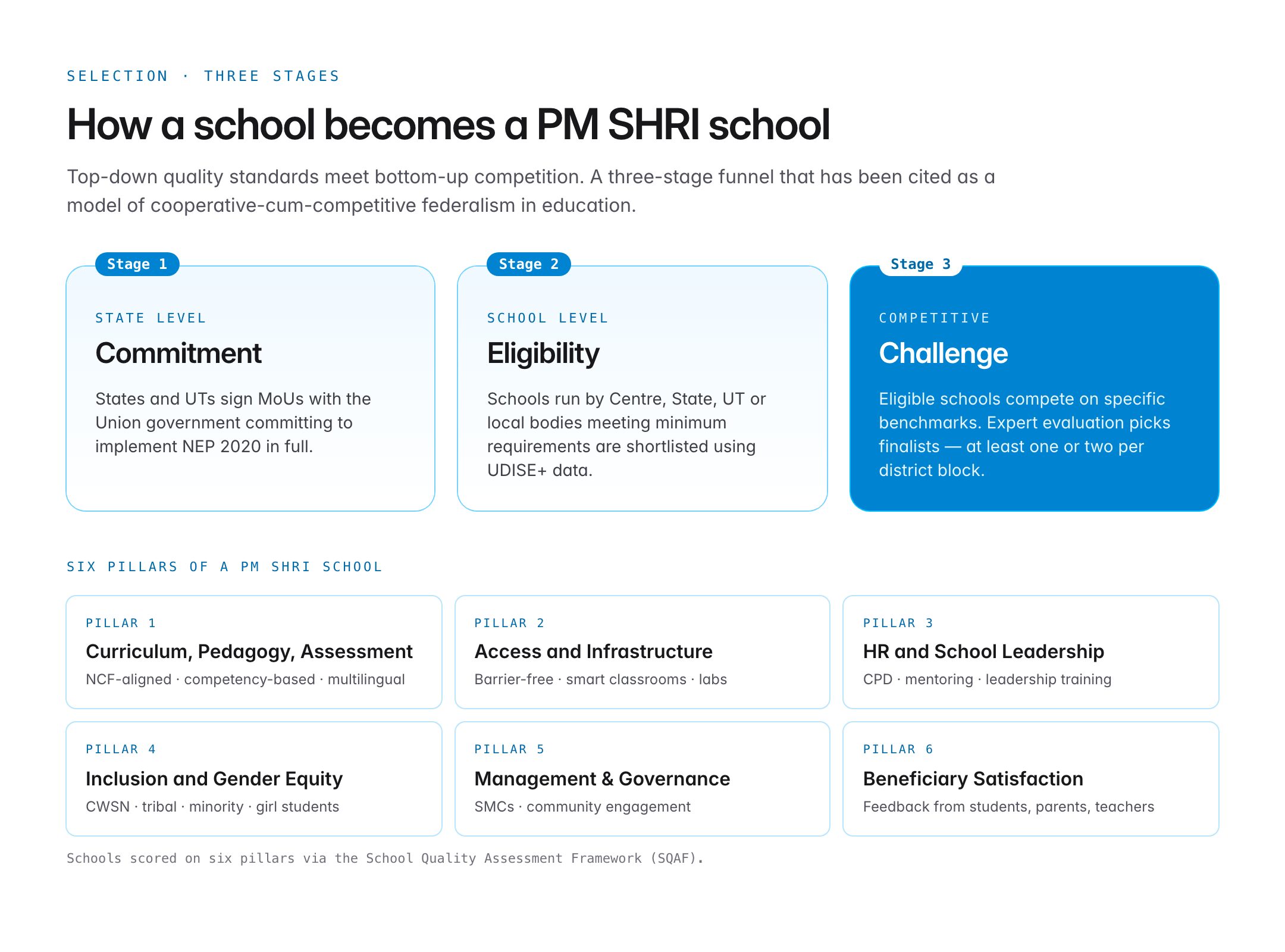
Schools are selected through a competitive, three-stage process:
- Commitment stage – States/UTs sign MoUs with the Union government committing to implement NEP 2020.
- Eligibility stage – Schools run by Centre, State, UT or local bodies that meet minimum requirements are shortlisted using UDISE+ data (infrastructure, teacher availability, basic facilities).
- Challenge stage – Eligible schools compete on specific benchmarks. Final selection is based on an expert evaluation; each block in a district is expected to have at least one or two PM SHRI schools.
This design mixes top-down quality standards with bottom-up competition and is cited as a model of cooperative and competitive federalism in education.
Six Pillars of a PM SHRI School
PM SHRI schools are to be developed along six pillars mirroring NEP 2020 priorities:
| Pillar | What it covers |
|---|---|
| Curriculum, Pedagogy and Assessment | NCF-aligned, competency-based, multilingual |
| Access and Infrastructure | Barrier-free, smart classrooms, labs |
| Human Resources and School Leadership | CPD, mentoring, school leadership training |
| Inclusive Practices and Gender Equity | Support for CWSN, tribal, minority and girl students |
| Management, Monitoring and Governance | School Management Committees, community engagement |
| Beneficiary Satisfaction | Feedback from students, parents and teachers |
Each school is scored against these pillars via the School Quality Assessment Framework (SQAF) developed under the scheme.
Linkages with Other Schemes
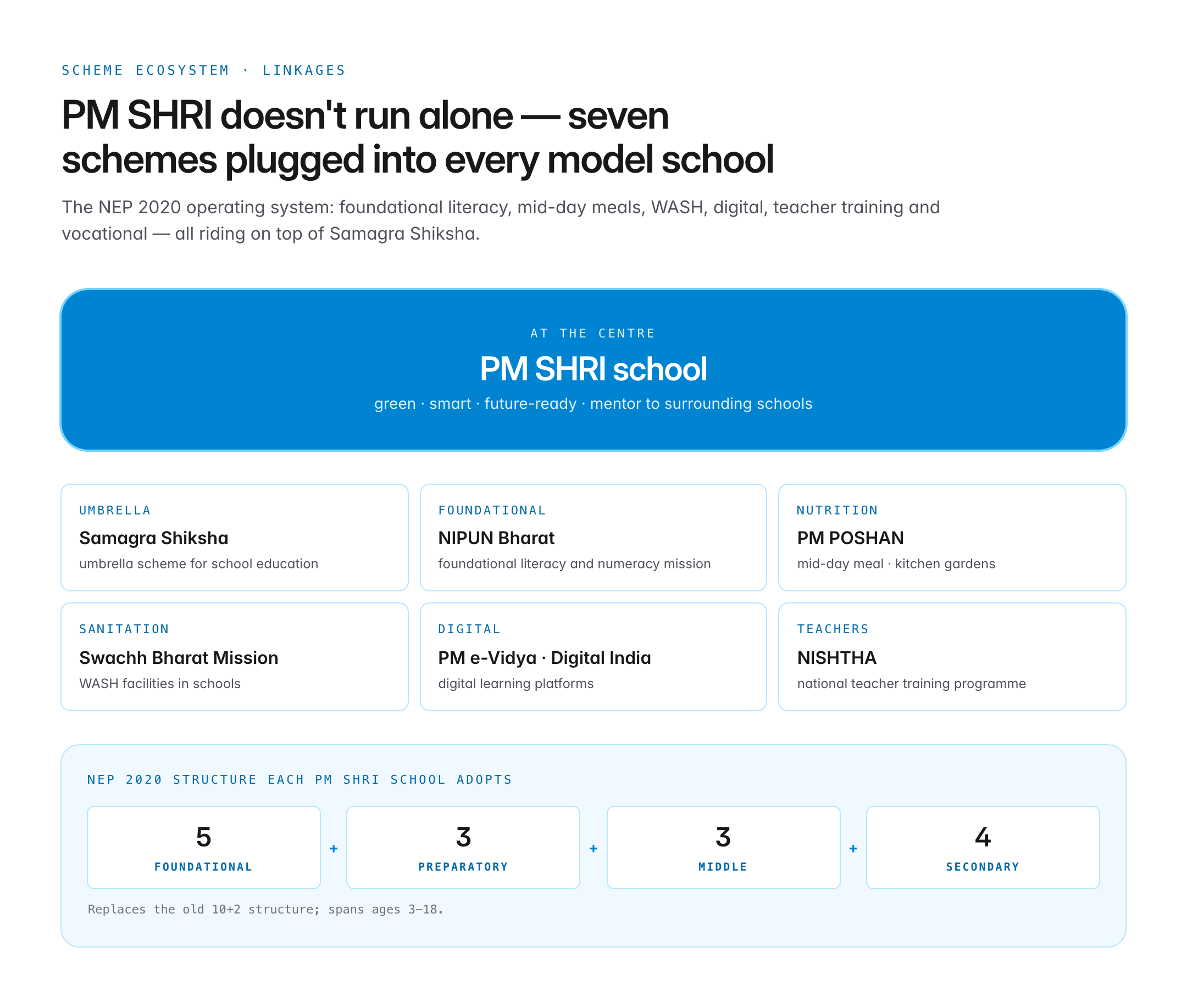
PM SHRI does not operate in isolation. It integrates with:
- Samagra Shiksha – umbrella scheme for school education.
- NIPUN Bharat Mission – foundational literacy and numeracy.
- PM POSHAN (Mid-Day Meal) – nutrition, kitchen gardens.
- Swachh Bharat Mission – WASH facilities.
- Digital India / PM e-Vidya – digital learning.
- NISHTHA – teacher training programme.
- Skill India and NEP vocational components – from class 6 onwards.
Significance
PM SHRI's importance extends beyond the 14,500 schools themselves:
- NEP implementation lab – PM SHRI schools serve as proof-of-concept for NEP reforms.
- Demonstration effect – mentoring nearby schools multiplies impact.
- Equity focus – by including schools across geographies, including aspirational districts, it attempts to balance quality with access.
- Federal model – links Central funding to State commitments on NEP.
- Green schooling – integrates sustainability into mainstream education.
- Outcome-oriented – measurable indicators under SQAF mark a shift from input-based to outcome-based funding.
Challenges and Criticism
Several concerns have been flagged by experts and some states:
- Conditional funding – a few states have raised concerns about tying Samagra Shiksha funds to MoUs on NEP.
- Cherry-picking – upgrading select schools may deepen within-district inequalities if mentoring is weak.
- Teacher shortage – quality teaching staff are critical but chronically short in many states.
- Language and curriculum – implementation of three-language formula and NCF-aligned curriculum varies.
- Monitoring capacity – effective SQAF-based monitoring requires strong state-level data and feedback systems.
- Urban-rural gap – rural schools may struggle more with digital and infrastructural upgrades.
UPSC Relevance
Prelims focus
- Full form: Pradhan Mantri Schools for Rising India.
- Year of launch: 2022; duration 2022-23 to 2026-27.
- Target: about 14,500 schools.
- Implementing ministry: Ministry of Education.
- Alignment with NEP 2020 and 5+3+3+4 structure.
- Type: centrally sponsored scheme; sharing pattern differences for NE/Himalayan states and UTs.
Mains GS-II angle
Use PM SHRI to address:
- Implementation of NEP 2020.
- Cooperative federalism and conditionality in central schemes.
- Quality vs equity debates in Indian education.
- Role of mentor schools and system-level reform.
- Digital divide and green schooling.
Sample PYQ angle – questions on "Discuss the role of flagship schemes in transforming Indian school education" or "Examine the implementation challenges of NEP 2020." A strong answer names PM SHRI, integrates it with Samagra Shiksha and NIPUN Bharat, and critically assesses conditionality, teacher shortages and outcome measurement.
PM SHRI is best understood as the operational spearhead of NEP 2020 – a lens through which UPSC aspirants can discuss quality schooling, federal design and long-term human capital strategy.