PM Vishwakarma Yojana Details: Scheme, Benefits and Eligibility
A central sector scheme that wraps recognition, skilling, a toolkit grant, cheap credit and market access around 18 traditional trades — and the gap between its 30 lakh registrations and its loan numbers.
A blacksmith in a small town keeps a forge going that his grandfather lit, but no bank will lend to him because he has no balance sheet, no collateral and no credit history a loan officer can read. A potter sells a week’s work to a middleman for a price she did not set. This is the everyday economics of India’s traditional artisans — skilled, self-employed, and almost entirely outside the formal system that moves money. PM Vishwakarma Yojana was built to pull exactly these workers across that line.
Prime Minister Narendra Modi launched the scheme on 17 September 2023, on Vishwakarma Jayanti, the day traditionally devoted to the divine craftsman of Hindu belief. It matters for the UPSC syllabus because it sits at the crossroads of three things the exam keeps returning to — informal-sector welfare, financial inclusion, and skilling — and because it tries something most artisan schemes don’t: it bundles recognition, training, tools, credit and market access into one chain rather than handing out a single benefit and walking away.
What PM Vishwakarma Yojana Actually Is
Let’s fix the basics, because the prelims questions live here. PM Vishwakarma is a Central Sector Scheme, which means it’s fully funded by the Union government rather than shared with the states the way a centrally sponsored scheme would be. According to the Press Information Bureau, the Cabinet Committee on Economic Affairs approved it with a financial outlay of Rs 13,000 crore for five years, running from financial year 2023-24 to 2027-28. The lead ministry is the Ministry of Micro, Small and Medium Enterprises, working with the Ministry of Skill Development and Entrepreneurship and the Department of Financial Services — so three arms of government, one scheme.
The target group is narrow and deliberate. You qualify if you’re an artisan or craftsperson who works with your hands and basic tools, is self-employed in the unorganised sector, and practises one of eighteen named family-based trades. The official name for the beneficiary is a “Vishwakarma,” and the scheme treats that identity as the first benefit it hands out — a point worth holding onto, because recognition turns out to be the quiet hinge the whole programme swings on.
So the simplest way to describe it is this: PM Vishwakarma takes a worker the formal economy can’t see, gives him a verifiable identity, sharpens his skills, puts a modern toolkit in his hands, lends him money no bank would otherwise risk, and then tries to find him a market. Each step is meant to unlock the next.
The 18 Trades and the Six-Part Benefit Stack
The eighteen trades are the heart of the scheme, and examiners like to test whether you know its edges. They are: carpenter, boat maker, armourer, blacksmith, hammer-and-toolkit maker, locksmith, goldsmith, potter, sculptor and stone carver, cobbler, mason, basket and mat and broom maker, doll and toy maker, barber, garland maker, washerman, tailor, and fishing-net maker. Notice what’s there — the village craft economy almost in full — and notice what’s missing, because the gap matters later: handloom weavers are not on the list, having long been covered separately under the Ministry of Textiles.
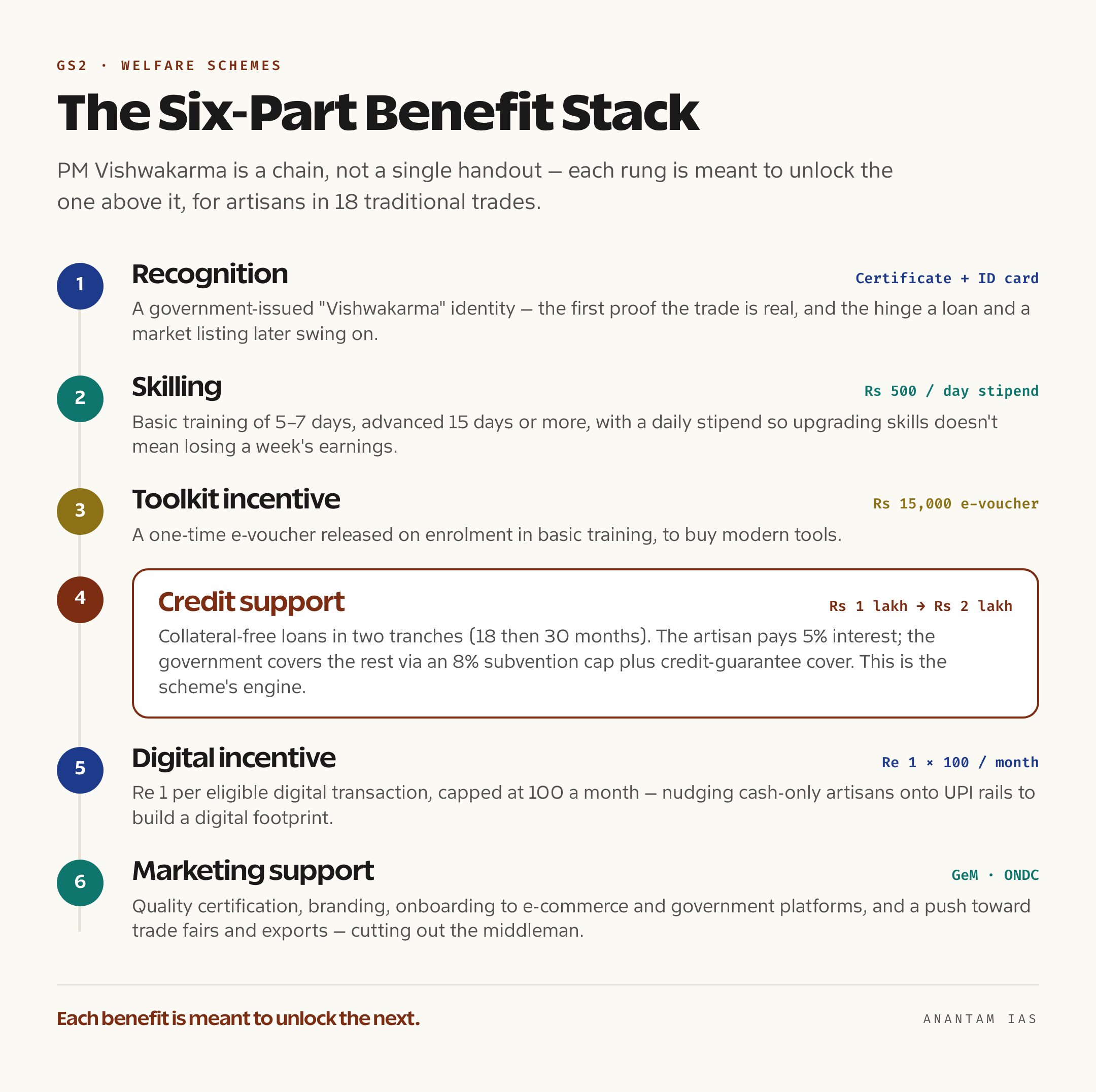
On top of those trades sits a six-part benefit stack, and the design intent is that each rung supports the one above it.
- Recognition. Every verified Vishwakarma gets a PM Vishwakarma certificate and an ID card. It sounds soft, but for an informal worker it’s the first government-issued proof that the trade is real — the thing that later makes a loan application and a market listing possible.
- Skilling. Basic training runs five to seven days; advanced training fifteen days or more for those who want to specialise. Trainees get a stipend of Rs 500 per day, so upgrading skills doesn’t mean losing a week’s earnings.
- Toolkit incentive. A one-time e-voucher worth Rs 15,000, released on enrolment in basic training, to buy modern tools.
- Credit support. Collateral-free “enterprise development” loans in two tranches — up to Rs 1 lakh repayable over 18 months, then up to Rs 2 lakh repayable over 30 months for those who repaid the first and went digital. The artisan pays a concessional 5% interest; the government covers the rest through an interest subvention capped at 8%, plus a credit-guarantee cover so banks aren’t carrying the default risk alone.
- Digital transaction incentive. Re 1 per eligible digital transaction, capped at 100 transactions a month, to nudge cash-only artisans onto UPI rails and build a digital footprint.
- Marketing support. Quality certification, branding, onboarding to e-commerce and government platforms like GeM and ONDC, and a push toward trade fairs and exports.
Registration is free, done through Common Service Centres using Aadhaar-based biometric authentication on the official portal, and it’s filtered through a three-tier verification chain — the Gram Panchayat or urban local body checks the applicant physically, the District Implementation Committee recommends, and a state-level Screening Committee gives final approval. Only one member per family can register, and anyone who took a similar credit-linked scheme such as PMEGP, MUDRA or PM SVANidhi in the last five years is barred, which is how the government avoids double-dipping.
Why the Scheme Matters
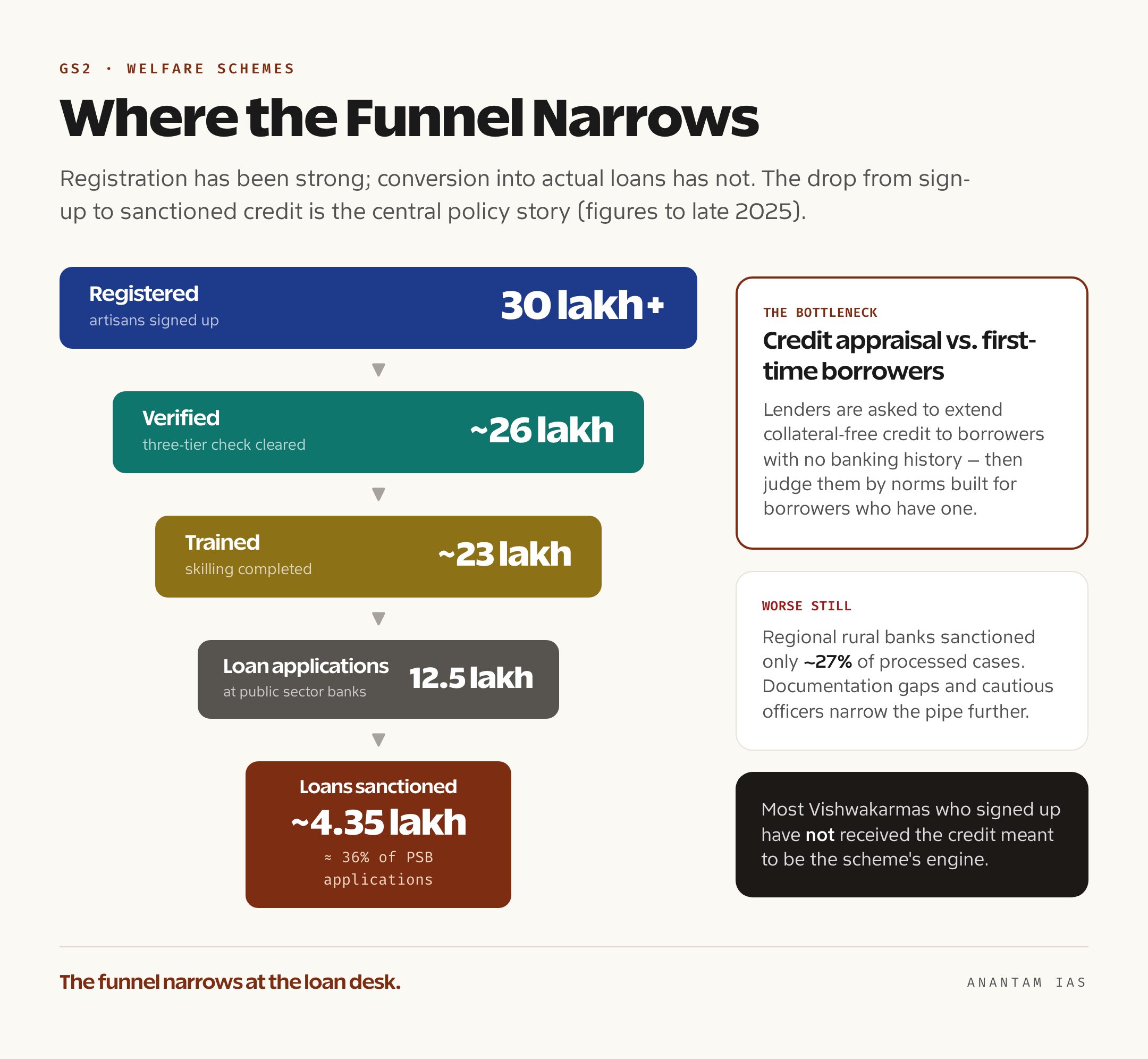
The case for PM Vishwakarma starts with who it reaches. Traditional artisans are overwhelmingly drawn from Scheduled Castes, Scheduled Tribes, Other Backward Classes, women and minorities, and they sit in the informal economy that formal welfare has always struggled to touch. By the government’s own count, the scheme had crossed 30 lakh registered artisans by late 2025, with around 26 lakh verified and roughly 23 lakh trained, according to figures compiled by the India Brand Equity Foundation. That’s a large number of previously invisible workers now holding a government ID and a bank-readable identity.
The financial-inclusion angle is the sharpest. For an unbanked artisan, the first Rs 1 lakh loan isn’t really about the money — it’s about creating a repayment record. Pay it back, transact digitally, and you’ve built the credit history that opens the second tranche and, in time, ordinary commercial credit. The scheme is quietly manufacturing creditworthiness for people the banking system was structurally blind to.
And it threads neatly into the government’s wider economic story. It feeds “Vocal for Local” and Atmanirbhar Bharat by strengthening domestic craft production; it dovetails with the One District One Product push and the Skill India Mission; and by routing artisans onto GeM and ONDC, it tries to cut out the middleman who has historically captured most of the margin. Done right, it’s not charity for a dying sector — it’s an attempt to make traditional crafts commercially durable.
The Challenges the Numbers Reveal
But the honest reading of PM Vishwakarma is in the gap between its top line and its bottom line, and the credit funnel is where it shows. Registration has been strong; conversion into actual loans has not. Public sector banks had received over 12.5 lakh loan applications by late 2025 and processed nearly all of them, yet only about 4.35 lakh — roughly 36% — were sanctioned, according to figures reported by Business Standard. Regional rural banks did worse, sanctioning only about 27% of processed cases. Set that against 30 lakh-plus registrations and the picture is stark: most Vishwakarmas who signed up have not received the credit that’s meant to be the scheme’s engine.
Why the drop-off? Bankers point to the obvious tension at the core of the design — you’re asking lenders to extend collateral-free credit to first-time borrowers with no banking history, and then judging them by credit-appraisal norms built for borrowers who do. Documentation gaps, eligibility checks and cautious officers all narrow the pipe. The credit guarantee is supposed to ease this, but on the ground the instinct to avoid bad loans wins often enough to matter.
There are three other faultlines. First, coverage: the exclusion of handloom weavers has drawn political fire, with West Bengal’s government calling it “step-motherly,” and the eighteen-trade list inevitably leaves out crafts that don’t fit its frame. Second, ambition versus design: experienced artisans often say a Rs 1 lakh first tranche is too small to scale a workshop, pushing them toward MUDRA-style credit instead. Third, the digital-literacy gap — the incentives reward UPI use and e-commerce listing, but older artisans without smartphones or confidence are the least able to claim them. And the budget signal isn’t reassuring either: the allocation for the scheme was trimmed for financial year 2026-27 even as banks kept processing applications, which suggests spending is being paced to actual loan uptake rather than to registration demand.
The Way Forward
The fix isn’t a new scheme; it’s making this one’s chain hold under load. The most important lever is the credit step. Banks need realistic, artisan-specific appraisal norms and a credit-guarantee mechanism strong enough that a loan officer feels safe saying yes to someone with no history — otherwise the recognition, training and toolkit all dead-end at the loan desk. Hand-holding through Common Service Centres and bank business correspondents, so applicants aren’t tripped up by documentation, would lift the conversion rate faster than any new benefit.
Market linkage is the second front. A toolkit and a skill mean little if the artisan still sells to the same middleman at the same price, so the GeM and ONDC onboarding has to become real, supported listings rather than a box ticked at registration. On coverage, periodically reviewing the trade list — and resolving the overlap with the Ministry of Textiles for weavers — would close the equity gap without blurring the scheme’s focus. And the digital push needs a softer on-ramp: assisted onboarding for older artisans rather than incentives only the already-digital can collect. Get the funnel to stop leaking between registration and credit, and PM Vishwakarma moves from an impressive enrolment drive to a genuine engine of artisan livelihoods.
For Your Mains Answer
PM Vishwakarma is a high-value example for GS Paper 2 (welfare schemes for vulnerable sections, government policies and their design/implementation) and GS Paper 3 (inclusive growth, the informal sector, financial inclusion, and the role of MSMEs in employment). It’s also a ready essay illustration on dignity of labour and the formalisation of traditional work. The examiner reward here is for treating it as a case study in scheme design — not just listing benefits.
How to Build the Answer
Open with the problem, not the scheme: the traditional artisan is skilled but invisible to the formal economy, with no credit access and weak market power. Then present PM Vishwakarma as an integrated response — recognition, skilling, toolkit, credit, digital, market — and stress the chain logic. Spend your real marks on the implementation gap (strong registration, weak loan conversion) and close with targeted fixes. That arc — problem, design, evidence of the gap, way forward — beats a flat description every time.
Common Mistakes to Avoid
Don’t reduce the answer to a benefits list; the analysis is in the funnel. Don’t quote the inflated “Rs 41,188 crore loans” figure that floats around — it’s inconsistent with the loan count; lead with the cleaner 30 lakh registered / ~4.7 lakh loans sanctioned story instead. Don’t confuse a Central Sector Scheme with a centrally sponsored one. And don’t ignore the criticisms — the handloom exclusion and low sanction rate are exactly what lifts an answer above average.
A Compact Answer Spine
Invisible informal artisan → PM Vishwakarma’s integrated chain (recognition → skilling + stipend → Rs 15,000 toolkit → collateral-free credit at 5% → digital + market support) → reach (30 lakh-plus registered) → the gap (only ~36% of PSB applications sanctioned) → causes (no credit history, appraisal norms, digital divide, coverage gaps) → way forward (artisan-specific appraisal, real market linkage, periodic trade-list review).
Diagram or Flowchart Idea
Draw a funnel: a wide mouth labelled “Registration (30 lakh+)” narrowing through “Verified” and “Trained” down to a thin neck labelled “Loans sanctioned (~4.7 lakh).” Annotate the narrowing point with “credit-appraisal bottleneck.” A funnel like this makes the central argument visible in one glance and is quick to draw.
A Balanced-Conclusion Line
PM Vishwakarma’s design is sound and its reach is real; its test now is whether the credit and market rungs hold the weight the recognition rung has already lifted — turning an enrolment success into a livelihoods one.
How to Use Data Without Cramming
Carry three anchors and no more: 17 September 2023 and Rs 13,000 crore (FY24-28) for the frame, 30 lakh-plus registrations for reach, and the ~36% loan-sanction rate for the critique. Attribute them lightly — “by the government’s own count,” “as reported in late 2025” — so they read as command of the subject rather than memorised trivia.
FAQ
What is PM Vishwakarma Yojana in one line? It’s a fully Union-funded Central Sector Scheme, launched on 17 September 2023 with a Rs 13,000 crore outlay through 2027-28 and led by the Ministry of MSME, that gives artisans in 18 traditional trades recognition, skilling, a toolkit grant, collateral-free credit and market support.
Who is eligible, and how do you register? Any self-employed artisan aged 18 or above who works with hands and tools in one of the 18 listed trades in the unorganised sector. Registration is free, done at Common Service Centres with Aadhaar-based biometric authentication, and approved through a three-tier check by the Gram Panchayat/ULB, a District Implementation Committee and a state Screening Committee.
What are the financial benefits? A Rs 15,000 toolkit e-voucher, a Rs 500-per-day training stipend, and collateral-free loans of up to Rs 1 lakh then Rs 2 lakh at a concessional 5% interest (the government covers the rest via an 8% subvention cap), plus Re 1 per digital transaction up to 100 a month.
What’s the main criticism of the scheme? The gap between registration and credit. Over 30 lakh artisans have registered, but only about 36% of loan applications at public sector banks were being sanctioned by late 2025 — first-time borrowers stumble on banks’ credit-appraisal norms. The exclusion of handloom weavers and a digital-literacy divide are the other recurring critiques.
Practice Questions
Prelims MCQs
- With reference to PM Vishwakarma Yojana, consider the nature of the scheme.
Which one of the following best describes it?
(a) Centrally Sponsored Scheme shared 60:40 with states
(b) Central Sector Scheme fully funded by the Union government
(c) A scheme funded entirely by the Ministry of Textiles
(d) A statutory programme under an Act of Parliament.
Answer: (b) It is a Central Sector Scheme, so it is wholly funded by the Union government and led by the Ministry of MSME. - PM Vishwakarma Yojana was launched with a financial outlay of:
(a) Rs 5,000 crore for 2023-24 to 2025-26
(b) Rs 10,000 crore for 2023-24 to 2026-27
(c) Rs 13,000 crore for 2023-24 to 2027-28
(d) Rs 20,000 crore for 2023-24 to 2028-29.
Answer: (c) The Cabinet approved Rs 13,000 crore for the five years from FY 2023-24 to FY 2027-28. - Under the credit support component of PM Vishwakarma, which of the following is correct?
(a) Loans require collateral above Rs 1 lakh
(b) The beneficiary pays 5% interest with an 8% interest subvention by the government
(c) Only a single tranche of Rs 3 lakh is offered
(d) Loans are interest-free for the first year.
Answer: (b) Artisans pay a concessional 5%, and the government provides an interest subvention capped at 8% along with credit-guarantee cover. - Which of the following trades is NOT covered under the 18 traditional trades of PM Vishwakarma Yojana?
(a) Blacksmith
(b) Potter
(c) Handloom weaver
(d) Cobbler.
Answer: (c) Handloom weavers are covered separately under the Ministry of Textiles and are not in the scheme’s 18-trade list. - Consider the following benefits under PM Vishwakarma:
1. A Rs 15,000 toolkit e-voucher 2. A Rs 500-per-day training stipend 3. An incentive for digital transactions. Which are correct?
(a) 1 and 2 only
(b) 2 and 3 only
(c) 1 and 3 only
(d) 1, 2 and 3.
Answer: (d) All three are components — a Rs 15,000 toolkit incentive, a Rs 500 daily stipend during training, and Re 1 per digital transaction up to 100 a month.
Mains Practice Questions
- “PM Vishwakarma Yojana attempts to formalise India’s traditional artisans through an integrated chain of benefits rather than a single handout.” Examine this design and assess how far it addresses the structural disadvantages of informal-sector workers. (15 marks, 250 words)
- Strong enrolment but weak loan conversion has emerged as the central tension of PM Vishwakarma Yojana. Analyse the reasons for this gap and suggest measures to close it. (15 marks, 250 words)
- Discuss the role of recognition and financial inclusion in welfare schemes for the unorganised sector, using PM Vishwakarma Yojana as a case study. (10 marks, 150 words)
- To what extent do schemes like PM Vishwakarma Yojana advance the goals of Atmanirbhar Bharat and “Vocal for Local”? Substantiate with the scheme’s market-linkage and skilling components. (15 marks, 250 words)
- The exclusion of certain traditional crafts and a persistent digital divide have been flagged as limitations of PM Vishwakarma Yojana. Evaluate these criticisms and discuss how the scheme can be made more inclusive. (10 marks, 150 words)