Vishwakarma is the divine craftsman, architect, and maker figure in Indian tradition. He is associated with creation, architecture, metallurgy, tools, craft, and sacred design in Hindu religious literature and cultural practice. His legacy survives through Vishwakarma Puja, observed annually by artisans, workers, and engineers across India. For UPSC, the topic matters in Art & Culture, especially where religion, artisanal traditions, symbols, and social practice intersect.
Key Facts
| Parameter | Details |
|---|---|
| Identity | Divine craftsman and architect of the gods |
| Tradition | Hindu religious and cultural tradition |
| Earliest references | Rigveda (Rigveda 10.81, 10.82 — Visvakarman Sukta) |
| Associated domains | Architecture, design, tools, metallurgy, construction, weapons |
| Cultural continuity | Worship among artisans, mechanics, engineers, and craft communities |
| Annual observance | Vishwakarma Puja (17 September — Kanya Sankranti, or other regional dates) |
| Modern policy link | PM Vishwakarma Scheme (named after this figure) |
Vishwakarma in Vedic Tradition
The name Visvakarman appears in the Rigveda — specifically in two hymns of Mandala 10 (Rigveda 10.81 and 10.82), known as the Visvakarman Sukta. In these hymns, Visvakarman is described as the all-creating deity who fashioned the earth and heavens, the one "whose eyes, face, arms, and feet are everywhere."
In early Vedic literature, the figure is associated with cosmic creation and ordering power — closer to a universal creator than a specific artisan deity. The term literally means "all-maker" or "maker of everything" (vishva = all; karma = maker/doer).
Vishwakarma in Puranic and Later Tradition
In later Puranic and popular tradition, Vishwakarma becomes more distinctly the architect-artisan of the divine world. He is credited with building:
- Lanka — the golden city of Ravana
- Dwarka — the city of Lord Krishna
- Indraprastha — the capital of the Pandavas
- Hastinapura — the Kuru capital
- Jagannath Puri temple — in some traditions
- Divine weapons — including the Sudarshana Chakra of Vishnu, Trishula of Shiva, and Vajra of Indra (fashioned from the bones of sage Dadhichi)
- Pushpaka Vimana — the aerial chariot
That shift from abstract cosmological creator to specific divine architect is important. It shows how Indian religious symbols evolve from philosophical ideas into socially meaningful figures tied to craft communities.
Iconography of Vishwakarma
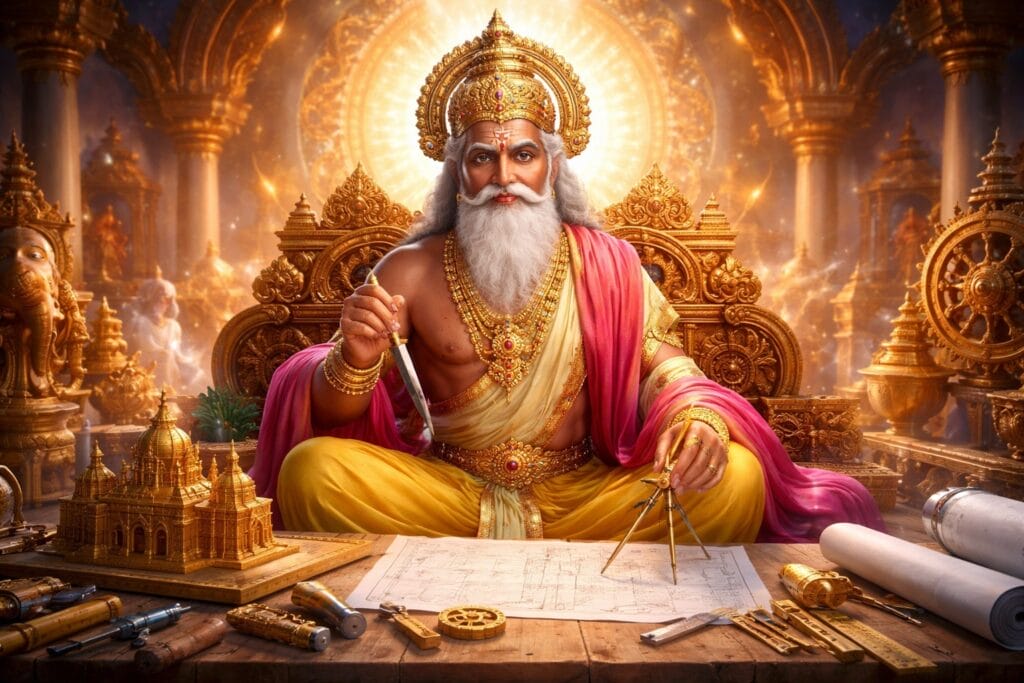
Vishwakarma is typically depicted as an elderly, wise figure carrying instruments of creation. Key iconographic elements vary by region but commonly include:
| Element | Significance |
|---|---|
| Multiple arms | Holding tools — hammer, chisel, compass, measuring instruments |
| Crown or turban | Authority and wisdom |
| White beard | Age, experience, mastery |
| Seated on a swan or elephant | Purity of creation, strength |
| Surrounded by creations | Palaces, weapons, chariots — symbols of productive skill |
A good UPSC culture answer should explain what the figure symbolizes rather than describe one rigid image.
Art, Architecture, and Temples Associated with Vishwakarma
Vishwakarma's influence extends into Indian architectural and artistic traditions:
- Vishwakarma temples exist in several states — notably in Rajasthan, Odisha, Karnataka, and West Bengal
- The Shilpa Shastras (ancient Indian texts on arts, crafts, and architecture) are attributed to Vishwakarma in many traditions
- Manasara and Mayamatam — important architectural treatises — carry forward the Vishwakarma tradition of sacred design principles
- Temple architecture across India follows principles that artisan communities trace back to Vishwakarma's divine authorship
- The Vishwakarma community (Panchal community in some regions) — comprising goldsmiths, blacksmiths, carpenters, sculptors, and coppersmiths — claim descent from five sons of Vishwakarma
Vishwakarma Puja: Significance and Practice
Vishwakarma Puja is observed across India, especially among artisans, workers, mechanics, factory employees, and those involved with tools and machines.
| Aspect | Details |
|---|---|
| Date | Typically 17 September (Kanya Sankranti); in some regions observed on the last day of Bengali month Bhadra |
| Observed by | Artisans, factory workers, mechanics, engineers, IT professionals |
| Key ritual | Worship of tools, machines, and workplaces |
| Regions | Especially strong in West Bengal, Bihar, Jharkhand, Odisha, Assam, Uttar Pradesh, and industrial zones |
| Factories and workshops | Machines are cleaned, decorated, and worshipped; work is often suspended for the day |
| Cultural meaning | Sacralisation of labour — work is treated as a form of devotion |
This is a rich culture answer point: Indian tradition often sacralizes work through symbols, not only through abstract theology. The puja bridges traditional craft identity with modern industrial work culture.
Vishwakarma and Indian Craft Traditions
Vishwakarma is not only a religious figure. He is a civilisational symbol for communities linked to:
- Metal work (blacksmiths, goldsmiths, coppersmiths)
- Carpentry and woodwork
- Masonry and stone carving
- Sculpture and idol-making
- Tool-making and engineering craft traditions
The Vishwakarma community (also known as Panchal in parts of western and southern India) has historically been the custodian of these crafts. Their social identity is inseparable from the divine figure — making Vishwakarma a case study in how religion, occupation, and community identity intertwine in India.
Vishwakarma as a Cultural Concept
For UPSC, the deeper value of the topic lies here. Vishwakarma represents:
- The dignity of skilled creation in Indian civilisation
- Continuity between sacred and material life — work as worship
- The cultural recognition of craft communities as contributors to civilisation
- The place of architecture and design in Indian imagination
- The idea that making is as sacred as knowing — craft is not inferior to scholarship
That is a much stronger explanation than simply saying "Vishwakarma is a god of artisans."
Connection with PM Vishwakarma Scheme
The PM Vishwakarma scheme, launched on 17 September 2023 (notably on Vishwakarma Jayanti), deliberately draws on this cultural heritage. The naming is significant:
- It gives civilisational respectability to artisan welfare policy
- It connects modern MSME support with traditional craft identity
- The choice of 17 September as launch date aligned with Vishwakarma Puja
This connection is useful in UPSC answers that bridge Art & Culture (GS-I) with Governance and Schemes (GS-II/III).
Related: PM Vishwakarma: Complete Guide for UPSC
Vishwakarma vs Other Cultural Figures
| Figure | Main association |
|---|---|
| Vishwakarma | Craft, architecture, tools, making |
| Saraswati | Learning, arts, knowledge, speech |
| Lakshmi | Wealth, prosperity, fortune |
| Agni | Sacrifice, fire, ritual medium |
| Tvashtar | Sometimes identified with Vishwakarma in Vedic texts; associated with fashioning forms |
| Maya Danava | Architect of the Asuras (counterpart to Vishwakarma in some texts) |
This kind of contrast helps in culture revision because it prevents symbolic confusion.
Related: Indian Culture: Key Features & Heritage
Related: Skill India: Mission, Components & Significance
UPSC Relevance of Vishwakarma
| Paper | Relevance |
|---|---|
| Prelims | Cultural or symbolic question — Vedic references, Vishwakarma Puja, associated texts |
| GS-I (Art & Culture) | Indian cultural traditions, artisanal heritage, Shilpa Shastras, temple architecture traditions |
| GS-I (Society) | Caste-occupation linkages, craft communities, social identity |
| GS-II/III crossover | Connection to PM Vishwakarma scheme — cultural naming in policy |
The strongest analytical line is this: Vishwakarma represents the cultural dignity of skilled creation in Indian civilisation — the idea that making is sacred.
Frequently Asked Questions
Who is Vishwakarma in Indian tradition?
Vishwakarma is the divine craftsman and architect in Indian tradition. He appears in the Rigveda as a cosmic creator and in Puranic literature as the builder of divine cities, weapons, and palaces.
Why is Vishwakarma important in Hindu culture?
He is important because he symbolizes craft, design, labour, and technical skill. His importance extends beyond mythology into living artisan and industrial traditions through Vishwakarma Puja.
What is Vishwakarma Puja?
Vishwakarma Puja is a ritual observance — typically on 17 September — in which artisans, mechanics, workers, and engineers honor Vishwakarma by worshipping their tools, machines, and workplaces.
What did Vishwakarma create according to Hindu mythology?
Vishwakarma is credited with building Lanka, Dwarka, Indraprastha, and divine weapons including the Sudarshana Chakra, Trishula, and Vajra.
Is Vishwakarma relevant for UPSC?
Yes. Vishwakarma is relevant in Art & Culture for questions on Indian heritage, craft traditions, Vedic literature, and the cultural meaning of labour. The topic also connects to the PM Vishwakarma scheme naming.
Tell Google you want more of this.
Add Anantam IAS as a preferred sourceOne tap, and this site shows up more often in your own Top Stories, AI Overviews and AI Mode. Remove it any time.