Ramjet vs Scramjet: Air-Breathing Engines, Mach Range, and India’s Hypersonic Programme
A complete UPSC GS-III explainer on Ramjet vs Scramjet engines. Covers air-breathing propulsion, the Mach range of each engine, the BrahMos cruise missile, the HSTDV scramjet flight, and India's path to hypersonic weapons.
A ramjet burns its fuel in subsonic airflow and works from roughly Mach 3 to Mach 6; a scramjet (supersonic combustion ramjet) burns fuel while the air is still moving faster than sound, letting it operate from about Mach 5 into the hypersonic range beyond Mach 12. Both are air-breathing engines with no moving parts in the main flow path, and both need a booster to reach their operating speed. India uses a ramjet in the BrahMos cruise missile and demonstrated sustained scramjet flight with the DRDO HSTDV in 2020.
A jet engine that has no moving parts sounds counterintuitive. A jet engine that not only has no moving parts but also burns its fuel in a stream of air moving faster than the speed of sound sounds frankly improbable. Both, however, exist. The first is called a ramjet. The second is called a scramjet. Together they form the family of air-breathing engines that work where ordinary turbojets cannot, opening the door to flight at speeds well above the speed of sound and, with continued development, to genuinely hypersonic flight at five times the speed of sound and beyond.
For UPSC, the topic ties together propulsion physics, the BrahMos missile family, the DRDO’s Hypersonic Technology Demonstrator Vehicle, and the broader strategic question of where Indian missile and aerospace technology is headed. This article explains how the two engines work, where they differ, and how the Indian programme has been built around them.
Quick Facts on Ramjet and Scramjet
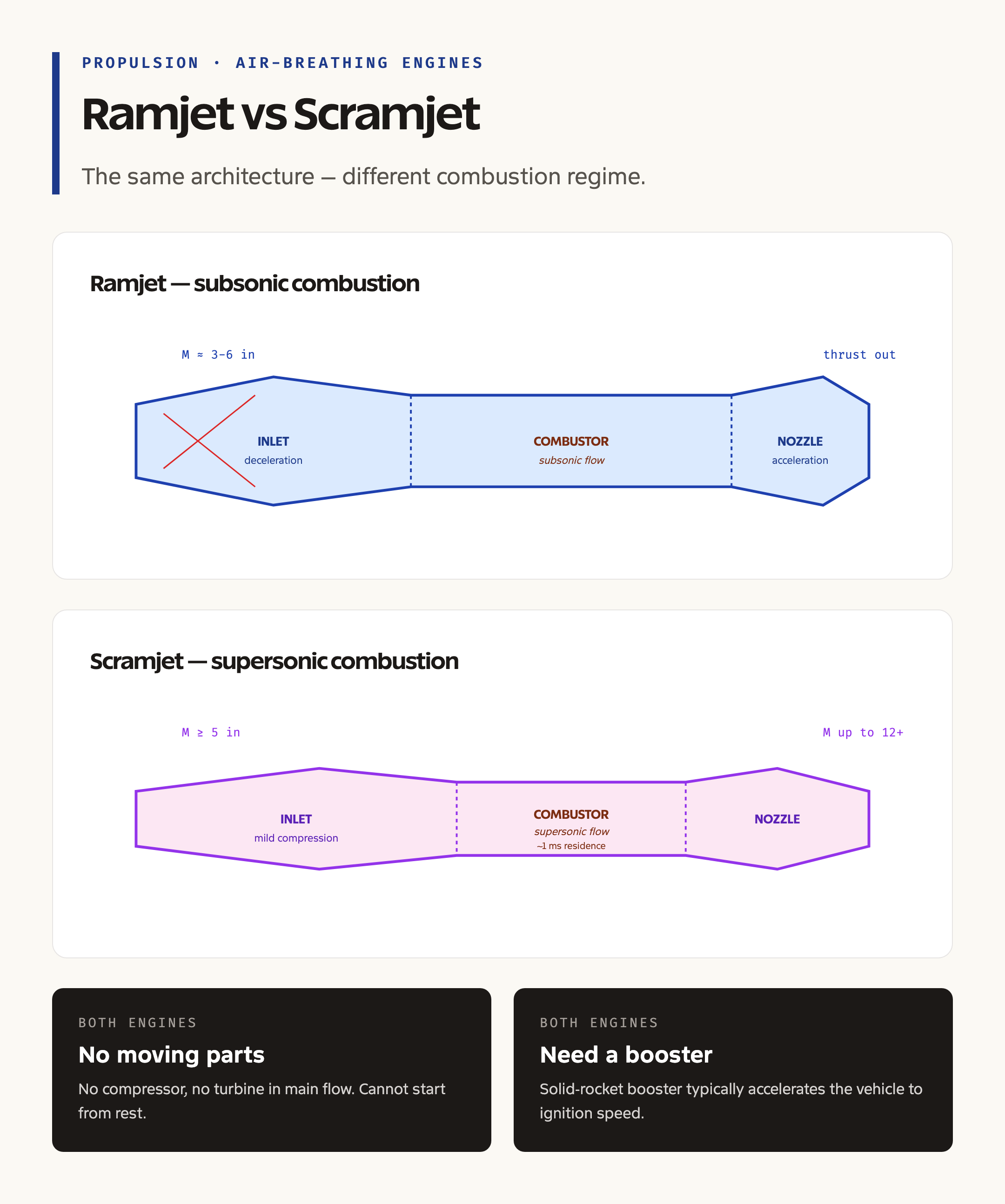
A ramjet is an air-breathing engine that uses the forward speed of the vehicle to compress incoming air, mixes it with fuel, and burns the mixture in a combustion chamber to produce thrust. It has no compressor, no turbine, and no moving parts in its main flow path. It cannot start from rest. It must be accelerated to supersonic speed by a booster before it can produce useful thrust. Ramjets operate efficiently in the range of about Mach 3 to Mach 6.
A scramjet, short for supersonic combustion ramjet, is the same kind of engine but with combustion sustained in airflow that is itself supersonic, rather than slowed to subsonic speed before burning. This allows the scramjet to operate at much higher Mach numbers, typically from Mach 5 upwards into the hypersonic regime, in some designs above Mach 12.
What an Air-Breathing Engine Actually Is
An air-breathing engine carries its fuel but draws oxygen from the surrounding atmosphere. A rocket, in contrast, carries both fuel and oxidizer in tanks. Air-breathing engines are far more fuel-efficient at the speeds and altitudes where they can operate, because they do not have to lift the mass of an oxidizer. The cost is that they only work where there is enough air, which limits them to roughly the lower hundred kilometres of the atmosphere.
The family of air-breathing engines includes the turbojet, the turbofan, the ramjet, and the scramjet. The first two use rotating compressors to raise the pressure of the incoming air before combustion. The last two replace the compressor with a carefully shaped intake that uses the vehicle’s own forward speed to compress the air. As a vehicle accelerates, the speed of incoming air at the engine face increases, and at high enough Mach numbers a properly designed inlet alone can deliver the compression that a turbojet’s compressor would otherwise provide.
Background and Historical Context
The basic principle of the ramjet was patented as early as 1913 by the French engineer René Lorin. The first practical ramjet flights came in the 1940s. Ramjets powered several Cold War-era cruise missiles, including the United States Bomarc surface-to-air missile and Soviet anti-ship missiles. The technology was mature by the mid-twentieth century but remained niche, since ramjets are unable to start from rest and require a booster.
The scramjet idea emerged in the 1950s and 1960s as engineers asked whether combustion could be sustained in supersonic airflow, removing the need to slow incoming air to subsonic speeds inside the engine. The challenge is severe. At Mach 6 and above, the air in the combustion chamber spends only milliseconds inside the engine. Igniting fuel and burning it cleanly in that time, in a flow already moving faster than sound, is one of the harder problems in propulsion engineering.
Decades of research in the United States, Russia, and other countries produced isolated successful flights. The X-43A, a NASA scramjet, flew at Mach 9.6 in 2004. The X-51A Waverider sustained scramjet-powered flight for more than three minutes at Mach 5 in 2013. India’s Hypersonic Technology Demonstrator Vehicle, the HSTDV, flew successfully in September 2020, with DRDO confirming sustained scramjet combustion. The flight placed India in a small group of countries with demonstrated scramjet capability, alongside the United States, Russia, and China, and built on broader Indian work in the Integrated Guided Missile Development Programme tradition.
How a Ramjet Works
A ramjet has three main sections. The first is the inlet, a carefully shaped diffuser that decelerates incoming supersonic air and raises its pressure and temperature. The deceleration is achieved through a series of oblique shock waves that compress the air without heavy losses. The second section is the combustion chamber, where fuel is injected, mixed with the now-subsonic air, and burned, producing hot, high-pressure exhaust. The third section is the nozzle, which accelerates the exhaust and produces thrust.
The defining feature of a ramjet is that the combustion happens in subsonic airflow. The engine’s geometry is fixed. There are no compressor blades, no turbine, and no rotating parts in the main flow path. The performance depends entirely on the vehicle’s speed and altitude, and the engine cannot produce useful thrust below roughly Mach 0.5. A booster is needed to accelerate the vehicle to a speed at which the ramjet can take over.
Ramjet efficiency is highest in the supersonic regime from Mach 3 to Mach 6. Below Mach 3, the inlet cannot achieve enough compression. Above Mach 6, the air entering the combustion chamber after deceleration to subsonic speed is so hot that further combustion produces little additional pressure rise, and the engine becomes inefficient.
How a Scramjet Works

A scramjet is structurally similar to a ramjet but solves the high-Mach problem differently. Instead of slowing the incoming air to subsonic speed before combustion, a scramjet keeps the airflow supersonic throughout the engine. The inlet decelerates the airflow only partially, raising its pressure and temperature but leaving it above the speed of sound. Fuel is injected into this supersonic stream and must mix and ignite within milliseconds.
The engineering challenge is concentrated in two places. The first is fuel injection and combustion, since the residence time inside the combustion chamber at hypersonic speeds is on the order of one millisecond. The second is thermal management, since the air at the inlet, even after partial deceleration, can be hot enough to soften ordinary structural alloys. Scramjets typically use exotic materials, advanced cooling, and short flight durations.
A scramjet, like a ramjet, cannot start from rest. It needs a launch booster, often a rocket, to accelerate the vehicle to a speed at which the scramjet can ignite. India’s HSTDV used a solid rocket booster derived from the Agni-1 to accelerate the vehicle to the Mach number at which scramjet combustion could be sustained.
Why Ramjet and Scramjet Matter for India
The strategic logic for ramjet and scramjet research in India is straightforward. Long-range cruise missiles powered by ramjets fly faster, sit closer to the ground, and respond faster to launch orders than turbojet-powered missiles. The BrahMos missile, the supersonic cruise missile developed jointly by India and Russia, uses a liquid-fuelled ramjet sustainer in its second stage. BrahMos flies at roughly Mach 2.8 to Mach 3, making it one of the fastest cruise missiles operationally deployed in the world.
Hypersonic weapons go further. A hypersonic glide vehicle launched by a ballistic booster, or a hypersonic cruise missile powered by a scramjet, sits in a manoeuvring regime where existing missile defence systems struggle to track and intercept. The HSTDV is the technology demonstrator for the hypersonic cruise missile path. The eventual operational system will combine the propulsion lessons from HSTDV with the seeker and warhead heritage from the BrahMos and Akash families.
Beyond weapons, scramjet research feeds into the long-running Indian work on reusable launch vehicles and air-breathing first stages for space access. A scramjet first stage, by drawing oxidizer from the atmosphere, dramatically reduces the take-off mass of a vehicle and could lower the cost of orbital launch. ISRO has flown several scramjet experiments aboard sounding rockets, building the foundation for eventual integration into operational launchers within the broader space technology programme.
Detailed Comparison of Ramjet and Scramjet
A side-by-side comparison brings out the differences clearly.
| Feature | Ramjet | Scramjet |
|---|---|---|
| Combustion airflow | Subsonic inside combustor | Supersonic inside combustor |
| Operational Mach range | Mach 3 to Mach 6 | Mach 5 to Mach 12 or more |
| Inlet design | Strong deceleration | Mild deceleration |
| Fuel | Typically kerosene | Typically hydrogen or specialized hydrocarbons |
| Combustion residence time | Tens of milliseconds | About one millisecond |
| Material requirements | High temperature alloys | Refractory materials, active cooling |
| Indian system | BrahMos sustainer | HSTDV demonstrator |
| Status | Operational since the 1950s globally | Demonstration phase, moving towards operational |
Both engines share the absence of moving parts in the main flow path. Both require a booster to start. The scramjet’s harder problem is keeping combustion stable at much higher speeds, which is why operational scramjets are still rare.
Comparative Engines: Turbojet, Ramjet, Scramjet, Rocket

A broader comparison places ramjet and scramjet inside the family of propulsion options.
| Engine | Speed Range | Oxidizer | Use Cases |
|---|---|---|---|
| Turbojet | Mach 0 to 3 | Atmospheric oxygen | Subsonic and moderate supersonic aircraft |
| Ramjet | Mach 3 to 6 | Atmospheric oxygen | High-speed cruise missiles, BrahMos |
| Scramjet | Mach 5 to 12+ | Atmospheric oxygen | Hypersonic vehicles, HSTDV |
| Rocket | Mach 0 to orbital | Onboard oxidizer | Space launch, ICBMs |
Each engine type has a band of speeds at which it works best. Combined-cycle propulsion concepts, such as turbo-ramjets and rocket-based combined cycle engines, attempt to span more than one band by combining two engine types in a single vehicle.
Challenges in Indian Hypersonic Programme
Several challenges are common to any country pursuing hypersonic propulsion. Materials capable of withstanding the temperatures encountered at Mach 6 and above are difficult to develop and manufacture. India has invested in carbon-carbon composites, ceramic matrix composites, and advanced metal alloys, building partly on its experience with re-entry materials for the Chandrayaan and Gaganyaan programmes.
Test infrastructure is another challenge. Ground-testing scramjets requires hypersonic wind tunnels and shock tunnels. India has invested in such facilities at IIT Madras, IISc Bangalore, and DRDO laboratories. Sustained ground testing time at hypersonic conditions remains limited globally and is a bottleneck on development pace.
Finally, fuel chemistry at hypersonic speeds is an active research area. Hydrogen offers the highest specific energy and the cleanest combustion but is bulky to store. Hydrocarbons are denser and easier to handle but harder to ignite and burn cleanly at hypersonic conditions. The choice of fuel shapes the entire vehicle architecture, including fighter jet generations and successor systems on the drawing board.
Prelims Pointers
- A ramjet is an air-breathing engine that uses the vehicle’s forward speed to compress incoming air, with combustion occurring in subsonic airflow.
- A scramjet is a supersonic combustion ramjet in which combustion occurs in supersonic airflow.
- Neither a ramjet nor a scramjet has moving parts in the main flow path.
- Neither engine can start from rest. Both require a booster to reach operational speed.
- Ramjets operate efficiently from roughly Mach 3 to Mach 6.
- Scramjets operate at roughly Mach 5 and above, into the hypersonic regime.
- The BrahMos cruise missile uses a liquid-fuelled ramjet in its second stage.
- The Hypersonic Technology Demonstrator Vehicle, HSTDV, was successfully flown by DRDO in September 2020.
- HSTDV used a solid rocket booster to accelerate the vehicle before scramjet ignition.
- Hypersonic typically refers to flight at Mach 5 and above.
- Scramjets often use hydrogen as fuel because of its high specific energy and clean combustion.
- The X-43A and X-51A are notable American scramjet flight test vehicles.
Mains Practice Questions
- Distinguish between ramjet and scramjet engines and discuss the strategic significance of mastering scramjet propulsion for India. How does the HSTDV programme fit into this picture?
- Examine the role of air-breathing propulsion in modern cruise missile and hypersonic weapon design. Critically evaluate the BrahMos missile programme as a case study.
- Discuss the technological, material, and infrastructure challenges in developing scramjet engines and assess the steps India has taken to address them.
Way Forward
The Indian path forward in air-breathing propulsion has three converging tracks. The first is the operational hypersonic cruise missile, expected to flow from continued HSTDV testing and integration with mature seeker and warhead technologies from the BrahMos and Akash programmes. The second is reusable launch vehicle technology, with scramjet first stages as a long-term option for low-cost orbital access. The third is fundamental research and test infrastructure, including more hypersonic wind tunnels, sustained-test scramjet rigs, and material development programmes.
International cooperation is part of the picture. India’s experience with the BrahMos joint venture is a template for collaborative development with Russia and potentially with other partners. Cooperation with countries that have advanced hypersonic test infrastructure, including the United States and Australia under existing defence agreements, is a possibility within current strategic alignments.
For an aspirant, the take-away is that ramjet and scramjet are not abstract physics curiosities. They sit at the centre of a strategic technology race in which India has staked out a credible position. The HSTDV success in September 2020 was the technical foundation. The next decade will determine whether India can convert that demonstration into deployed operational systems, with all the implications for deterrence and space access that follow.
Frequently Asked Questions
What is the basic difference between a ramjet and a scramjet?
A ramjet slows incoming air to subsonic speed before combustion. A scramjet keeps the airflow supersonic throughout the engine, with combustion sustained in supersonic flow.
Why can a ramjet not start from rest?
A ramjet relies on the vehicle’s forward speed to compress incoming air through its inlet. At rest, there is no incoming airflow to compress, so there is no compression, no combustion, and no thrust. A booster is required to accelerate the vehicle to a speed at which the ramjet can take over.
Does a scramjet have moving parts?
In its main flow path, no. Like a ramjet, a scramjet has no compressor, no turbine, and no rotating components in the airstream. The fuel injection and control systems do have valves and pumps, but the propulsion process itself is purely thermodynamic.
What is the speed range of a ramjet?
Ramjets operate efficiently from roughly Mach 3 to Mach 6. Below Mach 3, inlet compression is insufficient. Above Mach 6, the air after deceleration becomes too hot for efficient subsonic combustion.
What is the speed range of a scramjet?
Scramjets are designed to operate from roughly Mach 5 upwards, with current research targeting Mach 5 to Mach 12 and beyond. Some studies look at scramjets up to Mach 24, though no operational system has reached such speeds.
What does the BrahMos missile use?
The BrahMos cruise missile uses a solid-fuel rocket booster as its first stage and a liquid-fuelled ramjet as its sustainer in the second stage. This gives it a top speed of roughly Mach 2.8 to Mach 3 across its trajectory.
What is the HSTDV?
The Hypersonic Technology Demonstrator Vehicle is an Indian scramjet flight test platform developed by DRDO. It was successfully flown in September 2020, demonstrating sustained scramjet combustion and placing India in a small group of countries with proven scramjet capability.
Which fuel do scramjets typically use?
Many research scramjets use hydrogen because of its high specific energy and clean combustion. Operational concepts often consider denser hydrocarbon fuels, which are easier to store but harder to burn cleanly at hypersonic speeds.
What is hypersonic flight?
Hypersonic flight typically means flight at Mach 5 and above. At these speeds, the physics of the airflow around the vehicle changes significantly, including strong shock interactions and chemical effects in the air, requiring specialized propulsion and structures.
Does ISRO use scramjets?
ISRO has flown several scramjet experiments aboard sounding rockets and is researching air-breathing propulsion for future reusable launch vehicles. The technology has not yet been integrated into operational launchers but is part of the long-term road map for cheaper space access.